(by General Herman Haupt.)
I made the following report on how to destroy bridges and locomotive engines expeditiously:
Washington, D. C, November 1, 1862.
A simple and expeditious mode of destroying bridges, and rendering locomotive engines useless to an enemy, is often a desideratum. Cavalry may penetrate far into an enemy’s country, may reach bridges forming viaducts on important lines of communication, which, it may be desirable to break effectually; or, in retreat, the destruction of a bridge may be essential to the safety of an army, and yet time may not be sufficient to gather combustibles, or they may not be accessible, or the fire may be extinguished, or the damage may be so slight as to be easily repaired.
What is required is the means of certainly and effectually throwing down a bridge in a period of time not exceeding five minutes, and with apparatus so simple and portable that it can be carried in the pocket or a saddle-bag.
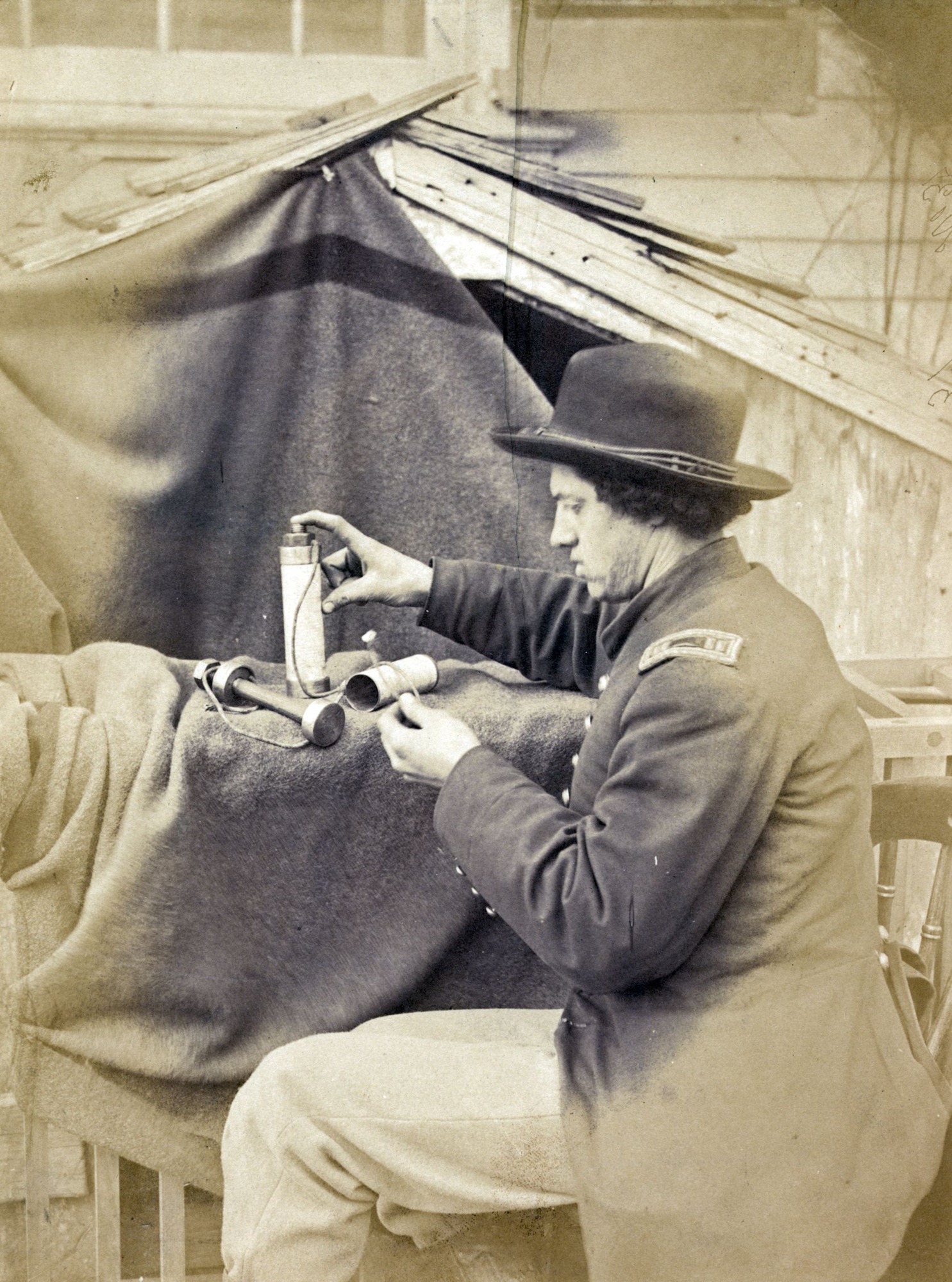
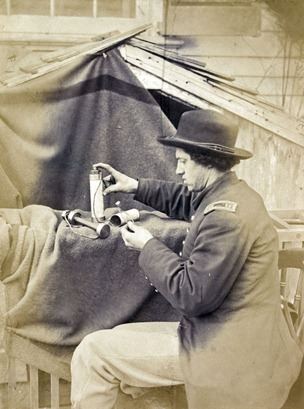 These requirements are fulfilled by a torpedo, which consists simply of a short bolt of seven-eighths inch iron, eight inches long, with head and nut—the head to be two inches in diameter, and about one inch thick. A washer of same size as the head must be placed under the nut at the other end, with a fuse-hole in it. Between the washer and the head is a tin cylinder one and three-quarters inches in diameter, open at both ends, which is filled with powder, and, when the washer and nut are put on, forms a case which encloses it.
In using this torpedo, a hole is bored in a timber; the torpedo (head downwards) is driven in by a stone or billet of wood, and the fuse ignited. The explosion blows the timber in pieces, and, if a main support, brings down the whole structure.
The time required is only that which is necessary to bore a hole with an auger. Ordinary cigar lighters, which burn without flame, and cannot be blown out, are best for igniting the fuse, which should be about two feet long.
For portability, the auger should be short, say thirteen inches, and the handle movable and of same length.
The proper place at which to insert the torpedo is of much consequence. Most of the Virginia bridges are Howe trusses without arches. In this kind of bridge, the destruction of the main braces at one end, and on only one side of a span, will be sufficient to bring down the whole structure. There are usually but two main braces in each panel, and two torpedoes will suffice to throw down a span. Two men can bore the two holes at the same time without interfering with each other.
Cartridges containing a fulminate would be more portable, but they are not always conveniently procurable, and their use is attended with risk of explosion.
It is only necessary to operate at one side and on one end of a bridge. If one side falls, the other side is pulled down with it.
If the structure contains an arch, two additional torpedoes will be required; but in this case it may be equally advantageous to operate upon the lower chord.
Experiments made at Alexandria proved that a timber placed in the position of a main brace, and similarly loaded, was shattered into many pieces, some of which were projected by the force of explosion more than a hundred feet.
To Render Locomotives Unfit for Service: The most expeditious mode is to fire a cannon ball through the boiler. This damage cannot be repaired without taking out all the flues.
The usual mode of disabling engines consists in burning the flues
by letting out the water and making a fire in the fire-box; but this is generally done so imperfectly that the enemy soon gets them in running order.
Cars are Readily Destroyed by Burning: On this subject no instructions are necessary. The destruction of more than four hundred cars by our own troops within the last six months proves that in the work of destroying such property perfection has been attained, and no room left for winning fresh laurels in this field.
The Superintendent of the Orange & Alexandria Military Railroad has instructions to furnish sample torpedoes to officers who may order them.
Address “J. H. Devereux, Superintendent of Orange & Alexandria Railroad, Alexandria, Va.”
H. HAUPT
Brigadier-General,
In Charge of United States Military Railroads.