Following the American Civil War Sesquicentennial with day by day writings of the time, currently 1863.

The American Civil War

U. S. Flag-Ship Hartford,

Philadelphia, Jan. 19, 1862.

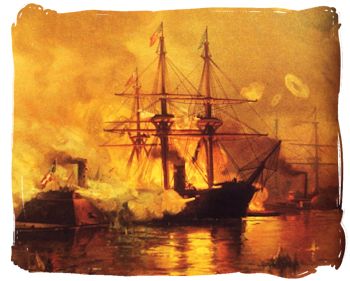
This morning, at 10 o’clock, the U. S. screw sloop Hartford was put in commission as the flag-ship of the Western Gulf Blockading Squadron. The following is a list of officers ordered to join her:

Flag Officer—David G. Farragut.

Fleet Captain—Henry H. Bell.

Commander—Richard Wainwright.

Lieutenant and Executive Officer—Jas. S. Thornton.

Lieutenant and Ordnance Officer—Albert Kautz.

Surgeon—W. Maxwell Wood.

Assistant Surgeon—Joseph Hugg.

Paymaster—George Plunkett.

Master—John C. Watson.

Acting Masters—D. S. Murphy, C. Desames, Jos. G. Lewis .

Marine Officers-1st Lieut., John L. Broome; 2d Lieut., Geo. Heisler.

Flag Officer’s Secretary—Thomas Walden.

Flag Officer’s Clerk—B. S. Osbon.

Acting Midshipmen—H. B. Tyson, E. C. Hazeltine, Jno.

H. Reed, H. J. Blake.

Engineers—Chief, J. B. Kimball; 2d Assistant, Jno. Purdy,

E. B. Latch, F. A. Wilson; 3d Assistant, C. M. Burchard,

Isaac Degraff, A. K. Fulton, C. J. COOPER.

Boatswain—James Walker.

Gunner—Jas. Duncan.

Acting Carpenter—J. H. Conley .

Acting Sailmaker—Jno. A. Holbrook.

Clerks—Captain’s, A. D. Bache; Fleet Captain’s, T. B. Waddell; Paymaster’s, F. C. Plunkett.

Master’s Mates—E. J. Allen, Thos. Mason, Lewis S. Locke.

The first business of the crew was to put the ship in sailing order, which, with taking on board provisions and the like, occupied several days. We dropped down to Newcastle, Del. and remained a couple of days, and then went back to Fort Mifflin and took in powder, which is said to be the last article taken on board before sailing, and the first article discharged on returning from a cruise. We then dropped down to Newcastle again, and after receiving on board the Flag Officer and the Fleet Captain, Henry H. Bell, with a salute, proceeded to sea.

January 19.—A battle took place to-day at Mill Springs, near Somerset, Ky., between the National forces under command of General Geo. H. Thomas, and the rebel forces, commanded by General F. K. Zollicoffer, resulting in the utter rout and defeat of the rebels. The Confederates commenced the attack at half-past five in the morning. The fight lasted till late in the afternoon,

when the rebels were driven off the field in great confusion, their leader, General Zollicoffer, being among the slain. On reaching their entrenchments, a few miles distant from the scene of action, they were cannonaded until dark, by the National batteries, and during the night succeeded in making good their escape across the Cumberland River. About one hundred and fifty rebel prisoners were taken, and ton guns, about one hundred wagons, upwards of twelve hundred horses and mules, large quantities of small arms, with subsistence and hospital stores captured. Besides these a large number of flags were taken on the field of battle, and in the deserted entrenchments.—(Doc. 16.)

— This evening the United States gunboat Itasca captured the schooner Lizzie Weston, of Apalachicola, Fla., loaded with two hundred and ninety-three bales of cotton, one hundred and fifty-two thousand five hundred pounds, bound for Jamaica or a market. She was sent in charge of a prize crew to Philadelphia.

—Colonel Williams’ regiment of Pennsylvania cavalry passed through Louisville, Ky., on their way to Munfordville, where they will take a position a few miles beyond Green River. They are well supplied with arms, though their horses are not generally up to the requirements of active service.—Louisville Journal, January 20.

18th.—I visited Washington to-day, through such rain and such mud, as no civilized country, save this, can sustain, and preserve its character for purity. Am back to-night. On my return, I find on my table the following: ” General Order No. 11.

“Headquarters, &c.

“When the time arrives for the troops of this Brigade to move, the following will be the allowance of the means of transportation:

“Five wagons to the companies of a Regiment (two wagons to each company); one wagon to the Regimental Hospital.

“Each wagon will carry the forage for its horses. The sixty rounds of reserved ammunition will be carried in extra wagons. In the company, wagons will be carried rations for two or three days, company mess equipage, and officers’ baggage, which will in no case exceed the amount by regulations for baggage in the field. The forage for horses of regimental and field officers will have to be carried in their wagons. This notice is given so that soldiers and officers may be aware, that all property not above mentioned, to be preserved, had better be removed, for if the troops march, it is probable the first notice given will be the presence of wagons for loading,

“By order of Brig. Gen. ––––.”

Now that begins to look like business, and if our General means to put us in the way of doing something—if it will only not prove another counterfeit cry of “wolf”—we shall be pleased. Gen. McClellan has already grown several inches in the estimation of those whose confidence began to get shaky. I do not like that expression of “for if the troops march.” It looks a little wolfy. But I shall try to think it means “go in.”

Saturday, January 18, 1862. — Attempting to rain this morning. All important movements everywhere stopped by the rain and mud already. Still further “postponement on account of weather.” How impatiently we look for action on Green River [and] at Cairo. As to the Potomac, all hope of work in that quarter seems to be abandoned. Why don’t they try to flank the Rebels — get at their communications in the rear? But patience! Here we are in a good position to get in the rear via two railroads. Suppose two or even three or four bodies of men were to start, one by way of Lewisburg for White Sulphur Springs and Jackson Depot, one via Peterstown and Union, east side of New River, for Central Depot, one via Princeton and Parisburg [Pearisburg] right bank of New River, for Dublin, and another via Logan Court-house for some point lower down on the railroad.

A heavy rain falls — warm, spring-like, copious. The scenery of New River is attractive. The river runs in a deep gorge cut through the rock to a depth of one thousand to two thousand feet. The precipitous cliffs, occasionally cut through by streams running into the river, the rapid rushing river, and brawling mountain streams furnish many fine views. The Glades, a level region near Braxton and Webster Counties, where streams rise, and a similar region, called the Marshes of Cool, are the cattle grounds of this part of western Virginia. Braxton and Webster are the haunts of the worst Rebel bushwhackers of the country. Steep mountains, deep gorges and glens afford them hiding-places. They are annoying but not dangerous except to couriers, mail-carriers, and very small parties. They shoot from too great a distance at large parties to do much harm. .

Mrs. Thomas Gibbons, mentioned in the following letters, was one of the distinguished Hopper family of “Friends”— strong abolitionists and managers of what was called the “underground railroad.” Through their efforts many wretched hunted colored people were landed safely in Canada. Mrs. Gibbons was busy in the war from the beginning, and all her life long, with serene determination, waged her own war against evil wherever she encountered it.

From Abby Howland Woolsey.

J. C. called here yesterday bringing Mrs. Thomas Gibbons to see us. She told me much that was interesting, and disgusting too, about her experience at Fall’s Church; the brutality of the regimental surgeon, etc. She and her daughter go on again the 24th of this month, and unless they hear something to the contrary will go to the same regiment, the 23d New York Volunteers. She had thought of writing to Georgy; wished I would do so, and see if she could learn from any of the assistant-surgeons, at the office, from the Commission, or from the army officers, where she would be most needed. They want to go where people are least liable to help, and where there is most to do. We are to have some towels, little books, etc., ready for her. . . . Mrs. Gibbons said that Horace Greeley was greatly distressed at the course of the Tribune; he was sick at her house three weeks with brain fever, this autumn, the result of disappointment, etc., etc., in the paper.

January 18.—John Tyler died at Richmond, Va., in his seventy-second year, having been born in 1790. He was a native of Charles City County, Va. On reaching his majority, he was elected to the Legislature of that State, and five years subsequently to the House of Representatives. In 1836, he was chosen Governor; but served only a year and a half, having been sent to the United States Senate to fill a vacancy. This spring-tide of promotion continued until 18-10, when he received the nomination for Vice-President from the Whig party. The death of General Harrison opened the White House to Mr. Tyler, soon after which, by turning his back upon the party which had placed him in power, he added a new term to the political vocabulary.

The great events of his administration were the vetoing of the United States Bank Bill, and the making of preparations for admitting Texas—a measure which was brought about shortly after his retirement, in 1845. Since that date Mr. Tyler lived on his plantation, near the village of Hampton, Va. The commotions of last winter brought him out of obscurity, when he acted the part of a peace-maker for some time, previous to his allying himself with the rebel faction.—N. Y. Commercial, January 21.

—Captain- Phelps, with the gunboat Conestoga, made a reconnoissance, from Cairo, Ill., up the Tennessee River to-day, and shelled a point just below Fort Henry, where a masked battery was supposed to be, but did not succeed in drawing its fire.

—Captains Murdock and Webster returned to Cairo last night, from an expedition to Bloomfield, Mo. It was a complete success. They captured forty of the rebels, among them one lieutenant-colonel, two surgeons, one adjutant and three captains.

Hall’s Hill, Fairfax County, I’a.,

Friday eve., Jan. 17, 1862.

Dear Sister L.:—

“The long and weary months pass by” and still we camp in old Camp Porter, or, as it was called before our new tents were up, Camp Leslie.

For several days the weather has been so stormy that we have had but little drill. We have had some two inches of snow and then rain and sleet, making everything so slippery that it stopped all military operations.

You will ask what we have busied ourselves about. In the daytime we sit round the tents, reading, telling stories, grumbling about the rations, discussing the prospects of marching, cursing the English about the Mason and Slidell affair, expressing a willingness to devote our lives to humbling that proud nation, and talking of this, that and the other. Those whose tastes incline them that way are playing with the “spotted papers,” but you will be glad to know that not one game of cards has been played in our tent since I lived in it or in the old one, either, and more than that, I have not played a game since I’ve been in the U. S. service. I don’t know as I am principled against it so much, but I don’t know how to play and don’t care to learn. I spend much time in writing. The boys laugh at me for writing so many letters, but I think it is as good a way of spending time as many others.

I have thought I would send you a present. Nothing less than my French comb. It is a singular thing, according to our notions, but I have no doubt it is a good one. Its value is nothing, however, except that which attaches to it as a soldier’s comb and all the way from France. I don’t know but some young ladies might consider it an insult for a young man to send them a fine comb. You can feel just as you please about it.

The individual, if there be any one in the army more thought of than any other, the one so long waited for by the boys with emaciated portemonnaies, has arrived. We were called to sign the pay-roll about 4 p. m. yesterday, and by midnight seven companies were paid and the rest of us by 9 o’clock this morning. That is rather quick work I call it.

I little thought when I crossed the Long Bridge last September that I would be so long here with no chance of meeting the enemy. But so it is. It seems to us very slow business, this crushing out the rebellion. I do not know but our leaders know best, but it seems to us very dull business, waiting for the rebels to be conquered by kindness. Our President is altogether too tender-hearted, too much afraid of touching the rebels in their tender spot— their niggers. General Sherman, whom he has sent to South Carolina, is such another bugaboo. He has done nothing except to land there. If Jim Lane had been sent there with permission to whip them the best he could, he would have had South Carolina used up by this time, Charleston and Savannah in our possession and a good foothold for our forces. But no, it would not do to go to work so. This is not a war against slavery, but for the Union. We must preserve the Union, but not touch slavery. Away with such nonsense, I say, and the soldiers all say so. Give us a haul-in-sweep of their niggers, their houses, towns, and everything, only conquer them quickly.

Friday 17th

Nothing new today. Soft moderate weather, the crossings all slush. Very muddy everywhere off the sidewalk. No particular war news. The financial affairs of the Nation look better. The 150,000,000 Tax Bill has passed both Houses of Congress which is a basis upon which loans can be made as it makes the interest sure. G. D. Prentice was writing in our room an hour or two today, he is quite a sober looking man. I went on to 7th St with “Bud” and got him a pair [of] Rubbers. Ha[ve] spent the evening at home. “Holly” has a bad cold, the rest of us in pretty good health but all fearing the small pox. Julia has been re-vaccinated, the rest of us will be.

______

The three diary manuscript volumes, Washington during the Civil War: The Diary of Horatio Nelson Taft, 1861-1865, are available online at The Library of Congress.

Jan. 17. The great storm has at last subsided and the sun once more shines out. All the bands are out playing, everything is putting on a more cheerful appearance, and we can now look around and see the result of the storm. Boats and vessels are ashore all around us, in a partially wrecked or damaged condition. The upper works of our boat are little better than a wreck, from the bowsprits of schooners and catheads of other craft that have fouled with us. Our accommodations are rather limited as is also the fare, but by practicing forbearance and great good nature, the harmony is as perfect as could be expected. A tug is alongside with rations, so at last the long fast is broken. I think the boys will not be over nice about their dinners when they get them. I have sometimes thought I could relish a dinner from that soup I saw at the park barracks. Our dinner today was served about 1 p. m.; bill of fare, pea soup and coffee. I have always persuaded myself that I didn’t like pea soup and wouldn’t eat it, but today I changed my mind and thought I never ate anything that tasted quite so good as pea soup. I voted it a great luxury.

January 17.—One hundred and fifty prisoners, released from the rebel government at Richmond, Va., arrived at Fortress Monroe. All of them were convalescents from the hospital. About twenty had crutches, and a dozen had to be carried on board, some on cots. All of them had been wounded. Dr. Higginbotham accompanied them, and the men were loud in commendation of his uniform kindness to them, and after cordially grasping his hand in taking leave of him, they gave him three enthusiastic cheers. They then saluted the old Stars and Stripes with a burst of enthusiasm that brought tears to the eyes, many waving their crutches above their heads. On the way back the wharves and embankments at Newport News were thronged with soldiers who greeted the released prisoners with tremendous cheers. The Cumberland and Congress, lying in the Roads, were also manned and gave a most enthusiastic greeting to the prisoners.

—This night, at Lynchburgh, Va., the Confederate flag, which had been flying from the yard of John O. L. Goggin, was forcibly torn down by some traitorous scoundrel, the flagstaff broken in two, and the cord by which the flag was hoisted cut up into small fragments. The flag itself was torn into tatters, and from its appearance, when found, would seem to indicate that the guilty party desired particularly to strip the stars from it, as not a vestige of any of them was left The act was a mean and despicable one, and proves conclusively that there is at least one Lincolnite in our midst, for no one, we feel sure, with one speck of Southern spirit could have been guilty of such an act—Lynchburgh Republican, January 18.

—The Burnside Expedition, which left Fortress Monroe on the 11th and 12th, arrived at Hatteras, N. C, having met with a severe storm and adverse winds.

—This day about four o’clock the steamer Connecticut spoke a small steamer off Juniper Inlet, on the Florida coast She promptly displayed a suspiciously new British ensign, which told the whole story—she had no name on her stern. She proved to be the Emma, (or, as some of the crew call her, the Onward, that being the name they shipped under,) that ran the blockade at Apalachicola in November last. She had been to Havana and taken a cargo of cotton and other stores, in value, according to the invoice found on board, twelve thousand dollars. The captain denied all knowledge of the intentions of the owners. He and the crew, he said, were shipped for St. John’s, N. B. Some correspondence was found, sufficient to condemn her; one paper was a telegraphic despatch stating the “blockade was open and the coast clear” at Apalachicola. This was at the time she slipped out. The Connecticut took possession of her as a prize.

—The Fortification Bill passed the United States House of Representatives to-day, appropriating an aggregate of five millions nine hundred and sixty thousand dollars. Among the appropriations were one hundred thousand dollars for Fort Knox, on Penobscot River; one hundred thousand dollars for fort on Hog Island, Port; land harbor; seventy-five thousand dollars for Fort Warren, and fifty thousand dollars for Fort Winthrop, Boston harbor; one hundred thousand dollars for the fort in New-Bedford harbor. The appropriation also included the following for the year 1862: fifty thousand dollars for Fort Knox; fifty thousand dollars for Hog Island Fort; fifty thousand dollars for Fort Winthrop and exterior batteries; fifty thousand dollars for fort at New-Bedford; fifty thousand dollars for Fort Adams, Newport.

—The Seventy – sixth Regiment New – York State Volunteers, under the command of Colonel Green, and two artillery companies, commanded by Captains von Puttakamer and Ellis, left Albany for the seat of war. They were reviewed in the Park by Governor Morgan, and addressed by Governor Pierce, of Ulstor, before their departure. They are a fine body of men, and number one thousand and three hundred strong.

—Navigation of the Mississippi River was entirely suspended at St. Louis in consequence of the gorging of the ice twenty miles below the city, extending to a point some distance from there, the ferry-boats not being able to run, and the ice not being sufficiently strong to bear heavy weights.

—A Flag of truce from Fortress Monroe to the rebels took to-day the following released prisoners: Colonel Pegram, Captain Sutton, Lieutenant A. C. Bell, Captain Tansill, Lieutenant John W. Pool, Lieutenant J. C. Lassell, Dr. R. W. Jeffreys and Captain L. J. Johnson.