Following the American Civil War Sesquicentennial with day by day writings of the time, currently 1863.

The American Civil War

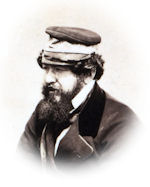
December 12th.—A big-bearded, spectacled, moustachioed, spurred, and booted officer threw himself on my bed this morning ere I was awake. Russell, my dear friend, here you are at last; what ages have passed since we met!” I sat up and gazed at my friend. “Bohlen! don’t you remember Bohlen, and our rides in Turkey, our visit to Shumla and Pravady, and all the rest of it?” Of course I did. I remembered an enthusiastic soldier, with a fine guttural voice, and a splendid war saddle and saddle-cloth, and brass stirrups and holsters, worked with eagles all over, and a uniform coat and cap with more eagles flying amidst laurel leaves and U. S.’s in gold, who came out to see the fighting in the East, and made up his mind that there would be none, when he arrived at Varna, and so started off incontinent up the Danube, and returned to the Crimea when it was too late; and a very good, kindly, warm-hearted fellow was the Dutch-American, who— once more in his war paint, this time acting Brigadier General (since killed in action in Pope’s retreat from the north of Richmond.)—renewed the memories of some pleasant days far away; and our talk was of cavasses and khans, and tchibouques, and pashas, till his time was up to return to his fighting Germans of Blenker’s division.

He was not the good-natured officer who said the other day, “The next day you come down, sir, if my regiment happens to be on picket duty, we’ll have a little skirmish with the enemy, just to show you how our fellows are improved.” “Perhaps you might bring on a general action, Colonel.” “Well, sir, we’re not afraid of that, either! Let ’em come on.” It did so happen that some young friends of mine, of H.M.’s 30th, who had come down from Canada to see the army here, went out a day or two ago with an officer on General Smith’s staff, formerly in our army, who yet suffers from a wound received at the Alma, to have a look at the enemy with a detachment of men. The enemy came to have a look at them, whereby it happened that shots were exchanged, and the bold Britons had to ride back as hard as they could, for their men skedaddled, and the Secession cavalry slipping after them, had a very pretty chase for some miles; so the 30th men saw more than they bargained for.

Dined at Baron Gerolt’s, where I had the pleasure of meeting Judge Daly, who is perfectly satisfied the English lawyers have not a leg to stand upon in the Trent case. On the faith of old and very doubtful, and some purely supposititious, cases, the American lawyers have made up their minds that the seizure of the “rebel” ambassadors was perfectly legitimate and normal. The Judge expressed his belief that if there was a rebellion in Ireland, and that Messrs. Smith O’Brien and O’Gorman ran the blockade to France, and were going on their passage from Havre to New York in a United States steamer, they would be seized by the first British vessel that knew the fact. “Granted; and what would the United States do?” “I am afraid we should be obliged to demand that they be given up; and if you were strong enough at the time, I dare say you would fight sooner than do so.” Mr. Sumner, with whom I had some conversation this afternoon, affects to consider the question eminently suitable for reference and arbitration.

In spite of drills and parades, McClellan has not got an army yet. A good officer, who served as brigade major in our service, told me the men were little short of mutinous, with all their fine talk, though they could fight well, Sometimes they refuse to mount guard, or to go on duty not to their tastes; officers refuse to serve under others to whom they have a dislike; men offer similar personal objections to officers. McClellan is enforcing discipline, and really intends to execute a most villanous deserter this time.
London, December 12, 1861

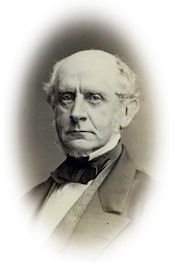
It has given us here an indescribably sad feeling to witness the exultation in America over an event which bids fair to be the final calamity in this contest. We wonder that there has been so little of comprehension of the nature of the struggle here in public opinion not to jump at once to the conclusion that it would be turned against us by such an act. Putting ourselves in the place of Great Britain, where would be the end of the indignation that would be vented against the power committing it? Yet it seems everywhere to have been very coolly taken for granted that because she did outrageous things on the ocean to other powers, she would remain quiet when such things were done to her. A little observation of her past history ought to have shown that she never sees the right until half a century after she has acted wrong. She now admits her error in our revolution, and in the last war. Now she is right in principle and only wrong in point of consistency. Our mistake is that we are donning ourselves in her cast-off suit, when our own is better worth wearing. And all for what? Why to show our spite against two miserable wretches, twenty thousand of whom are not worth a single hair in the head of any of the persons on both sides of the controversy whose lives and happiness are endangered by the quarrel. . . .

Winchester, December 12, 1861.

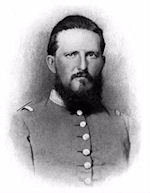
Last Monday night I returned to our camp here, where I had the pleasure of reading the letters of Mary and Helen informing me that your troubles were all over, that we had another little boy in the crib, and that his mamma, as Mary happily expressed it, “Was doing as well as could be expected.” I would have written them to express my gratification at the good news from home, but I had orders to leave again upon another expedition to the Potomac which afforded no time for writing a letter. I reached Charlestown the next morning about daylight and spent most of the day on my horse. The morning started with the forces at one o’clock, passing by Shepherdstown to Dam No. 4 on the Potomac, where we captured eight Federal soldiers whom we found on this side of the river, in which we lost one man wounded—I suppose fatally. We remained there until late in the evening, when we started for Martinsburg, where we arrived about nine o’clock, having made a march of about twenty-six miles. I left Martinsburg the next afternoon and returned to Winchester, where, having been some time engaged in a conference with Jackson, I found a bed and went to sleep, tired enough, I am sure. This morning I returned to camp. So, Love, I have given you together my operations for the last few days, which furnish the reason for my not writing sooner.

To-day I received Mary’s letter of the 9th inst., from which I learn that you are improving, that the baby is doing well, which I am delighted to hear. I really sympathize with you, Love, in your lonely situation. You must be uncomfortable, lying all day and night in bed, though not suffering much with pain. In ten days more, I suppose, you will be able to sit up, and then in a week or so get about, attending to matters at home, as usual. I assure you that I reciprocate your wish for my return home, and heartily wish that I could consistently with my duty remain with you. If I can get a leave for only a few days, I will go before long to give a kiss and a greeting to the little fellow who has such strong claims upon my love and care. Active operations must soon cease, when there will be no reason why a short furlough should not be granted. The weather is already cold enough to make it uncomfortable in tents and such conveniences as we are able to provide. It would be intolerable if we were put upon the march with insufficient means which the men would have of making themselves comfortable.

I suppose by this time the hands have been making considerable progress in getting up the corn crop, and hope they may be able to finish it before Christmas. For the hired hands clothing must be furnished before Christmas. Can you get Annie or your ma to call upon Wm. White and get the goods and have them made up? Give my love to Helen and Mary and say to them I am much indebted to them for their letters and wish them to continue to write until you are able. And now, Love, good-bye again. Give my love to your father, ma and Annie. A kiss to Matthew, Galla and the baby, and for yourself, dearest, my hearty wish for your speedy recovery.

December 12.—The Montgomery (Ala.) Mail, of this day, says that “there have been six alarms of fire in that city within the two previous days. The Commercial Hall was fired twice in broad daylight. There was much excitement and great exasperation among the citizens.”

—In the Maryland Legislature, in session at Annapolis, a resolution was introduced declaring the seat of Hon. Coleman Yellott, Senator from Baltimore, vacant, on the ground that during three successive sessions of the body he absented himself from his seat therein, without assigning any reason therefor; and whereas, it is a matter of public notoriety, established also by testimony before the Committee on Judicial Proceedings, that the said Senator from Baltimore City has gone to Virginia, and has no intention of resuming his seat in the Senate; and whereas, it is right and proper, in these times of public peril, the large and populous city of Baltimore should be represented here; and whereas, the Constitution of Maryland provides that in the event of the removal of a Senator from the county or city for which he is elected, the President of the Senate shall issue his warrant for the election of another person in his place: therefore, &c.

Quite an animated discussion ensued between several of the members on the preamble and resolutions, when the vote was taken and the resolution declaring the seat vacant was passed.

—Last night and this morning a terrible conflagration raged in the city of Charleston, S. C., consuming and totally destroying nearly all the business portion of the city east of King St., in the direction of the Cooper River.—Richmond (Va.) Enquirer, Dec. 15.

—The authorities having learned that a number of rebels in the vicinity of Bagdad, Shelby County, Kentucky, on the line of the Louisville and Frankfort Railroad, were becoming troublesome, and had even gone so far as to compel loyal citizens to take the oath of allegiance to the Southern Confederacy, a squad of men from Col. Whitaker’s regiment, at Spring Garden, near Louisville, Ky., were despatched to the neighborhood to-night, with orders to arrest the rebels. Arriving on the ground, they were proceeding to make the desired arrests, when they were fired upon from the residence of a rebel, which was occupied by about forty persons. The fire was returned by the squad of half a dozen National troops, who were finally overpowered and forced to retreat, but one of them, however, having been wounded, and he not mortally.—Louisville Journal, Dec. 14.

—A scouting expedition, composed in part of Col. Merrill’s regiment of cavalry, returned to Sedalia, Mo., bringing as prisoners four captains, two lieutenants, and about forty men. They also captured a mortar and a large number of horses. The expedition went as far as Waverly, Mo. The man who hauled down the American flag after Colonel Mulligan’s surrender at Lexington, was arrested as a spy.

—The Bowling Green Courier publishes what purports to be a message from George W. Johnson, who signs himself “Provisional Governor,” addressed to “Mr. President and Gentlemen of the Legislative Council.” The so-called ” Provision Council” has been organized as follows: President of Council, Willis B. Machen, of Lyon; State Treasurer, Judge T. L Burnett, of Spencer; State Auditor, Capt. Richard Hawes, of Bourbon; Secretary of State, Robert McKee, of Louisville; Clerk of Council, A. Frank Brown, of Pulaski; State Printer, W. N. Haldeman, of Oldham; Sergeant-at-Arms, John E. Thompson, Jr., of Mercer.—N. Y. Times, Dec. 14.

—A skirmish occurred to-day on the banks of Green River, Ky. Company I of the Fifteenth Ohio was attacked by about one hundred and fifty rebel cavalry, who had dismounted from their horses and approached the patriots unobserved. The rebels fired one round without killing or wounding a man, and it was returned by the Ohio infantry with a couple of volleys, wounding several. The cavalry then retired, bearing their wounded with them.— Louisville Journal, Dec. 16.

11th.—I have just received a letter from a lady friend of mine aye, and of the soldiers, too, in which she says she “cannot but think of the suffering patriot-soldier, with nothing but a tent above his head, with no covering but a single blanket, and but so little care when sick.” This induces me to put on record here, the following description for reference, a long time hence, when, if this war continues, I may wish to read it and compare it with the hospitals then existing, with the improvements which experience shall have causes to be adopted:

My hospital at present consists of five large tents, fourteen feet long by fifteen feet wide. They open into each other at the ends, so as to make of the whole one continuous tent, seventy feet long. This will accommodate forty patients comfortably. On an emergency, I can crowd in fifty-five. In the center of the first tent is dug a hole about three feet in circumference and two and a half deep. From this hole there passes through the middle of the tents a trench or ditch two feet wide and of the same depth, which terminates in a large chimney just outside of the fifth tent. It is covered for about ten feet of its length, at the beginning with broad stones, the next fifteen feet with sheet iron, thence to the chimney with stones and earth. A fire is made in the hole at the beginning of this ditch, which, through its large chimneys, has a great draught. The blaze sweeps through its whole length, and by means of this fire, no matter what the weather, or how changeable, the temperature in the hospitals need not vary three degrees in a month, and at all times, night and day, have full ventilation without varying the temperature. Since the adjustment of the difficulties, I have my full quota (10) of nurses, and these are never, night or day, less than two on watch. The cots for the sick are ranged side by side, with their heads to the wall and feet to the center of the tent, leaving just room between their sides for the nurses to move freely, and for the patients to get up and down, and between their ends for the ditch, on which, over the covering already described, is a ladder or rack, with slats so close as not to admit the feet between them when the nurses and patients are walking on them.

So long as there is room in the hospital, no patient of my regiment is permitted to be confined to his tent by sickness. The moment he is sick enough to be confined to bed, he is brought to hospital, where he remains constantly under the eye of the Surgeon and nurses till he recovers. There are, to-day, thirty-six in hospital, each, instead of lying with “nothing but a tent above his head, and with no covering but a single blanket,” is on a comfortable bed of straw, the tick emptied and refilled once in four weeks, with all the covering they want. I have plenty of good sheets, and not less than two blankets for each, besides what they bring with them. They are never without fresh meat, rarely without rice, potatoes, jellies in abundance, tea, coffee, sugar, milk, and I am now purchasing for them two dozen chickens a week; and I have this day a hospital fund of not less than one hundred and seventy-five dollars, which is increasing every day, from from which I can replenish or add to the comforts now allowed.[1] This is a description of my own hospital. I regret to learn from the U. S. Medical Inspector who has visited me to-day, that other hospitals are not so well provided or so comfortable. I regret it, because there is no reason why all may not be provided just as well, so long as we remain near a good market; and if they are not, there is blame either in medical or military departments, which ought to be corrected.

From ninth of November to this date, the time I was shut out from the medical supervision of the camp, there have been more deaths in the regiment than during the whole five months before, including the sickly season of August, September and October. The health of the regiment now, however, is good, and I hope it will remain so during the winter.


[1] It may be a matter of some interest to the reader to know how this hospital fund is realized. It is thus: The soldier is entitled to certain rations every day, and these continue, whether he is sick or well. When well, they are drawn by the captains of companies and distributed to the men. When sick and in hospital, the Surgeon notifies the Commissary of the fact, and they are not issued to the Captain, but credited to the hospital. The Surgeon draws them in whole, in part, or not at all. The days’ rations are worth from 17 to 20 cents per man. Now, any economical and honest Surgeon can feed his sick men well when near a market, and save to the hospital fund at least one third of this amount, for the purchase of delicacies. Give him thirty in hospital, he can realize two dollars per month on each man, ($60 per month.) In a neighborhood where markets are very high, this will be proportionally reduced. Where he cannot buy at all, it will be increased.

December 11th.—The unanimity of the people in the South is forced on the conviction of the statesmen and people of the North, by the very success of their expeditions in Secession. They find the planters at Beaufort and elsewhere burning their cotton and crops, villages and towns deserted at their approach, hatred in every eye, and curses on women’s tongues. They meet this by a corresponding change in their own programme. The war which was made to develop and maintain Union sentiment in the South, and to enable the people to rise against a desperate faction which had enthralled them, is now to be made a crusade against slaveholders, and a war of subjugation—if need be, of extermination—against the whole of the Southern States. The Democrats will, of course, resist this barbarous and hopeless policy. There is a deputation of Irish Democrats here now, to effect a general exchange of prisoners, which is an operation calculated to give a legitimate character to the war, and is pro tanto a recognition of the Confederacy as a belligerent power.

Bird’s Point, Mo., December 11, 1861.

Our cavalry brought in 16 prisoners to-night, about 10 last night; a band of Thompson’s men took a couple of boys from our regiment prisoners, out 10 miles from here at the water tank on the railroad. The owner of the house happened to be outside when they surrounded the house and he scooted down here with the news, and by 2 o’clock we had a lot of cavalry and infantry en route for the scene of action. The cavalry started them out of the brush and captured this 16. The Rebels killed one of Colonel Oglesby’s men. They did not recover our men but started up and lost another gang that probably has them.

We will be in our quarters next week although we don’t need them. It is rather pleasant here now. I took a swim yesterday. ‘Twas confounded cold, but I wanted to bathe so I took the river for it. We haven’t had a man complaining in the company for a week. We buried one poor fellow last week, but he would have died at home. When I was home last I weighed 142, now I weigh 160. Can you imagine me.

December 11.—Two companies of infantry, under command of Lieutenant-Colonel Rhodes, and two companies of cavalry, under command of Major J. J. Mudd, had a skirmish with the rebels near Bertrand, Missouri, to-day, losing one man. They took sixteen prisoners and a number of horses and fire-arms.—Missouri Democrat, December 12.

—In the Legislature of Western Virginia, in session at Wheeling, to-day, Mr. Carksadon, of Hampshire, introduced a resolution to prohibit any person engaged in the rebellion from ever holding office in the State. Mr. Snider, of Monongahela, introduced a resolution modifying these parts of the code which prohibit writing or speaking against slavery, so as to make them conform to the spirit and genius of the National institutions.

—The Eleventh Michigan infantry, twelve hundred strong, commanded by Col. Win. J. May, arrived at Jeffersonville, and were at once despatched to Bardstown, Ky. They are a fine body of men, and will doubtless do good service in the Union cause. Michigan has done nobly thus far, and the Eleventh is considered as good as, if not better than, any regiment yet sent to the war from that State.—Louisville Journal, December 12.

—Reliable news reached Fort Smith, Arkansas, to-day, from the Indian country, from which it is learned that a large number of Creeks, Cherokees, and Seminoles have joined Opothleyholo. The Cherokee regiment, under Colonel Drew, has disbanded, a part have joined the Nationals, a portion have returned home, and a part remain with Colonel Cooper. Opothleyholo is encamped about the Big Bend of Arkansas, with a force variously estimated at from two to four thousand men, well armed, and all naked to the waist, and painted.

Colonel Cooper is encamped within five miles of the Nationals, with a small force, consisting of Colonel Simms’ Texas regiment, Colonel McIntosh’s Creek regiment, and the Chocktaw and Chickasaw regiment.—Fort Smith (Ark.) News, Dec. 12.

—Five vessels of the stone fleet, and the ships George Green and Bullion, of Gen. Butler’s expedition, sailed to-day from Boston, Mass.

—An expedition, under Commander Rodgers, U. S. N., left Port Royal harbor, S. C., and explored Ossabaw Sound, Ga. It passed up the Vernon River, Ga., and was fired on by a fort on the eastern end of Green Island, without damage. Returning to the Sound, the expedition sailed up the Great Ogeechee River, and landed at Ossabaw Island, but found it abandoned. No batteries, except the one on Green Island, were discovered.—(Doc. 224.)

—This morning a party of rebels commenced firing on some National pickets in the vicinity of Dam No. 4, on the Potomac, near Sharpsburg, Md., but were forced to retreat to the woods, more than a mile from the river, after losing seven killed and many wounded. When the rebels disappeared, a party of National troops crossed the river to reconnoitre, but were forced to retreat by a company of rebel infantry. Before reaching the river, however, their escape was cut off by a troop of eighty cavalry, and the whole party, after a slight skirmish, captured. No assistance could be sent them by the National troops on the Maryland side of the river, and it was afterward ascertained that the prisoners had been taken to Martinsburg, Va.—(Doc. 225.)

A Walk into the Country.

Dec. 10. The weather holds warm and springlike. We have no need of overcoats, unless doing guard duty nights. The people here tell us it is an unusually mild fall, but that we shall get right smart lots of cold and snow before many days. I took a walk of a few miles into the country yesterday, on a tour of observation. I noticed what appeared to me a great extent of good land, but very badly improved. Occasionally I saw a farm where things seemed to be kept up snug and showed some evidences of thrift, but more of them looked as though the owners studied to see how shiftless they could be and still manage to live. Buildings and fences are going to decay; fields of corn are yet unharvested, the cattle and hogs running through and destroying them. I asked one man why he didn’t harvest his corn. “Oh,” he said, “there is no hurry about that, I have got all winter to do it in, and the corn is just as well off in the field as anywhere.” I came to the conclusion that his plan of harvesting was about as fast as he wanted it to eat. I said to another man I met, “You have good land about here, sir; easy of cultivation and close to a market. I suppose you make a pile of money?” “Oh, no,” he said, “you are mistaken; right poor land about yere, one can hardly make a living on it, but you go over yere a few miles to some creek [the name of which I have forgotten], and you will find right good land; make as much again corn on it as you can on this.” I asked, “What do you value this land at?” “Well,” he replied, “we reckon the land around yere worth about $10 an acre; reckon some of it mought be bought for a little less, but the land around Annapolis is worth from $25 to $50 an acre.” I made up my mind that a man with an ordinary degree of enterprise, with our improved implements for farming and with hired labor, might take this land and make money on it. I am unable to see any profits from slave labor in Maryland; it is poor help at the best; besides they have to be clothed and fed several months in a year during which time they are not earning much, and there is always on a farm employing a dozen or more field hands, a lot of old men and women and small children who are not earning anything, but still have to be supported.

Post image for “I do not, I think, possess quite enough of the Vandal spirit for anything like predative warfare.”—War Letters of William Thompson Lusk.

Headquarters 2d Brigade,

Port Royal District, Dec. 10th, 1861.

My dear Mother:

I am still much busied — still find it difficult to cull even a few moments from multifarious duties, even to write my dear mother. I would like much to have a chance to write you a good long letter, yet must wait until more leisure shall fall to my share. We have the last few days been more than ever busy, owing to our formal occupation of Beaufort, where we are now pleasantly living. All sorts of comforts are at our disposal. The house occupied by the General is one belonging to Rev. (I think) Mr. Smith, an extremely elegant one. The portrait of Bishop Eliot looks down benignantly from over the mantel while I write.

I wish the owners were back in their old homes, notwithstanding they have relinquished all their old home luxuries to us. I do not, I think, possess quite enough of the Vandal spirit for anything like predative warfare. I have spoken of the extreme pressure of duties, and this you will understand when I tell you I often ride thirty miles, visiting posts, arranging pickets, and in the examination of doubtful points, during the day, besides performing many other duties, such as may fall to my share. I must say night generally finds me weary and after evening work is done, disinclined even to write you.

All things seem to thrive with us so far. What we still need is a sufficiently efficient organization to enable us to strike with rapidity. Here we are, nearly five weeks in possession of this point, and as yet we have hardly been able to get the stores ashore which we originally brought with us. And all this time too we read in the newspapers of the great zeal and activity displayed by Captain _____ who has charge of these things. By this time we ought, considering the great fear that filled the inhabitants on our first landing, to have been able to follow up our first successes by a series of determined blows, placing the entire State at our disposal. Still we are young at war, and cannot hope to learn all these things at once. We have however done something. Immense quantities of cattle, corn, and provisions have been gathered into the commissary stores, Hilton Head has been securely fortified, and some cotton saved, though much of the latter has been burned by the South Carolinians to prevent its falling into our hands. I think Cousin Louisa’s favorite, Sam Lord, is in the Army awaiting us on the mainland. At least I heard such to be the case from a negro driver on one of the plantations, who seemed to know him. The Pringles lived somewhere in this neighborhood too, so I am brought almost face to face with old friends.

Believe me,

Very Affec’y.,

W. T. Lusk.