Following the American Civil War Sesquicentennial with day by day writings of the time, currently 1863.

The American Civil War

Post image for A Diary of American Events.–August 5, 1861

August 5.—At Washington, the representatives of the newspaper press held a consultation with Gen McClellan by his special invitation, when it was unanimously decided that the following suggestions from him be transmitted to the editors of all the newspapers in all the loyal States and in the District of Columbia:

1st. That all such editors be required to refrain from publishing, either as editorial or correspondence, any description, from any point of view, of any matter that might furnish aid and comfort to the enemy.

2d. That they be also requested and earnestly solicited to signify to their correspondents here and elsewhere their approval of the foregoing suggestion, and to comply with it in spirit and letter.

It was resolved that the Government be respectfully requested to afford the representatives of the press facilities for obtaining and immediately transmitting all information suitable for publication, particularly touching engagements with the enemy.

—The following queries were put to the Confederate District-Attorney at Charleston:

First—Is it lawful for a citizen of the Confederate States to purchase of our enemy State stock or bonds of any of the Confederate States, and demand the interest when due?

Second—Is it lawful for the same parties to purchase notes given by merchants of the Southern Confederacy to Northern houses, and demand payment for the same?

Third—If lawful and proper to pursue the above course, would it not be equally legal for the small trader to buy merchandise of the enemy; or, in other words, does the law intend to operate in favor of the fortunate holders of capital against the humble dealers in wares and merchandise?

The response is as follows:—The acts specified by you certainly constitute “trading with the enemy” peculiarly objectionable, because they afford a direct assistance to the enemy, by the transmission of money to foster his resources. And, in addition, such conduct is highly unpatriotic, because directly injurious to the interests of the States and citizens of our Confederacy, whose obligations are thus withdrawn from the enemy’s country, where it is for the interests of the States that they should remain, since they could not there be called upon for payment during the war. Such operations are certainly worse than the simple purchase of merchandise in the enemy’s country, because they, at the same time, aid our enemies and injure our friends.N. Y. Times, August 5.

—Claiborne F. Jackson, the deposed Governor of Missouri, publishes in the Memphis Appeal a document entitled “Declaration of Independence of the State of Missouri,” and addressed to the people of that State. The ex-Governor says he takes this step by virtue of authority conferred upon him by the State Legislature to do such things as to him might seem proper to “suppress the rebellion and repel invasion.” He thereupon assumes that the waging of war by the Federal Government upon the sovereign State of Missouri, ipso facto, sunders the connection of the latter from the former, and accordingly so declares—subject, however, to the ratification of the people at such future time as their Impartial and unbiased verdict can be obtained through the ballot-box, —(Doc. 163.)

—Gen. Lyon with his forces fell back on Springfield, Mo. The rebels were advancing on the latter place by four different roads, and their advance was from ten to fifteen miles distant. Three of the routes on which the enemy were moving, were the Neosho, Carthage, and the Overland roads. Gen. Lyon called in two thousand five hundred Home Guards from the neighborhood. Farther than this addition to his force, no other reinforcements seemed to be near. It was expected that the enemy were resolved on an immediate attack, from the fact that their commissariat was in a miserable condition, the rebels depending on forced contributions for temporary supplies.

It was generally remarked in Springfield that Gen. Lyon was perfectly confident of success, in the event of an attack. The latest estimate places the rebel force at twenty thousand. Their arms are thought to be very inferior, judged by the specimens taken during the skirmish at Dug Spring, where Gen. Lyon had no intrenchments, depending upon his splendid artillery in the open field.—St. Louis Democrat, August 9.

—In the Maryland Legislature to-day, S. Teaklo Wallis, from the committee to whom was referred the memorial of the police commissioners, submitted a long report, followed by preamble and resolutions, setting forth as arbitrary and unconstitutional the course of the Government in superseding the police board, and imprisoning Marshal Kane and the commissioners. The committee appealed in the most earnest manner to the whole people of the country, of all parties, sections, and opinions, to take warning by the usurpations mentioned, and come to the rescue of the free institutions of the country, so that whatever may be the issue of the melancholy conflict which is now covering the land with sacrifice and threatens to overwhelm it with debt and ruin, there may at least survive to us when it is over the republican form of government which our fathers bequeathed to us, and the inestimable rights which they framed it to perpetuate.—N. Y. World, August 6.

—The bark Alvarado, having a prize crew from the privateer Jeff. Davis on board, was chased ashore near Fernandina, Florida, and subsequently burned by the sailors of the United States ship Vincennes.—(Doe. 170.)

—A Sharp skirmish took place this morning in Virginia, opposite the Point of Rocks, between a detachment of sixty men of the Twenty-eighth Regiment of New York Volunteers, under the command of Lieut.-Col. Brown, and a party of cavalry of Capt. Mead’s company of the Confederate army. The Colonel ordered the Confederates to halt, which was not obeyed. The Unionists then fired on them and killed three, wounded two, and took twenty horses, with their equipments, and seven prisoners, who were taken before Gen. Banks. None of the Federal troops were hurt. The engagement occurred at daybreak. The advancing party forded the river, and caught the cavalry pickets of the enemy at breakfast.

The prisoners were brought into camp at Sandy Hook. Nearly every man captured had sword-arms and revolvers. On the sword-belt of one was marked in ink, “John H. Rollins, Leesburg, Va.” One captain of the rebels was killed. Previous reports from Colonel John C. Starkweather, of the First Wisconsin Regiment, stationed at Edward’s Ferry, stimulated the action which resulted so successfully. Colonel Starkweather had already made reconnoissances on the Virginia side, destroyed the rendezvous of the rebel pickets, and had but one man wounded, Mr. W. H. Langworthy, of Company E. All the captured are from Loudon County, Va.—(Doe. 164.)

—In the House of Representatives at Washington, Mr. Calvert, of Maryland, introduced a resolution providing for the appointment of a Committee to consider and report such amendments to the Constitution as may restore confidence and insure the preservation of the Union. Laid on the table.—Mr. May, of Maryland, was refused permission to introduce resolutions providing for the appointment of Commissioners to procure an armistice, and so compromise as to preserve the Union if possible; if not, to provide for the peaceful separation of those States that have seceded or may hereafter secede.— Mr. Diven offered a resolution declaring that, as rebels are now in arms against tho Government, all resolutions looking to a compromise are either cowardly or treasonable. The House refused to suspend the rules to receive Mr. May’s resolution. The Senate bill, increasing the pay of the volunteers and legalizing the acts of the President, was passed.

—A letter written on board the steam-sloop Brooklyn, off the mouth of the Mississippi River, giving an account of the manner by which the rebel privateer Sumter was suffered to run the blockade, was published in the Baltimore American.(Doc. 165.)

—A band of rebels, numbering from one thousand to twelve hundred, made an attack upon a camp of Union men at Athens[1], Missouri, this morning at five o’clock. There was a considerable amount of arms and ammunition for United States troops stored at that place, under a guard of the troops composing the camp. The United States Volunteers numbered about three hundred and fifty men, under the command of Captain Moore. The fighting lasted about one hour, when the rebels retreated. In the mean time Captain Moore, having been reinforced by about one hundred and fifty men from Centralia, Iowa, on the opposite side of the river, gave chase to the rebels for about a mile and a half, killing one, taking eighteen prisoners, and capturing thirty-one horses and two secession flags. Several of the rebels were also wounded in the chase. After the battle, six or eight rebels were found dead on the field. In the afternoon the bearer of a rebel flag of truce to the Union camp was admitted. They carried off fourteen killed, and as many more wounded and missing. The rebels were led by Martin Green, a brother of ex-Senator Green. Of the Union men there were three killed and eight wounded.—(Doc. 166.)

—Several shots were exchanged between the U. S. blockading steamer off Galveston, Texas, and some sand batteries on shore.—(Doc. 167.)


[1] Athens is a small town in the extreme northeast of Missouri, on the Desmoines River, twenty-five or thirty miles from Keokuk.
August 4th.—I had no idea that the sun could be powerful in Washington; even in India the heat is not much more oppressive than it was here to-day. There is this extenuating circumstance, however, that after some hours of such very high temperature, thunder-storms and tornadoes cool the air. I received a message from General McClellan, that he was about to ride along the lines of the army across the river, and would be happy if I accompanied him; but as I had many letters to write for the next mail, I was unwillingly obliged to abandon the chance of seeing the army under such favourable circumstances. There are daily arrivals at Washington of military adventurers from all parts of the world, some of them with many extraordinary certificates and qualifications; but, as Mr. Seward says, “It is best to detain them with the hope of employment on the Northern side, lest some really good man should get among the rebels.” Garibaldians, Hungarians, Poles, officers of Turkish and other contingents, the executory devises and remainders of European revolutions and wars, surround the State department, and infest unsuspecting politicians with illegible testimonials in unknown tongues.

Post image for Hospital, injuries, prisoners, telegraph, news—Rutherford B. Hayes

August 4. Sunday.—Visited the hospital. It is airy and comfortable—the court-house of the county, a large good building. The judge’s bench was full of invalids, convalescent, busily writing letters to friends at home. Within the bar and on the benches provided for the public were laid straw bedticks in some confusion, but comfortable. A side room contained the very sick, seven or eight in number. The total inmates about seventy-five. Most of them are able to walk about and are improving; very few are likely to die there. One poor fellow, uncomplaining and serene, with a good American face, is a German tailor, Fifth Street, Cincinnati; speaks little English, was reading a history of the Reformation in German. I inquired his difficulty. He had been shot by the accidental discharge of a musket falling from a stack; a ball and several buckshot pierced his body. He will recover probably. My sympathies were touched for a handsome young Canadian, Scotch or English. He had measles and caught cold. A hacking cough was perhaps taking his life. Nobody from the village calls to see them!

A hot day but some breeze. We hear that Colonel Matthews with the right wing was, on the morning of the third day from here, near Bulltown, twenty-seven miles distant. Governor Wise is somewhere near Lewisburg in Greenbrier County. Cox [General J. D.] is in no condition to engage him and I hope will not do it. I rather hope we shall raise a large force and push on towards Lynchburg and east Tennessee. Jewettt is doing well.

_______

WESTON, VIRGINIA, August 4, 1861.

DEAR MOTHER:—I write often now, as we soon pass out of reach of mails. We hear the news by telegraph here now from all the home towns, but mails are uncertain and irregular. We are very healthy, but the weather is hotter than any I have known in a great while. Our wounded lieutenant, Jewett, is doing well. His father is here nursing him. The fine large hospital for all this region of country, having one hundred patients belonging to different regiments, is in charge of Dr. Joe. It is the courthouse. The people here do not find us much of a nuisance. Of course, in some respects we are so, but all things considered, the best of the people like to see us. I mean to go to church this pleasant Sunday. My only clerical acquaintance here is an intelligent Catholic priest who called to see Colonel Scammon. I have been cross-examining a couple of prisoners—one a Methodist preacher—both fair sort of men, and I hope not guilty of any improper acts. Good-bye.

Affectionately,

R. B. HAYES.

MRS. SOPHIA HAYES.

_______

NEAR WESTON, VIRGINIA, August 4, 1861.

DEAR LAURA:—As we ride about this exceedingly pretty country and through this reasonably decent village, I am reminded of young ladies in Ohio by occasionally meeting a damsel wearing a stars-and-stripes apron, or by seeing one who turns up her nose at the said stars, etc.

We are leading camp life again—watching Secessionists, studying geography, sending and receiving scouts and couriers and sich like. Colonel Matthews has gone with the five companies of the right wing forty-four miles further up into the hills. We shall follow him if there are any hostile signs up there, and he will return to us if such sign fail him.

You and Jeanie Ahave been of use. The bandages are used in dressing the shocking wound of young Jewett of Zanesville— a lieutenant, handsome, gallant, and intelligent. Just the person you would wish to serve in this way. Dr. Joe hopes he will not be crippled. At first it seemed that he must lose his foot; but your bandages or something else are bringing him up. It will be perhaps months before he can walk.

The court-house here (about like yours) is a hospital for the sick and wounded of all the regiments hereabouts. It would be a glorious thing if some Florence Nightingales would come here. They could be immensely useful, and at the same time live pleasantly in a pretty mountain village, safe as a bug in a rug. Won’t you come? It is easy getting here and cheap staying. Too hot under canvas to write much. Love to all.

Your uncle,

R.

MISS LAURA PLATT,

Columbus.

Post image for A Diary of American Events.–August 4, 1861

August 4.—About five o’clock, this morning, the Second Regiment of Connecticut Volunteers, passed through Philadelphia, Pa., on their way home. The regiment is under Colonel A. H. Terry, and participated in the engagement at Bull Run. In the fight they lost sixteen men killed and wounded. The officers of this regiment deny that it was through hunger that the men were exhausted. The Connecticut men were supplied with full haversacks; and the only drawback in their opinion to final success, was the impetuous feeling to go ahead and fight. In order to get within the enemy’s lines, a long march was necessary to this end. From two o’clock A. M. until ten they marched; and even then the men were unable to rest. To this fact alone, the officers of this regiment attribute, in a great measure, the reverse. The regiment acted as part of the reserve, and did not get into battle till late in the day.—Philadelphia Bulletin, August 5.

—A Meeting was held this evening in Rev. Dr. Adams’ Church, on Madison-square, New York city, to aid in measures taken for the prevention and suppression of intemperance in the National Army. A. R. Wetmore, Esq., presided, and Dr. De Witt offered a prayer. Resolutions were read by Dr. Marsh, which were responded to in an able speech by Rev. Mr. Willets, of Brooklyn, and Paymaster Bingham, of the Twenty-sixth Regiment.—(Doc. 162.)

—Admiral Sir Alexander Milne, Commander-in-Chief of the British forces, at Halifax, in a private letter to the British Consul at Boston, says: “I see a long article in the papers and extracts from a letter from Fort Pickens, alluding to orders I have given; all I can say is that it is not my version of blockade nor my orders on the subject.”—Buffalo Evening Courier, August 5.

—Delaware has contributed two regiments for the war. One is already in the field. The other has not yet been complete, and is commanded by Colonel Charles Wharton, brother of George M. Wharton, of Philadelphia. One company of the regiment is entirely made up of Philadelphians. It is the Hancock Guards, Capt. John F. Heishley. The men are remarkably well fed, clothed, and sheltered. In this particular Delaware has equalled, if not surpassed, the other States. They are encamped at Camp Brandywine, Wilmington. — Philadelphia Bulletin, August 5.

Manassas, August 3,1861.

I reached here last night after spending a day in Staunton. When I reached there I found the militia of Rockbridge, and some of the officers insisted upon my remaining a day to aid them in raising the necessary number of volunteers (270) to have the others disbanded and sent home. I was very glad, indeed, that it was accomplished and the others permitted to return home and attend to their farms. I found, upon reaching Manassas, that our encampment had been removed eight miles from there, in the direction of Alexandria; and after a walk of some three hours I reached here about nine o’clock at night, somewhat fatigued. I do not know what our future operations are to be; but think it probable that we shall remain here for some time in idleness. I am free to confess that I don’t like the prospect; without any employment or amusement, the time will pass with me very unpleasantly, and such soldiering, if long continued, I fear, will make most of us very worthless and lazy; perhaps send us home at last idle loafers instead of useful and industrious citizens. Such a result I should regard as more disastrous than a dozen battles. In passing along the road from Manassas, the whole country seemed filled with our troops, and I understand that our encampment extends as far as eight miles this side of Alexandria. I think we have troops enough to defend the country against any force which may he brought against us.


Since this much of my letter was written, Lewis has handed me your note of 25th ult. You say you are almost tempted, from my short and far between letters, to think that I do not love you as well as I ought. You are a mean sinner to think so. Just think how hard I fought at Manassas to make you the widow of a dead man or the wife of a live one, and this is all the return my darling wife makes for it. If I was near enough I would hug you to death for such meanness. In truth, Love, I may say that I never closed one of my short notes until my eyes began to smart. Sometimes I did not wish to write. When we were for some time on the eve of a battle I did not wish to write lest you might be alarmed for my safety. Until the last month, when danger seemed so threatening, I think I have written once a week. But, Love, when you doubt my affection, you must look to the past, and if the doubt is not dispelled, I can’t satisfy you, and you must continue in the delusion that the truest and steadiest feeling my heart has ever known—my love for you—has passed away.

I know, Love, you think I exposed myself too much in the battle. But for such conduct on the part of thousands, the day would have been lost, and our State would now have been in the possession of our enemies. When I think of the result, and the terrible doom from which we are saved, I feel that I could have cheerfully yielded up my life, and have left my wife and little ones draped in mourning to have achieved it. Our future course must be the same, if we expect a like result.

I’ve created a short video using photographs from the civil war and and mixed it with a couple of medleys of civil war music recorded almost 100 years ago.


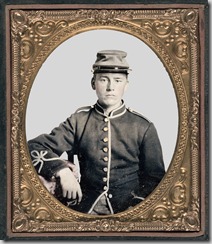
Unidentified young soldier in New York Zouave uniform

All of the photographs are from the U.S. Library of Congress Prints and Photographs Online Catalog.

_________

Description of photographs:

  • Keedysville, Md., vicinity. Confederate wounded at Smith’s Barn, with Dr. Anson Hurd, 14th Indiana Volunteers, in attendance, September 1862.
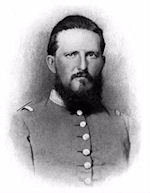
  • Unidentified soldier in Confederate uniform and forage cap.
  • Chickahominy River, Va. Grapevine bridge built May 27-28, 1862, by the 5th New Hampshire Infantry under Col. Edward E. Cross.
  • Unidentified young soldier in Union uniform with musket, bayonet, and knapsack.
  • Aquia Creek Landing, Va. Embarkation of 9th Army Corps for Fort Monroe, February 1863.
  • Unidentified soldier in Confederate uniform and slouch hat, missing jacket buttons.
  • Cedar Mountain, Va. A Confederate field hospital, 1862.
  • Unidentified young soldier in New York Zouave uniform.
  • Cumberland Landing, Va. Federal encampment April – May 1862.
  • Unidentified young soldier in Confederate shell jacket, Hardee hat with Mounted Rifles insignia and plume with canteen and cup.
  • Military Bridge across the Chicahominy, June 1862.
  • Unidentified African American soldier in Union uniform in front of painted backdrop showing military camp.
  • Rebel gun in front of Fort Hell, April 1865, a Confederate cannon inside of Fort Sedgwick in Petersburg, Virginia.
  • Unidentified soldier in Confederate uniform.
  • Yorktown, Va. Embarkation for White House Landing, Va.
  • Unidentified young sailor in Union uniform.
  • Antietam Bridge, September, 1862.
  • Unidentified soldier in Confederate shell jacket and slouch hat with object hanging from neck in front of painted backdrop showing waterfall.
  • Confederate prisoners at Fairfax Courthouse, June 1863.
  • Unidentified girl in mourning dress holding framed photograph of her father as a cavalryman with sword and Hardee hat.
  • Hand colored; Tending wounded Union soldiers at Savage’s Station, Virginia, during the Peninsular Campaign, 1862.
  • Two unidentified women reading letters.
  • James River, Va. Sailors on deck of U.S.S. Monitor; cookstove at left, July 9, 1862.
  • Unidentified soldier in Confederate uniform and civilian, likely his father or older brother.
  • Harper’s Ferry, meeting of the Potomac and the Shenandoah, July 1865.
  • Unidentified soldier in Confederate uniform.
  • Libby Prison, Richmond, Va., August 23, 1863.
  • Unidentified African American Union soldier with a rifle and revolver in front of painted backdrop showing weapons and American flag at Benton Barracks, Saint Louis, Missouri.
  • Manassas, Virginia. Camp of General Irvin McDowell’s body guard, hand colored photographic print.
  • Unidentified soldier in uniform with young woman, probably his wife.
  • Secret Service agents, Whitehouse, Va.
  • Unidentified soldier in Confederate uniform of the 11th Virginia regiment with knapsack and bedroll.
  • Dinner time in camp.
  • Unidentified woman wearing mourning brooch and displaying framed image of unidentified soldier.
  • Confederate artillery near Charleston, S.C.
  • Unidentified soldier in Union uniform with Company E, 12th Regiment New Hampshire Volunteers hat.
  • Confederate prisoners at Belle Plain Landing, Va., captured with Johnson’s Division, May 12, 1864.
  • 1863, Interior view of Fort Sumter showing ruins and explosion.

AUGUST 3D.—Conversed with some Yankees to-day who are to be released to-morrow. It appears that when young Lamar lost his horse on the plains of Manassas, the 4th Alabama Regiment had to fall back a few hundred yards, and it was impossible to bear Col. Jones, wounded, from the field, as he was large and unwieldy. When the enemy came up, some half dozen of their men volunteered to convey him to a house in the vicinity. They were permitted to do this, and to remain with him as a guard. Soon after our line advanced, and with such impetuosity as to sweep everything before it. Col. Jones was rescued, and his guard made prisoners. But, for their attention to him, he asked their release, which was granted. They say their curiosity to see a battle-field has been gratified, and they shall be contented to remain at home in safety hereafter. They regarded us as rebels, and believed us divided among ourselves. If this should be true, the rebellion would yet be crushed; but if we were unanimous and continued to fight as we did at Manassas, it would be revolution, and our independence must some day be acknowledged by the United States. But, they say, a great many Northern men remain to be gratified as they had been; and the war will be a terrible one before they can be convinced that a reduction of the rebellion is not a practicable thing.

Post image for A Diary of American Events – August 3, 1861

August 3.—At Baltimore, Md., this morning, Sergeants Wallis and Cook, with Officer James Pryor, of the Middle District Police, went on board the steamer George Weems, at her wharf foot of Frederick street, and on her leaving for the usual trip to various landing places on the Patuxent River, proceeded in her as far as Fort McHenry wharf, where they directed Captain Weems to stop. A search of the steamer was here made, resulting in the discovery of concealed arms and ammunition in various out-of-the-way places in the hold. Immediately under the upper deck, between the lower deck and the skylight, were found 200 new Colt’s patent revolvers, done up singly in paper. In the aft part of the hold the officers found a barrel in which rubbish had been placed for several months. Concealed in the rubbish was a valise filled with boxes, each containing 250 rifle percussion caps. There was also found in the hold, separate from the other freight, a halfbarrel of sulphurated quinine, contained in bottles and packages. On the discovery of these articles General Dix directed that the steamer should be detained for a more minute examination of the freight. He also directed that the steamer Planter should be got ready to convey the passengers to their place of destination.—Captain Weems disavowed any knowledge of the contraband articles.—Baltimore American, August 3.

—Governor Gamble, of Missouri, issued a proclamation to the citizens of that State, in which he calls upon all those who are enrolled in the State militia now in arms against the Federal Government, who were called out by his predecessor, Jackson, to return to their homes, promising them protection if they do so. He appeals to the sheriffs of counties and other magistrates, to exercise all the authority vested in them by law, in arresting and punishing every one who may break the peace, molest his fellow-citizens, or retain arms, the property of the Federal Government. He also notifies all those citizens of other States, who may be in arms within the boundaries of Missouri, (in the rebel ranks,) to withdraw to their own States, as Missouri does not need nor desire their presence. After the issue of this proclamation, Governor Gamble received a despatch from the War Department, stating his promise of protection to all those who may lay down their arms would be sustained by the Government. In several counties of Northern Missouri committees of safety have been appointed to suppress rebellion, with the assurance that if they cannot effect that purpose, the military power will be used to its utmost extent.—(Doc. 156.)

—The Charleston Mercury of to-day, says: “We have been provoked beyond endurance by reading the most complacent and gratulatory comments of certain Virginia papers on the charming charity and benevolence of certain citizens and officials of that State toward the invaders of their soil, plunderers of their estates, destroyers of their homes and firesides, and polluters of their women. We demand that every prisoner in Richmond be incarcerated and put in irons. Justice, humanity, and civilization alike cry aloud for ‘stern retribution.’ ”

—Senator Kennedy, of Maryland, in the Senate, at Washington, presented a memorial from the Legislature of that State, denouncing the National Government in unmeasured terms, and protesting against its action in imprisoning Ross Winans and others suspected of conspiracy. Its reception was objected to by several members on account of its disrespectful tone, but it was finally admitted and ordered to be printed, on the ground that it would not do to deny the right of petition.—N. Y.Times, August 5.

—Beriah Magoffin, Governor of Kentucky, issued a proclamation commanding all persons having arms belonging to the State, that have been unlawfully seized, to immediately deliver them up, that they may be returned to the State Arsenal, at Frankfort.—(Doc. 157.)

—The Senate of the United States confirmed numerous army appointments. Among them are Major-Generals McClellan, Fremont, Dix, and Banks; and Brigadier-Generals Hooker, Curtis, McCall, Sherman, Lander, Kelly, Kearney, Pope, Heintzelman, Porter, Stone, Reynolds, Hunter, Franklin, Rosecrans, Buell, Mansfield, McDowell, and Meigs.—Philadelphia Inquirer, August 5.

—The Twenty-ninth Regiment of Pennsylvania Volunteers, under the command of Colonel John K. Murphy, left Hestonville, West Philadelphia, for the seat of war.—Philadelphia Press, August 8.

—Mrs. Lincoln having kindly consented to receive and distribute the havelocks made by the ladies of Katonah and Bedford, Westchester, N. Y., a case was despatched to-day from the Jay homestead to the executive mansion by Pillion’s and Adams’s express, containing 1,300 havelocks, of which 1,165 were made by the ladies of Katonah and its vicinity, and 135 by those of Bedford.—N. Y. World, August 6.

—A letter from Isham G. Harris, Governor of Tennessee, to the editors of the Memphis Avalanche, on the military power of that State, was published.—(Doc. 158.)

—The First Regiment of New Hampshire State Militia, under the command of Colonel Mason W. Tappan, passed through Philadelphia on their return from the seat of war. This regiment composed part of the command of Col. Stone, and marched to Harper’s Ferry, Va. They have been principally on guard duty, and had a skirmish with the rebels at Harper’s Ferry. The men have performed marches on foot to the extent of one hundred and sixty miles since they left Washington. The regiment has twenty ladies with them. They return numerically as strong as when they left, except six of the men, who were taken prisoners.—Philadelphia Bulletin, August 5.

—The House of Representatives, at Washington, passed, with a slight amendment, the Confiscation Bill. The amendment is, that slaves in the military or naval service, or working in the intrenchments of the rebels, will be confiscated.—(Doc. 159.)

—The Sixth Regiment of Wisconsin Volunteers, commanded by Colonel L. Cutler, and the Twenty-first Regiment of Indiana Volunteers, under the command of Colonel J. W. McMillan, arrived at Baltimore, Md.—Baltimore American, August 5.

—The N. Y. Journal of Commerce suggests as “a way by which our troubles can be settled without more bloodshed”—1, an armistice ; 2, delegates from every State, North and South, to meet at Louisville; 3, the delegates to agree upon a modified Constitution; or 4, a peaceable separation.

One of its plans for reconstruction is to have a Northern and Southern section in each House of Congress, and no bill to become a law until agreed to by a majority on both sides!—(Doc. 160.)

—As engagement took place at Messila, N. M., between a body of Federal troops and seven hundred Confederates, under command of Capt. Baylor. Capt. McNeely and Lieutenant Brooks, of thr Federal army, were wounded in the engagement, and twelve of the Confederates killed. Night coming on put an end to the engagement.—Baltimore American, August 21.

—The secret expedition from Fortress Monroe to the eastern shore of the Chesapeake Bar, under the command of Captain Crosby, U. S. A, returned to Old Point Comfort. The object of the expedition was to search for vessels engaged in illegal trade, and to reconnoitre the coast for defences erected by the rebels.— (Doc. 161.)

——-

Late addition to Volume 3:


August 3.—Lient.-Col. Baylor, commanding the rebel forces in Arizona, has issued a proclamation taking possession of the Territory in the name and on behalf of the Confederate States, declaring all offices, civil and military, vacant and no longer existing, and making provision for the government of the Territory until such time as the Confederate Congress may otherwise provide. Col. Baylor, as Governor of the Territory, has also appointed a Secretary of the Territory, Attorney-General, and other officers. —Lieut. R. H. Brewer, late of the first regiment of the United States Dragoons, has arrived in New Orleans, and informs the Picayune that on the 5th ultimo, Gen. A. S. Johnston, who arrived from California, was at Picach, about five miles north of Mesilla, in command of the Confederate forces, which command, tendered by Lieut.-Col. Baylor, the General had accepted. The Confederate forces numbered about five hundred men, and had four pieces of artillery. They were awaiting the approach of four companies of Federal troops (two companies of dragoons and two companies of infantry) under command of Lieut. Moore. Forts Breckinridge and Buchanan had been destroyed.—Mesilla Times, August 3.

WESTON, August 1, 1861.

DEAREST:—Do you remember a year ago today we were riding on the Grand Trunk Railroad from Detroit by Sarnia eastwardly? Jolly times those. If you were here, these would be as pleasant. The water in the river below our camp flows past you in the Ohio; in these low water days, about a month after they leave here.

We are now in telegraphic communication with the world. Dr. Joe receives dispatches about medicines and Colonel Scammon about military matters from Columbus and Cincinnati. We had the two county court clerks before the colonel taking the oath of allegiance to the United States and to the new Government of Virginia. They squirmed a little, but were required to do it or go to Camp Chase.

Colonel Matthews left this noon with five companies—right wing—for Sutton, a place forty-four miles south of this place. We suspect that Wise has left western Virginia. If so, our campaigning here is likely to be pacific and uninteresting.

August 2.—I have been out to report myself at reveille, and not feeling like resuming my nap, am seated on my trunk jotting down these lines to my darling. Colonel Jewett arrived last night from Zanesville. He finds his boy doing well. It is still very uncertain what is to be the result. It is probable that no amputation will be necessary, and there is hope that he may not be more than very slightly crippled, He will be unable to use his foot, however, for perhaps months.

Our news is that Wise has continued his retreat burning the bridges after him. This confirms our suspicions as to his abandoning all west of the mountains. There is, however, a report from the East that General Lee is to be sent out here to look after General Rosecrans, with a considerable force. I do not believe it, but if so, we shall have lively times. Colonel Ammen with the Twenty-fourth is reported in our neighborhood. We shall be glad to be with them again.

Puds, here it is Saturday, the 3d, and my foolishness isn’t off yet and won’t be until Monday. It is so hot and pleasant. I am so lazy and good-natured. Joe says, “I wish Webb was here”; I say, I wish you were all here. We may be ordered to move any hour, and it may be [we] shall be here a week hence. We have got our camp into good order—clean and pretty. Joe was pretty sick last night, but is under a nice shade today, as lazy and comfortable as possible. The effect is curious of this fine mountain air. Everybody complains of heat, but everybody is in a laughing humor. No grumbling reaches me today.

I have called on divers leading lawyers and politicians, generally Union men, and find them agreeable people. The courthouse here is a good one and is used as a hospital for all these regiments. About one hundred sick are there. When Joe gets perfectly well, which I advise him not to do, he will have charge of all of them. We have four or six there.

Very affectionately, your

R.

“Love me?” I have heard nothing from Ohio except an occasional newspaper. Write about Uncle and everybody. Our men sing beautifully tonight.

MRS. HAYES.

_______

Diary

August 2, 1861.—A. M. fired pistol with Captain Zimmerman and P. M. Enfield rifle with Captain Sperry. My pistol shooting rather poor. Rifle shooting at one hundred yards good, at three hundred yards, tolerable. Weather hot. In the evening passed the sentinels to try them, back and forth several times. Found them generally defective; they took instruction kindly and I hope they may do well yet.

Cairo, August 2, 1861.

Hot! You don’t know what that word means. I feel that I have always been ignorant of its true meaning till this week, but am posted now, sure. The (supposed-to-be) “never failing cool, delicious breeze” that I have talked about so much, seems to be at “parade rest” now and—I can’t do justice to the subject. The health of the camp is much better now than at any time before, since we have been here. There is not a sick man in our company. My health remains gorgeous. We drill now five hours a day, under a sun that cooks eggs in 13 minutes, but we think we feel the heat no more walking than lying around the quarters.

The seceshers this morning took the packet that has been plying between here and Columbus, and have run her off down to Memphis. I thought that Prentiss stopped her sometime since, but this at last closes all communication between the North and South at this point. Our “ossifers” we think are really scared about an attack here, but you could not make the soldiers believe in the like till they see the fight begin. About a thousand of our men were rushed off to Bird’s Point to-day to work on intrenchments, and won’t they sweat?

My chum heard Colonel Oglesby tell an officer two hours ago that there were 17,000 Rebels within 15 miles of the Point. The scouts reported this body at New Madrid, 40 mile’s down the Mississippi, two days since. Yesterday 12 men from the Pekin company and 12 from our’s with some artillerymen went 30 miles up the Mississippi to collect all the boats we could find on the Missouri shore. We found three large flats tied up to trees along the shore which we confiscated. One of them wasn’t very good so we sunk it. The object was to prevent marauders from visiting Illinois. I had charge of the men from our company.