Following the American Civil War Sesquicentennial with day by day writings of the time, currently 1863.

The American Civil War

Post image for Description of the navy yard, and how we passed the time there.—We cross the Potomac and march to meet the enemy.—Diary of Josiah Marshall Favill.

(April to the middle of July)

Arrangements were made to quarter the regiment in the various sail lofts and store-houses. Double bunks, three tiers high, built to hold two men each, filled the room, with numerous narrow passages running between them. My company was assigned the upper floor of the first store room to the left, on entering. Company A and the band having the ground floor. In one corner of our room was a little partition, separating the company officers. The place was commodious enough, and kept scrupulously clean. I was given an upper front berth, in company with a young fellow from New Jersey named Dodd, and together we passed three months as bedfellows on the best of terms. He was bright, intelligent, and proved a pleasant companion.

This yard is a most delightful spot, particularly at this season of the year. It is entirely enclosed with a high brick wall, having a fine entrance, ornamented with anchors, cannons, and other naval devices. A beautiful, well shaded avenue runs from the entrance to the water, flanked by pretty grass plots; at many of the angles are picturesque arrangements of cannon balls, curious old cannons, etc. Around the top wall are perched little sentry boxes within sight of each other and hailing distance; in them our regiment performs most of its duty, and of a fine moonlight night, the sentries pacing up and down the walls, peering into the dark shadows of the outside world, seemed very romantic. Every time the clock strikes after dark, the sentinels call off the hours, adding in a singing voice, “and all’s well!” These calls are repeated throughout the entire circuit of the wall; if there is any interruption, the sergeant of the guard is soon on hand to know the reason why. On Friday, May 3d, in the afternoon, we were paraded for review by General McDowell, Inspector General, U. S. A., and after the drill, were mustered into the United States service in our company quarters; having now become United States troops, we settled down to regular garrison routine, drilling assiduously, two hours every morning and every afternoon, occasionally firing at targets with ball cartridges. This part of the duty we liked, and averaged very fair shooting, although we were obliged to fire with bayonets fixed, which made the musket too heavy for me to hold steady enough for good shooting. Every evening at five o’clock, we fell in for dress parade on the main avenue, which became the fashion for the aristocrats of the city, and scores of fine ladies drove to the yard every evening, to see the parade and listen to the superb music of Dodworth’s band. The regiment, after it received its uniforms, made a fine appearance, drilled with great precision, and had the reputation of being a swell affair; this gave it great importance in the eyes of society people. It is in fact, a regiment mostly of very fine looking young fellows.

Our food is cooked by men employed for that purpose, so we have none but strictly military duties to perform; of course we wash our own clothes, and at first found it rather hard work to get our flannel shirts clean in cold water, but outside of this, and keeping our own quarters well swept, we do no police duty, that being done by marines on duty in the yard. By degrees we became initiated into the mysteries of a soldier’s life. Reveille sounds at daybreak, when all hands turn out, dress themselves, and fall in for roll call; this over, we put our quarters in order, then go to the hydrants in the street and perform our morning ablutions, stripped to the waist, dousing ourselves liberally with cold water, subsequently adjusting, with nice accuracy, our fresh paper collars. At seven A. M. we fall in for breakfast in one rank, march to the kitchen, and through a window receive a cup of coffee, and large slice of bread; we have the same for tea, but dinner is varied — salt pork, fresh beef, corned beef in daily rotation, with abundance of bean soup — constitutes this meal. We sit around on the curbstones to eat, and generally a great many fashionable people remain after the parade to see us dispose of our evening meal.

There is plenty of sport, fencing, leaping, running, and forever playing tricks on each other. In the evening we lie in our bunks (having no chairs or benches) and read or write, a candle stuck in the socket of a bayonet, jammed in the side of the bunk, furnishing the necessary light. Tattoo at half past eight, and taps at nine, when every light must go out, without exception. If there are any delinquents, a shower of boots, shoes, or other handy material, whizzes around their candle in the twinkling of an eye, accompanied with loud and continuous yells of “douse the glint.” The great diversion, however, is the correspondence. Everybody at home wants to hear from us, and we like to receive letters, so there is an immense amount of letter writing. Good-natured congressmen frank them for us, so it costs nothing except for stationery. This is generally highly ornamented with warlike and patriotic pictures in various colors, really very curious and interesting. One of our men, a former employee of the Post Office Department, is detailed as postmaster, and his duty is anything but a sinecure. Very free criticism of affairs military is one of our prerogatives, and the people at home get many weighty opinions on the conduct of the war; as for our ability to furnish any real information, truth obliges me to say we have to seek all our news at present from the New York papers. One of the pleasant incidents of this rather monotonous life, is the occasional detail of men to serve on board the “Anaconda,” a small war steamer that patrols the Potomac; the detail usually amounts to about a dozen men and extraordinary efforts are made to be one of the party. The boat frequently wakes up the rebel batteries about Acquia creek, and along the Virginia shore, but is principally occupied in preventing smuggling across the river. The boys come back enthusiastic over their adventures afloat, and anxious for another detail. To show what the naval people think of us, I copy the following letter addressed to our commanding officer.

United States Ship Anaconda, June 2d, 1861.

Sir:

I have great pleasure in informing you of the excellent character and conduct of the detachment of the Seventy-First Regiment, ,C°mPany C, serving on this vessel. They have my warmest thanks for their assistance in working our guns at Acquia creek; as gentlemen, soldiers, or boatmen, they do honor to their regiment. Signed,

N. Collins,

Lieutenant, Commanding.

One afternoon the President sent word that he desired to inspect and review the regiment. The next day he came, attended by several people of distinction, and passed through every company’s quarters in the yard; we were all drawn up within our own rooms, and the President passed in front of us, shaking hands with every man. Afterwards we fell in for parade, and passed in review in full marching order. He paid us several compliments, and we cheered him lustily as he rode away. Mr. Lincoln has a strange, weird, and melancholy face, which fascinates you at first sight; he seemed overwhelmed with responsibility, and looked very tired.

On the 20th of May Colonel Vosburg died of an hemorrhage, and was buried with distinguished honors. The President, Secretary Seward, half a dozen batteries, and several regiments of infantry assisting in making a very solemn and distinguished funeral. Lieutenant Colonel Martin succeeded to the command of the regiment. He is a fine, soldierly looking man, and said to be a good officer, but is apparently not much known.

Since our arrival, Washington has become an immense fortress; the streets are crowded with men in an endless variety of uniforms, and all the public buildings are more or less, turned into temporary barracks. The capitol itself is full of men, some of them terrible looking fellows, especially, the New York Fire Zouaves in their red breeches and singular dress. They are certainly a hard looking crowd, and are commanded by young Ellsworth, of fancy drill renown. They are in the rotunda, while several other regiments, are in the wings and basement. The city is being completely surrounded by a complicated and strong system of earth works, upon which heavy details from the regiments, are at work night and day; several immense forts are already fully constructed.

On the 23d of May, our regiment, in company with several others, were put on transports and sent to occupy Alexandria, until this time left in the hands of the enemy. The rebels abandoned the place at our approach, and we took possession without opposition; shortly after we landed, Colonel Ellsworth, commanding the Fire Zouaves, observing a rebel flag flying from the Marshall House, went into the hotel, ran upstairs, and hauled it down; as he was descending, with the flag in his hand, the landlord, one J. W. Jackson, met him on the stairs, armed with a shot gun, and shot him dead, Frances E. Brownell, a private in the Fire Zouaves, close at hand, instantly leveled his rifle, and shot the traitor dead, and so the young ambitious colonel was instantly revenged, and the rebel citizens taught a wholesome lesson.

This dramatic event caused great excitement, and the utmost sorrow, as great things were expected of Ellsworth. As soon as possible the colonel’s body, wrapped in an American flag, was transferred to the Navy Yard, where it lay in the engine house, and was viewed by thousands of people; so great was the interest in the young man and the tragical event, that the President himself drove down to the yard, soon after the body was deposited there, and seemed greatly affected. Two days afterwards he caused his remains to be transferred to the White House, where they lay in state and were viewed by immense throngs of people. His funeral, like that of Vosburg, was out of all proportion to his rank, but this is the very beginning of hostilities, and colonels seem to be of much importance.

About the 1st of July the troops were brigaded on the Virginia side of the river, and formed into an army, commanded by General McDowell. On the 15th of July we received orders to cross the Potomac the following day, carrying three days’ cooked rations; we marched out, about one o’clock from the yard, very cheerfully, and crossed the long bridge into Old Virginia, singing lustily, “Away Down South in Dixie,” and went into bivouac near Annandale, a distance of eight or nine miles. Here were gathered together an immense body of men, being organized into an army. Our regiment was brigaded under Colonel Burnside, with the First and Second Rhode Island regiments, and the Second New Hampshire. We had no tents or shelter of any kind, only one blanket to cover us, and what was worse than all, no old soldiers to teach us the simple tricks of campaigning comfortably. In the Navy Yard we slept on the bare boards, but that soon became easy for us; now with no boards, and no shelter when it rains, we shall be in a pretty pickle. I once wondered, I remember, what kind of beds we should have in the army; by degrees, I am finding that out, as well as some other things.

In the evening our enthusiasm burst out anew, when we saw the countless camp fires, extending in every direction as far as the eye could reach. Here around us was a veritable army, with banners, opening to our imagination, a glimpse of the glorious pomp, and circumstance of war. Later on, the music of the bands came floating over the gentle summer breeze, while the increasing darkness brought into more distinct relief the shadowy groups of soldiers sitting around the fires, or moving between the long lines of picturesquely stacked arms. At intervals were batteries of artillery, their horses tethered amongst the guns, while in rear of all, just discernible by the white canvas coverings, were wagons enough apparently, to supply the combined armies of the world.

At nine o’clock tattoo was sounded by thousands of drums and fifes, and shortly afterwards the men were mostly asleep. A young fellow named Kline (Dodd having remained in the yard on the sick list) and I slept together, and shared each other’s fortunes; we spread my rubber and woolen blankets on the ground, covering ourselves with his blankets, and without other protection from the weather slept our first sleep in the open air, with the new army of Virginia; we lay for a long time gazing at the starry heavens before we slept, our stony pillows not fitting as well as those we had been used to, but at last we slept, and only awoke at the beating of the drums for reveille.

We turned out promptly, feeling pretty stiff, hair saturated with the heavy dew and generally shaky, but after a good wash at a running brook near by, and a bountiful supply of muddy coffee, were as bright and active as ever. This morning we got many particulars of the approaching campaign; it seems we are to move forward to Centreville, where the rebel army is in position; attack, and if possibly, destroy it, and so end the rebellion. We formed column, and marched soon after breakfast, with bands playing, and colors flying, in a happy frame of mind, without a thought of danger or failure. Nothing barred our progress until we approached Fairfax Court House. Here we found the roads blockaded by felled trees, and it required considerable time to remove the obstructions; shortly afterwards our advance guard exchanged shots with the enemy’s mounted videttes, and a strong line of skirmishers was thrown out, which soon cleared the way and we entered the town in great spirits, the rebels retiring as we advanced, leaving behind them a good many stores, and their flag flying from a pole in front of the court house; it was a blue cross on a red ground, with white stars on the bars. Our men quickly hauled it down and ran up the Stars and Stripes amidst vociferous cheering. The place is a wretchedly dirty, straggling little village, now almost deserted; all the men, and most of the well to do women gone, the best houses generally being deserted. Many of the women stood in the doorways watching us march past, and I am sure, I never saw so many poor, ill fed, dirty looking creatures in my life before. They are what they call poor whites here, and seem hopelessly tired out; they acted ugly, evidently considering us enemies. I fear they had cause subsequently, as many of our men acted like barbarians. We halted, stacked arms, and rested in the main street of the village. As soon as ranks were broken, the men made a dash for the large houses, plundering them right and left; what they could not carry away, in many cases, they destroyed; pianos were demolished, pictures cut from their frames, wardrobes ransacked, and most of the furniture carried out into the street. Soon the men appeared wearing tall hats, women’s bonnets, dresses, etc., loaded down with plunder which they proceeded to examine and distribute, sitting on sofas, rocking chairs, etc., in the middle of the dusty street. What was not considered portable, or worth keeping, was smashed and destroyed; in this general sack the deserted houses came in for most attention, few of those having any one in charge being molested, and I did not hear of any personal indignities. It seemed strange to me the men desired mementoes of something we did not have to fight for, and I took no part or interest in the business. This was Fairfax’s first taste of war at the hands of the enemy, and it must have been decidedly bitter.

We went into bivouac just in front of the town, with headquarters in the village. It seemed as though we had men enough in the encampment to overrun the whole world. If it were not for the numerous trains of wagons needed to supply us, how quickly we could finish up this war. This second bivouac was in all respects similar to the first.

It is reported that General Beauregard, commanding the rebel army, has taken a position just beyond Centreville, and is awaiting our approach, intending to give battle; also that they are strongly intrenched behind breast works and rifle pits.

We are told too, that the woods are full of masked batteries, commanding the roads over which we must march, and it looks now as though we should have some severe fighting in a few hours’ time. It does not yet seem really like war, and it is hard to believe we shall actually have a battle, I suppose one good action will enable us to realize the requirements necessary to make a good soldier, and prove our usefulness, or otherwise, as nothing else will; I hope we may prove equal to the emergency.

Reveille the next morning sounded at daybreak, and soon afterwards we were enroute for Centreville, distant about eight miles; the day was very hot and there was much straggling, many of the men proving poor walkers; at intervals we halted to give time for the advance guard to properly reconnoiter, and also to rest the men, so that we did not arrive in front of our objective point till 1 P. M.; one trouble was the complete blockade of the road by wagons and artillery, obliging the infantry to take to the fields on either side of them, this causing much delay. I was in good condition, and did not mind the fatigue at all. Arriving at Centreville we found no enemy, but a little squalid, wretched place, situated on rising ground overlooking a good deal of the surrounding country. The column turned out to the right and left, forming a line of battle facing almost west, stacked arms, and lay down to await developments. Three regiments of infantry were shortly afterwards sent ahead to reconnoiter, and about a mile in front commenced exchanging shots at long range with the enemy’s pickets; as they advanced, they brought on quite a little fight, in which some of the rebel batteries joined for the first time. We saw the white puffs from the cannon, and watched with breathless interest this first evidence of actual hostilities. Presently an aide came back for reinforcements, and two other regiments were ordered to advance, but had hardly started, when General McDowell coming on the ground, ordered the advance to be discontinued for the present, and the troops withdrawn. We had four men killed outright, and several wounded in this first baptism of fire, which of course, produced great excitement, in the rear, especially when the ambulance with the wounded came in. We knew now there was more to be done than simply marching, and bivouacking, and began to feel a little curious, but still equal to the task, and sure of giving a good account of ourselves. We remained in position the rest of the day and night, watching during the evening the long lines of dust far away to the right and front, which is said to indicate the arrival of reinforcements for the enemy.

This morning we hear the rebel army is posted in a commanding position along the Bull Run stream, deep in many places, but having numerous fords. The rebel general, Johnson, has joined from Winchester, which explains the long dusty lines seen last evening. General McDowell, it is said, intends resting our army for a day or two here, in the mean time ascertaining the exact position of the rebels; we are not at all in need of rest, and I don’t see why we cannot go right ahead, but I suppose it is none of our business to speculate on the conduct of affairs. The wagons are now separately parked, so is the artillery, and the infantry placed so that the color line instantly becomes a line of battle in case of necessity. If the rebs would only come and attack us, how we should warm them.
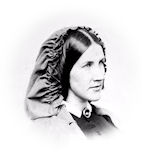
Post image for The opposition women nurses endured.—Woolsey family letters, Georgeanna, writing in 1864 of the annoyances of those first days in 1861.

“No one knows, who did not watch the thing from the beginning, how much opposition, how much how much unfeeling want of thought, these women nurses endured. Hardly a surgeon whom I can think of, received or treated them with even common courtesy. Government had decided that women should be employed, and the army surgeons—unable, therefore, to close the hospitals against them—determined to make their lives so unbearable that they should be forced in self-defence to leave. It seemed a matter of cool calculation, just how much ill-mannered opposition would be requisite to break up the system.

Some of the bravest women I have ever known were among this first company of army nurses. They saw at once the position of affairs, the attitude assumed by the surgeons and the wall against which they were expected to break and scatter; and they set themselves to undermine the whole thing.

None of them were ‘strong-minded.’ Some of them were women of the truest refinement and culture; and day after day they quietly and patiently worked, doing, by order of the surgeon, things which not one of those gentlemen would have dared to ask of a woman whose male relative stood able and ready to defend her and report him. I have seen small white hands scrubbing floors, washing windows, and performing all menial offices. I have known women, delicately cared for at home, half fed in hospitals, hard worked day and night, and given, when sleep must be had, a wretched closet just large enough for a camp bed to stand in. I have known surgeons who purposely and ingeniously arranged these inconveniences with the avowed intention of driving away all women from their hospitals.

These annoyances could not have been endured by the nurses but for the knowledge that they were pioneers, who were, if possible, to gain standing ground for others,—who must create the position they wished to occupy. This, and the infinite satisfaction of seeing from day to day sick and dying men comforted in their weary and dark hours, comforted as they never would have been but for these brave women, was enough to carry them through all and even more than they endured.

At last, the wall against which they were to break, began to totter; the surgeons were most unwilling to see it fall, but the knowledge that the faithful, gentle care of the women-nurses had saved the lives of many of their patients, and that a small rate of mortality, or remarkable recoveries in their hospitals, reflected credit immediately upon themselves, decided them to give way, here and there, and to make only a show of resistance. They could not do without the women-nurses; they knew it, and the women knew that they knew it, and so there came to be a tacit understanding about it.

When the war began, among the many subjects on which our minds presented an entire blank was that sublime, unfathomed mystery ‘Professional Etiquette.’ Out of the army, in practice which calls itself ‘civil,’ the etiquette of the profession is a cold spectre, whose presence is felt everywhere, if not seen; but in the Medical Department of the Army, it was an absolute Bogie, which stood continually in one’s path, which showed its narrow, ugly face in camps and in hospitals, in offices and in wards; which put its cold paw on private benevolence, whenever benevolence was fool enough to permit it; which kept shirts from ragged men, and broth from hungry ones; an evil Regular Army Bogie, which in full knowledge of empty kitchens and exhausted ‘funds,’ quietly asserted that it had need of nothing, and politely bowed Philanthropy out into the cold.

All this I was profoundly ignorant of for the first few months of the war, and so innocently began my rounds with my little jelly pots and socks knit at home for the boys—when, suddenly, I met the Bogie;—and what a queer thing he was! It was a hot summer morning, not a breath of air coming in at the open windows—the hospital full of sick men, and the nurses all busy, so I sat by a soldier and fanned him through the long tedious hours. Poor man, he was dying, and so grateful to me, so afraid I should tire myself. I could have fanned him all day for the pleasure it was to help him, but the Bogie came in, and gave me a look of icy inquiry. My hand ought to have been paralysed at once, but somehow or other, it kept moving on with the fan in it, while I stupidly returned the Bogie’s stare.

Finding that I still lived, he quietly made his plan, left the room without saying a word, and in ten minutes afterward developed his tactics. He was a small Bogie—knowing what he wanted to do, but not quite brave enough to do it alone; so he got Miss Dix, who was on hand, to help him, and together, they brought all the weight of professional indignation to bear upon me. I ‘must leave immediately.’ Who was I, that I should bring myself and my presumptuous fan, without direct commission from the surgeon-general,’ into the hospital? ‘Not only must I leave at once, but I must never return.’

This was rather a blow, it must be confessed. The moment for action had arrived—I rapidly reviewed my position, notified myself that I was the Benevolent Public, and decided that the sick soldiers were, in some sort, the property of the B. P. Then I divulged my tactics. I informed the Bogies (how well that rhymes with Fogies) that I had ordered my carriage to return at such a hour, that the sun was hot, that I had no intention whatever of walking out in it, and that, in short, I had decided to remain. What there was in these simple facts, very quietly announced, to exorcise the demon, I am unable to say, but the gratifying result was that half an hour afterward Professional Etiquette made a most salutary repast off its own remarks; that I spent the remainder of the day where I was; that both the Bogies, singly, called the next morning to say—‘Please, sir, it wasn’t me, sir, —’twas the other boy, sir;’ and from that time the wards were all before me.”

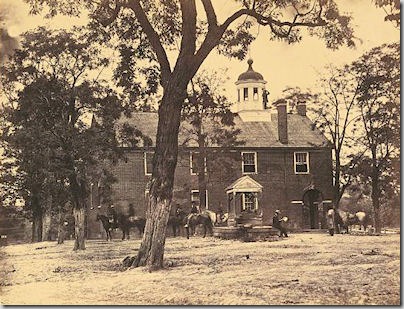
Faifax Court House—The advance column of the National army occupied Fairfax Court House, Va., at eleven o’clock to-day, meeting with no opposition from the Confederates either on the march or in taking possession of the place. Trees had been felled across the road and preparations made at one point for a battery, but there were no guns or troops on the route. The Confederates were drawn up beyond the town and a battle was expected, but as the National forces pressed on they retreated. The cavalry followed them some miles toward Centreville, but the heat of the weather and the previous long march prevented the infantry following. The abandonment of the village by the Confederates was so sudden that they left behind them some portions of their provisions, intrenching tools, and camp furniture. The army advances in three columns, one on the Fairfax road, and the others to the north and south of the road. The advance will be continued to Centreville, eight miles beyond Fairfax, where the Confederates will probably make a stand if they design attempting to hold Manassas Junction. The only casualties reported by Gen McDowell are an officer and three men slightly wounded.—(Doc. 98.)
—The Sixth Regiment of Maine volunteers, commanded by Colonel Abner Knowles, left Portland for the seat of war. The regiment, which has been recruited mainly from the counties of Washington and Penobscot, consists mostly of stout, hardy lumbermen, already inured to hard work and apparently ready for more. Many of the privates measure six feet four. They are uniformed in a similar manner to the other Maine regiments. Each man has an extra fatigue uniform, consisting of gray pants and shirt, presented to them by various sewing societies. Surgeon-General Garcelon, of Maine, accompanies the regiment to Washington.—Boston Post, July 18.

—The following order relative to contraband negroes was issued from the army head-quarters in Washington:

Head-quarters Department of Washington,

Washington, D. C., July 17, 1861

mansfield_jkf

General Orders No. 33.

Fugitive slaves will, under no pretest whatever, be permitted to reside, or in any way be harbored in the quarters and camps of the troops serving in this department. Neither will such slaves be allowed to accompany troops on the march. Commanders of troops will be held responsible for a strict observance of the order.

By command of Brigadier-General Mansfield.

Theodore Talbot,

Assistant Adjutant-General.

—General Patterson’s entire command moved from Bunker Hill, Va., at an early hour this morning, but instead of moving directly towards Winchester it took the road for Charlestown, distant from Bunker Hill about eight miles, and laying at right angles with the Winchester road. The reason of this unexpected move is as follows: Winchester is defended on the north side by a strong breastwork, in the form of the letter V, having the town behind the angle. It cannot be attacked from that side without exposing the soldiers to a heavy and most destructive cross-fire. The side west of the town is defended by a palisade; but the east aide is only covered by a veil. On the east side there is also an eminence which commands the town. This eminence has been left unoccupied.—Baltimore American, July 18.

—The Twelfth Ohio Regiment, two companies of the Twenty-first Ohio and a battery of light artillery, attacked the rebels at a place called Scarytown, on the Kanawha River, Va., and were repulsed with a loss of thirty killed and wounded.—(Doc. 99.)

Post image for William Howard Russell’s Diary: The “State House” at Annapolis.—Washington.

July 19th. (probably 16th, based on sequence in book and events)—I baffled many curious and civil citizens by breakfasting in my room, where I remained writing till late in the day. In the afternoon I walked to the State House. The hall door was open, but the rooms were closed; and I remained in the hall, which is graced by two indifferent huge statues of Law and Justice holding gas lamps, and by an old rusty cannon, dug out of the river, and supposed to have belonged to the original British colonists, whilst an officer whom I met in the portico went to look for the porter and the keys. Whether he succeeded I cannot say, for after waiting some half hour I was warned by my watch that it was time to get ready for the train, which started at 4·15 P.M.. The country through which the single line of rail passes is very hilly, much wooded, little cultivated, cut up by water-courses and ravines. At the junction with the Washington line from Baltimore there is a strong guard thrown out from the camp near at hand. The officers, who had a mess in a little wayside inn on the line, invited me to rest till the train came up, and from them I heard that an advance had been actually ordered, and that if the “rebels” stood there would soon be a tall fight close to Washington. They were very cheery, hospitable fellows, and enjoyed their new mode of life amazingly. The men of the regiment to which they belonged were Germans, almost to a man. When the train came in I found it was full of soldiers, and I learned that three more heavy trains were to follow, in addition to four which had already passed laden with troops.

On arriving at the Washington platform, the first person I saw was General M’Dowell alone, looking anxiously into the carriages. He asked where I came from, and when he heard from Annapolis, inquired eagerly if I had seen two batteries of artillery— Barry’s and another—which he had ordered up, and was waiting for, but which had “gone astray.” I was surprised to find the General engaged on such duty, and took leave to say so. “Well, it is quite true, Mr. Russell; but I am obliged to look after them myself, as I have so small a staff, and they are all engaged out with my head-quarters. You are aware I have advanced? No! Well, you have just come in time, and I shall be happy, indeed, to take you with me. I have made arrangements for the correspondents of our papers to take the field under certain regulations, and I have suggested to them they should wear a white uniform, to indicate the purity of their character.” The General could hear nothing of his guns; his carriage was waiting, and I accepted his offer of a seat to my lodgings. Although he spoke confidently, he did not seem in good spirits. There was the greatest difficulty in finding out anything about the enemy. Beauregard was said to have advanced to Fairfax Court House, but he could not get any certain knowledge of the fact. “Can you not order a reconnaissance?” “Wait till you see the country. But even if it were as flat as Flanders, I have not an officer on whom I could depend for the work. They would fall into some trap, or bring on a general engagement when I did not seek it or desire it. I have no cavalry such as you work with in Europe.” I think he was not so much disposed to undervalue the Confederates as before, for he said they had selected a very strong position, and had made a regular levée en masse of the people of Virginia, as a proof of the energy and determination with which they were entering on the campaign.

As we parted the General gave me his photograph, and told me he expected to see me in a few days at his quarters, but that I would have plenty of time to get horses and servants, and such light equipage as I wanted, as there would be no engagement for several days. On arriving at my lodgings I sent to the livery stables to inquire after horses. None fit for the saddle to be had at any price. The sutlers, the cavalry, the mounted officers, had been purchasing up all the droves of horses which came to the markets. M’Dowell had barely extra mounts for his own use. And yet horses must be had; and, even provided with them, I must take the field without tent or servant, canteen or food—a waif to fortune.

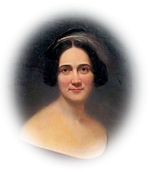
Post image for Mary Chesnut’s diary.—”As far as I can make out, Beauregard sent Mr. Chesnut to the President to gain permission for the forces of Joe Johnston and Beauregard to join, and, united, to push the enemy, if possible, over the Potomac…”

July 16th.—Dined to-day at the President’s table. Joe Davis, the nephew, asked me if I liked white port wine. I said I did not know; “all that I had ever known had been dark red.” So he poured me out a glass. I drank it, and it nearly burned up my mouth and throat. It was horrid, but I did not let him see how it annoyed me. I pretended to be glad that any one found me still young enough to play off a practical joke upon me. It was thirty years since I had thought of such a thing.

Met Colonel Baldwin in the drawing-room. He pointed significantly to his Confederate colonel’s buttons and gray coat. At the White Sulphur last summer he was a “Union man” to the last point. “How much have you changed besides your coat?” “I was always true to our country,” he said. “She leaves me no choice now.”

As far as I can make out, Beauregard sent Mr. Chesnut to the President to gain permission for the forces of Joe Johnston and Beauregard to join, and, united, to push the enemy, if possible, over the Potomac. Now every day we grow weaker and they stronger; so we had better give a telling blow at once. Already, we begin to cry out for more ammunition, and already the blockade is beginning to shut it all out.

A young Emory is here. His mother writes him to go back. Her Franklin blood certainly calls him with no uncertain sound to the Northern side, while his fatherland is wavering and undecided, split in half by factions. Mrs. Wigfall says he is half inclined to go. She wondered that he did not. With a father in the enemy’s army, he will always be “suspect” here, let the President and Mrs. Davis do for him what they will.

I did not know there was such a “bitter cry” left in me, but I wept my heart away to-day when my husband went off. Things do look so black. When he comes up here he rarely brings his body-servant, a negro man. Lawrence has charge of all Mr. Chesnut’s things—watch, clothes, and two or three hundred gold pieces that lie in the tray of his trunk. All these, papers, etc., he tells Lawrence to bring to me if anything happens to him. But I said: “Maybe he will pack off to the Yankees and freedom with all that.” “Fiddlesticks! He is not going to leave me for anybody else. After all, what can he ever be, better than he is now—a gentleman’s gentleman?” “He is within sound of the enemy’s guns, and when he gets to the other army he is free.” Maria said of Mr. Preston’s man: “What he want with anything more, ef he was free? Don’t he live just as well as Mars John do now?”

Mrs. McLane, Mrs. Joe Johnston, Mrs. Wigall, all came. I am sure so many clever women could divert a soul in extremis. The Hampton Legion all in a snarl—about, I forget what; standing on their dignity, I suppose. I have come to detest a man who says, “My own personal dignity and self-respect require.” I long to cry, “No need to respect yourself until you can make other people do it.”

Post image for A Diary of American Events – July 16, 1861

July 16.—The Union troops in Missouri had a fight with the rebels to-day, at a point called Millsville, on the North Missouri Railroad. The Union troops, consisting of eight hundred men, were fired into at that point, as they came up in a train of cars, and an engagement at once ensued. The number of the rebels is not known, but seven of their number were killed and several taken prisoners.—N. Y. Herald, July 18.

—The Third Massachusetts Regiment sails from Fortress Monroe for Boston this evening in the steamer Cambridge. They were reviewed by General Butler to-day.—The Sixth Massachusetts Regiment follows to-morrow.—Col. Max Leber’s and Col. Baker’s Regiments were to occupy Hampton, but the plan has been somewhat changed.—Brigadier-General Pierce returns with the Massachusetts Regiments.—Col. Duryea will be acting Brigadier General in Hampton.—Several companies went out from Newport News last night to surprise, if possible, a body of light horse, which have for some time hovered in the vicinity.—National Intelligencer, July 18.

—In the House of Representatives at Washington, the Committee on Commerce, in response to a resolution directing inquiry as to what measures are necessary to suppress privateering, and render the blockade of the rebel ports more effectual, reported a bill authorizing the Secretary of the Navy to hire, purchase, or contract for such vessels as may be necessary for a temporary increase of the navy, the vessels to be furnished with such ordnance, stores, and munitions of war as will enable them to render the most efficient service. According to the orders issued to their respective commands, the temporary appointments made of acting lieutenants, acting paymasters, acting surgeons, masters and masters’ mates, and the rates of pay for these officers heretofore designed, are, by this bill, legalized and approved.

For the purpose of carrying this act into effect to suppress piracy and render the blockade more effectual, three millions of dollars are appropriated. The bill was referred to the Committee on Naval Affairs.—A bill, authorizing the President to call out the militia to suppress rebellion, was passed unanimously.—The bill, authorizing the President to accept the services of five hundred thousand volunteers, was also passed.—The Senate’s amendments to the Loan bill were all concurred in.—A joint resolution, conveying the thanks of Congress to Major General George B. McClellan and the officers and soldiers under his command, for the recent brilliant victories over the rebels in Western Virginia, was unanimously adopted.

—Lieut. W. H. Free, of the Seventh Ohio Regiment, from a company enlisted in Perry County, Ohio, arrived at Columbus in that State with four Secessionists. Free, with twenty-five men, was conducting a transportation train from Ravenswood, Virginia, to Parkersburg. On Sunday last, he stopped at a farm-house to bait the horses. He immediately found that the women of the house sympathized with Secession. The farmer was absent. Thinking he might learn some facts of importance, ho assured the women that he was an officer from Wise’s brigade. At first they distrusted him, but at length gave him their confidence, and treated him very kindly. He learned that the farmer would be at home at night. About ten o’clock he came. Free soon gained his confidence, and was told that a meeting had been arranged at a neighboring house for the purpose of planning an attack upon Union men. Free pretending to need a guide to show him the way to Wise’s camp, the farmer, named Fred. Kizer, sent for some of his neighbors. Three of them came, one of whom was recommended as a guide. Free became satisfied from their conversation that they intended harm to Coleman and Smith, Union men, who had been influential, and at a concerted signal called his men around him, and declared himself an officer of the United States army. Instantly Kizer and his rebel friends were seized. The Lieutenant immediately ordered a march, and the next morning delivered his prisoners to Captain Stinchcomb, at Parkersburg, who sent him with three guards to Columbus. The names of the prisoners are Frederick Kizer, David H. Young, John W. Wigal, and John H. Lockwood.—Cincinnati Gazette, July 17.


—In the Senate of the United States, John 0. Breckenridge, of Kentucky, in an elaborate speech, opposed the resolution approving the acts of the President in suppressing the Southern rebellion. He rehearsed the old arguments against the right of the Government to put down rebellion, and in the course of his remarks, took occasion to deny positively that he had ever telegraphed to Jeff. Davis that President Lincoln’s Congress would not be allowed to meet in Washington on the 4th of July, or that Kentucky would furnish 7,000 armed men for the rebel army.—(Doc. 94.)

—It is doubtful, says the National Intelligencer of this date, whether, since the days of Peter the Hermit, the world has seen such an uprising, at the bidding of a sentiment, as this country has exhibited in the last ninety days. Perhaps the magnitude of the effort is best appreciated by observing what has been done by single States of the Confederacy. And to illustrate this, we need not even adduce the exertions of sovereignties dating back to Revolutionary days, as New York, Pennsylvania, and Massachusetts. Younger members of the Confederacy, States that half a century since had no existence, contribute singly no inconsiderable army to the assembling forces of the Union. Let us instance one of these, which recent events in Western Virginia have brought favorably and prominently forward—Indiana, forty-five years ago a frontier Territory, where the red man still contended with the white pioneer. Indiana has equipped, and is equipping for the General Government, a force such as has decided ere now the fate of a nation—twenty-three regiments, a volunteer army of more than twenty thousand infantry and twelve hundred cavalry; and these she has not only uniformed and accoutred, but partially armed with the improved rifle of the day, meanwhile at her own expense.

This is no isolated example. Others have done as well. If the power of a sentiment is to be estimated by the deeds it prompts, how strong must be the love of the Union in the hearts of its citizens!

—The Federal army in Virginia to-day took up the line of march for Fairfax and Manassas. The force standing to-day is fully 60,000 strong, the number reaching by actual count about 68,000. These are about 3,000 regular infantry, cavalry, and artillery, and 50,000 volunteers. The two Rhode Island, the 71st New York, and the 2d New Hampshire, comprising Colonel Burnside’s brigade, left Washington at 4 o’clock this afternoon, and struck the road for Fairfax Court House. The 27th New York went over at 6 o’clock, and also took the Fairfax route. As soon as these regiments came together and passed the encampment, the soldiers cheered lustily and shouted congratulations to each other that they were fairly on the road to the rebel capital. The Dekalb Regiment passed over the bridge and went into Camp Runyon.—(Doc. 97.)

Post image for “Who wouldn’t be a nuss”—Woolsey family letters, Harriet Roosevelt Woolsey to Georgeanna and Eliza.

New York, Monday, July 15, 1861.

My dear Girls: I might as well give you the benefit of a scrawl just to thank you for the big yellow envelope in Georgy’s handwriting lying on the library table by me. It has just come and I think you are two of the luckiest fellows living to be where you are, down in the very thick of it all, with war secrets going on in the next tent and telegraph-wires twitching with important dispatches just outside of your door. “Who wouldn’t be a nuss” under such circumstances? or would you prefer staying at home to arrange flowers, entertain P. in the evenings, devise a trimming for the dress Gonden is making for you, and go off into the country to fold your hands and do nothing? I tell you, Georgy, you are a happy creature and ought to be thankful. Jane and Abby have been in Astoria all the week. It was a triumph of ours to make Abby loosen her hold of those abominable old women of the widow’s society. She won’t get back to them for some time either. . . . Mother and I went up to Northampton, Mass., one evening last week to look up summer quarters. We went via New Haven by the 11 o’clock boat. Charley saw us on board and we got to bed about twelve. Quite a good night for a boat. Mother says she slept well, and was prime for a walk over to the depot before breakfast the next morning. She is certainly made of more enduring material than the rest of us, and, after getting through our business, wanted to come back in the express train at 5.30 that evening. Mr. Frank Bond and Mr. Thomas Denny spent the other evening here. F. B. is going on to Washington very soon, and is to be with General Tyler, something or other to him, and charged me when I wrote to let you know he was coming, and renewed his invitation to you to accompany them into Virginia as chief surgeon!

Mary has cut Bertha’s hair square across her forehead, which makes her look more sinful and unregenerate than ever. Polly has had her’s cut, and is more comfortable. Did Robert mention the box of old wine for General Scott, from Uncle E.? Think how glorious a part to take—propping up the government with rare old wine from one’s own cellar.”

Post image for Tribulation.—”‘Indeed,’ I burst out, forgetting my resolution not to argue…”—War Diary of a Union Woman in the South.

July 15, 1861.—The quiet of midsummer reigns, but ripples of excitement break around us as the papers tell of skirmishes and attacks here and there in Virginia. “Rich Mountain” and “Carrick’s Ford” were the last. “You see,” said Mrs. D. at breakfast to-day, “my prophecy is coming true that Virginia will be the seat of war.” “Indeed,” I burst out, forgetting my resolution not to argue, “you may think yourselves lucky if this war turns out to have any seat in particular.”

So far, no one especially connected with me has gone to fight. How glad I am for his mother’s sake that Rob’s lameness will keep him at home. Mr. F., Mr. S., and Uncle Ralph are beyond the age for active service, and Edith says Mr. D. can’t go now. She is very enthusiastic about other people’s husbands being enrolled, and regrets that her Alex is not strong enough to defend his country and his rights.

______

Note: To protect Mrs. Miller’s job as a teacher in New Orleans, the diary was published anonymously, edited by G. W. Cable, names were changed and initials were often used instead of full names — and even the initials differed from the real person’s initials.

Post image for Rebel War Clerk.—More War Office petty politics.

JULY 15TH. —Early this morning, Major Tyler was seated in the Secretary’s chair, prepared to receive the visitors. This, I suppose, was of course in pursuance of the Secretary’s request; and accordingly the door-keeper ushered in the people. But not long after Col. Bledsoe arrived, and exhibited to me an order from the President for him to act as Secretary of War pro tem. The colonel was in high spirits, and full dress; and seemed in no measure piqued at Major Tyler for occupying the Secretary’s chair. The Secretary must have been aware that the colonel was to act during his absence but, probably, supposed it proper that the major, from his suavity of manners, was best qualified for the reception of the visitors. He had been longer in the department, and was more familiar with the routine of business. Yet the colonel was not satisfied; and accordingly requested me to intimate the fact to Major Tyler, of which, it seemed, he had no previous information, that the President had appointed Col. Bledsoe to act as Secretary of War during the absence of Mr. Walker. The major retired from the office immediately, relinquishing his post with grace.

—General Patterson’s division, in its advance upon Winchester, Va., had a very brilliant skirmish to-day with the rebels near Bunker Hill, about nine miles from Martinsburg. The Rhode Island battery and the Twenty-first and Twenty-third Pennsylvania Regiments headed the advancing column, supported by the Second United Cavalry, under Colonel Thomas. When near Bunker Hill the rebel cavalry, 600 strong, under Colonel Stuart, charged the United States infantry, not perceiving the battery behind them. The infantry at once opened their lines, and the Rhode Island artillery poured in a discharge of grape and shell that sent the rebel cavalry reeling back. The United States cavalry then charged and pursued them for two miles, until they were entirely routed.—(Doc. 92.)

—Brig.-Gen. Hurlbut issued a proclamation to the citizens of Northeastern Missouri, denouncing the false and designing men who are seeking to overthrow the Government. He warns them that the time for tolerating treason has passed, and that the man or body of men who venture to stand in defiance of the supreme authority of the Union, peril their lives in the attempt. He says the character of the resistance which has been made, is in strict conformity with the source from which it originated. Cowardly assassins watch for opportunities to murder, and become heroes among their associated band by slaughtering, by stealth, those whom openly they dare not meet. This system, hitherto unknown to civilized warfare, is the natural fruit which treason bears. The process of the criminal courts as administered in disaffected districts will not cure this system of assassination, but the stern and imperative demand of a military necessity, and the duty of self-protection, will furnish a sharp and decisive remedy in the justice of a court-martial—(Doc. 93.)

—A Peace Meeting was held at Nyack, Rockland Co., N. Y. Addresses were delivered, and resolutions were adopted, deprecating the present war.—(Doc. 96.)