Following the American Civil War Sesquicentennial with day by day writings of the time, currently 1863.

The American Civil War

May 12th. Mr. Forsyth had been good enough to invite me to an excursion down the Bay of Mobile, to the forts built by Uncle Sam and his French engineers to sink his Britishers—now turned by “C. S. A.” against the hated Stars and Stripes. The mayor and the principal merchants and many politicians — and are not all men politicians in America? — formed the party. If any judgment of men’s acts can be formed from their words, the Mobilites, who are the representatives of the third greatest port of the United States, will perish ere they submit to the Yankees and people of New York. I have now been in North Carolina, South Carolina, Georgia, Alabama, and in none of these great States have I found the least indication of the Union sentiment, or of the attachment for the Union which Mr. Seward always assumes to exist in the South. If there were any considerable amount of it, I was in a position as a neutral to have been aware of its existence.

Those who might have at one time opposed secession, have now bowed their heads to the majesty of the majority; and with the cowardice, which is the result of the irresponsible and cruel tyranny of the multitude, hasten to swell the cry of revolution. But the multitude are the law in the United States. “There’s a divinity doth hedge” the mob here, which is omnipotent and all good. The majority in each State determines its political status according to Southern views. The Northerners are endeavoring to maintain that the majority of the people in the mass of the States generally, shall regulate that point for each State individually and collectively. If there be any party in the Southern States which thinks such an attempt justifiable, it sits silent, and fearful, and hopeless in darkness and sorrow hid from the light of day. General Scott, who was a short time ago written of in the usual inflated style, to which respectable military mediocrity and success are entitled in the States, is now reviled by the Southern papers as an infamous hoary traitor and the like. If an officer prefers his allegiance to the United States’ flag, and remains in the Federal service after his State has gone out, his property is liable to confiscation by the State authorities, and his family and kindred are exposed to the gravest suspicion, and must prove their loyalty by extra zeal in the cause of secession.

Our merry company comprised naval and military officers in the service of the Confederate States, journalists, politicians, professional men, merchants, and not one of them had a word but of hate and execration for the North. The British and German settlers are quite as vehement as the natives in upholding States’ rights, and among the most ardent upholders of slavery are the Irish proprietors and mercantile classes.

The Bay of Mobile, which is about thirty miles long, with a breadth varying from three to seven miles, is formed by the outfall of the Alabama and of the Tombigbee river, and is shallow and dangerous, full of banks and trees, embedded in the sands; but all large vessels lie at the entrance between Fort Morgan and Fort Gaines, to the satisfaction of the masters, who are thus spared the trouble with their crews which occurs in the low haunts of a maritime town. The cotton is sent down in lighters, which employ many hands at high wages. The shores are low wooded, and are dotted here and there with pretty villas; but present no attractive scenery.

The sea breeze somewhat alleviated the fierceness of the sun, which was however too hot to be quite agreeable. Our steamer, crowded to the sponsons, made little way against the tide; but at length, after nearly four hours’ sail, we hauled up alongside a jetty at Fort Gaines, which is on the right hand or western exit of harbor, and would command, were it finished, the light draft channel; it is now merely a shell of masonry, but Colonel Hardee, who has charge of the defences of Mobile, told me that they would finish it speedily.

The Colonel is an agreeable, delicate-looking man, scarcely of middle age, and is well-known in the States as the author of “The Tactics,” which is, however, merely a translation of the French manual of arms. He does not appear to be possessed of any great energy or capacity, but is, no doubt, a respectable officer.

Upon landing we found a small body of men on guard in the fort. A few cannon of moderate caliber were mounted on the sand-hills and on the beach. We entered the unfinished work, and were received with a salute. The men felt difficulty in combining discipline with citizenship. They were “bored” with their sand-hill, and one of them asked me when I “thought them damned Yankees were coming. He wanted to touch off a few pills he knew would be good for their complaint.” I must say I could sympathize with the feelings of the young officer who said he would sooner have a day with the Lincolnites, than a week with the mosquitoes for which this locality is famous.

From Fort Gaines the steamer ran across to Fort Morgan, about three miles distant, passing in its way seven vessels, mostly British, at anchor, where hundreds may be seen, I am told, during the cotton season. This work has a formidable sea face, and may give great trouble to Uncle Sam, when he wants to visit his loving subjects in Mobile in his gunboats. It is the work of Bernard, I presume, and like most of his designs has a weak long base towards the land; but it is provided with a wet ditch and drawbridge, with demi lunes covering the curtains, and has a regular bastioned trace. It has one row of casemates, armed with 32 and 42-pounders. The barbette guns are 8-inch and 10-inch guns; the external works at the salients, are armed with howitzers and field pieces, and as we crossed the drawbridge, a salute was fired from a field battery, on a flanking bastion, in our honor.

Inside the work was crammed with men, some of whom slept in the casemates—others in tents in the parade grounds and enceinte of the fort. They were Alabama Volunteers, and as sturdy a lot of fellows as ever shouldered musket; dressed in homespun coarse grey suits, with blue and yellow worsted facings and stripes—to European eyes not very respectful to their officers, but very obedient, I am told, and very peremptorily ordered about as I heard.

There were 700 or 800 men in the work, and an undue proportion of officers, all of whom were introduced to the strangers in turn. The officers were a very gentlemanly, nice-looking set of young fellows, and several of them had just come over from Europe to take up arms for their State. I forget the name of the officer in command, though I cannot forget his courtesy, nor an excellent lunch he gave us in his casemate after a hot walk round the parapets, and some practice with solid shot from the barbette guns, which did not tend to make me think much of the greatly-be-praised Columbiads.

One of the officers named Maury, a relative of “deep-sea Maury,” struck me as an ingenious and clever officer; the utmost harmony, kindliness, and devotion to the cause prevailed among the garrison, from the chief down to the youngest ensign. In its present state the Fort would suffer exceedingly from a heavy bombardment—the magazines would be in danger, and the traverses are inadequate. All the barracks and wooden buildings should be destroyed if they wish to avoid the fate of Sumter.

On our cruise homewards, in the enjoyment of a cold dinner, we had the inevitable discussion of the Northern and Southern contest. Mr. Forsyth, the editor and proprietor of the “Mobile Register,” is impassioned for the cause, though he was not at one time considered a pure Southerner. There is difference of opinion relative to an attack on Washington. General St. George Cooke, commanding the army of Virginia on the Potomac, declares there is no intention of attacking it, or any place outside the limits of that free and sovereign State. But then the conduct of the Federal Government in Maryland is considered by the more fiery Southerners to justify the expulsion of “Lincoln and his Myrmidons,” “the Border Ruffians and Cassius M. Clay,” from the capital. Butler has seized on the Relay House, on the junction of the Baltimore and Ohio railroad, with the rail from Washington, and has displayed a good deal of vigor since his arrival at Annapolis. He is a democrat, and a celebrated criminal lawyer in Massachusetts. Troops are pouring into New York, and are preparing to attack Alexandria, on the Virginia side, below Washington and the Navy Yard, where a large Confederate flag is flying, which can be seen from the President’s windows in the White House.

There is a secret soreness even here at the small effect produced in England compared with what they anticipated by the attack on Sumter; but hopes are excited that Mr. Gregory, who was travelling through the States some time ago, will have a strong party to support his forthcoming motion for a recognition of the South. The next conflict which takes place will be more bloody than that at Sumter. The gladiators are approaching—Washington, Annapolis, Pennsylvania are military departments, each with a chief and Staff, to which is now added that of Ohio, under Major G. B. McClellan, Major General of Ohio Volunteers at Cincinnati. The authorities on each side are busy administering oaths of allegiance.

The harbor of Charleston is reported to be under blockade by the Niagara steam frigate, and a force of United States troops at St. Louis, Missouri, under Captain Lyon, has attacked and dispersed a body of State Militia under one Brigadier General Frost, to the intense indignation of all Mobile. The argument is, that Missouri gave up the St. Louis Arsenal to the United States Government, and could take it back if she pleased, and was certainly competent to prevent the United States troops stirring beyond the Arsenal.
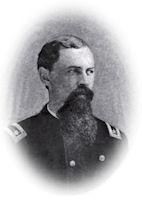
Sunday, May 12th, 6 p.m.

Several men from Alabama arrived here to-day with their backs beaten blue. We caught another spy last night. The drums rolled last night at 11 and we all turned out in the biggest, dark and deepest mud you ever saw. It was a mistake of the drummer’s. Six rockets were let off and he thought that they stood for an attack but they were only signals for steamboats. We thought sure we were attacked, but the boys took it cool as could be, and I think never men felt better over a prospect for a fight. Two hundred troops have landed since I commenced writing this time. Just now the clouds seem to be within 100 yards of the ground. Prospect of a tremendous storm. I am writing standing up in ranks for evening roll call.

Charles Francis Adams To His Mother

Fort Independence, May 12, 1861

The truth is that in garrison life, with guard duty three times in two weeks, five hours drill a day and the necessity of waiting on oneself, it is difficult either to write or read much in a room about the size of our bed-room in Boston in which eleven other men are quartered — that is live, eat and sleep — besides myself. Yet I like the life very much and am getting as rugged and hearty as an ox, passing all my time in eating, drilling, sleeping and chaffing. Our mess is made up of very good fellows indeed, all friends of mine, such men as Clark and Pratt, the two celebrated rowers, Tom Motley, Jr., Caspar Crowninshield, Fred d’Hauteville, etc. Our life is one of rigid garrison duty: reveille at half past five with breakfast at six; dress parade at seven; a squad drill at eight and a company drill at ten; at twelve dinner and at three a battalion drill which lasts until half past five, when we have an evening dress parade, which finishes work for those off guard for the day. At six we have tea and amuse ourselves till half past nine, when tattoo beats and we go to bed and after a little sky-larking quickly to sleep. When on guard, which every man is about twice a week, it is rather restless, as for twenty-four hours we are on guard two hours and off four, day and night, and properly can’t leave the guard room; but as our mess are especial friends of the sergeants rules are rather relaxed in our favor. Food is tolerable, coarse but enough, though devilish unclean at times. In our mess each man takes his turn in washing up the dishes and keeping the quarters of the mess clean. So once in ten days or so visitors see the best blood in America, in the person of your son, washing dishes, sweeping floors, wheeling coal, etc., like a family servant. Meanwhile health is superb and I never looked so browned and hearty in my life. . . .

Outside we hear a good deal of a raging military ardor. A good many young men we know are getting commissions, especially in Gordon’s regiment, and from our mess three men went up in one day, among them George R. Russell’s son Henry; but two of them came back, Hal only staying. Sam Quincy they say is a Captain. Elliot Parkman has a commission of some sort in the navy and Dick Goodwin, George Bangs, Rufus Choate, Greely and Pelham Curtis and others with Gordon. . . .

—The Boston Rifle Company, numbering seventy-two men, now at Washington, is armed with the Whitney rifle and sabre bayonet, and is a reliable body of soldiers. The officers are: Capt., A. Dodd; First Lieut., C. Dodd; Second Lieut., C. G. Atwood; Third Lieut., G. A. Hicks; Fourth Lieut., J. Nason. The uniform is light blue pants, red shirt, dark gray overcoat, and fatigue cap.—National Intelligencer, May 18.

—General Wm. S. Harney, commanding the military department of the West, at St. Louis, Mo., issued a proclamation declaring that the public peace must be preserved, and asking the people to return to their avocations, abstain from the excitement of heated discussions, and observe the laws of the local authorities.—(Doc. 156.)

—An attempt was made at night to destroy the Monocacy Bridge, three miles from Frederick, Md., by a party from Point of Rocks. They cut the wires in the telegraph office, and threatened to kill the operator if he resisted. They then went to the bridge, but could not set fire to it, as it is all iron and stone.—N. Y. Times, May 16.

—There was a grand review at York, Penn., to-day. The Governor and many members of the Legislature were present. There were five regiments on the ground.

An attempt was made to tear up the track of the Northern Central Railroad, fourteen miles North of Baltimore. It was detected before much injury was done.—N. Y. Times, May 18.

—The Connecticut Regiment, under the command of Colonel Alfred H. Terry, arrived at Washington.—(Doc. 157.)

—The New Orleans Picayune of to-day says:

“Books were opened yesterday at the Merchants’ Exchange for subscriptions to stock in a propeller steamer to be fitted out as a privateer. Fifty thousand dollars have already been subscribed, and fifty thousand more are required. A fine chance is now presented to our enterprising citizens to embark in a venture which cannot fail of yielding a handsome profit. The books will continue open in the back room of the Exchange, up stairs, until all the stock is taken.”

—The apportionment of the President’s call for seventy-five regiments for three years was published.—(Doc. 158.)

From the first moment of the firing on Fort Sumter Joseph Howland had felt that “solemn and compelling impulse” that forced men, almost in spite of themselves, into the service of the government. Making his decision quietly, seriously, he gave up the new home and all that it meant, and early in May, 1861, joined the Sixteenth New York Volunteers—a fine regiment from the northern counties of the state, then forming at Albany under the command of Colonel Thomas A. Davies,—into which he was mustered as Lieutenant and Adjutant.

Eliza Woolsey Howland to Mother.

May 11, 1861.

Dear Mother: Joe had a note from his Colonel last night requesting him to report himself at headquarters, 678 Broadway, on Wednesday of this week. This may be merely to take the oath, receive his commission, etc., but he will arrange matters to stay if required. He is now under orders and not his own master. It is generally known now that he is going, and hearty blessings and congratulations pour in upon him. He wrote to Uncle Edward and his sisters last night, and was busy till a very late hour settling business matters and explaining things to me. He goes off with rather a sad heart, but he feels that he is doing right, and I can give him nothing but encouragement. Our friends here have been most kind in their sympathy and in offers of service to me; and, as for me, if I can have all or any of you here I shall be very courageous. Don’t forget our big house in making your summer plans. I would rejoice in having you with me.

—A great Union demonstration took place in San Francisco, Cal. Nothing like it was ever seen there before. Business was totally suspended; all the men, women and children of the city were in the streets, and flags waved everywhere. Three stands for speakers were erected, and Senator Latham and McDougall, General Sumner, General Shields, and others addressed vast audiences. The spirit of all the addresses, as well as of the resolutions adopted, was: the Administration must be sustained in all its efforts to put down secession and preserve the Union complete.

A procession marched through the principal streets, composed of thousands of men on horseback, in carriages and on foot, and embracing all the military and civic organizations of the city. All political parties joined in the demonstration.—Alta Californian, May 12.

—The Savannah Republican of to-day says: “we have conversed with a gentleman who has just returned from the camp at Pensacola and brings the latest intelligence.

As details are not to be expected, we may state generally that the condition of the troops and fortifications is all that could be desired. Gen. Bragg has proved the very man for the work, and the volunteers lend a ready hand to carry out every order. Pickens is covered by our batteries on three sides. There are eight between the Navy-Yard and Fort Barrancas, four between the latter and the light-house, and a formidable mortar battery in the rear of Fort McRae. There is also a heavy mortar battery in the rear of Barrancas. All these works have been erected by the hands of the volunteers, and are armed with the very heaviest and best of artillery. The channel on a line between McRae and Pickens has been obstructed by sinking a number of small vessels. It was supposed that every thing would be complete by the middle of the coming week, after which we shall have a bombardment that will be worthy of record. Pickens must fall, and the more men they put in it the greater will be the destruction. Besides Pickens, the enemy have thrown up a battery on the island some five miles from the fort, which they are now engaged in arming for the struggle. Some hundred or more horses can be seen on the island, and seven ships of war and transports are lying off; something less than a mile from the shore.”

—The Fifth Regiment of N. Y. V. M. arrived at Washington from Annapolis, Md.—National Intelligencer, May 13.

—A large meeting took place at Wheeling, Va. Hon. John S. Carlile and Frank Pierpont spoke. Mr. Carlile took ground in favor of separation from Eastern Virginia, and was rapturously applauded. He proclaimed that while there should be no coercion to go out, there should be none to prevent remaining in the Union. Virginia, he said, owed forty-nine milions of dollars; a debt incurred without benefit to Western Virginia; and he demanded to know by what right the citizens of this section should not be allowed to have an opinion of their own expressed and recognized in the State councils, when the question of allegiance was discussed. Allegiance was first due to the Federal Government if there was no interference with State rights —N. Y. Times, May 12.

—The First Regiment of Pennsylvania Infantry, under command of Colonel Lewis, arrived at Washington.—N. Y. Tribune, May 12.

—This afternoon, a large body of the Home Guards entered St. Louis, Mo., through Fifth street, from the. Arsenal, where they had been enlisted during the day, and furnished with arms. On reaching Walnut street, the troops turned westward, a large crowd lining the pavement to witness their progress. At the corner of Fifth street the spectators began hooting, hissing, and otherwise abusing the companies as they passed, and a boy about fourteen years old discharged a pistol into their ranks. Part of the rear company immediately turned and fired upon the crowd, and the whole column was instantly in confusion, breaking their ranks, and discharging their muskets down their own line and among the people on the sidewalks. The shower of balls for a few minutes was terrible. Seven persons were killed, and a large number wounded. To allay the excitement and restore confidence to the people, Gen. Harney issued a proclamation to the people of St. Louis and the State, which was posted throughout the city, expressing deep regret at the state of things existing, pledging himself to do all in his power to preserve peace, and calling on the people and public authorities to aid him in the discharge of his duties. He says the military force under his command will only be used at the last extremity, and hopes be will not be compelled to resort to martial law, but simply states that the public peace must be preserved, and the lives of the people protected. He says he has no authority to change the location of the Home Guard quarters in the city, but to avoid all cause of circulation of the excitement, if called upon to aid the local authorities, will use the regular army in preference. In accordance with this proclamation, a battalion of regulars was sent to the city and placed under the direction of the Police Commissioners to act as a military police corps.—N. Y. Times, May 18.

—The United States Steam Frigate Niagara arrived off the bar of Charleston, S. C., and began the blockade of that port.—(Doc. 155.)

—Six companies of volunteers left Buffalo, N. Y., for the rendezvous at Elmira. Buffalo has so far sent to camp ten companies of volunteers.

The Third Company of the Broome Co. N. Y. Volunteers, under command of Captain Peter Jay, took their departure from Binghamton, N. Y., for Elmira. They were addressed by the Hon. Daniel S. Dickinson, Tracy R. Morgan, and others. They vowed to stand by the Constitution and the Union as long as one star remained.—N. Y. Times, May 12.

—Schooner G. M. Smith, prize to the frigate Cumberland, arrived at New York in charge of prize-master Thos. Chisholm.—Idem.

May 10, 1861.—I am tired and ashamed of myself. Last week I attended a meeting of the lint society to hand in the small contribution of linen I had been able to gather. We scraped lint till it was dark. A paper was shown, entitled the “Volunteer’s Friend,” started by the girls of the high school, and I was asked to help the girls with it. I positively declined. To-day I was pressed into service to make red flannel cartridge-bags for ten-inch columbiads. I basted while Mrs. S. sewed, and I felt ashamed to think that I had not the moral courage to say, “I don’t approve of your war and won’t help you, particularly in the murderous part of it.”

______

Note: To protect Mrs. Miller’s job as a teacher in New Orleans, the diary was published anonymously, edited by G. W. Cable, names were changed and initials were often used instead of full names — and even the initials differed from the real person’s initials.
Jane Stuart Woolsey to a Friend in Paris.

8 Brevoort Place, Friday, May 10, 1861.

I am sure you will like to hear what we are all about in these times of terrible excitement, though it seems almost impertinent to write just now. Everything is either too big or too little to put in a letter. Then one can’t help remembering sometimes that you are that august being, a “Tribune’s Own,” and as unapproachable on your professional pinnacle as the ornament of the Calendar whom Georgy will persist in calling Saint Simeon Stalactites. But the dampest damper to enthusiastic correspondents on this side is the reflection that what they write as radiant truth today may be “unaccountably turned into a lie” by the time it crosses the “big water.” So it will be best perhaps not to try to give you any of my own “views” except, indeed, such views of war as one may get out of a parlor window. Not, in passing, that I haven’t any! We all have views now, men, women and little boys,

“Children with drums

Strapped round them by the fond paternal ass,

Peripatetics with a blade of grass

Betwixt their thumbs,”—

from the modestly patriotic citizen who wears a postage stamp on his hat to the woman who walks in Broadway in that fearful object of contemplation, a “Union bonnet,” composed of alternate layers of red, white and blue, with streaming ribbons “of the first.” We all have our views of the war question and our plans of the coming campaign. An acquaintance the other day took her little child on some charitable errand through a dingy alley into a dirty, noisy, squalid tenement house. “Mamma,” said he, “isn’t this South Carolina?”

Inside the parlor windows the atmosphere has been very fluffy, since Sumter, with lint-making and the tearing of endless lengths of flannel and cotton bandages and cutting out of innumerable garments. How long it is since Sumter! I suppose it is because so much intense emotion has been crowded into the last two or three weeks, that the “time before Sumter” seems to belong to some dim antiquity. It seems as if we never were alive till now; never had a country till now. How could we ever have laughed at Fourth-of-Julys? Outside the parlor windows the city is gay and brilliant with excited crowds, the incessant movement and music of marching regiments and all the thousands of flags, big and little, which suddenly came fluttering out of every window and door and leaped from every church tower, house-top, staff and ship-mast. It seemed as if everyone had in mind to try and make some amends to it for those late grievous and bitter insults. You have heard how the enthusiasm has been deepening and widening from that time.

A friend asked an Ohio man the other day how the West was taking it. “The West? “ he said, “ the West is all one great Eagle-scream!” A New England man told us that at Concord the bells were rung and the President’s call read aloud on the village common. On the day but one after that reading, the Concord Regiment was marching into Fanueil Hall. Somebody in Washington asked a Massachusetts soldier: “How many more men of your state are coming?” “All of us,” was the answer. One of the wounded Lowell men crawled into a machine shop in Baltimore. An anti-Gorilla¹ citizen, seeing how young he was, asked, “What brought you here fighting, so far away from your home, my poor boy?” “It was the stars and stripes,” the dying voice said. Hundreds of such stories are told. Everybody knows one. You read many of them in the papers. In our own little circle of friends one mother has sent away an idolized son; another, two; another, four. One boy, just getting over diphtheria, jumps out of bed and buckles his knapsack on. One throws up his passage to Europe and takes up his “enfield.” One sweet young wife is packing a regulation valise for her husband today, and doesn’t let him see her cry. Another young wife is looking fearfully for news from Harper’s Ferry, where her husband is ordered. He told me a month ago, before Sumter, that no Northman could be found to fight against the South. One or two of our soldier friends are surgeons or officers, but most of them are in the ranks, and think no work too hard or too mean, so it is for The Flag. Captain Schuyler Hamilton was an aid of General Scott’s in Mexico, and saw service there, but he shouldered his musket and marched as a private with the Seventh. They wanted an officer when he got down there, and took him out of the ranks, but it was all the same to him; and so on, indefinitely.

The color is all taken out of the “Italian Question.” Garibaldi indeed! “Deliverer of Italy!” Every mother’s son of us is a “Deliverer.” We women regretfully “sit at home at ease” and only appease ourselves by doing the little we can with sewing machines and patent bandage-rollers. Georgy, Miss Sarah Woolsey and half a dozen other friends earnestly wish to join the Nurse Corps, but are under the required age. The rules are stringent, no doubt wisely so, and society just now presents the unprecedented spectacle of many women trying to make it believed that they are over thirty!

The Vermont boys passed through this morning, with the “strength of the hills” in their marching and the green sprigs in their button-holes. The other day I saw some companies they told me were from Maine. They looked like it — sun-browned swingers of great axes, horn-handed “breakers of the glebe,” used to wintering in the woods and getting frost-bitten and having their feet chopped off and conveying huge fleets of logs down spring-tide rivers in the snow and in the floods.— The sound of the drum is never out of our ears.

Never fancy that we are fearful or gloomy. We think we feel thoroughly that war is dreadful, especially war with the excitement off and the chill on, but there are so many worse things than gun-shot wounds! And among the worst is a hateful and hollow peace with such a crew as the “Montgomery mutineers.” There was a dark time just after the Baltimore murders, when communication with Washington was cut off and the people in power seemed to be doing nothing to re-establish it. It cleared up, however, in a few days, and now we don’t feel that the “social fabric”— I believe that is what it is called —is “falling to pieces” at all, but that it is getting gloriously mended. So, “Republicanism will wash”— is washed already in the water and the fire of this fresh baptism, “clothed in white samite, mystic, wonderful,” and has a new name, which is Patriotism.

_____

¹ That was the newspaper’s way of spelling “Guerilla.”

May 10.—Since writing last, I have been busy, very busy, arranging and rearranging. We are now hoping that Alexandria will not be a landing-place for the enemy, but that the forts will be attacked. In that case, they would certainly be repulsed, and we could stay quietly at home. To view the progress of events from any point will be sad enough, but it would be more bearable at our own home, and surrounded by our family and friends. With the supposition that we may remain, and that the ladies of the family at least may return to us, I am having the grounds put in order, and they are now so beautiful! Lilacs, crocuses, the lily of the valley, and other spring flowers, are in luxuriant bloom, and the roses in full bud. The greenhouse plants have been removed and grouped on the lawn, verbenas in bright bloom have been transplanted from the pit to the borders, and the grass seems unusually green after the late rains; the trees are in full leaf; every thing is so fresh and lovely. “All, save the spirit of man, is divine.”

War seems inevitable, and while I am trying to employ the passing hour, a cloud still hangs over us and all that surrounds us. For a long time before our society was so completely broken up, the ladies of Alexandria and all the surrounding country were busily employed sewing for our soldiers. Shirts, pants, jackets, and beds, of the heaviest material, have been made by the most delicate fingers. All ages, all conditions, meet now on one common platform. We must all work for our country. Our soldiers must be equipped. Our parlor was the rendezvous for our neighborhood, and our sewing-machine was in requisition for weeks. Scissors and needles were plied by all. The daily scene was most animated. The fires of our enthusiasm and patriotism were burning all the while to a degree which might have been consuming, but that our tongues served as safety valves. Oh, how we worked and talked, and excited each other! One common sentiment animated us all; no doubts, no fears were felt. We all have such entire reliance in the justice of our cause and the valor of our men, and, above all, on the blessing of Heaven! These meetings have necessarily ceased with us, as so few of any age or degree remain at home; but in Alexandria they are still kept up with great interest. We who are left here are trying to give the soldiers who are quartered in town comfort, by carrying them milk, butter, pies, cakes, etc. I went in yesterday to the barracks, with the carriage well filled with such things, and found many young friends quartered there. All are taking up arms; the first young men in the country are the most zealous. Alexandria is doing her duty nobly; so is Fairfax; and so, I hope, is the whole South. We are very weak in resources, but strong in stout hearts, zeal for the cause, and enthusiastic devotion to our beloved South; and while men are making a free-will offering of their life’s blood on the altar of their country, women must not be idle. We must do what we can for the comfort of our brave men. We must sew for them, knit for them, nurse the sick, keep up the faint-hearted, give them a word of encouragement in season and out of season. There is much for us to do, and we must do it. The embattled hosts of the North will have the whole world from which to draw their supplies; but if, as it seems but too probable, our ports are blockaded, we shall indeed be dependent on our own exertions, and great must those exertions be.

The Confederate flag waves from several points in Alexandria: from the Marshall House, the Market-house, and the several barracks. The peaceful, quiet old town looks quite warlike. I feel sometimes, when walking on King’s street, meeting men in uniform, passing companies of cavalry, hearing martial music, etc., that I must be in a dream. Oh that it were a dream, and that the last ten years of our country’s history were blotted out! Some of our old men are a little nervous, look doubtful, and talk of the impotency of the South. Oh, I feel utter scorn for such remarks. We must not admit weakness. Our soldiers do not think of weakness; they know that their hearts are strong, and their hands well skilled in the use of the rifle. Our country boys have been brought up on horseback, and hunting has ever been their holiday sport. Then why shall they feel weak? Their hearts feel strong when they think of the justice of their cause. In that is our hope.

Walked down this evening to see _____. The road looked lonely and deserted. Busy life has departed from our midst. We found Mrs. _____ packing up valuables. I have been doing the same ; but after they are packed, where are they to be sent? Silver may be buried, but what is to be done with books, pictures, etc.? We have determined, if we are obliged to go from home, to leave every thing in the care of the servants. They have promised to be faithful, and I believe they will be; but my hope becomes stronger and stronger that we may remain here, or may soon return if we go away. Every thing is so sad around us! We went to the Chapel on Sunday as usual, but it was grievous to see the change—the organ mute, the organist gone; the seats of the students of both institutions empty; but one or two members of each family to represent the absentees; the prayer for the President omitted. When Dr. _____ came to it, there was a slight pause, and then he went on to the next prayer—all seemed so strange! Tucker Conrad, one of the few students who is still here, raised the tunes; his voice seemed unusually sweet, because so sad. He was feebly supported by all who were not in tears. There was night service, but it rained, and I was not sorry that I could not go.

.—The Confederate Secretary of War invested R. E. Lee with the control of the rebel forces of Va., by the following order:

Mongomery, May 10, 1861.

To Major-Gen. R. E. Lee:
To prevent confusion, you will assume the control of the forces of the Confederate States in Virginia, and assign them to such duties as you may indicate, until further orders; for which this will be your authority.
…………..I. P. Walker, Secretary of War.
National Intelligencer, May 15.

—The Charleston News of this day contains the prayer of the Rev. James Bardwell, at the opening of the Tennessee Legislature on the 25th of April.—(Doc. 149.)

—In addition to the new Military Departments of Washington, Annapolis, and Pennsylvania, the States of Ohio, Indiana, and Illinois will constitute a fourth, subdivided into several others, to be called the Department of the Ohio. Major-General McClellan, Ohio Volunteers, is assigned to its command; headquarters, Cincinnati.

The President, by general orders, directs that all officers of the army, except those who have entered service since 1st April, take and subscribe anew the oath of allegiance to the United States, as set forth in the 10th article of war.—N. Y. Evening Post, May 11.

—The First Regiment of Vermont Volunteers, commanded by Colonel J. Wolcott Phelps, arrived at New York, and took up their quarters in the Park Barracks. This regiment consists of ten companies—77 men each—of hardy Green Mountain boys, whose stalwart frames and broad shoulders are the envy of all beholders. These ten companies were selected from four different regiments. The uniform of the regiment is of gray cloth, each man being supplied with a heavy overcoat of the same material. One or two companies have a blue uniform instead of the gray. Each man wears a hemlock sprig in his hat. They are all supplied with new Minié muskets, but have no ammunition.

The men are nearly all Vermonters, there being scarcely a dozen foreigners in the regiment. They are all esteemed citizens at home, and nearly every one abandoned a profitable business to give his strong arm to his country. They have been encamped at Rutland, Vt., for the past eight days, completing their outfit, and when they came to strike their tents and take up the line of march, not a man was on the sick list. Their destination is Fort Monroe.

The character of the Green Mountain boys may be illustrated by the following incident: As the cars were leaving their camp-ground in Rutland, on the morning of the 9th instant, a private, in response to the cheers of the people, said: “The Vermont Regiment, citizens in peace, soldiers in war, give you the sentiment embodied in the charge of the Grecian matron to her son—We will bring back our shields or be brought back upon them.”—(Doc. 150.)

—The Protestant Episcopal Diocese of Alabama adopted the following ordinance:

“Whereas, the Constitution of the Diocese of Alabama was adopted when the said Diocese actually was, on the presumption of its continuing to be, a part of the Protestant Episcopal Church in the United States;’

“And whereas, the State of Alabama is no longer a part of the United States:

“Therefore, it is hereby declared by this convention that the first article of the constitution of the Diocese, with all those canons, or portion of canons, dependent upon it, are null and void.

“It is furthermore declared that all canons, or portions of canons, both diocesan and general, not necessarily dependent upon the recognition of the authority of the Church in the United States, are hereby retained in force.

“This declaration is not to be construed as affecting faith, doctrine or communion.”—N. O. Picayune, May 12.

—President Lincoln issued a proclamation directing the commander of the forces of the United States on the Florida coast to permit no person to exercise any office or authority upon the islands of Key West, the Tortugas, and Santa Rosa, which may be inconsistent with the laws and Constitution of the United States, authorizing him at the same time, if he shall find it necessary, to suspend there the writ of habeas corpus, and to remove from the vicinity of the United States fortresses all dangerous or suspected persons.—(Doc. 151.)

—Captain Tyler, of the Second Dragoons, commanding at Fort Kearney, fearing that a mob might take and turn against the garrison the ten twelve-pounder howitzers in his possession, spiked them. He had received orders to remove the pieces to Fort Leavenworth, but thought it unsafe to do so in the distracted state of the country. Threats had been made to take them from him—N. Y. Sun, May 14.

—The Second Regiment of Connecticut Volunteers, Colonel Terry, embarked from New Haven for Washington, on the steamer Cahawba. They marched down Chapel street, escorted by a large body of citizens, cavalry, a body of old New Haven Grays, and by the Emmot Guard—making a very fine appearance. The whole city was alive with people, and the route of the procession was a grand array of flags.—N. Y. Evening Post, May 11.

—The London News publishes an interesting article on the difficulties in the United States, and endeavors to indicate the position which the States under Jefferson Davis now occupy with relation to those under President Lincoln, and the status which both portions of the country now hold with relation to Great Britain and the rest of the world.—(Doc. 152.)

—The steamer Pembroke sailed from Boston, Mass., for Fort Monroe, with reinforcements, including Capt. Tyler’s Boston Volunteers, and a company from Lynn, under Capt. Chamber  —N. Y. World, May 11.

—The Winans steam-gun was captured this morning. A wagon, containing a suspicious-looking box and three men, was observed going out on the Frederick road from Baltimore, and the fact being communicated to General Butler, at the Relay House, he despatched a scouting party in pursuit, who overtook the wagon six miles beyond the Relay House, at Ilchester. On examination it was found that the box contained the steam-gun. It was being taken to Harper’s Ferry. The soldiers brought the gun and the three men back to the Relay House. The prisoners, one of whom was Dickenson, the inventor of the gun, were sent to Annapolis.— Baltimore American, May 11.

—The Diocesan Convention of Massachusetts passed resolutions in regard to the present state of affairs. One of them is as follows:—

Resolved, That the convention of clerical and lay delegates of the Protestant Episcopal Church in the diocese of Massachusetts do hereby express their heartfelt sympathy with the National Government in all right efforts to vindicate the authority of the Federal Union against “all sedition, privy conspiracy, and rebellion.”—Boston Advertiser, May 11.

—The Maryland Legislature passed a resolution, imploring the President of the United States to cease the present war.—(Doc. 153.)

—At about 2 P. M., a sudden movement was made by the U. S. forces in St. Louis under Capt. Lyon, upon Camp Jackson, near that city, by which the camp was entirely surrounded in less than half an hour, and compelled to an unconditional surrender. A great mob followed the U. S. troops to the camp, and began a noisy demonstration against them, and to throw stones. One company received the order to fire, and did so. Twenty-two persons were killed, and many were wounded. The mob then dispersed. A large quantity of arms and munitions were taken in the camp, together with 689 prisoners.—(Doc. 154.)