Following the American Civil War Sesquicentennial with day by day writings of the time, currently 1863.

The American Civil War

—A large Union meeting was held at Kingwood, Preston county, Va., when resolutions were adopted expressing unalterable opposition to the ordinance of secession, favoring a division of the State, and resolving to vote for a delegate to the next session of Congress.—National Intelligencer, May 11.

—Commodore Charles Stewart, of the United States Navy, addressed a letter to George W. Childs of Philadelphia, furnishing him with the reminiscences of a conversation which passed between Com. Stewart and John C. Calhoun, in the year 1812, after the declaration of war against Great Britain by the Congress of the United States.—(Doc. 132.)

—The artists of New York met at the rooms of Messrs. Kensett and Lang in that city. Mr. D. Huntingdon was called to the chair. Messrs. Kensett, Gray, and Lang embodied resolutions which were adopted by those present, expressing their desire to contribute to the relief of families of volunteers of the city of New York who are now serving in defence of government and law, and resolving that a committee be appointed to solicit contributions of pictures or other works of art, to be disposed of at public auction; said committee to have power, also, to receive moneys presented in aid of the fund. Messrs. Gray, Lang, Hubbard, Huntington, Stone, and Baker were named the committee, with full power to forward the plan proposed. —N. Y. Evening Post, May 7.

—The Ithaca (N. Y.) volunteers arrived in New York on their way to the seat of war. They number one hundred and fifteen men, and are commanded by the following officers:—Captain, Jerome Rowe; First Lieutenant, James Tischner; Ensign, William O. Wyckoff; Orderly Sergeant, William Godley; Second Sergeant, Edwin C. Fulkenson; Third do., Edward Atwater; Fourth do., Dr. Tolbo; First Corporal, Leonard Atwater; Second do., Clinton McGill; Third do., James A. Dickinson; Fourth do., George Shepherd.—N. Y. Herald, May 5.

—The Onondaga Regiment left Syracuse, N. Y., for Elmira. This is the first regiment organized under the new Volunteer bill of the State of New York. Ten full companies presented their muster-rolls to the Adjutant-General, not merely full, but with an excess of nearly one hundred men.—N. Y. Tribune, May 5.

—The New Orleans Delta of to-day contains a full account of the numbers and condition of the rebel troops and defences in the vicinity of Fort Pickens; from which it appears that Gen. Bragg has under his command an army of over six thousand fighting men, besides a large force of laborers, sailors, and marines.—(Doc. 133.)

—The Buena Vista Volunteers, from Philadelphia, Captain Powers, arrived at New York. They are to join Col D. E. Sickles’s regiment. These are men who went unarmed to Baltimore, and fought the Gorillas with their fists.— N. Y. Tribune, May 5.

—The Phoenix Ironworks at Gretna, opposite Lafayette, New Orleans, cast the first gun for the Confederate Navy. It is an eight-inch Dahlgren shell, and has eight feet six inches bore.

The steamship Star of the West was put in commission as the receiving ship of the Confederate States Navy at New Orleans. She is stationed at the navy yard at Algiers, under the temporary command of Midshipman Comstock, for receiving sailors and marines now being enlisted for the navy.—N. O. Picayune, May 5.

—A committee of the Maryland Legislature held an interview with President Lincoln. They admitted both the right and the power of the government to bring troops through Baltimore or the State, and to take any measures for the public safety which, in the discretion of the President, might be demanded either by actual or reasonably apprehended exigencies. They expressed their belief that no immediate effort at secession or resistance of the federal authority would be attempted by the Legislature or State authorities, and asked that, in this view, the State should, as long as possible, be spared the evils of a military occupation or a mere revengeful chastisement for former transgressions. The President replied that their suggestions and representations should be considered, but that he should now say no more than that the public interests, and not any spirit of revenge, would actuate his measures—N. Y. Herald, May 5.

—A Union meeting was held at Wheeling, Va, Hon. Frank Pierpont, of Mason county, and George M. Porter, late member of the convention, addressed the people in able speeches, urging resistance to the secession ordinance, ad favoring the division of the State. Resolutions were adopted approving the action of the merchants in refusing to pay taxes to the authorities at Richmond, denunciatory of the secession ordinance, and declaring adhesion to the stars and stripes.—Boston Transcript, May 8.

—The American flag was displayed from the tower of the First Baptist Church in Broome street, New York, with appropriate ceremonies. A large concourse of people listened to stirring speeches by President Eaton, of Madison University, Rev. Dr. Armitage, Rev. Mr. Webber, of Rochester, and Hon. W. D. Murphy, of the Oliver street church.

Dr. Armitage referred to the fact that the pastors of this First Baptist Church (a church which has existed more than a century) had all been noted for their zealous patriotism. One of the most eminent of them—Spencer H. Cone—had, in the war of 1812, himself gallantly defended that emblem of civil and religious liberty, the stars and stripes, at Fort McHenry; and at this moment members of this church are in the camp, equally ready to defend it against all aggression. No free government or constitutional liberty have ever been secured or perpetuated by any nation without the seal of its own blood. If the liberties thus purchased for us by our fathers, and the government which they founded—the best the world has ever seen—are to be insulted and trampled upon, shall we not strike down the traitor, even though he be one of the family—even though he be our own brother?

“I too,” said Dr. Eaton, “am emphatically a man of peace, for I am a minister of the gospel of the Prince of Peace; but in this crisis, my friends, it is my firm conviction that the best and surest way to perpetuate the blessing is promptly to send down, if need be, half a million of men to those seditious brethren of ours, and compel them to keep the peace. We cherish no malice against them—God forbid. But their traitorous hands are now clutching the very life of our body politic, and we must use prompt and vigorous action in defence of our very national existence.”—N. Y. Evening Post, May 7.
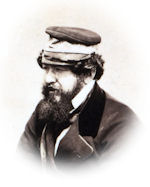
May 3rd.—I bade good-by to Mr. Green, who with several of his friends came down to see me off, at the terminus or “depȏt” of the Central Railway, on my way to Montgomery—and looked my last on Savannah, its squares and leafy streets, its churches, and institutes with a feeling of regret that I could not see more of them, and that I was forced to be content with the outer aspect of the public buildings. I had been serenaded and invited out in all directions, asked to visit plantations and big trees, to make excursions to famous or beautiful spots, and specially warned not to leave the State without visiting the mountain district in the northern and western portion; but the march of events called me to Montgomery.

From Savannah to Macon, 191 miles, the road passes through level country only partially cleared. That is, there are patches of forest still intruding on the green fields, where the jagged black teeth of the destroyed trees rise from above the maize and cotton. There were but few negroes visible at work, nor did the land appear rich, but I was told the rail was laid along the most barren part of the country. The Indians had roamed in these woods little more than twenty years ago—now the wooden huts of the planters’ slaves and the larger edifice with its verandah and timber colonnade stood in the place of their wigwam.

Among the passengers to whom I was introduced was the Bishop of Georgia, the Rev. Mr. Elliott, a man of exceeding fine presence, of great stature, and handsome face, with a manner easy and graceful, but we got on the unfortunate subject of slavery, and I rather revolted at hearing a Christian prelate advocating the institution on scriptural grounds.

This affectation of Biblical sanction and ordinance as the basis of slavery was not new to me, though it is not much known at the other side of the Atlantic. I had read in a work on slavery, that it was permitted by both the Scriptures and the Constitution of the United States, and that it must, therefore, be doubly right. A nation that could approve of such interpretations of the Scriptures and at the same time read the “New York Herald,” seemed ripe for destruction as a corporate existence. The malum prohibitum was the only evil its crass senses could detect, and the malum per se was its good, if it only came covered with cotton or gold. The miserable sophists who expose themselves to the contempt of the world by their paltry thesicles on the divine origin and uses of slavery, are infinitely more contemptible than the wretched bigots who published themes long ago on the propriety of burning witches, or on the necessity for the offices of the Inquisition.

Whenever the Southern Confederacy shall achieve its independence — no matter what its resources, its allies, or its aims —it will have to stand face to face with civilized Europe on this question of slavery, and the strength which it derived from the ægis of the Constitution — “the league with the devil and covenant with Hell” — will be withered and gone.

I am well aware of the danger of drawing summary conclusions off-hand from the windows of a railway, but there is also a right of sight which exists under all circumstances, and so one can determine if a man’s face be dirty as well from a glance as if he inspected it for half an hour. For instance, no one can doubt the evidence of his senses, when he sees from the windows of the carriages that the children are barefooted, shoeless, stockingless — that the people who congregate at the wooden huts and grog-shops of the stations are rude, unkempt, but great fighting material, too — that the villages are miserable places, compared with the trim, snug settlements one saw in New Jersey from the carriage windows. Slaves in the fields looked happy enough — but their masters certainly were rough looking and uncivilized — and the land was but badly cleared. But then we were traversing the least fertile portions of the State — a recent acquirement — gained only one generation since.

The train halted at a snug little wood-embowered restaurant, surrounded by trellis and lattice-work, and in the midst of a pretty garden, which presented a marked contrast to the “surroundings” we had seen. The dinner, served by slaves, was good of its kind, and the charge not high. On tendering the landlord a piece of gold for payment, he looked at it with disgust, and asked, “Have you no Charleston money? No Confederate notes?” “Well, no! Why do you object to gold?” “Well, do you see, I’d rather have our own paper! I don’t care to take any of the United States gold. I don’t want their stars and their eagles; I hate the sight of them.” The man was quite sincere — my companion gave him notes of some South Carolina bank.

It was dark when the train reached Macon, one of the principal cities of the State. We drove to the best hotel, but the regular time for dinner hour was over, and that for supper not yet come. The landlord directed us to a subterranean restaurant, in which were a series of crypts closed in by dirty curtains, where we made a very extraordinary repast, served by a half-clad little negress, who watched us at the meal with great interest through the curtains — the service was of the coarsest description; thick French earthenware, the spoons of pewter, the knives and forks steel or iron, with scarce a pretext of being cleaned. On the doors were the usual warnings against pickpockets, and the customary internal police regulations and ukases. Pickpockets and gamblers abound in American cities, and thrive greatly at the large hotels and the lines of railways.

Abby Howland Woolsey to Eliza Woolsey Howland

Friday.

Dear Eliza: We got off our first trunk of Hospital supplies for Colonel Mansfield Davies’ Regiment yesterday and feel today as if we were quite at leisure. You have no idea of the number of last things there were to do, or the different directions we had to go in, to do them. Mr. Davies came in at breakfast yesterday, in his regimentals, quite opportunely, to tell us what to do with the trunk. It went down to his headquarters at 564 Broadway and thence by steamer to Fort Schuyler for the sick soldiers there. Charley and Ned drove out there yesterday afternoon from Astoria to see the drill, and saw the box safely landed within the walls. It was the old black ark which you and G. had in Beyrout, Syria, marked with a capital H, which now answers for Hospital. There were in it as follows—for you may be curious to know:—

42 shirts,

2 drawers,

6 calico gowns,

24 pairs woolen socks, .

24 pairs slippers,

24 pocket handkerchiefs,

18 pillow sacks,

36 pillow-cases,

18 damask napkins,

36 towels,

24 sponges,

4 boxes of lint,

beside old linen, oiled silk, tape, thread, pins, scissors, wax, books (Hedley Vicars and the like), ribbon, cloth, etc., and fifty bandages.

This morning Mother has been putting up a tin box of stores for Mr. Davies — sardines, potted meats, arrow root, chocolate, guava and the like, with a box of cologne, a jar of prunes and a morocco case with knife, fork and spoon, fine steel and double plated, “ just out “ for army use. Lots more. The box, a square cracker box, holds as much in its way as the trunk. I am glad you are in the library at last. You will grow accustomed to it and find it pleasanter even than the dining-room.

—The American flag was elevated above the roof of the University at New York, by Captain Jones, late of Harper’s Ferry, amid the enthusiastic cheers of a large collection of people.

Dr. Bethune made some remarks, taking occasion to make a fitting allusion to Major Anderson and Fort Sumter, which were received with repeated and enthusiastic cheering. He had looked over ancient history for a parallel to this deed of valor, but found none. The bravery shown by the three hundred Spartans at the Pass of Thermopylae was well known; but there still was one coward among them. There was no coward among the men at Sumter. He had been present at a conversation with the gallant defender of the fort, when a gentleman remarked he regretted that the major had not blown up the fort, to which Major Anderson replied that it was better as it was. The ruined battlements and battle-scarred walls of Fort Sumter would be an everlasting shame and disgrace to the South Carolinians. At the conclusion of Dr. Bethune’s remarks the “Star-spangled Banner” was sung, all the audience rising to their feet and joining in the chorus. Col. Baker and Capt. Jones also made short addresses.—The World, May 4.

—Governor Letcher published a proclamation, saying that the sovereignty of the Commonwealth of Virginia having been denied, her territorial rights assailed, her soil threatened with invasion by the authorities of Washington, and every artifice employed which could inflame the people of the Northern States against her, it therefore becomes the solemn duty of every citizen of Virginia to prepare for the impending conflict.

To this end, and for these purposes, and with a determination to repel invasion, Governor Letcher authorizes the Commanding General of the military forces to call out, and cause to be mustered into service from time to time, as the public exigencies may require, such additional number of volunteers as he may deem necessary.—(Doc. 129.)

—The First Regiment, Colonel Johnson; the Second, Col Baker; the Third, Col. Napton; the Fourth, Col. Miller, of New Jersey Troops, with Brigadier-General Runyon and staff, left Bordentown for the seat of war, proceeding down the Delaware, via the Delaware and Chesapeake canal. The troops and stores are in a fleet of fourteen steam propellers, the W. Woodward, Henry Cadwalader, Octorora, Delaware, Raritan, Trenton, Patroon, F. W. Brune, Elizabeth, Franklin, Farmer, J. B. Molleson, Eureka, and Fanny Gardner.— World, May 4.

—Union Ward meetings were held to-night throughout Baltimore, Md., and resolutions were adopted to the following purport:—

That we cherish the Constitution and laws of the United States, and will devote our fortunes and lives to defend their integrity against all revolutionary or violent assaults; that we regret the violent attacks on the troops of the United States while peacefully marching through the city to protect the seat of Government, and indignantly repudiate making it a pretext to organize an armed mob, under the guise of a special police, to place the city in a hostile attitude to the General Government; declaring abhorrence at the attempt of the Legislature to inaugurate a military despotism by the bill for the creation of a Board of Public Safety; that the persons named for said Board have not the confidence of the people, and we protest against the whole measure as an invasion on the prerogatives of the Governor and a usurpation of the Executive power by the Legislature.—N. Y. Tribune, May 4.

—The following notice was issued at Pittsburg, Pa., to-day: Shippers of goods in New York are hereby notified that all packages found to contain guns, pistols, powder, and other articles contraband of war, destined for the Southern States, will not be permitted to pass the city of Pittsburg.
………..By order of the Committee,
………………..E. D. Gazzani, Chairman.
N. Y. Tribune, May 4.

—A letter was received at New York giving information of a design to burn that city, the supply of water to be cut off at the time the city was fired. Philadelphia and Boston were also to be burned.—(Doc. 130.)

—Fourteen companies of Kentuckians from the border counties tendered their services to the Secretary of War through Colonel T. V. Guthrie. Ten were accepted with orders to encamp on the Ohio side of the river.—Boston Transcript, May 4.

—The Connecticut legislature unanimously passed a bill appropriating $2,000,000 for the organization and equipment of a volunteer militia, and to provide for the public defence.—N. Y. Tribune, May 4.

—Governor Jackson of Missouri, in a message to the legislature of that State, says the President of the United States in calling out the troops to subdue the seceded States, has threatened civil war, and his act is unconstitutional and illegal, and tending towards consolidated despotism. While he evidently justifies the action of the Confederate States in seceding, he does not recommend immediate secession, but holds the following language:

“Our interest and sympathies are identical with those of the slaveholding States, and necessarily unite our destiny with theirs. The similarity of our social and political institutions, our industrial interests, our sympathies, habits, and tastes, our common origin, territorial contiguity, all concur in pointing out our duty in regard to the separation now taking place between the States of the old federal Union.” He further adds that “Missouri has at this time no war to prosecute. It is not her policy to make an aggression; but, in the present state of the country, she would be faithless to her honor, recreant to her duty, were she to hesitate a moment in making the most ample preparation for the protection of her people against the aggression of all assailants. I therefore recommend an appropriation of a sufficient sum of money to place the State at the earliest practicable moment in a complete state of defence.”

In conclusion he says: “Permit me to appeal to you and through you to the whole people of the State, to whom we are all responsible, to do nothing imprudent or precipitate. We have a most solemn duty to perform. Let us then calmly reason one with another, avoid all passion and tendency to tumult and disorder, obey implicitly the constituted authorities, and endeavor ultimately to unite all our citizens in a cordial cooperation for the preservation of our honor, the security of our property, and the performance of all those high duties imposed upon us by our obligations to our families, our country, and our God.”—Louisville Journal, May 4

—President Lincoln issued a proclamation calling into the service of the United States 42,000 volunteers for three years’ service, and directing the increase of the regular army and navy of the United States.—(Doc. 131.)

—Four companies of volunteers left Buffalo, N. Y., for the rendezvous at Elmira. They were escorted to the depot by the Home Guard. Major Millard Fillmore, Ex-President, commanding in person. The Home Guard is composed of retired commissioned officers of the State Militia, and is being thoroughly drilled by Major Fillmore. About 150 members are already enrolled.—N. Y. Tribune, May 4.

—Two associations of ladies of New Orleans were formed for aiding and equipping volunteers, and for making lint and bandages, and nursing the sick and wounded. The meetings were very large and enthusiastic.—Baltimore Sun, May 7th.

May 2nd.—Breakfasted with Mr. Hodgson, where I met Mr. Locke, Mr. Ward, Mr. Green and Mrs. Hodgson and her sister. There were in attendance some good-looking little negro boys and men dressed in liveries, which smacked of our host’s Orientalism, and they must have heard our discussion, or rather allusion, to the question which would decide whether we thought they are human beings or black two-legged cattle, with some interest, unless indeed the boast of their masters, that slavery elevates the character and civilizes the mind of a negro, is another of the false pretences on which the institution is rested by its advocates. The native African, poor wretch, avoids being carried into slavery totis viribus, and it would argue ill for the effect on his mind of becoming a slave if he prefers a piece of gaudy calico even to his loin-cloth and feather headdress. This question of civilizing the African in slavery is answered in the assertion of the slave-owners themselves, that if the negroes were left to their own devices by emancipation, they would become the worst sort of barbarians—a veritable Quasheedom, the like of which was never thought of by Mr. Thomas Carlyle. I doubt if the aboriginal is not as civilized, in the true sense of the word, as any negro, after three degrees of descent in servitude, whom I have seen on any of the plantations—even though the latter have leather shoes and fustian or cloth raiment, and felt hat, and sings about the Jordan. He is exempted from any bloody raid indeed, but he is liable to be carried from his village and borne from one captivity to another, and his family are exposed to the same exile in America as in Africa. The extreme anger with which any unfavorable comment is met publicly, shows the sensitiveness of the slave-owners. Privately, they affect philosophy; and the blue books, and reports of Education Commissions and Mining Committees, furnish them with an inexhaustible source of argument if you once admit that the summum bonum lies in a certain rotundity of person, and a regular supply of coarse food. A long conversation on the old topics— old to me, but of only a few weeks’ birth. People are swimming with the tide. Here are many men who would willingly stand aside if they could, and see the battle between the Yankees, whom they hate, and the Secessionists. But there are no women in this party. Wo betide the Northern Pyrrhus whose head is within reach of a Southern tile and a Southern woman’s arm!

I re-visited some of the big houses afterwards, and found the merchants not cheerful, but fierce and resolute. There is a considerable population of Irish and Germans in Savannah, who to a man are in favor of the Confederacy, and will fight to support it. Indeed, it is expected they will do so, and there is a pressure brought to bear on them by their employers which they cannot well resist. The negroes will be forced into the place the whites hitherto occupied as laborers —only a few useful mechanics will be kept, and the white population will be obliged by a moral force drafting to go to the wars. The kingdom of cotton is most essentially of this world, and it will be fought for vigorously. On the quays of Savannah, and in the warehouses, there is not a man who doubts that he ought to strike his hardest for it, or apprehends failure. And then, what a career is before them! All the world asking for cotton, and England dependent on it. What a change since Whitney first set his cotton gin to work in this state close by us! Georgia, as a vast country only partially reclaimed, yet looks to a magnificent future. In her past history the Florida wars, and the treatment of the unfortunate Cherokee Indians, who were expelled from their lands as late as 1838, show the people who descended from old Oglethorpe’s band were fierce and tyrannical, and apt at aggression, nor will slavery improve them. I do not speak of the cultivated and hospitable citizens of the large towns, but of the bulk of the slaveless whites.

THURSDAY 2

Cold today, fire comfortable. M. down to 40. A fine flag was raised on the Pat office today at noon. The RI Regt paraded with Gov Sprague at the head on 7th St. The 7 NY Regt went into camp up 14th St. near Collumbia College. Regiments are now drilling and parading in the streets every day. I was at Willards tonight when the NY Zuaves Col Ellsworth Regt marched up the “Ave” to the War department, eleven hundred strong, and every man with a Sharps Rifle on his shoulder. Signed a petition for Mr Wood of NY to be Comr of public Buildings. Conversed an hour with Prof Heidrick. Went “Maying” with wife & Julia after dinner.

______

The three diary manuscript volumes, Washington during the Civil War: The Diary of Horatio Nelson Taft, 1861-1865, are available online at The Library of  Congress.

MAY 2d. —There are vague rumors of lawless outrages committed on Southern men in Philadelphia and New York; but they are not well authenticated, and I do not believe them. The Yankees are not yet ready for retaliation. They know that game wouldn’t pay. No — they desire time to get their money out of the South; and they would be perfectly willing that trade should go on, even during the war, for they would be the greatest gainers by the information derived from spies and emissaries. I see, too, their papers have extravagant accounts of imprisonments and summary executions here. Not a man has yet been molested. It is true, we have taken Norfolk, without a battle; but the enemy did all the burning and sinking.

—The Sixty-ninth New York Regiment, (altogether composed of Irishmen,) under the command of Col. Corcoran, arrived at Washington, from the Annapolis Junction, Md., where, with the exception of one company which preceded them on Tuesday, they have been on duty for several days past.—National Intelligencer, May 8.

—Governor Andrew, the Mayors of Lowell and Lawrence, and others, met at the State House, in Boston, Mass., for the purpose of identifying the bodies of the Massachusetts soldiers killed in Baltimore. Several articles which were the property of the deceased were exhibited, but failing to identify the bodies by these, the company proceeded to the vault beneath King’s Chapel, where the coffins were opened. The first corpse was at once recognized as Sumner H. Needham of Lawrence, by two of his brothers. The second was recognized as that of Addison O. Whitney of the Lowell City Guards, by three of his intimate friends. He was reported as among the missing when the regiment reached Washington. He died from a shot in the left breast. He was a spinner in the Middlesex Mills, and has a sister at Lowell. The third body proved to be that of Luther C. Ladd of Lowell, also of the Lowell City Guards. He had not been heard from since the fight, but a letter was received from his brother in the regiment at Washington stating that he was missing. The body was identified by a brother-in-law of Ladd. He was about eighteen years of age, a machinist, and was born at Alexandria, N. H. Ho was shot in the thigh, and probably bled to death at once. His face was somewhat swollen, and gave evidence of rough usage.—Boston Traveller, May 8.

—The mouth of James River, and Hampton roads are under strict blockade. The blockading vessels are the frigate Cumberland, steamships Monticello and Yankee, and three or four steam tugs.—The World, May 4.

—Ellsworth’s Regiment of Fire Zouaves arrived at Washington. Their march through the city was a complete ovation. They were greeted with great cheering and other demonstrations of enthusiasm. The splendid appearance of the regiment, both as to numbers and equipments, caused great surprise, and elicited universal praise.—N. Y. Tribune, May 8.

—The adjourned meeting of merchants to take into consideration the action necessary in regard to the state license, was held at Wheeling, Va. The Committee made a report setting forth the law in reference to the matter, submitted a resolve to the effect that we are good citizens of the State of Virginia, and at the same time hold ourselves loyal citizens of the United States, and will maintain allegiance to the same as heretofore; that we are willing to pay a license tax so long as Virginia is in the United States, but we are not willing to pay revenue to the present usurped government at Richmond, which, without the consent of the people of Virginia, has assumed to absolve us from allegiance to the United States, recommending the merchants of Wheeling and Ohio county to withhold the payment of taxes for the present. The resolutions were unanimously adopted. A German announced that the commissioner of the revenue resigned to forward the patriotic undertaking.—The World, May 3.

—Judge Campbell of the United States Supreme Court, who resides in Alabama, sent in his resignation. He is a Unionist, but feels bound to adhere to the fortunes of his State.— N. Y. Tribune, May 8.

The Marine Artillery of Rhode Island (flying artillery) arrived in Washington having a battery of six pieces, apparently perfect, like all we have thus far seen from that gallant little State, in every appointment of military art that can give efficiency to this most effective arm of modern warfare. The battery is served by about one hundred and sixty men, who are experienced cannoneers, and who, we learn, have left behind them an equal number, ready at a moment’s notice to tender their services to the Government. The Rhode Island regiment of infantry, twelve hundred strong, appeared also in the streets on parade, attracting universal admiration for the military precision of their movements and the fine soldiery bearing of both officers and men.

The Artillery made a visit to the President of the United States about five o’clock in the afternoon. He received them in front of the mansion, and was complimented in return by three hearty cheers as they passed in review. —National Intelligencer, May 8.

—The New Orleans Picayune, of to-day, says: “We heard but recently of a united North to defend and preserve the Union—now we hear of a united North to subjugate the South. The change is rapid. It shows the increasing strength of those whose permanent success would be destructive of liberty. These are the enemies the South has to combat. A Southern victory at Washington would not only strike terror into their ranks, but go far towards releasing the good and estimable people of the North from a thralldom which has become as terrible as it is degrading. We hope to have the pleasure, ere many days, of chronicling the glorious achievement.”

—The national flag was hoisted over the Interior Department at Washington. It was enthusiastically greeted by the dense mass of spectators and by the Rhode Island regiment, whose appearance and drill, together with their music, elicited general praise. They were accompanied by Governor Sprague and suite in full uniform.

The President and Secretaries Seward and Smith were near the staff when the flag was raised, and having saluted it, they were in turn cheered.

The regiment, having re-entered the building where they are quartered, sung “Our Flag still Waves.”—N. Y. Evening Post, May 8.

—The religious press presents a singular and varied view of the political affairs of the United States.—(Doc. 128.)

MAY 1st.─Troops are coming in from all directions, cavalry and infantry; but I learn that none scarcely are accepted by the State. This is great political economy, with a vengeance! How is Gov. Letcher to be ready to fight in a few days? Oh, perhaps he thinks the army will spontaneously spring into existence, march without transportation, and fight without rations or pay! But the Convention has passed an act authorizing the enlistment of a regular army of 12,000 men. If I am not mistaken, Virginia will have to put in the field ten times that number, and the confederacy will have to maintain 500,000 in Virginia, or lose the border States. And if the border States be subjugated, Mr. Seward probably would grant a respite to the rest for a season.

But by the terms of the (Tyler and Stephens) treaty, the Confederate States will reimburse Virginia for all her expenses; and therefore I see no good reason why this State, of all others, being the most exposed, should not muster into service every well-armed company that presents itself. There are arms enough for 25,000 men now, and that number, if it be too late to take Washington, might at all events hold this side of the Potomac, and keep the Yankees off the soil of Virginia.

May, 1861.—Many of the young men are going from Canandaigua and all the neighboring towns. It seems very patriotic and grand when they are singing, “It is sweet, Oh, ’tis sweet, for one’s country to die,” and we hear the martial music and see the flags flying and see the recruiting tents on the square and meet men in uniform at every turn and see train loads of the boys in blue going to the front, but it will not seem so grand if we hear they are dead on the battlefield, far from home. A lot of us girls went down to the train and took flowers to the soldiers as they were passing through and they cut buttons from their coats and gave to us as souvenirs. We have flags on our paper and envelopes, and have all our stationery bordered with red, white and blue. We wear little flag pins for badges and tie our hair with red, white and blue ribbon and have pins and earrings made of the buttons the soldiers gave us. We are going to sew for them in our society and get the garments all cut from the older ladies society. They work every day in one of the rooms of the court house and cut out garments and make them and scrape lint and roll up bandages. They say they will provide us with all the garments we will make. We are going to write notes and enclose them in the garments to cheer up the soldier boys. It does not seem now as though I could give up any one who belonged to me. The girls in our society say that if any of the members do send a soldier to the war they shall have a flag bed quilt, made by the society, and have the girls’ names on the stars.