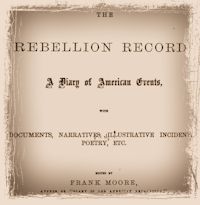
Following the American Civil War Sesquicentennial with day by day writings of the time, currently 1863.

The American Civil War

January 2.—The battle of Stone River, or Murfreesboro, Tenn., between the Union army of the Cumberland, under the command of Major-General Rosecrans, and the rebel force under General Bragg, which commenced two days previous, was resumed this morning, and, after a most obstinate and bloody contest, which lasted all day, resulted in the retreat of the rebel forces with great slaughter.—(Docs. 26 and 146.)

— Skirmishing continued yesterday around Vicksburgh, and this morning the rebels advanced upon a portion of General Grant’s army who were engaged erecting works on the lake near the city, causing them to retreat with a slight loss. General Pemberton, in command of the rebels, sent a despatch to Richmond stating that “the enemy finding all his efforts unavailing to make any inroad upon our position here, has reembarked, leaving a considerable quantity of intrenching tools and other property, and apparently has relinquished his designs upon Vicksburgh.”

— President Lincoln’s Emancipation Proclamation was officially issued as “General Order No, 1.”

—A Detachment of Stuart’s rebel cavalry, commanded by Major Herring, made a descent into Dumfries, Va., and captured a quantity of public stores and ten sutler’s wagons, belonging principally to Maine and New-York regiments. The movement was accomplished with such extraordinary expedition, that but two drivers only escaped.— At Richmond, Va., brown sugar sold at one dollar and ten cents per pound, molasses at eight dollars a gallon, and other necessaries of life in proportion. — Richmond Examiner.

Salutes in honor of the confirmatory proclamation of the President of the United States, declaring freedom to the slaves of rebels, were given in many portions of the loyal States.— Boston Transcript.

—Union prisoners captured at Galveston, yesterday, arrived at Houston, Texas. In noticing the event, the Telegraph said: “They are a fine looking body of men, and ought to be ashamed of themselves for volunteering their services in the villainy of trying to subjugate a chivalrous people.” —Colonel Hoskins, commanding military post at Lebanon, Ky., made report of his operations before that place, commencing on the twentieth day of December, 1862, at which time he was notified by General Boyle that the rebel forces under General Morgan had again entered Kentucky, and ending on this day, when the pursuit of them was abandoned, by order of General Fry, three miles beyond Columbia, Ky.— (Doc. 52.)


JANUARY 1, 1863.

—Abraham Lincoln, President of the United States, issued his confirmatory Emancipation Proclamation, declaring the slaves in certain States and parts of States in rebellion to be henceforth and forever free.—An enthusiastic meeting was held in Tremont Temple, Boston, throughout the whole of this day—morning, afternoon, and evening—in honor of the Proclamation. The day was also celebrated in Norfolk, Va., by the entire negro population. They marched through the town in procession, numbering over four thousand persons, headed by a band of music, carrying the Union flag, cheering for the downfall of slavery, etc. At Beaufort, S. C, the day was celebrated by the freedmen, by an excursion up the Beaufort River to the encampment of the First South-Carolina colored volunteers, where they were addressed by Brigadier-General Saxton, Colonel Higginson, Rev. Mr. French, and others. After singing an “Ode for Emancipation Day,” the multitude partook of refreshments. The tables were loaded with roast beef, bread, coffee, etc. Five oxen were roasted whole for the occasion.

—Galveston, Texas, was captured by a rebel force under General Magruder. The town was garrisoned by only three hundred troops, protected by six small gunboats: namely, the Westfield, Clifton, Harriet Lane, Owasco, Sachem, and Corypheus. Of these, the Harriet Lane was captured, after fighting until her captain and most of his officers and crew were killed; the Westfield got aground and was prematurely blown up, together with the commander of the fleet, Commodore Renshaw, and most of her officers and crew; the others escaped.—(Doc. 95.)

—Richard Yeadon, of Charleston, S. C, issued the following notice: “President Davis having proclaimed Benjamin F. Butler, of Massachusetts, to be a felon, deserving of capital punishment, for the deliberate murder of William B. Mumford, a citizen of the Confederate States, at New-Orleans, and having ordered that the said Benjamin F. Butler be considered or treated as an outlaw and common enemy of mankind, and that in the event of his capture, the officer in command of the capturing force do cause him to be immediately executed by hanging, the undersigned hereby offers a reward of ten thousand dollars ($10,000) for the capture and delivery of the said Benjamin F. Butler, dead or alive, to any proper confederate authority.”

December 30-—The Union army before Vicksburgh were occupied all day in removing the wounded and burying the dead.—(Doc. 91.)

—To-day, the Union expeditionary forces, under General Carter, completely destroyed the Union and Watauga bridges on the East-Tennessee and Virginia Railroad, and a locomotive, tender, and cars. They also captured four hundred rebel troops, six or seven hundred stand of arms, and a large quantity of valuable stores.— (Doc. 92.)

—Major-General Sherman, commanding the Union army before Vicksburgh, raised the siege of that town by reembarking his army on his transports, and sailing out of the Yazoo.—(Doc. 91.)

—General J. E. B. Stuart, with his rebel cavalry, returned to Richmond this morning from his expedition to Occoquan, Dumfries, and Anandale, Va., having been absent seven days, during which time he burned several bridges on the Orange and Alexandria Railroad, and captured or destroyed large quantities of National stores.— Richmond Dispatch, January 3, 1863.

—The iron-clad steamer Monitor, Commander Bankhead, sprung a leak and foundered a few miles south of Cape Hatteras, N. C. Four officers and twelve men were lost in her.—(Doc. 93.)

—The battle of Parker’s Cross-Roads, Tenn., was this day fought between a detachment of Union troops, under the command of Colonel C. L. Dunham, and a large rebel cavalry force, under General Forrest. After a desperate conflict of several hours’ duration, during which neither party obtained the victory, General Sullivan arrived on the field with reinforcements, and attacked the rebels, routing them with great slaughter.—(Doc. 94.)

—The battle of Stone River, or Murfreesboro, Tenn., fought by the Union army of the Cumberland, under the command of Major-General Rosecrans, and the rebel forces under General Bragg, commenced early this morning. After a desperate conflict of more than ten hours’ duration, both armies receded and suspended operations for the night, the contest being undecided.— (Docs. 26 and 146.)

—Emancipation was celebrated in various portions of the loyal States of the Union.—A meeting of the workingmen of Manchester, England, was held at “Free Trade” Hall, for the purpose of passing resolutions in support of the National cause in the United States, and agreeing on an address to President Lincoln.—(Doc. 96.)

December 29.—A party of Mexicans, under the leadership of a half-Indian, named Munoz, invaded the State of Texas, and stole forty horses and fifty head of cattle from a ranche in Zapata County. Demand was made through the United States military authorities for the arrest and punishment of the robbers by the Mexican officers, and also for the restitution of the property. Governor Lopez, of Tamaulipas, had the criminals arrested, but they subsequently escaped. The property was never returned.—Brownsville Flag.

—The United States Provisional Court for the State of Louisiana was opened at New-Orleans, with the reading of the order from President Lincoln, establishing the tribunal and appointing Judge Charles A. Peabody to preside over it.— The Union army, under General Sherman, made a concerted assault on the rebel works at Vicksburgh, Miss., and after a desperate contest, were repulsed at all points with great loss.—(Doc. 91.)

December 28.—The trestle-work at Muldraugh’s Hill, Ky., guarded by the Seventy-first Indiana regiment, was captured, after a fight of ten hours, by a superior force of rebels, under John H. Morgan, and destroyed.—New-Madrid, Mo., was evacuated by the National forces, after destroying the barracks and magazine.—Louisville Journal.

—A skirmish occurred to-day in the vicinity of Suffolk, Va., between a reconnoitring force of troops, under the command of Acting Brigadier-General Gibbs, and a force of rebel cavalry, in which the latter were routed and driven for six or eight miles. The Nationals captured a number of horses and fire-arms, the latter of which the rebels threw away in their flight.— Baltimore American.

Van Buren, Ark., was entered and captured by a force of Union troops, under the command of General J. G. Blunt, together with the rebel garrison, a large amount of ammunition, four steamboats laden with army supplies, and a ferry-boat.— (Doc. 90.)

—Major Foley, commanding an expedition sent by Major-General Granger to Elk Fork, Campbell County, Tenn., composed of two hundred and fifty men of the Sixth and Tenth Kentucky cavalry, surprised a camp of rebels, three hundred and fifty strong, at that place, killing thirty, wounding one hundred and seventy-six, and capturing fifty-one, without the loss of a man. All of their camp equipage was burnt, eighty horses, and a large amount of arms captured.—General Wright’s Despatch.

—Early this morning the attack on Vicksburgh was resumed, and continued all day, but without any important result. The rattle of musketry and booming of cannon was heard on all sides, but when evening came, the opposing armies were found to be in much the same positions as when they began.—(Doc. 91.)

—A skirmish took place near Clinton, La., between a party of Stuart’s Baton Rouge rebel cavalry and a detachment of National cavalry, resulting in the retreat of the latter, with a loss of one man and five horses killed.—Jackson (Miss.) Appeal.

December 27.—Elizabethtown, Ky., was this day captured by the rebel forces, under General J. H. Morgan, after a short resistance by the Union garrison of the post, under the command of Lieutenant-Colonel H. S. Smith. An immense amount of public and private property was destroyed and carried off by the rebel troops.— (Docs. 52 and 88.)

—A fight took place at Dumfries, Va., between the garrison of the town, consisting of three infantry regiments, a section of a field-battery, and a regiment of cavalry, under the command of Colonel Charles Candy, and the rebel forces of Generals Stuart and Fitz-Hugh Lee, with a battery of artillery, in all about three thousand five hundred men, resulting, after a desperate conflict of several hours’ duration, in a retreat of the rebel forces with great loss.—(Doc. 89.)

—Yesterday the expeditionary army, under General Sherman, successfully disembarked near the mouth of the Yazoo River, and to-day marched on Vicksburgh.—(Doc. 91.)

—To-day the Union army under General Sherman, in conjunction with the gunboats on the Mississippi, commenced the attack on the rebel forces before Vicksburgh. The gunboats, after several hours’ firing, were compelled to retire, considerably disabled, but the Union troops, after a desperate contest of eight hours’ duration, closing at nightfall, drove the rebel forces back some distance toward their works, both forces resting on their arms for the night.—(Doc. 91.)

December 26. — Thirty-eight condemned Indians were hung at Mankato, Minnesota, for participating in the late massacre in that State.— Jefferson Davis delivered an extended address on the subject of the rebellion, before the Legislature of Mississippi, assembled at Jackson.—(Doc. 87.)

—Major Stevens, of the Fourteenth Kentucky cavalry, with one hundred and fifty men, who were ordered upon a scout to ascertain the whereabouts of a large band of guerrillas in the eastern part of Powell County, Kentucky, after travelling all night over obscure and dangerous bridle-paths, came upon the rebel camps this morning. The Nationals dashed upon them, capturing their leader, a noted guerrilla, and eleven of his band. The remainder, though outnumbering Major Stevens’s force, were utterly routed, and escaped into the dense woods, brush, and mountain gorges. Twenty-five horses and a large amount of clothing, blankets, guns, pistols, etc., that were being transported to Humphrey Marshall’s camp, were also captured.—General Wright’s Despatch.

December 25.—A skirmish took place at Green’s Chapel, near Munfordville, Ky., between a detachment of Union troops, under the command of Colonel Gray, and the advance-guard of the rebel forces under General J. H. Morgan, which resulted in the latter falling back on the main body, with a loss of nine killed, twenty-two wounded, and five prisoners.—(Doc. 88.)

—The rebel schooner Break-o’-Day, with a cargo of cotton, ran the blockade of Mobile, Ala.— Colonel Shanks, in command of the Twelfth Kentucky cavalry, attacked the rear-guard of the rebel forces, under General Morgan, at Bear Wallow, Ky., killing one, wounding two, and taking ten or twelve officers and men prisoners, with no loss to his own force.—(Doc. 88.)

—A skirmish took place at Bacon Creek, near Munfordville, Ky., between a company of the Second Michigan, Captain Dickey, and the advance-guard of the rebel forces, under General Morgan, resulting in a retreat of the Unionists, with a loss of twenty-one men and two officers taken prisoners.—(Doc. 88.)

December 24.—In promulgating President Lincoln’s preliminary proclamation of emancipation, General Banks, commanding the Department of the Gulf, issued an address to the people of Louisiana in order to correct public misapprehension and misrepresentation, for the instruction of the troops of his Department, and the information of all parties in interest.—(Doc. 86.)

—A letter from Alexander H. Stephens, Vice-President of the rebel government, written on the 24th of December, 1860, was made public. In it occurs the following: “While I hope for the best, I am prepared for the worst. The election of Mr. Lincoln, I am well persuaded, is owing much more to the divisions of the Democratic party, and the disastrous personal strifes among its leaders at Charleston and at Baltimore, than to any fixed determination on the part of a majority of the people of the North to wage an exterminating war against Southern institutions. Disappointed ambition has much to do with the origin of our present troubles; the same cause will be greatly in the way of amicable and satisfactory adjustment. I can but believe that there is still enough patriotism in the land, North as well as South, to save the present Union under the existing Constitution, with all its guarantees and obligations, if the great heart of the nation can be touched and aroused. All that is wanting is a little time and patriotic forbearance.”—A brief skirmish took place in the vicinity of Munfordville, Ky., between a detachment of the Second Michigan cavalry, under the command of Lieutenant Darrow, and the advance-guard of the rebel forces, under General J. H. Morgan, resulting in a retreat of the latter with some loss.—(Doc. 88.)

—The obsequies of Rev. A. B. Fuller, late Chaplain of the Sixteenth regiment of Massachusetts volunteers, killed at Fredericksburgh, Va., took place at Boston, Mass.—A portion of Colonel Spears’s Eleventh Pennsylvania cavalry, had a spirited engagement at Joiner’s Bridge, four miles above Franklin, on the Blackwater River, Va., with a squadron of rebel cavalry and a body of infantry, whom he dispersed, capturing one man and horse, and three infantry soldiers and their arms.—Philadelphia Inquirer.

—A detachment of General Sherman’s expeditionary army, under the command of General M. L. Smith, destroyed a section of the Vicksburgh and Texas Railway, about ten miles west of Vicksburgh, and burned the stations at Delhi and Dallas (Doc. 91.)

December 23.—Jefferson Davis issued a proclamation declaring General Butler, commanding the Department of the Gulf, to be a felon deserving of capital punishment, and ordering that he should no longer be considered or treated merely as a public enemy of the rebel States, but as an outlaw and common enemy of mankind.— (Doc. 85.)

—The rebel schooner Pelican, with a cargo of eighty-two bales of cotton, ran the blockade at Mobile, Ala.—Major P. Graham, and Lieutenant E. T. Dorton, both of the Fifteenth Arkansas rebel cavalry, “being convinced of the wickedness and folly” of the rebellion, respectfully requested “alike the privilege of peacefully returning to their allegiance and to their homes” in the North.—An attempt was made by a party of rebels to cross the Rappahannock, fourteen miles below Port Conway, Va., and capture a squadron of the Eighth Pennsylvania cavalry, but the movement was frustrated by timely information of the rebel intentions by a trusty negro.—The National forces moved from Romney and took possession of Winchester, Va., which place was evacuated by the rebel pickets on their appearance before the town.—National Intelligencer.