Following the American Civil War Sesquicentennial with day by day writings of the time, currently 1863.

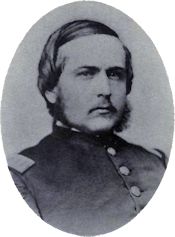
The Diary of a Line Officer, Captain Augustus C. Brown, Co. H, 4th NY Heavy Artillery

Thursday, May 5th.

Turned out stiff and sore this morning, and drenched to the skin with dew, which falls so heavily here that in the morning the appearance of the tents and fields is very much like that after a severe storm. At five o’clock fell in line and, joining the Corps Headquarter’s train as a guard, we started for Orange Court House. After marching about a mile we began to hear occasional shots from the picket line which preceded us, as our skirmishers met those of the “Johnnies,” and soon we received orders to countermarch and park the train. Returning to the point whence we started we stacked arms in a meadow immediately in front of General Headquarters and awaited developments.

While on the march we met a body of prisoners, who, because we had cut loose from our communications and so could not safely send them to any point in our rear, were kept moving in a circle close to the army and under a strong guard. Among them was a young man of about my own age, a Captain in some Georgia regiment, and calling him aside we sat down for a few moments on a bank of clay while my company was passing. He was a member of the staff of some Georgia brigade, and was captured the night before on the picket line, where he ran into a Yankee picket post supposing it to be composed of his own men. He had read law at the Harvard Law School, which he left to join the Southern army, and was a typical southern aristocrat who looked upon Northerners as little better than the “poor whites” of the South. He was very bitter in his denunciation of the war, and utterly scorned the idea that the South could be “subjugated,” actually declaring with the utmost sincerity that the north was already tired of the effort, and that even now the grass was growing between the stones of the pavements on Broadway in the City of New York, and he showed a clipping from a southern paper in which that statement was actually made. I assured him that I had been in New York in the previous March, and that from the appearance of things there no one would suspect that a war was going on, but I could make no impression upon him whatever. As we parted he gave me his name, but as I did not make a note of it I forgot it before night, a fact for which I am very sorry as I would like to meet him again after the war is over.

The picket firing, which in the morning was light and desultory, gradually increased as the day advanced and seemed to draw nearer and extend to the right. Meantime numerous divisions, brigades and regiments are pressed hastily forward to various points, and as they are lost in the woods and come within range, the sound of musketry deepens until it resembles the roll of heavy thunder, particularly on the right and in front of our (Fifth) corps. Soon the stretcher-bearers, with their ghastly freight, begin to pass by us to the hospitals now established on the plank road in our rear, and returning, with their stretchers dripping with the blood of the last occupants, press to the front again for other wounded. Crowds of soldiers, slightly wounded and assisted by comrades, flock past, many of whom as they stop to rest entertain our boys with stories of the fearful slaughter. Sounds like these followed by sights like these are not, I am bound to say, calculated to screw one’s courage to the sticking point, and I am decidedly of opinion that in time of action, troops just out of range are in more danger of demoralization than those at the immediate front. The former see only the wounded, the dying and the dead, not the living. They hear the terrible sounds of the combat and the groans of the suffering, not the cheers of the victors. They listen to tales of bloody and disastrous defeat, not of the crowning victory. In short, every sense is absorbed in the contemplation of the horrors rather than the glories of war.

About one o’clock P. M. a little cannonading was heard, but the surface of the country is so broken and irregular, and the forests, with their undergrowth of saplings, vines and brambles are so dense, that but little use can be made of artillery. Lieut. Shelton, of our brigade, whom I saw riding gaily by yesterday, lost two guns to-day on a narrow road in our front and was himself taken prisoner. Various wild rumors are flying about, such as that two rebel brigades were completely annihilated this morning, but though the fighting has been very hot and the losses undoubtedly great on both sides, as the firing dies away I cannot learn that either side has attained any decided advantage. The movements would seem to indicate efforts on both sides to get control of commanding points preparatory to more bloody and decisive work. Just at night the Headquarters Train moved back a short distance across the plank road by which we came into the field, and parked in an old corn field, while our battalion pitched its tents near by. Just after I had crawled under my shelter tent I heard the familiar voice of Dr. Lawrence, one of our assistant surgeons, now of the First Battalion attached to the Sixth Corps, anxiously inquiring for my tent, and, having found it, he jumped from his horse and looking in inquired breathlessly if I was much hurt. I assured him that so far as I knew I was not yet very badly damaged, whereupon he expressed the greatest relief, and explained that he had ridden in great haste from the Sixth Corps headquarters, some three miles away, where he had been informed that I had been very dangerously wounded. Being assured of my safety, and showing me the instruments he had brought for the purpose of taking off my leg, arm or head, as the case might require, he remounted his horse and was soon lost in the darkness, but I shall not soon forget an act of such disinterested kindness on the part of the doctor, upon whom I had no sort of claim whatever, personal or professional.

Wednesday, May 4th.

Orders to march were received at two o’clock this morning, and joining the Artillery Brigade, already in line, we moved off via Stevensburg to the Germania Ford, on the Rapidan River, which we reached about so o’clock A. M. Here the river, which in any reputable northern locality would be called simply a creek, cuts its way between two ranges of hills with the bank on the southerly side quite abrupt, and is spanned by a pontoon bridge, the first thing of the kind I have ever seen. Crossing the bridge and winding up the steep bank, we halted just within a line of breastworks constructed to command the approaches to the ford, but which were abandoned by the enemy last night on the appearance of our advancing cavalry. The earthworks were skilfully and substantially built, while little redoubts for artillery crowned several commanding points, and it is a subject of general surprise that the enemy evacuated so strong a defensive position without any serious attempt to hold it. A few shells and a stray minie ball now and then greeted us, invited perhaps by our own artillery, a battery of which, drawn up near the road by which we descended to the bridge, sent a half dozen shells towards the heights on the opposite side of the river. One of the minies went through my overcoat which Lynch just behind me was carrying nicely rolled up on his shoulder, and as he unrolled the garment that night and showed me the numerous holes made by the missile as it went through the folds, he remarked with a chuckle, “Its a good thing you weren’t in it that time, Captain.” After crossing the bridge we passed an old tobacco drying shed, and some of my men helped themselves to a few specimens of genuine “Virginia Leaf,” and that evening presented me a handful of very well rolled but rather green “home made” cigars.

The day was warm and pleasant, and the men, with characteristic recklessness, threw away one article after another, until many were reduced to pants, shirt, hat and musket, and the line of march from Culpepper to the river was literally covered with coats, blankets and knapsacks, a rich field for foraging, whether by the rebels or by cavalry. Nor can I blame the poor fellows under the circumstances, for a long march is about as convincing an argument as I know of that


“Man wants but little here below,

Nor wants that little long.”


I myself debated for some time which I would part with —my overcoat or my blanket—and finally actually threw the blanket away.

By a singular coincidence I met Col. Bates and Capt. Watkins, of the Culpepper Examining Board, about 9 o’clock this morning near the Rapidan, each with his regiment, and as we had adjourned yesterday to meet at that hour to-day, we halted under a tree and amid considerable laughter adjourned the Board sine die. Lieut. Shelton, of the First N. Y. Artillery, passed me with his battery on the march to-day, having just got his promotion from a sergeantcy and therefore feeling in excellent spirits.

At about five o’clock we reached our destination for the day, after a march estimated at twenty-three miles, and camped in a field near the old Wilderness Tavern and some four miles from Mine Run

Tuesday, May 3rd.

Received orders after “taps,” about 10 o’clock, to-night to be ready to move in two hours. Rumors of all kinds are flying about, and the general impression seems to be that the whole army is in motion. I directed Sergeant Theben to turn out the company, strike tents and pack up, which was accomplished in less than the time allotted. But one wagon is detailed to furnish transportation for the effects of the whole battalion, so baggage is reduced to the minimum, and large quantities of ordnance stores and camp and garrison equipage, as well as private property of officers and men, are left behind strewn over the camping ground, a striking illustration of the waste of war.

Monday, May 2nd.

Still in camp near Culpepper. Nothing of interest has occurred since the 23rd of April beyond the daily routine of camp life, except that large bodies of troops have been moving up and camping near us, or passing by towards the Rapidan (Rapid Ann). The company has been almost exclusively in command of Sergt. Theben, Lieut. Edmonston and I having been constantly engaged, the one on court martial and the other on the examining board. Since the organization of the board we have met daily at 9 o’clock in the morning and continued in session until 3 in the afternoon, examining on an average twenty-five candidates a day, and recommending about one third of them for leaves of absence. CoI. Bates, I find, is perfectly familiar with infantry tactics and army regulations, and conducts his part of the examination very thoroughly, leaving artillery and mathematics to me. Capt. Watkins is a capital fellow, but does not trouble the “victim” with many questions. He says he is entirely satisfied with the examinations as conducted by the Colonel and myself, and that his department is “to give character and dignity to the Board, and inspire the applicants with a just sense of the importance of that body.” The list of candidates embraces representatives from all classes of men and all branches of the service. The dapper First Sergeant of the Regulars and the dilapidated army “bummer” stand side by side and hand in their “recommendations.” The influential politician of some rural district, who enlisted as a private from “purely patriotic motives,” now bleached of his patriotism, sits nervously at the door awaiting the result of this his last expedient to gain the path of promotion and honor. The rough, honest country boy with corporal’s chevrons, shares the anxious seat with the intelligent representative of the legal profession, whose simple army blouse hides all appearance of the “wig and gown.” In fact every conceivable shade of character, capacity and intelligence is represented, and the labor of sifting the wheat from the chaff is by no means light. The fact, however, that we have now been in session nearly two weeks, and have reported favorably on about a hundred cases, and yet no furlough has been granted in accordance therewith, furnishes some ground for the suspicion that the object of this proceeding is rather to allay the agitation of some turbulent spirits, and occupy their leisure moments in camp until the time comes for a movement of the army, rather than to furnish students for the Philadelphia School or officers for the colored troops.

Saturday, April 23rd.

When the mail for the Company was distributed today, Sergeant Theben received a package containing two pairs of heavy woolen socks, and until I explained the situation, his gratitude to the unknown donor was unbounded. I had forgotten to inform him that at Stevensburg I had written home for the articles, and inasmuch as only enlisted men were permitted to receive such things through the mail, I had, without any regard for the postal rules, directed that they be sent to me via Theben, and hence the contretemps. Previous to leaving Fort Marcy, and following the advice of a relative who had been out for two years with Duryea’s Zouaves, I had supplied myself with woolen under and over shirts, but had neglected the socks, but with our experience at Stevensburg I made haste to complete the woolen outfit.

Friday, April 22nd.

Lieut. Clark having been detailed to Co. E, which has been assigned to guard the ammunition train, and Lieut. Edmonston being still engaged on court martial, I left the Company in command of First Sergt. Theben this morning, and met the officers composing the examining board at Corps Headquarters. Col. Locke, the gentlemanly Adjt. Genl. of the Fifth Corps, had quarters, stationery and the necessary orderlies assigned to us, and the Board began operations.

Thursday, April 21st.

Received an official copy of the order promulgated yesterday, and reported in person to Col. Bates, President of the Board. I found him drilling his regiment, and made an appointment to meet to-morrow at 9 o’clock at Corps Headquarters at Culpepper.

Wednesday, April 20th.

Received an order detailing Col. James L. Bates, 12th Mass., Capt. C. A. Watkins, 76th New York, and myself, as a Board to examine enlisted men of the Fifth Corps who are recommended for admission to the Military School at Philadelphia, whence, after a brief attendance, so it is said, they are to be sent before Gen. Casey’s Board at Washington for examination as to fitness for commissions in the negro regiments.

Tuesday, April 19th.

Sent the body of Private Hastings to Washington in charge of Corpl. Foster for embalmment, after much difficulty in securing a coffin and transportation at Culpepper. Capt. Jones with his company, D, was to-day detailed as a guard for the ammunition train of our Artillery Brigade, which leaves three companies of our Battalion still to be disposed of, and Lieut. Edmonston was detailed as a member of a Brigade Court Martial.

Monday, April 18th.

Weather warm and pleasant. Private Hastings died suddenly to-day in a fit brought on by dissipation. I learn that he was a dentist of considerable skill and reputation at home, and belonged to a highly respectable family, and I have directed his body to be sent to Washington to be embalmed, and have written to his friends, forwarding his few personal effects.

I called this afternoon on the ladies occupying the old brick house, with a view of polishing up my manners a little, which I fear have suffered materially from long absence from the “elevating and refining influences of female society,” and also for the purpose of purchasing a pie, the consumption of which would appear to be the highest type of physical beatitude just at this time. I found the ladies occupying a corner room on the first floor, having deserted the rest of the premises, and engaged in entertaining Capt. Jones of Co. D of our battalion, and vigorously rocking a miniature canal boat wherein unconsciously reposed a scion of the noble house. Jones being a handsome young man, and versed in all the little arts that kill or captivate, in which particulars he ranks me, I leave conversation pretty much to him, except on the pie question, and occupying a primitive cane-bottomed chair, listen attentively to the stories of war, privation and suffering which “we uns” have brought upon “they uns” in the pure and unadulterated Virginia vernacular. The elder lady is a woman of perhaps sixty years of age, and the younger, the mother of the cradle-full, is a stout masculine creature of about thirty. Both are clad in the plainest and scantiest homespun, and the few articles of furniture and clothing that are scattered about the room are of the meanest and dirtiest description. In one corner of the room is an old bed, with a dilapidated hoopskirt and other articles of female wearing apparel scattered about upon it to the best advantage apparently. Two or three old chairs adorn the next corner and side of the room, together with a lounge of antique structure. Then comes another hoopskirt on a nail, a door and three or four dresses “and things” hanging to as many nails. Then alongside of a primitive table, in a tub stuffed with straw, sits an old hen endeavoring to hatch a brood of chickens from a nest full of eggs. The older woman is sharp featured, rather large, dark-haired and wears high-heeled shoes, and as she sits in the cradle while rocking it, she frequently addresses the dirty little occupant as “little lady,” from which fact I gather that the infant also belongs to the female persuasion. In conversation with Jones, and doubtless to impress us both with the fact that her family was “some pumpkins” “befo’ the wa’,” the old lady said that when her husband died some years ago he left her “Wal, sar, I couldn’t say, sar, how much land, but it goes down to the run (all streams are called “runs” here), then over thar and thar and thar,” etc., indicating not less than a thousand acres. That she had three sons “on the line” (i. e., in the Reb army), and that her granddaughter there present lost her husband at “Anti-eat-urn.” That she was “born and raised right thar, and was never further north than Warrenton” (eight or ten miles). That “Virginians used to think the north a splendid country, but didn’t think so much of it now.” That “thar used to be lots o’ niggers about here (there isn’t one now); they’s the cause of the war and I wish thar wasn’t one on earth, and a good many Virginians wish so, too.” She thought it wicked to make soldiers of the negroes, but that colonization was just the thing. She believed heartily in the Southern Confederacy, and would not take the Yankee oath of allegiance for “a million o’ dollars.” She was willing to take both greenbacks and Confederate scrip at par for her pies, and rejoiced that she had been able to save six chickens and five guinea hens from the ravages of war. She pointed out a house where a Yankee shell had killed two Rebs and wounded four or five others, and told us that a Yankee Captain was killed right by the spring from which we got all our water, and that a Reb was killed just where our camp is located, and wound up by showing us some houses two or three miles away where she said some very pretty “Secesh” girls resided, and I couldn’t but hope that their surroundings were more attractive than those of this old woman and her grand-daughter. No northern family, however poor, could live amid such surroundings, and yet these people speak with loftiest contempt of the “dirty niggers” and the “mean whites,” and anathematize the uncivilized “Yanks,” not excepting their present company, just as if the commissariat of those same “Yanks” was not all that stands between them and starvation. My cravings for “polite society” having been fully satisfied I withdrew, not, however, until I had secured a fair specimen of a “secesh” pie for which I paid the moderate price of forty cents in greenbacks, but which I soon discovered, by analytical mastication, was apparently composed of saw-dust and cider “bound in calf.”