Following the American Civil War Sesquicentennial with day by day writings of the time, currently 1863.

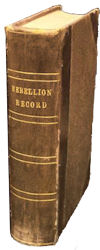
The Rebellion Record—A Diary of American Events; by Frank Moore

—A large meeting was held at Norfolk, Va., this evening. Strong speeches were made, urging the citizens to arm themselves and place themselves in a state of defence for any emergency, which were loudly cheered.

Resolutions recommending the Legislature to organize thoroughly the military power of the State, and prepare for civil war should it occur; scorning coercion; and preparing to resist invasion, were unanimously adopted.—National Intelligencer, Jan. 7.

—Apprehensions of an attack on Washington are subsiding, in consequence of the measures already taken. General Carrington, of that city, has issued a call for a military organization for its defence.—(Doc. 15.)

—In the State Convention of Florida, assembled at Tallahassee, resolutions were offered declaring the right of Florida to secede, and the duty of the State to prepare for secession, made special order for the 7th.

Resolution was unanimously adopted in the Missouri Senate, instructing the Committee on Federal Relations to report a bill calling a State Convention.— Times.

—Steamship Star of the West, Captain McGowan, cleared at New York for Havana and New Orleans. Two hundred and fifty artillerists and marines, with stores and ammunition, were put on board in the lower bay by steam-tug, and in the night the ship went to sea, supposed to be destined for Charleston.

—The South Carolina Convention adjourned this morning, subject to the call of the president—Evening Post, Jan. 5.

—Great excitement prevailed at Norfolk, Va., in consequence of the report that four companies of soldiers at Fortress Monroe had been ordered to Charleston.—Balt. Sun.

—It is stated in Washington, on the authority of a member of the Georgia delegation, that the United States revenue cutter Dolphin was fired upon and seized to-day, by the secessionists at Savannah. Upon the same statement in Georgia, the Governor issued an order for her release.—Times, Jan. 5.

—The South Carolina Convention appointed Hons. T. J. Withers, L. M. Keitt, W. W. Boyce, James Chesnut, Jr., R. B. Rhett, Jr., R. W. Barnwell, and C. G. Memminger, delegates to the General Congress of the seceding States.

—The United States arsenal at Mobile was taken by the secessionists at daylight this morning. It contained six stand of arms, 1,500 barrels of powder, 300,000 rounds of musket-cartridges, and other munitions of war. There was no defence.—Evening Post, Jan. 7.

—An appeal to the people of Florida, by the Charleston Mercury, to seize the forts and other defences at Pensacola and Key West, threatens the capture of the California treasure ships by letters of marque and privateers.—(Doc. 13.)

—Fast-day throughout the United States, by proclamation of the President. It is generally observed.—(Doc. 14.)

—Fort Morgan, at the entrance of Mobile Bay, was taken this morning by Alabama troops, and is now garrisoned by two hundred men.—The Press, Jan. 5.

—This evening a workingmen’s meeting was held at Cincinnati, Ohio. Speeches were made, and resolutions adopted, declaring that the Union must be preserved in its integrity by the enforcement of the laws in every part of the Union, by whatever means may be necessary; that the remedy for all grievances can be had under the constitution, and that the only way to safety and peace is the maintenance of it.—Troy Times.

—At Schenectady a salute was fired in honor of Major Anderson and his brave men. National airs were performed amid cheers for Major Anderson and Secretaries Holt and Stanton.—Albany Journal.

—A meeting was held at Westchester, Pa., to enrol volunteers in the regiment of Chester county, to offer their services to the Government to maintain the constitution and enforce the laws.—Evening Post. Jan. 5.

—The following notice is served on residents of Charleston, indiscriminately:

Beat No 1, 16th Regiment, Regimental Parade.

Sir: You are hereby summoned to be and appear at the Citadel Square, properly armed and accoutred, according to law, on Wednesday next, at 1 o’clock P. M., precisely. An inspection of arms will take place at each parade. If you appear in pantaloons, blue or black coat and black hat, arms and accoutrements in complete order will be furnished you at each parade on the ground; if not, the law compels you to furnish yourself with a musket, bayonet, cartridge-box, bayonet-scabbard, with cross-belts, all in good order and fit for service, on one dollar fine for each defect.

Every person subject to military duty in this regiment, who removed from one beat to another, is required to report himself to the captains of the beats from which and to which he has removed, or be fined five dollars, besides all fines for the non-performance of military duty in both beats.

Court-martial held on defaulters at the Military Hall, Wentworth street, on the third Monday of December, at 12 o’clock IL By order of captain.

S. Vale Mallins, Corporal.
—The order for the removal of guns from the Allegheny arsenal to southern forts is revoked by the War Department, under a decision of the Cabinet.

—Fort Pulaski, at Savannah, Ga., is taken possession of by State troops, by order of the Governor.

—A book is opened in New York city, for the enrolment of volunteers to meet any demand which may be made by the Governor of the State for troops to aid in preserving the Union.—Times, Jan. 4.

—The Florida State Convention assembled at Tallahassee.

—Hon. H. Dickenson, Commissioner from Mississippi, addresses both Houses of the Delaware Legislature, inviting Delaware to join a Southern Confederacy. The House, having heard him, passed unanimously the following resolution, in which the Senate concurred:

Resolved, That, having extended to Hon. H Dickenson, Commissioner from Mississippi, the courtesy due him as a representative of a sovereign State of the Confederacy, as well as to the State he represents, we deem it proper and due to ourselves and the people of Delaware to express our unqualified disapproval of the remedy for the existing difficulties suggested by the resolutions of the Legislature of Mississippi.—Philadelphia Ledger.

—The South Carolina Commissioners left Washington for Charleston, upon the President’s declination to receive any further communication from them. They consider the abrupt termination of their business by the President an insult to themselves and their State, and treat it as a declaration of war.—(Doc.12.)

—In Washington, reports that armed bands were organizing to take possession of the capital before the votes for President and Vice President are counted, meet with general credence. General Scott is actively engaged in the preparations to put down this mob.

—The steam frigate Brooklyn and another vessel at Norfolk are ordered to be in readiness for immediate departure to Charleston. The secession leaders discovered the intention to start these vessels, and notified their sympathizers at Norfolk to have minute-men ready to seize them if they attempted to go to sea. The Administration is on the watch to prevent it.—Commercial Advertiser.

A letter received in Washington from Alabama, states the secession sentiment to be utterly uncontrollable; and says that, in the event of the firing of a single gun in opposition to disunion, “Mr Lincoln’s life will not be worth a week’s purchase.”—Boston Courier.

—Captain Charles Stone, upon the recommendation of General Scott., is appointed to organize the militia of the District of Columbia. Captain Stone graduated at West Point at the head of his class, went into the Ordnance Corps, was a lieutenant in command of a battery at the siege of Vera Cruz; was brevetted for gallant conduct at Molina del Rey, and served on the entire line of operations from Vera Cruz to the city of Mexico, directly under the eye of General Scott, who expresses the highest confidence in his genius for command.—Tribune.

—Intelligence is received in Washington that Fort Sumter is besieged; that all Major Anderson’s communications are cut off; that Fort Moultrie has been completely repaired and the guns remounted; and that every thing is in readiness to open a fire on Major Anderson. New batteries are being erected around him by the secessionists.—N. Y. Times.

—In New York city an assembly of the people in the City Hall Park fire 100 guns in honor of Major Anderson.

—Five thousand citizens of Baltimore have signed a letter addressed to Governor Hicks, of Maryland, approving his course in refusing to convene the Legislature of that State. The list is headed by John P. Kennedy, Mr. Fillmore’s Secretary of the Navy, and comprises the names of nine-tenths of the business men of the city. Calls for public meetings to sustain the Governor are now being issued all over the State.—Baltimore American.

—Governor Ellis, of North Carolina, dispatched troops to seize upon Fort Macon, at Beaufort, the forts at Wilmington, and the United States arsenal at Fayetteville.—Times, Jan. 3.

The evidences of a purpose on the part of the secessionists to seize upon the public property and usurp the Government at its capital, have become so clear that energetic measures are taking to defeat their plans, and repress the treason. Now that the Administration begins to appreciate the necessity of preserving the Government, and manifests the purpose to repudiate the treasonable influences which have hitherto paralyzed its arm, the people are beginning to report facts exposing the violent plots concocting in the District and its neighborhood.

It is now well known that military companies have been organized and drilled for months past in Maryland and Virginia—some of them under the eye of an officer of the regular army —and that the distinct object of their organization is to aid in the seizure of Washington city in the interest of the disunionists, or the prevention by force of Lincoln’s inauguration, Some of the less prudent of their leaders boast in private circles that they have five thousand well-armed and organized men ready to strike the blow instantly upon the concerted signal being given.—Times, Jan. 2.

—At Charleston, the attitude of the Administration is regarded as warlike.

A censorship is exercised over the telegraph, and the city is nightly patrolled by the military. It is proposed to starve out the troops at Fort Sumter, and then attack them on rafts with the aid of batteries already erected. There is a battery of earthwork, logs, and sand, on the end of Sullivan’s Island, and also one on Morris’ Island.

Commander Pettigru, of Castle Pinckney, orders that no boat shall be allowed to approach the wharf-head without permission, under penalty of serious consequences in case of violation. The city river-front is carefully guarded. The Palmetto Guards, 100 strong, have charge of the arsenal under the palmetto flag, instead of the Federal flag.

Collector Colcock notifies ship-masters that all vessels from and for ports outside of South Carolina must enter and clear at Charleston.

The Columbia Artillery, numbering 50 men, arrived at 1 o’clock to-day, and proceeded to the harbor. They will use cannon belonging to Charleston.—Boston Transcript, Jan. 2.

In South Carolina Convention passed an ordinance to define and punish treason. It declares that in addition to that already declared treason by the General Assembly, treason against the State shall consist only in levying war against the State, adhering to its enemies, and giving them aid and comfort. The penalty is death without the benefit of the clergy.— Evening Post, Jan. 2.

—Strong fortifications have been ordered by the South Carolina Convention in and around Charleston harbor, to resist any reinforcements that may be sent to Major Anderson.

Governor Pickens is in daily receipt of dispatches from the South, tendering men to defend South Carolina from invasion.

—The scene in the Senate at Washington to-day was intensely exciting. Senator Benjamin, of Louisiana, who, it had been reported, would make a conciliatory speech, gave out that he would make a parting secession speech —an announcement which drew an immense audience. Senator Benjamin spoke calmly throughout, but the character of his speech at the close opened up to every one the new era in national affairs. His closing declaration, that the South could never be subjugated, was greeted by the galleries with disgraceful applause, screams, and uproar. It was evidently the act of persons who had purposely packed the galleries. For this demonstration the galleries were promptly cleared; but as the people passed out, remarks were current among the mob such as, “That’s the talk “—”Now we will have war”—”Benjamin’s a brick”— “ D—n the abolitionists”—” Abe Lincoln will never come here.”—Times, Jan. 1.

—General Wool takes strong ground in favor of the Union, of sustaining Anderson in his position at Fort Sumter, and earnestly urges that a firm ground be adopted to put down rebellion.

He declares that if Fort Sumter be surrendered to the secessionists, in twenty days two hundred thousand men will be in readiness to take vengeance on all who would betray the Union into the hands of its enemies.—(Doc. 11.) —Troy Times, Dec. 31.

—It is generally considered that Mr. Floyd has not resigned because of Major Anderson’s patriotic course, but merely used it as a pretext to conceal the real cause. The whole country knows that his position, under the “trying circumstances,” has not been a very agreeable one, especially during the last two weeks. The alleged cause of his leaving Mr. Buchanan is, that the latter refuses to recall or order back to Fort Moultrie the gallant Anderson. Floyd asserts that he, some time ago, promised the South Carolina seceders to leave things in the harbor of Charleston undisturbed —in statu quo ante bellum—and that the President gave the same promise. This agreement having been broken by Major Anderson, he insisted upon his returning to Fort Moultrie; and, because the President was unwilling to give that order, he sent in his resignation.—Phila. Press, Dec. 31.

—The South Carolina troops took possession of the arsenal at Charleston. The arsenal contains many thousand arms and military stores. Military preparations are actively and zealously progressing.—Evening Post, Dec. 31.

—Major Anderson is denounced by the Charleston papers. The Courier says:

“Major Robert Anderson, United States Army, has achieved the unenviable distinction of opening civil war between American citizens by an act of gross breach of faith. He has, under counsels of a panic, deserted his post at Fort Moultrie, and, under false pretexts, has transferred his garrison and military stores and supplies to Fort Sumter.”

The Mercury, more temperately, says:

“Major Anderson alleges that the movement was made without orders and upon his own responsibility, and that he was not aware of such an understanding. He is a gentleman, and we will not impugn his word or his motives. But it is due to South Carolina and to good faith that the act of this officer should be repudiated by the Government, and that the troops be removed forthwith from Fort Sumter.”—(Doc. 9.)

—John B. Floyd resigned his position as Secretary of War, owing to the refusal of the President to withdraw the Federal troops from the forts at Charleston.—(Doc. 10.)—Baltimore Sun, Jan. 1.

—Early this afternoon the palmetto flag was raised over the Custom House and Post Office at Charleston; and to-night Castle Pinckney and Fort Moultrie have been taken possession of by the South Carolina military. These forts are held under instructions from Governor Pickens, who authorizes their peaceable possession, for the protection of the government property. Castle Pinckney and Fort Moultrie were held by a very small force, which surrendered without collision.—Times, Dec. 29.

—An enthusiastic Union meeting was held at Memphis, Tenn., to-day. It was addressed by Hon. Neil S. Brown and others. Resolutions were passed opposing separate State secession; against coercion; and favoring a Convention of the Southern States to demand their rights, and if refused to take immediate action. —Phila. Press, Dec. 29.

—The citizens of Wilmington, Del., fired a salute of twenty-one guns in honor of Major Anderson and his heroic band.

—Governor Hicks’ refusal to convene the Maryland Legislature for disunion purposes, is generally regarded at Washington with warm approbation, and creates great dismay among the disunionists who have urged it. The greater portion of the latter are said to be office-seekers, disappointed politicians, and rowdies, who seek plunder. A prominent gentleman, who has just seen Governor Hicks, says the rank and file of Maryland are true to him.—Tribune, Dec. 29.

—A meeting of the citizens of Pittsburgh, Pa., was held, to give expression to the public indignation created by the removal of ordnance to the Southern forts. General William Robinson presided. Resolutions were adopted, declaring loyalty to the Union, deprecating any interference with the shipment of arms under government orders, however inopportune or impolitic the order might appear; deploring the existing state of things in connection with the administration of important deportments of the public service, so as to have shaken confidence in the people of the free Slates; that, while Pennsylvania is on guard at the Federal capital, it is her special duty to look to the fidelity of her sons, and in that view call on the President as a citizen of this Commonwealth, to see that the public receive no detriment at his hands. It behooves the President to purge his cabinet of every man known to give aid and comfort to, or in any way countenancing the revolt of any State against the authority of the constitution and the laws of the Union.—Evening Post, Dec. 28.

—“Captain N. L. Coste, U. S. R. Service, in command of the cutter William Aiken, betrayed his vessel into the hands of the State authorities of South Carolina.

“The crew, on being notified of the position of Captain Coste, under the State ordinance concerning the customs, promptly volunteered to remain under his command as an officer of South Carolina under that ordinance.”

(See Statement of Lieutenant Underwood, N. Y. Times, Jan. 9, 1861.)

—A meeting was held this evening at Richmond, Va., to give expression of opinion on the present crisis. Several speeches were made, favoring prompt secession measures, and others advocating a resort to negotiation.—Herald, Dec. 29.

—The Governor of South Carolina is tendered the services of troops from Georgia, Alabama, and different portions of Carolina.