Following the American Civil War Sesquicentennial with day by day writings of the time, currently 1863.

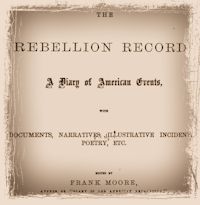
The Rebellion Record—A Diary of American Events; by Frank Moore

May 30.—This morning, at about half-past ten, the rebels attacked a train of sixteen cars from Alexandria, loaded with forage, about a mile and a half from Kettle Run, toward Warrenton Junction, Va. The Third brigade, under Colonel De Forrest, was stationed at Kettle Run, and the pickets were first notified of the enemy’s presence by hearing heavy firing. A force was immediately sent in the direction of the firing, but too late to save the train, which was utterly demolished, the locomotive being pierced by two six-pound cannon-balls.—(Doc. 203.)

—Great excitement existed at Harper’s Ferry, Md., and its vicinity, on account of the reported approach of the rebel General Lee, with a view of entering Maryland.—The Thirtieth regiment of New York volunteers, under the command of Colonel William M. Searing, returned to Albany from the seat of war.—A rebel camp near Carthage, Tenn., was surprised by a party of the Twenty-sixth Ohio regiment, who captured twenty-two prisoners, and thirty-five horses, besides destroying all the camp equipage.— Cincinnati Commercial.

—A large meeting was held at Newark, N. J., “by the Democracy of that city, to express their opposition to the recent arrest and banishment of Mr. Vallandigham. There were six thousand persons present, and the sentiments uttered by the various speakers were heartily applauded.” Speeches were made by A. J. Rogers, Eli P. Norton, Judge A. R. Speer, and General Theodore Runyon.—New-York Daily News.

—The town of Tappahannock, on the right bank of the Rappahannock River, Va., was this day captured by four Union gunboats. A party of troops landed and carried off and destroyed a large amount of rebel stores, etc. They also captured a large quantity of personal property, and a number of negroes.

May 29.—A detachment of the First Vermont cavalry had a skirmish near Thoroughfare Gap, Va. with a scouting-party of Stuart’s cavalry, consisting of forty men, commanded by Captain Farleigh, of General Stuart’s staff. The rebels fled precipitately, with the loss of one killed, two wounded, and one man taken prisoner. The Nationals had five horses wounded; but sustained no loss or casualty, with the exception of one man taken prisoner.—The Sixth regiment of Massachusetts volunteers, after two terms of service in the war, returned to Boston, where they were received with great enthusiasm.—New-York Tribune.

—Brigadier-General Reed returned to Lake Providence, La., from an expedition into Mississippi. Three days ago he embarked with a portion of the First Kansas volunteers, and a regiment of Louisiana colored troops. Ascending the river ten miles, the troops landed near Moon lake, from which place they advanced into the interior, and succeeded in capturing sixty head of cattle, and a large quantity of stores belonging to the rebels.

May 28.—The Eighth Illinois cavalry, under the command of Col. D. R. Clendenin, returned to the headquarters of the army of the Potomac, after a raid along the banks of the Rappahannock and Potomac Rivers below Fredericksburgh, Va. The regiment were on the scout for eleven days, during which time they captured five hundred horses and mules, destroyed twenty thousand pounds of bacon, and a large quantity of flour; burned one hundred sloops, yawls, ferry-boats, etc., laden with contraband goods, intended for the use of the rebels, and valued at one million dollars; and brought into camp eight hundred and ten negro men, women, and children, with a great deal of “personal” property, consisting of horses, mules, carts, clothing, etc., and also one hundred rebel prisoners, several of whom were officers of the rebel army.

—There was much excitement in Boston, on the occasion of the departure of the Fifty-fourth regiment, colored Massachusetts troops, for South Carolina. This was the first negro regiment sent from the North.—A party of two hundred rebel cavalry made a descent in Kentucky, near Somerset, and captured a small number of Nationals belonging to Wolford’s cavalry. — Elections in Norfolk and Portsmouth, Va., took place, resulting in the success of the Unionists.

—The rebel steamer Banshee, ran the blockade of Wilmington, N. C.—Richmond Examiner.

—To-day a severe skirmish took place on the Little Black River, in the vicinity of Doniphan, Mo., between a force of National troops, under the command of Major Lippert, of the Thirteenth Illinois cavalry, and a numerically superior body of rebels, terminating, after a desperate contest of half an hour’s duration, in the defeat of the Union force, with the loss of eighty of their number in killed, wounded, and missing.

May 27.—The rebel fortifications at Port Hudson were this day attacked by the National forces under the command of General Banks, but, after a desperate conflict of eight hours’ duration, they were unable to reduce them. In the first charge made upon the works, Captain Callioux and Lieutenant Crowder, both colored officers, were killed. — (Doc. 201.)

—The United States gunboat Cincinnati, was sunk by the rebel batteries at Vicksburgh, Miss. Lieutenant Commander Bache, gave the following report of the occurrence to Admiral Porter: “In obedience to your order, the Cincinnati got under way this morning at seven o’clock, and steamed slowly down until a little abreast of where the mortars lie. When we rounded to, the enemy fired several shots from a gun called ‘Whistling Dick,’ but soon gave it up. At half past eight, with a full head of steam, we stood for the position assigned us. The enemy fired rapidly, and from all their batteries. When abreast of our pontoon, and rounding to, a ball entered the magazine, and she commenced sinking rapidly. Shortly after, the starboard tiller was carried away. Before and after this, the enemy fired with great accuracy, hitting us nearly every time. We were especially annoyed by plunging shots from the hills, and eight-inch rifled and ten-inch smooth-bore shots did us much damage. The shots went entirely through our protection—hay and wood. And now, finding that the vessel would sink, I ran her up-stream as near the right-hand shore as our damaged steering apparatus would permit. About ten minutes before she sank we ran close in, got out one plank, and put the wounded ashore. We also got a hawser out to make fast to a tree to hold her until she sunk. Unfortunately, the men ashore left the hawser without making it fast. The enemy were still firing, and the boat commenced drifting out. I sung out to the men to swim ashore, thinking we were in deeper water (as was reported) than we really were. I suppose about fifteen were drowned and twenty-five killed and wounded, and one probably taken prisoner. This will sum up our whole loss. The boat sunk in about three fathoms of water; she lies level and can easily be raised, but lies within range of the enemy’s batteries. The vessel went down with her colors nailed to her mast, or rather to the stump of one, all three having been shot away. Our fire, until the magazine was drowned, was good, and I am satisfied did damage. We only fired at a two-gun water-battery.”

—The Eleventh battery of Massachusetts volunteers, returned to Boston from the seat of war.

May 26.—Colonel J. T. Wilder, with his regiment of mounted infantry, returned to Murfreesboro, Tenn., from a scout in the direction of McMinnville, in search of the rebel cavalry under the command of Colonel Breckinridge. He encountered the rebel pickets a short distance from Woodbury, and commenced an attack, which attracted the rebels in the vicinity, and they having collected, a running fight was kept up for several miles. Twelve miles west of McMinnville, the Union forces came on the camp of the rebels under Breckinridge, and after a short fight, routed them and captured nine prisoners, several horses and thirty head of cattle. Having secured the prisoners and burned the tents and baggage left by the rebel cavalry, the Nationals pushed forward, driving the enemy till within seven miles of McMinnville, when the pursuit was abandoned. On the return to Murfreesboro, the Nationals scouted the country on both flanks, and succeeded in capturing a number of rebel soldiers who were at home on furlough.—New-York Times.

—Colonel F. M. Cornyn, of the Tenth Missouri cavalry, left Corinth, Miss., in command of a strong force of cavalry, on a raid into Alabama.

—Miss Hozier, a young woman residing a few miles from Suffolk, Va., was arrested while trying to reach Richmond. In the handle of her parasol were diagrams and papers giving in detail the character and location of all the fortifications in the vicinity of Suffolk, and the strength of the forces garrisoning them. — The Thirty-second regiment of New-York volunteers, under the command of Colonel Francis E. Pinto, returned to New-York.

—At Sheffield, England, Mr. Roebuck made an address, in which he was very violent in his attack upon America. The meeting adopted resolutions in harmony with Mr. Roebuck’s views, although a respectable minority declared in favor of non-recognition of the rebel government.

—Joseph E. Brown, rebel Governor of Georgia, issued the following address to the people of that State: “I have this day received a despatch from General Joseph E. Johnston, commanding the army in Mississippi, stating that he is informed that numbers of stragglers from the army are reported going East through Georgia, especially the northern part, and requesting me to have them, officers as well as men, arrested and sent back to Jackson, ’employing for that purpose associations of citizens as well as State troops.’ I therefore order the commanding officers of the State troops, and all militia officers of this State, and request all good citizens, to be vigilant and active in arresting all stragglers and deserters, whether officers or men, and when arrested, to deliver them to Colonel G. W. Lee, commanding post at Atlanta, to be by him sent to Jackson, in obedience to the orders of General Johnston. Prompt and energetic action is necessary.”

May 25. —The National forces under the command of General Michael Corcoran, were engaged in destroying the Norfolk and Petersburgh Railroads, Va.—A body of rebels crossed the Cumberland River at Fishing Creek and Hartford, Ky., but were driven back by the National troops after a brief skirmish.—An expedition from Germantown, Miss., under Colonel McCrellis, attacked a rebel force at Senatobia, and drove them south of the Tallahatchie River, with a loss of six killed and three wounded of their number.

May 24.—Austin, Mississippi, was visited and burned by the forces under General Ellet, commanding the ram fleet in the department of the Mississippi.—(Doc. 202.)

—A wagon-train, laden with commissary stores, with an escort of thirty colored troops, under the command of a white officer, were captured near Shawnee Creek, Kansas, by a gang of rebel guerrillas.—Leavenworth Conservative.

— The schooner Joe Planner was captured while trying to run the blockade of Mobile, Ala., by the gunboat Pembina.—Major-Generals A. P. Hill and R. S. Ewell, of the rebel army, were appointed Lieutenant-Generals. — General Curtis relinquished the command of the Department of the West of the army of the United States, and General Schofield assumed it, and issued orders to that effect.

—Considerable excitement existed in England regarding the depredations of the rebel privateer Alabama—the cargoes of three of the vessels captured and destroyed by her on the South American coast being British property.

May 23. —The following petition was circulated in Columbus and other portions of Ohio: “The undersigned, citizens of Franklin County, respectfully represent that the most sacred rights of citizens are guaranteed by the Constitution of our fathers. It has been violated in the arbitrary arrest, illegal trial, and inhuman imprisonment of Hon. C. L. Vallandigham. We therefore demand of the President of the United States his immediate and unconditional release.”

—The rebel sloop Fashion, having on board fifty bales of cotton, was captured by a boat expedition from the National steamer Port Royal, at a point forty-five miles above Apalachicola, Fla.—Acting Master Van Slyck’s Report.

May 22.—A brief skirmish took place near Middleton, Tenn., between a detachment of the One Hundred and Third Illinois, with a company of Tennessee Unionists, and a scouting-party of eighteen men of the Second Mississippi rebel regiment, under the command of Captain S. Street. terminating in the capture of eleven rebels, six of whom were badly wounded, and the escape of the rest.

—A force of Union troops under the command of Colonel J. Kilpatrick, returned today to Gloucester Point, after a raid into Gloucester and Mathew counties, Va., in conjunction with the gunboat Commodore Morris, Lieutenant Commanding Gillis, and a transport, in the North and East Rivers. The parties were absent two days, during which time they captured a large number of horses, mules, and cattle; five mills filled to their utmost capacity with flour and grain, were burned, and a large quantity of corn and wheat collected in storehouses, was also destroyed.

—The Bureau for colored troops was established in the department of the Adjutant-General of the army of the United States.—A reconnoissance under Col. J. R. Jones, of the Fifty-eighth Pennsylvania regiment from Newbern, N. C, was made to Gum Swamp, resulting in the surprise and capture of a large number of rebels. In the fight which occurred, Colonel Jones was killed (Doc. 199.)

—The English schooner Handy was captured by the National gunboat Octorara.—The Baptist Missionary Union, in session at Cleveland, Ohio, adopted a series of resolutions, characterizing the war as just and holy, declaring their belief that the authors of the rebellion had inflicted the death-blow to slavery in the District of Columbia and the rebel States; believing the war to be completely successful, and exhorting the Union to sustain the Administration by its prayers, influence, and personal sacrifices.

—The rebel steamer Beauregard, under the command of Captain Louis M. Coxetter, successfully ran the blockade into Charleston, S. C.

—The British and Foreign Anti-Slavery Society held its anniversary in London this day. Lord Brougham declined to preside, “as such a course seemed to him to be inconsistent with British neutrality.” A letter from Mr. Adams, the American Minister, was read, conveying the thanks of President Lincoln for the proceedings in January last, and resolutions were adopted expressing strong sympathy with the success of the emancipation policy.—Mr. Vallandigham, from the military prison at Cincinnati, addressed a letter to the Democracy of Ohio.—The legitimate business between the cities of Washington and Georgetown, D. C, being “daily and flagrantly abused,” an order was issued by the Secretary of War regulating the trade to and from those cities.—General Orders No. 141.

—To-day the Union forces under General Grant made a general assault on the whole line of the rebel fortifications at Vicksburg ; but, after a desperate and most obstinate conflict of more than eight hours’ duration, they were repulsed at all points, and were compelled to retire discomfited, (Doc. 200.)

May 21.—A band of guerrillas who day before yesterday plundered the town of Richmond, Mo., this day visited Plattsburgh, in the same State, and carried off eleven thousand dollars belonging to the State, beside committing other depredations.

—The Mobile Register of this date said: “We are informed by the Mayor that the British subjects residing in Mobile have formed a company, known as the British Consular Guards, commanded by F. J. Helton, Captain, and have offered their services to the Mayor to aid in the preservation of the good order of the city in case of insurrection, invasion, inundation, devastation by fire, or any other duty not inconsistent with the retaining of their original nationality.”

—Last night a large steamer was discovered by the gunboat Powhatan, coming out of Charleston by the North channel. She was fired at repeatedly, and finally driven back; but before she reached the bar again the Powhatan’s fire, and that of two or three other blockaders that had slipped their cables and come up, was so heavy and well-directed that the Anglo-rebel was bored through and through and sunk in about eight fathoms of water. Nothing but her topmasts were visible this morning at daylight. She was a very large steamer, loaded with an immense cargo of cotton and tobacco. Her name was not ascertained, nor the fate of her officers and crew.—An expedition of National troops composed of levies from Massachusetts, New-York, and Maine, left Bemis’s Landing, La., this morning at daybreak.—(Doc. 197.)

—Vicksburgh, Miss., was completely invested by the National forces under Major-General Grant. The rebels sent out a flag of truce offering to surrender the place and all their arms and munitions of war, if they would be allowed to pass out. The offer was refused. —William Robe, a citizen of Morgan County, Ind., was shot while at work in his field, by a man named Bailey. Robe had been instrumental in collecting evidence against the Knights of the Golden Circle.

—The Twelfth regiment of New-York volunteers returned to Syracuse from the seat of war.— A rebel camp near Middleton, Tenn., was attacked and broken up by a party of National troops under the command of General Stanley.—(Doc. 198.)

—The citizens of Richmond, Va., were organized for the defence of the city, and officers were appointed by General George W. Randolph, assisted by a select committee of the City Council. The people of Manchester, on the opposite bank of the James River, were invited to cooperate in the movement.—Richmond Examiner.