Following the American Civil War Sesquicentennial with day by day writings of the time, currently 1863.

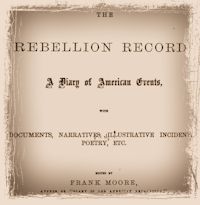
The Rebellion Record—A Diary of American Events; by Frank Moore

March 31.—Captain Jabez C. Rich, of Gorham, Me., of the rebel marine corps, was arrested in that place to-day, and conveyed to Fort Preble by Provost-Marshal Elliott, under orders of the Secretary of War. He claimed to be a paroled prisoner.—The Legislature of Virginia passed a bill authorizing the impressment of the saltworks in Washington County, Va., to be worked on State account.—Major-General Herron was assigned to the command of the National army of the frontier.—A large Union meeting was held at Washington, D. C, at which speeches were made by Admiral Foote, Green Adams of Kentucky, Mayor Wallach, and others, and resolutions were adopted in support of the National Government and for the vigorous prosecution of the war against all traitors at home and abroad. —National Intelligencer.

—President Lincoln issued a proclamation declaring all commercial intercourse not licensed and conducted as provided by law between citizens of the States now in rebellion, and those of the loyal States of the Union, to be unlawful, and would remain unlawful until such rebellion should cease, notice of which would be duly given by proclamation.—(Doc. 155.)

March 30.—President Lincoln issued a proclamation designating and setting apart Thursday, the thirtieth day of April, as a day of national humiliation, fasting, and prayer.—(Doc. 151.)

—The correspondence between the rebel agent in London, J. M. Mason, and Earl Russell, the British Minister of Foreign Affairs, concerning the questions of the blockade of the Southern ports, and foreign intervention in the affairs of America, was made public.—See Supplement.

—A battle was this day fought near Somerset, Ky., between a National force under General Gillmore, and the rebel army under General Pegram, resulting in a defeat and rout of the latter with great loss.—(Doc. 152.)

—Washington, N. C., garrisoned, by two thousand National troops under the command of General Foster, was attacked this morning by a strong force of rebels under Generals Hill and Pettigrew. The Union pickets and skirmishers were driven in with considerable loss, but the gunboat Commodore Hull opening on the rebels with shell, they were driven back to the hills surrounding the town, where they immediately commenced to fortify themselves.—National Intelligencer.

—Mount Pleasant, Va., was this day captured and plundered by a numerous band of rebel guerrillas under Colonel Jenkins. The town was garrisoned by a company of the Thirteenth Virginia volunteer infantry, under the command of Captain Carter. They intrenched themselves in the court-house, where they were attacked by the rebels, but after a four hours’ contest, in which the rebels had twenty killed, twenty-five wounded, and twenty-seven of their number captured, they hastily retreated from the town, many of them throwing away their booty.—(Doc. 153.)

—General McClernand took possession of the town of Richmond, Miss., with a small force, driving the rebel cavalry from the place after two hours’ sharp fighting.

— The rebel schooner Expeditious was captured in the Savannah River. The vessel was from Nassau, N. P., with a cargo of three hundred and forty sacks of salt, and attempted to run past Fort Pulaski up to Savannah. In the darkness she missed the channel and went into Calibogue Sound, where she was discovered at daylight A detachment of the Forty-eighth regiment was at once put on board the Mattano and despatched to secure her, which they did.

March 29.—The schooner Nettie was captured by the United States steamer South-Carolina, about twenty-five miles east of Port Royal, with a cargo consisting of cotton, mostly damaged.— A party of blockade runners was captured at Poplar Hill Creek, Md., by a detachment of the First Maryland regiment, under the command of Lieutenant J. L. Williams.

—A detachment of the Sixth Illinois cavalry, under the command of Colonel Loomis, while encamped near Somerville, Tenn, were surprised by a large force of rebel guerrillas under Colonel Richardson, but after a desperate conflict, in which the National party had over forty of their number killed and wounded, the rebels were beaten off and retreated.—Chicago Times.

—Early this morning the National pickets in the vicinity of Williamsburgh, Va., were attacked by an overwhelming number of rebel cavalry, killing two, wounding six—including Lieutenant Wingel, of the Fifth Pennsylvania, in command of the pickets —and taking three prisoners. Eight horses were killed, one of which received as many as thirteen balls.

March 27.—The following bill was this day presented to the Legislature of Virginia: “Be it enacted by the General Assembly of Virginia, That if any person buy any article of food (including salt) for man or beast, and withhold the same from market, or ask and receive more than five per centum commission or profit on cost and transportation, such person shall be deemed guilty of misdemeanor, and shall forfeit the article so bought—one half to the informer and the other to the Commonwealth: Provided, That this act shall not apply to market-men collecting supplies for daily city consumption, or to any person bringing such food from beyond the confederate army lines, or purchases for family consumption.

“This act shall be in force from its passage, and continue during the war.”

—Ant important debate took place in the British House of Commons, concerning the depredations of the rebel privateer Alabama.

—Jacksonville, Fla., was burned, after its evacuation, this day by the National forces under Colonel Rust.—(Doc. 148.)

—Colonel Talcott, of the rebel army, was arrested at New-York City.—The English steamer Aries, while endeavoring to run the blockade, was captured by the gunboat Stettin, off Bull’s Bay, S. C.—Robert Gay of company D, Seventy-first Indiana volunteers, convicted of desertion to the rebels, was shot at Indianapolis, Ind.—Fast Day in the rebel States.—Some clergymen in Norfolk, Va., attempted to hold service in their churches, in conformity with Jeff Davis’s fast proclamation, but were prevented from so doing by the Union soldiers in that place.

—This morning the United States steamer Hartford, the flag-ship of Admiral Farragut, engaged the rebel batteries at Warrenton, three miles below Vicksburgh, and passed below.

March 28.—The Legislature of Massachusetts adopted unanimously a resolution tendering to the soldiers of that State the thanks of the Commonwealth for the services they had rendered in the war for the restoration of the Union, and pledging such reinforcements to their support as the National authority should from time to time demand.—The National gunboat Diana, was this day captured by the rebels near Pattersonville, La.— (Doc. 149.)

Thiess morning Coles’s Island, nine miles from Charleston, S. C, was taken possession of by the One Hundredth New-York volunteers, under the command of Colonel George F. B. Dandy.— (Doc. 150.)

—The rebels burned the temporary bridge with which the National forces had replaced the Stone Bridge at Bull Run, Va. They also were engaged in collecting all the grain and other supplies they could obtain in Loudon and Fauquier counties in that State.

—The steamer Sam Gaty was stopped and boarded at Sibley, Mo., by a gang of rebel guerrillas who killed a number and robbed all of the passengers of their money and wearing apparel; captured eighty negroes, twenty of whom they wantonly killed, and destroyed a quantity of government stores. The boat was then allowed to proceed on her voyage.—(Doc. 161.)

—The expeditionary force of National troops under the command of Colonel Fairchild, of the Second Wisconsin infantry, returned to Belle Plain, Va., to-day after a successful foraging expedition to Northern Neck. One thousand pounds of pork, three hundred pounds of bacon, three thousand bushels of corn, and a large quantity of wheat, beans, and oats were secured. The cavalry portion of the escort seized a number of horses and mules, captured several prisoners, and broke up the ferries at Union and Tappahannock. The force also burned a schooner engaged in smuggling contraband goods into Virginia.—Baltimore American.

March 26.—A large and enthusiastic Union meeting was held this evening at Buffalo, N. Y. Resolutions firmly and decidedly for the support of the Government and the prosecution of the war until a peace was conquered, were unanimously adopted.—The Legislature of Maine adjourned, having adopted concurrent resolutions fully indorsing President Lincoln’s emancipation proclamation, approving the use of negroes in the military service of the United States, and opposing all suggestions of compromise.—An expedition sent to Rome, Tenn., by Gen. George Crook commanding at Carthage, Tenn., returned tonight, having captured twenty-eight prisoners, among them a rebel captain named Rice, together with seven wagons and thirty horses.—General Burnside issued an order assuming command of the Department of the Ohio.

March 25.—The United States rams Lancaster and Switzerland undertook to run the batteries at Vicksburg. As soon as they came within range, the rebels opened a tremendous fire. The Lancaster was struck thirty times. Her entire bow was shot away, causing her to sink immediately, turning a complete somerset as she went down. All the crew except two escaped. The Switzerland was disabled by a sixty-four-pound ball penetrating the steam drum. She floated down; the batteries still firing and striking her repeatedly, until finally the Albatross ran alongside, and towed her to the lower mouth of the canal. Both these gunboats were improvised from light-built wooden river steamers, and not calculated to sustain a heavy fire.

—Brentwood, Tenn., garrisoned by a force of National troops, numbering five hundred men, under the command of Colonel Bloodgood, was this day captured and sacked by the combined rebel forces of Wheeler, Forrest, Armstrong, and Stearns. After the capture, the rebel forces were pursued by a body of Union troops, under the command of General Green Clay Smith, and overtaken near Franklin, Tenn. The Nationals were inferior in numbers to their opponents, who were drawn up in line prepared to receive them, but they immediately made the attack, and, after a brief contest, they routed and drove them for a distance of five or six miles, killing and wounding great numbers of them. In their flight the rebels abandoned the whole of the plunder captured in Brentwood a few hours previous.—(Doc. 147.)

—This citizens of Savannah, Ga., were suffering greatly for the want of an adequate supply of provisions. Even corn-meal could be had only in small quantities. The railroads were forbidden to carry any food out of the town.

—Governor Brown, of Georgia, sent a message to the Legislature of that State, recommending the passage of an act restricting the planting of cotton to a quarter of an acre to each hand, under a heavy penalty. He also recommended that further restrictions should be put upon the distillation of spirits, so as to prevent the use of potatoes, peas, and dried peaches for that purpose. He was in favor of giving a cordial support to the rebel government.

—The Union fleet of iron-clad monitors and gunboats under the command of Admiral Du Pont, “left Hilton Head, S. C, to-day.

—The rebel schooner Clara was this day captured, while trying to run the blockade at Mobile, Ala., by the United States gunboat Kanawha.

—The British steamer Dolphin, laden with contraband of war, was captured by the United States gunboat Wachusett off Porto Rico.
March 24.—The rebel steamer Havelock, under the command of Captain L. M. Coxetter, ran the blockade into Charleston, S. C. A correspondent of the Mobile Register, gave the following account of her “narrow escape:” “She had run through the blockaders just before day, having left Nassau on the twentieth instant, bringing a most valuable cargo. After crossing the bar, however, she ran ashore on Drunken Dick Shoals, and it was feared the enemy’s gunboats would run in and endeavor to capture her, which might have been done at the time had they had pluck enough to have attempted it The confederate States rams Chicora, Captain Tucker, and Palmetto, Captain Rutledge, immediately got under weigh and went down to offer battle, should the enemy attempt a capture. There was evidently great commotion among the fleet, who could be seen rapidly signalizing each other. The battery was crowded by spectators watching events, and eagerly looking for some demonstrations on the part of the Federals, as our rams glided down to the scene of action. The British steamer Petrel, which had been delayed in rendering assistance to the French steamer Renaudin, which had just gotten off, was now seen going out at this time, passing Sullivan’s Island. Numerous sail-boats and barges were seen running down the bay, adding to the interest of the scene. For a time the greatest interest and excitement prevailed. By the assistance of the high tide, and after throwing overboard some ten heavy slabs of iron and about forty boxes of tin, the Havelock floated off and came safely up to the city, much to the chagrin of the Federals.”

—Ponchatoula, La., was this day captured, after a brief skirmish with the enemy, by an expeditionary force of National troops, under the command of Colonel Clark.—(Doc. 144.)

—The English schooners Mary Jane and Rising Dawn, while attempting to run into Wilmington, N. C, were captured by the gunboats State of Georgia and Mount Vernon.

March 23.—The treaty between the United States and Liberia was officially promulgated.— The schooner Charm was captured at the mouth of Indian River Inlet, Fla., by a boat expedition from the National steamer Sagamore.—The expeditionary force of National troops, under the command of Col. John D. Rust, which left Beaufort, S. C, on the nineteenth instant, arrived at Jacksonville, Florida, to-day.—(Doc. 148.)

March 22.—This morning, at ten o’clock, a scouting-party of fifty men, belonging to the Fifth Missouri cavalry, encountered Quantrel’s guerrillas near Blue Spring, Mo. A short skirmish ensued, after which the National cavalry retreated with a loss of nine killed, five missing and several wounded. The rebel casualties were not ascertained.—The steamer Granite City was captured off Eleuthera, Bahamas, by the United States gunboat Tioga.—Mount Sterling, Ky., garrisoned by a detachment of National troops, under the command of Captain Radcliff, was this day captured by a small body of rebel cavalry, under Colonel Cluke.—(Doc. 143.)