Following the American Civil War Sesquicentennial with day by day writings of the time, currently 1863.

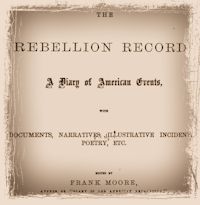
The Rebellion Record—A Diary of American Events; by Frank Moore

January 30.—The United States gunboat, Isaac Smith, under the command of Acting Lieutenant Conover, while reconnoitring in the Stono River, S. C, was fired into by three masked batteries of rifled guns, and, the vessel getting aground, was captured.—(Doc. 114.)

—A Party of National troops under the command of Colonel Wood, Twenty-second Ohio volunteers, left Trenton, Tenn., and proceeded to Dyersburg, where they broke up a camp of rebel guerrillas, under the leadership of Captain Dawson. Thirty-four of Dawson’s men were killed or captured, but he himself escaped.

—Yesterday one hundred conscript rebel soldiers went into Murfreesboro, Tenn., and voluntarily surrendered themselves, declaring their attachment to the Union, requesting the privilege of taking the oath of allegiance, and to-day two hundred more followed their example.

—The schooner Hanover of Provincetown, Massachusetts, was captured off the south side of San Domingo by the rebel schooner Retribution.—Boston Traveller.

—A fight took place at a point nine miles from Suffolk, Ya.,.known as the “Deserted House,” between a force of Union troops under General Corcoran, and a body of rebels under the command of General Roger A. Pryor, resulting, after a desperate struggle of three hours’ duration, in the retreat of the rebels. The loss in this affair was about equal on both sides.—(Doc. 115.)

January 29.—The British iron steamer Princess Royal, laden with rifled guns, arms, ammunition, steam-engines, etc., was captured off Charleston, S. C, while attempting to run the blockade,—(Doc. 112.)

—The Senate of Missouri passed the resolution of the lower House asking the Congress of the United States to appropriate twenty-five millions of dollars for emancipation purposes in that State, by a vote of twenty-six yeas to two nays.—General Banks at New-Orleans, issued a general order promulgating the confirmatory Emancipation Proclamation of President Lincoln.

—A fight took place at Bear River, Washington Territory, between a force of Union troops under the command of Colonel Connor, and a large body of Indians, resulting, after a bloody contest of four hours’ duration, in a rout of the Indians with great loss.—(Docs. 113 and 142.)

—The first decision under President Lincoln’s Emancipation Proclamation was made in St. Louis by Judge Glover, who decided in favor of its legality, and ordered the discharge of the slave of a rebel who had been arrested under State law for leaving his master. This decision, if sustained, would leave Missouri secessionists without civil authority to reclaim their slaves.—General McClernand’s forces landed on the Louisiana side of the Mississippi River, five miles below the mouth of the Yazoo River, and in full view of the city of Vicksburgh.—Missouri Republican.

—The Emancipation Society of London, England, held a meeting at Exeter Hall, which proved to be one of the most important demonstrations of public opinion known in London since the days of the League. For half an hour before the time appointed for the commencement of the proceedings the great hall was crowded, and it became necessary to hold a second meeting in the lower hall, while a third meeting was held in the open air, in Exeter street. The name of Abraham Lincoln was received with immense applause, the audience rising and cheering and waving their handkerchiefs. During the course of the proceedings, the chairman received telegrams from Bradford and Stroud, announcing that meetings were being held in those towns, and that resolutiond had been passed in favor of negro emancipation. Resolutions sympathizing with the cause of the North, and advocating the policy of the President of the United States were adopted, and speeches were made denunciatory of the South, and the London Times.—London Daily News.

January 28.—At St. Louis, Mo., a large and enthusiastic meeting was held this evening to ratify the Emancipation Proclamation of President Lincoln. Speeches were made by Charles D. Drake and others, and a poem contributed to the meeting by W. D. Gallagher, was received with unbounded applause and approbation.—St. Louis Democrat.

—Brigadier-general Schofield from his head-quarters at Springfield, Mo., sent the following message to General Curtis: “Colonel Harrison telegraphs from Fayetteville the success of a scout just returned from Van Buren, Mo., having captured the steamer Julia Roan and three hundred prisoners, about two hundred of whom were paroled. The scout consisted of one hundred and thirty men of the First Arkansas cavalry and Tenth Illinois cavalry, under command of Lieutenant-Colonel Stewart. No loss on our side. On that of the enemy, two killed and several wounded.—A heavy snow-storm prevailed on the Rappahannock River, which, partially melting as it fell, put the roads in an indescribable condition.

January 27.—Bloomfield, Mo., was visited by a party of the Sixty-eighth Missouri militia, under the command of Colonel James Lindsay, and a large number of rebel guerrillas were driven out of the town, with a loss of fifty-two prisoners, seventy horses with their trappings, and nearly one hundred stand of arms. The Unionists met with no loss.—Col. Lindsay’s Despatch.

— Fort McAllister, on Genesis Point, Great Ogeechee River, Ga., was attacked by the ironclad monitor Montauk, under the command of Captain John L. Worden, three gunboats, and a mortar-schooner, but after a bombardment of many hours’ duration, they failed to reduce it.— Savannah News.

—A. D. Boileau, the proprietor of the Philadelphia Evening Journal, was this day arrested by order of the National Government and taken to Washington.—An enthusiastic Union demonstration took place at Fayetteville, Ark.—Captain Williamson of General Weitzel’s brigade, had a fight with a small body of rebel troops at Indian Village, on Bayou Plaquemine, La., and succeeded in routing them without any material loss to the Nationals.—New-Orleans True Delta.

January 26.— Major-General Joseph Hooker, having been appointed to succeed Major-General Burnside, assumed the command of the army of the Potomac, and issued general orders to that effect from his headquarters at Falmouth, Va.— Major-Generals W. B. Franklin and E. V. Sumner relinquished their commands in the army of the Potomac—At Vicksburgh, Miss., the gunboat Chillicothe was engaged in shelling the lower rebel batteries, without provoking a return fire.

—Early this morning a party of rebels in ambush, commanded by a lieutenant of the Second South-Carolina infantry, attacked a scouting-party of twenty-one men from Colonel Do Cesnola’s cavalry brigade near Morrisville, Va., killing a scout named Michael A. Fagan, company C, Fourth New-York cavalry, and wounding another scout named Dixon, of the Ninth New-York cavalry.—New-York Times, February 1.

— The bark Golden Rule, Captain Whitebury, belonging to the Panama Railroad Company, was captured by the privateer Alabama, fifty miles south of St. Domingo. The Alabama sent a boat’s crew on board the ship, and the captain was asked if his cargo belonged to neutral owners. He replied that it did, whereupon Semmes demanded the evidence of the fact. This could not be produced, as the captain had not even a bill of lading to show that his cargo was shipped by neutrals. Semmes informed him that if he had even a consular certificate that any portion of his cargo was the property of neutrals, he would let him depart unmolested. In the absence of such evidence the officers and crew were removed to the Alabama, portable articles of value were taken, and the ship set on fire and destroyed. The captain was allowed the liberty of the ship, but the mates and crew were placed in irons. The captain was treated with great kindness, and all hands safely landed at the city of St. Domingo.

—A short skirmish took place at Woodbury, Tenn., between General Palmer’s division of Grant’s army and seven rebel regiments, resulting in the defeat and rout of the latter, with a loss of thirty-five killed, including a rebel colonel, and over one hundred prisoners. General Palmer had two killed and nine wounded.—At Mendota, Illinois, a grand Union meeting was held at which resolutions were adopted and speeches were made indorsing the action of President Lincoln and the Emancipation Proclamation.—Chicago Tribune.

—Inthe rebel Congress in session at Richmond, a desultory debate occurred on a resolution introduced by Mr. Crockett of Kentucky, with reference to the conditions on which peace should be negotiated. Mr. Foote of Tennessee indicated the claims and interest which Maryland would have in such a negotiation, as the faith of Congress had been pledged that peace should not be concluded without securing to her a free election of what her position should be. He expressed continued faith in the loyalty and patriotism of the people of Maryland, and thought that no more prejudice should attach to the position of this State than to that of Kentucky and Missouri. He ridiculed the idea of a Border Confederacy. He was not in favor of any political confederation with the States of the North-West. He had been misrepresented in this respect. He was in favor of a military league, offensive and defensive, with any one of the North-Western States that would lay down her arms, and he would assist and protect such State against the power of the Lincoln Government. He thought that by proper influences and methods the North-West could be disjointed from New-England and the Middle States in this war in less than sixty days.

After touching a number of topics in connection with the probable event of a negotiation for peace, Mr. Foote said he was not prepared to discuss the whole subject within the confines of the present resolution before the House, but that he would at a future time submit some enlarged resolutions on the subject.—Richmond Examiner.

Governor Vance of North-Carolina, issued a proclamation commanding the soldiers of that State who were illegally absent from their regiments in the rebel army, to return to duty on or before the tenth day of February, under pain of being tried, and, upon conviction, executed for desertion.

January 25.—The organization of the First regiment of colored South-Carolina loyal volunteers, was this day completed.—General Saxton, in announcing the event to the Secretary of War, said: “The regiment is light infantry, composed of ten companies of about eighty-six men each, armed with muskets and officered by white men. In organization, drill, discipline, and morale, this regiment, for the length of time it has been in service, is not surpassed by any white regiment in this department. Should it ever be its good fortune to get into action, I have no fear but it will win its way to the confidence of those who are willing to recognize courage and manhood, and vindicate the wise policy of the Administration, in putting these men into the field, and giving them a chance to strike a blow for the country and their own liberty. In no regiment have I ever seen duty performed with so much cheerfulness and alacrity; and as sentinels, they are peculiarly vigilant. I have never seen, in any body of men, such enthusiasm, and deep-seated devotion to their officers as exists in this; they will surely go wherever they are led. Every man is a volunteer, and seems fully persuaded of the importance of his service to his race. In the organization of this regiment, I have labored under difficulties which might have discouraged one who had less faith in the wisdom of the measure; but I am glad to report that the experiment is a complete success. My belief is, that when we get a footing on the main land, regiments may be raised, which will do more than any now in service to put an end to this rebellion. I have sent the regiment on an expedition to the coast of Georgia, the result of which I shall report for your information, as soon as it returns.”—General Saxton’s Report.

—A party of rebel cavalry attacked a train on the Nashville and Chattanooga Railroad, at a point nine miles below Nashville, captured and paroled fifty prisoners, and made an attempt to burn the cars, but National reinforcements approaching from different points, they left, after causing a partial destruction of two platform cars.—The obsequies of the rebel Major C. R. Wheat, were celebrated at Richmond, Va. — A battalion of Colonel Mix’s New-York cavalry surprised an important rebel picket station on the road from Newborn to Kinston, S. C, and captured nine rebel soldiers, with their arms and accoutrements.

January 24.—General Dodge, commanding the military district of Corinth, Miss., reported that the rebels were putting to death many of the inhabitants of his district, for the only reason that they were loyal and Union-loving people. He gave the names of several who were hanged, others who were hunted down by bloodhounds, and of others whose houses were burned over their heads.—(Doc. 111.)

—The steamer Warsaw, while on her way to Memphis, was fired into by a rebel battery of two guns, at Island No. 84, on the Mississippi River.—Brigadier-General Daniel S. Donelson was appointed to the command of the rebel department of East-Tennessee, in the place of General E. Kirby Smith.—Richmond Whig.

January23.— A band of Tories, (loyalists,) about seventy in number, “under an outlaw named Taylor,” were this day attacked by a body of rebels under Colonel Folk, in Johnson County, East-Tennessee. “The Tory cavalry and infantry were parading in a field near the Fish Springs. Colonel Folk ordered his men to swim the river and charge them. The Tories seeing this, abandoned their horses and took shelter upon the summit of a large ridge. Folk’s men were then dismounted, and charged up the ridge, completely dispersing the Tories. All of their horses were captured. Four of the Tories were killed, and a number wounded, and captured. The captured were immediately hung, by order of Colonel Folk. Taylor was killed.”—Richmond Dispatch.

—A severe snow-storm prevailed at Staunton, Charlotteville, and other points in the Shenandoah Valley, Va.—The National army and gun boats at Arkansas Post, Ark., having blown up the fortifications and demolished every thing that could be made a means of offence or defence, evacuated the place and proceeded to Vicksburgh.—Simon Cameron resigned his position as American Minister to Russia.

January 22.—The second attempt on the part of the Union army of the Potomac, under the command of General Burnside, to obtain possession of the southern bank of the Rappahannock as a base of operations against Richmond, was unsuccessful. The attempt was foiled by a rainstorm, which made the roads impassable.—(Doc. 110.)

—The brig Windward was captured and burned by the rebel privateer Oreto, off Cuba,—John Gill Shorter, rebel Governor of Alabama, issued an address to the people of that State, urging them again to come forward in the defence of the Southern government, and expressing the hope that none would “be permitted to hide under cover of home from their appropriate duty.”— See Supplement.

January 21.—Governor Vance of North-Carolina, sent a message to the General Assembly of that State, then in session, informing them that since their adjournment the invaders of their State had concentrated a large force upon the coast, and were threatening their remaining seaports and lines of communication; that every preparation possible had been made to resist the invaders, and, he hoped, not without success. But still, that much remained to be done to strengthen their army and add to its efficiency; he, therefore, offered a few suggestions to them on that subject (Doc. 108.)

—The National ship of war Morning Light, together with the schooner Velocity, which were blockading the Sabine Pass, Texas, were surprised and captured by the rebel steamers Josiah Bell and Uncle Ben.—Colonel J. B. Douglass, commanding the Sixty-first regiment of Missouri volunteers, from his headquarters at Columbia, Mo., sent the following to General Curtis: “Late this evening, a body of troops under my command, whilst on a scout and some nine miles from my headquarters, found a confederate camp, with tent and all the necessary appurtenances thereto, containing eight confederate captains. The camp was situated in a very brushy country; consequently they escaped from their tent, my men following, and eventually succeeding in capturing four of them, after a brief resistance. We got all their arms, camp equipage, etc. The lateness of the attack prevented us from capturing the whole of them. My men camped on the ground. We also succeeded in capturing two of Porter’s men in addition.

“I regret to say that two of my bravest troops got seriously wounded in the fight before we captured the four rebel captains. They never surrendered until they had exhausted all their shots, they being armed with double-barrelled shot-guns, in addition to navy revolvers.

“You can now see why I object to this indiscriminate release of bad men from prison, and why you should not permit banished men to return here.”

—Colonel S. H. Mix, Third New-York cavalry, with eight companies of his regiment, returned to Newbern, after a successful scouting expedition into Onslow, Trent, and Jones counties, N. C. He obtained much valuable information, had several skirmishes with the rebels, routing them on every occasion, captured a number of prisoners, arms, mules, etc.—(Doc. 109.)

—The schooner Ettiwan, while attempting to run the blockade out of Swash channel, Charleston harbor, was captured by the gunboat Ottawa, under the command of Lieutenant William D. Whiting.—The rebel Lieutenant-Colonel Hutchinson, with one hundred men of Morgan’s cavalry, made a descent upon Murfreesboro, Tenn., and captured a large party of National troops and carried off thirty wagons.— (Bragg’s Despatch.)

—Galveston, Texas, being occupied by rebel troops who were engaged in erecting defences in and around that city, Commodore H. H. Bell, commanding the blockading fleet off that port, issued an order warning the foreign consuls and foreign subjects and all other persons concerned, that the city of Galveston and its defences were liable to be attacked at any day by the forces of the United States under his command, and gave twenty-four hours for “innocent and helpless persons” to withdraw.—Fitz-John Porter was cashiered and dismissed the service of the United States.

— At Ashton, England, Milner Gibson, M.P., President of the British Board of Trade, delivered an address to his constituents reviewing the position of England toward the United States. He alleged that slavery was the main cause of the war by inducing even secession for its defence. He urged England to adhere to her neutral course in the strictest manner, and denied the wisdom of foreign mediation, intervention, or a “hasty recognition” of the “so-called confederates.” In this connection Mr. Gibson recited statistics setting forth the largely increased imports of breadstuffs and provisions from the United States to England during the year just ended, and warned his hearers that if the Executive involved their country in a war with the United States their first act should be to blockade the American ports, and thus cut off this immense and vital supply from the starving operatives of Lancashire.