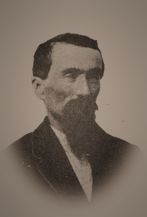
December 23 — Very cold last night and to-day. Nearly the whole company was busily engaged in building houses for winter quarters. Each mess puts up its own domicile. However, I am building one of my own without a chimney, as I have sworn off from the chimney-building business for this winter; I will be a boarder with my mess, but I furnish my own lodging.
Three Years in the Confederate Horse Artillery — George Michael Neese.
December 22— We renewed our march this morning, but made little progress, as it took us the entire day to march six miles. Our horses stalled at every hill on the road. At one place one of the drivers became so vexed and aggravated at his balking horses that he dismounted and drew out his pocket knife with the determination to cut their throats; however, before he proceeded with the deadly operation he asked me what I thought of his intention. I told him it was most too late in the campaign, and that we were near the end of our march for this year, for anything of that kind. He hesitated a moment, with his knife open and ready to cut. I saw that he was in earnest, so I advised him not to commit the rash deed, as it might prove to be a serious affair in the end, when the officers of the company heard of the murder. He then put his knife in his pocket and went to work on his horses with a hoop pole.
We forded the north fork of the Rivanna this morning, which took us just three hours, in consequence of the ford being very icy and the south bank on coming out place slippery and very steep. One of our artillery horses fell down in the middle of the river and was very near being drowned before we could extricate it from the harness. One of the cannoneers stripped off his clothes and plunged into the icy water and assisted the struggling horse to rise from its perilous submerged situation. Late this evening we crossed the south fork of the Rivanna at Rio bridge on the Earleysville road, five miles from Charlottesville. We are camped this evening in a woods on the Earleysville road, about four miles from Charlottesville, and at the place of our intended winter quarters.
December 21 — This morning we were ordered to Charlottesville, to go into regular winter quarters, sure enough. We left our house and chimney on the Rapidan and marched to Orange Court House; there we fell in with the remainder of the battalion of horse artillery, and struck out for Charlottesville. The roads are in a bad condition, the hills are rough, and the low places are deep with mud.
Some of our artillery horses are weak, worn out, worthless or false; they stalled several times during the day, and we had to push, pull, and start the pieces by man motor. Beautiful work and very desirable for an artillery man on a cold day, to push at a wheel thickly covered with two kinds of freezing mud. We passed through Summerset, Barboursville, and Stony Point. The latter place is merely a post office in Albemarle County, ten miles northeast of Charlottesville. We marched till ten o’clock to-night, and camped one mile west of Stony Point and near the North Rivanna River. The country along the Rivanna is very hilly.
December 17 — Rained all last night and to-day. A cold freezing wind blew from the north all night and froze the rain into a slippery sheet of ice nearly as fast as it fell. I got wet from top and bottom in bed, the torrents of rain that fell causing the water to run under me, which rendered my bed so uncomfortable and disagreeable that I had to leave it and seek the comforts of a camp-fire long before day. I was working in the rain all day, carrying rocks up a steep slippery hill for a chimney to our house, and by the holy Joshua, if we have to leave this house in a few days, like we did the first one we built, I build no more chimneys this’ winter.
December 16 — We were busy to-day building quarters again, but we are getting rather discouraged with the building business, as we had to leave our houses that we built a few days ago the very next day after we finished them, and we have no positive assurance that we will remain here more than a few days.
December 15 — As wood was very scarce where we camped last night, we moved this morning, and we are now camped little below Barnett’s Ford, right on the bank of the Rapidan.
December 14 — General Lomax moved camp to-day to the south side of the Rapidan near Barnett’s Ford. We moved up the river and are now camped a mile south of Barnett’s Ford.
December 13 — We had copious showers of rain last night, with a strong south wind, but the weather today was warm, clear, and pleasant. This morning our battery was ordered to report to General Lomax again, and at ten o’clock we left and started for Lomax’s camp. We passed through Orange Court House and moved out on the Rapidan Station road till we arrived within about a mile of the river, where we were informed that the Rapidan is not fordable on account of the recent heavy rains. We halted then, and here, and camped. General Lomax’s camp is on the north side of the Rapidan.
December 7 — As we have very few tents, nearly the whole company was engaged in the peaceful avocation of building quarters to-day.
December 3 — This morning we were ordered back to camp with General Lomax’s Brigade. The brigade moved back to the same camp it occupied previous to the enemy’s recent advance. The camp is on the north side of the Rapidan, one mile below Barnett’s Ford, and on the south side of the Robinson River. We arrived at General Lomax’s camp this evening after dark. We forded the Rapidan at Paton’s Ford; the current of the river there is rapid and the ford is very rough and rocky. This morning we passed the winter quarters of a brigade of infantry. The camp is laid off in regular streets like a town, and the houses are all built of logs, with the interstices neatly and tightly daubed with clay, which make the houses all appear very comfortable. Every house has a fireplace, with a shapely chimney plastered on the outside with mud.


