July 16.— Started from Burkettsville and marched about four miles, when we encamped for the day. Our headquarters were at Mr. West’s house, our tents being pitched in a pleasant, shady spot in his front yard.
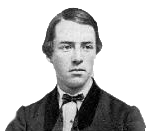
War diary and letters of Stephen Minot Weld
July 15.— Received orders to march to Berlin. We marched to Keedysville, and from there to Crampton’s Gap. Our corps did not go through the Gap, but headquarters were at Burkettsville on the other side of the Gap. Day pleasant most of the time. The march was long and tiresome, as other corps were ahead of us.
Headquarters 1st Army Corps,
Camp near Williamsport, July 14.
Dear Hannah, — Johnny Reb has got away from us again, I am sorry to say. They left our front last night, and crossed the river in safety. It is too bad, but I don’t well see how it could have been helped, as it would have been utterly useless for us to have attacked their position with the few men we had. I suppose now that we shall wait here until we get our conscripts, and then move on them again, and have another campaign in that godforsaken, desolated country of Virginia. It is rather discouraging, but I think we ought to be satisfied with having driven them successfully out of Pennsylvania. General Meade has certainly done all that a man could do with the few men under his command. The enemy occupied a strong natural position here, made almost impregnable to our small force by fortifications.
Without disparaging General Meade, one can’t drawing a parallel between McClellan’s campaign at Antietam last year, and this present one. In both of them we whipped the enemy, but he succeeded in crossing the river safely. It seems to me that God has so ordered it that everything should turn out to show that General Geo. B. McClellan was right in his campaigns, and that he acted as every true soldier would act.
I am an acting aide for General Newton, and shall probably remain with him. All the other aides report to the Adjutant-General of the Army.
Please direct your letters to me, as before, to headquarters 1st Army Corps. . . .
July 14.— Went to bed last night wondering whether I should not be waked up by shells, etc., in the morning. We heard none, however, and soon found out that the enemy had evacuated. All the corps were put in motion for Williamsport. I went through Hagerstown and saw lots of pretty females. I met Mrs. Porter there, also. Our corps went on to within a mile of Williamsport, where we established our headquarters at a house owned by Mr. Findlay.
July 13. — General Wadsworth went to a council of war last night, and the opinion is that they voted not to attack the enemy to-day. The vote was as follows, I believe. Against it were General Sedgwick, French, Hays, Slocum; and in favor, Generals Wadsworth, Pleasonton, and Howard. General Meade was also understood to be in favor of an attack. It rained all day long, and the only excitement we had was from the rebs opening on us with artillery. They fired four or five shots, and then subsided. I rode along our lines this morning. Had our tents pitched. Briggs’s brigade joined us this evening.
July 12. — Sunday, and therefore a day to expect a battle. We did not have it, however. Our corps started in the morning with orders to hold Funkstown Heights. The weather was sultry and disagreeable and, although we had not more than three or four miles to march, we found it quite fatiguing. The Eleventh Corps got ahead of us, and we had to wait about three hours for them. Just before entering Funkstown, we found the enemy’s rifle-pits, which they evacuated last night. The town is just like all Maryland towns. After entering the village, we turned to the right, and crossed the Antietam on the Hagerstown pike. We formed our line on the left of the Eleventh Corps, which formed our extreme right resting on Antietam Creek. On our left we joined the Sixth Corps. Our men built rifle-pits all along the line, and were prepared for an attack, although these measures were merely precautionary. Our line was a very strong one indeed, running parallel for a long distance to the Hagerstown and Sharpsburg pike, and then crossing it on the left, and running towards the river. The enemy’s line was not much over 1000 yards from ours, the skirmishers of both parties being sharply engaged almost all the time. The general was sick to-day, and in the afternoon General Wadsworth assumed command of the corps. I rode into town to get some supper, and met Secretary Cameron and General Reynolds’s brother, at a house in town. We had a severe thunder shower in the afternoon.
July 11. — The Maryland Brigade under General Kenly joined us to-day, and was assigned to Rowley’s division, thus putting Kenly in command of the division. Nothing new occurred to-day. Weather warm and sultry. A regular dog-day. General Newton went to a council of war this evening.
July 10. — Started at 6 A.M. and moved to a position beyond Beaver Creek, and about 5 miles from Boonesboro. Our cavalry had a fight with the rebels, and drove them. We took up our position on the right flank of the Sixth Corps. Saw Whittier to-day. Skirmishing going on all day. We bivouacked at night in the woods.
July 9. — We remained here during the day. I rode over the mountain where our corps was, and learned all the roads. Our tents were pitched this afternoon. Headquarters of the Army of the Potomac moved up to the Gap to-day. Egbert returned this afternoon, having escaped from the rebels. Day pleasant. Sixth Corps moved through the Gap to the front. Saw the 1st Massachusetts Cavalry.
Headquarters 1st Army Corps, MD., July 8, 1863.
Dear Father, — I joined the corps this morning at Middleton, where we now are, about 8 miles from Frederick. I reported to General Newton, who is in command of the corps, and shall stay for the present with him.
On my way back from Philadelphia and while at the Eutaw House in Baltimore, I met General Butterfield, who was wounded slightly in the breast. He said that he would like me to go with him when he came back. I told him that I was trying to get on to Sedgwick’s staff, but if not successful would be happy to go on to his staff.
On my way here from Frederick, I passed the body of a spy hanging to a tree. He was stark naked and was a most disagreeable object, as he had been hanging there for two days. Our cavalry captured him and hung him immediately. He was a man who had been selling papers, etc., in our camps, and when caught was leading the rebel cavalry to our trains. . . .
What glorious victories we are having! I really begin to think now that we are soon to see the end of this war.


