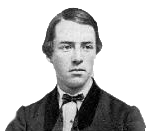
May 9. — Weather warm and pleasant. Went over to headquarters to try Lieutenant Oliver’s horse. Major Spaulding’s detachment went into camp with their regiment. Enemy’s tents visible in the same place as before. General Stoneman’s force crossed the river safely, and so the canvas pontoon train returned to camp.
War diary and letters of Stephen Minot Weld
May 8. — I went over to the headquarters of Whipple’s division this morning, and saw Dalton. He told me that General Whipple had died from the effects of his wound. Gave me my shoulder-straps. Went to Griffin’s headquarters and saw Batchelder, who told me that he could get me a place on General Crawford’s staff as aide. Was waked up early in the morning (4 A.M.) to send Captain Lubey and his canvas train up to Kelly’s Ford to meet and cross over General Stoneman and his cavalry. The animals for the train arrived at 9 minutes of 8, and the train started at 8.15 A.M. Went to General Stoneman’s headquarters in the evening. Heard here when I came back that was to be relieved. Day cloudy.
Headquarters Engineer Brigade,
Camp near Falmouth, VA., May 7, 1863.
Dear Father, — We are back again from the front and in our old position near headquarters of the army. The whole army has likewise re-crossed the river, and are occupying their old positions. The loss in killed, wounded and prisoners will be about 10,000 men, as nearly as I can judge. From what I can see and hear, I should think that Hooker’s plan was a good one, but he was unable to carry it out on account of the superior numbers of the enemy who were reinforced from Petersburg, Richmond, and, I think, even from Tennessee. They have shown their accustomed vigilance and activity, and have rather got ahead of us again. Hooker’s plan was to turn their left, but they quickly massed their troops there, and by their superior numbers and through the disgraceful behavior of the Eleventh Corps, they compelled us to halt, and use the much despised (by us) shovel and spade for our defence. We were not whipped anywhere, and I think their loss was much greater than our own. The chief mistake that was made, was abandoning the heights of Fredericksburg after we had once taken them, and in underestimating the force opposed to us. As far as I can see, the soldiers are not disheartened, although the unsuccessful termination of this affair will, I am afraid, injure General Hooker, who was, as it were, on trial for ability to command this army.
I will try and give you an account of what our brigade has done during this move. On the morning of the 29th, 5 bridges were laid. On the 30th, 2 bridges were taken up and started for Bank’s Ford, General B. and his staff going with them. We remained here six days, laying the bridges Sunday and Monday. Fourteen bridges were laid during this move. On Sunday I crossed Bank’s Ford with Captain Clapp and went up to General Sedgwick’s corps, who were engaged in a fight. I saw the whole affair. A brigade charged and drove the enemy to Salem Church, where they made a stand and drove our forces back to their original position.
In regard to General ——, I would say that I received your letter to-day and shall certainly leave his staff as soon as I can get a chance. Major Whittier of General Sedgwick’s staff has been trying to get me a place there, but I am afraid that I can’t get it, as General S. says that it would be a rude thing for him to take me away from General Benham. They were talking about General B.’s affairs, and my name was mentioned in reference to it. General Reynolds who was present spoke a good word for me, and told General Sedgwick that whatever I said could be relied on. Whittier is still trying for me, and I hope will succeed. Please be careful and not have anything written to General S., as I would prefer him to select me, if he should do so, of his own choice and not through any pressure brought to bear on him by his friends. I am very much obliged to Miss Sedgwick, and am glad that she was kind enough and took enough interest in me to write the general, but of course I don’t want him to think that I am writing home and trying to get his friends to get the place for me. You can understand how I feel, and of course will do nothing out of the way in that respect.
General Benham is not in the habit of getting drunk, as far as I know, and I do not think would have been so the other night were it not for his fatigue, etc. Still, I am not willing to be with any man who is at all liable to any such failing. You know Rosecrans charged him with the same thing. General Benham is a man whom every one hates and laughs at, and I can assure you my place is not pleasant with him. Please say nothing about what I have written about him.
General Reynolds told me, some three weeks ago, that he was glad that I had got a place, but as he afterwards told Whittier, he did not say he was glad that I was with ——, as he knew I would not like him. General B. has tried to make me say that he was not —— three times, but each time I have told him to his face that he was, and have given him my reason for so saying. His want of delicacy and tact disgusts me. He jokes with the privates and tries to cotton to them; but as he passes them, the staff see them laughing and making jokes about him. It is not pleasant, I can tell you. The contrast between him and General Porter is not favorable to the former.
As soon as I can learn in regard to our next move, I will write you.
May 7.— Day cloudy, but not rainy. Went to headquarters in the morning. We received an order to have everything ready for a move this afternoon, and from the aspect of affairs I should judge that we were to move to-night, and lay the bridges at Franklin’s Crossing. The order was revoked this evening for our crossing the river to-night. The President and Halleck were here this morning, and went away in the evening. There was a great feeling of relief when we found that we were not to cross the river immediately.
May 6. — Came to camp early in the morning. Slept during the day. The last boat was taken out of the river at Bank’s Ford at 11 A.M. No pursuit of our army was attempted. Day rainy and disagreeable. I received a letter from Frank and Hannah. Also from Uncle Oliver. Read a paper for the first time since the movement began. Trains from Bank’s Ford arrived late at night.
May 5. — The whole of Sedgwick’s corps got across by 4 A.M., the enemy shelling at random, but not injuring any one. The night was dark and foggy, and favorable for taking up the bridges, which were swung round dismantled during the mist, the boats being drawn up the ravines under cover. During the day the enemy shelled us, throwing some shells over two miles. In the afternoon we started for United States Ford, having sent our wagons back to headquarters. We reached the ford at about 3.30 o’clock, and I was sent forward in a pouring rain to General Hooker, whom I found 3 miles out. He said that General Benham might return to camp. We found that the whole army was going to retreat during the night. On the way up, we passed all the wagon trains of the army on their way to Potomac Creek. We left United States Ford at 5 o’clock, and I went ahead. On arriving at the railroad, I found the creek so swollen that it could not be forded, so I went back to Falmouth, and spent the night with John Perry.
May 4. — General Benham received orders to build another bridge, which he managed to do with the remnants of two trains. It took some six hours to finish the bridge, and before it was done the enemy began shelling it, sending their shot and shell disagreeably near the bridges, but luckily not hitting them. One sergeant of the 15th [New York Volunteer Engineers] was killed. The enemy got in Sedgwick’s rear, and retook Fredericksburg. Sedgwick was hard pressed on all sides, and during the night sent for General Benham, when it was decided that he should retreat.
May 3. — The enemy evacuated the ford to-day, and General Benham laid one of the bridges. After he had done so, he received a telegram ordering him not to lay it. The other bridge was ordered to United States Ford, where it went with Colonel Colgate, and sixteen boats. General Sedgwick carried the heights behind Fredericksburg this morning, and made his way up as far as B.’s Ford, on the plank road. About 5.30 I went across the river, and saw his men attack the enemy posted near Salem Church. We were driven back. General Hooker telegraphed in the morning that he was driving the enemy, and that he only needed Sedgwick to make his victory complete.
May 2. — General Reynolds’s corps moved up to-day from the left to United States Ford. Captain Lubey came here in the evening. He said that the canvas pontoon train was used at Kelly’s Ford, where three corps crossed on it. General Benham sent me to General Hunt,[1] to ascertain whether he considered himself in command here. General Hunt said that he did. There was heavy firing on the right in the evening, which turned out to be the enemy attacking the Eleventh Corps, which ran disgracefully.[2] Day was pleasant, and in the night we had the moon, which is now almost full. General B. spoke to me again about the occurrences of April 28 and 29, and I had to tell him my opinion again. Captains Strang and Nares were here to-day.
[1] General Hunt was Chief of the Artillery.
[2] May 2 was the second day of the battle of Chancellorsville.
May 1. — We travelled all night with our pontoon trains, reached Bank’s Ford at 6.15 A.M., and found that the enemy had not evacuated the ford. During the day we put the road leading to where our bridges were to be placed, in repair. General Hunt came up during the day, with orders to protect the ford, and keep the enemy from crossing. We were stampeded in fact, and the few men that we had with us in our brigade were ordered out on picket-duty at the ford. The day was pleasant, and reminded me very much of May Day at home. As we lunched in the woods, the presence of ladies was alone wanting to make one think that he was on a picnic. We had three tents with us. Captain Clapp and I slept in the ambulance. No alarm during the night.


