Cloud’s Mills, March 18, 1862.
Dear Father, — I think we are going up Pocosin [Poquoson?] River, a small river just behind Fort Monroe. This is confidential.
Cloud’s Mills, March 18, 1862.
Dear Father, — I think we are going up Pocosin [Poquoson?] River, a small river just behind Fort Monroe. This is confidential.
Friday, March 14. — We started for here last Monday morning, and have been here ever since.
Fairfax Court House, March 13, 1862.
Dear Father, — . . . The President’s Proclamation[1] is liked very much by all the officers I have seen.
I have got the box here, and daily tickle the palates of myself and brother officers with the different things you were kind enough to send me. I will see that the stockings go to the soldiers, etc.
Coming in from Hall’s Hill yesterday I was struck with the picturesque scene which I saw in the village. It was about half an hour from sundown, the air soft and balmy as could be, and resembling some of our delightful autumn or spring days. It was just the hour when the camps are busiest, and present their most lively appearance. First we came to a cavalry regiment with their horses fastened to a long rope stretched along parallel with the road, and eating their supper, neighing, biting and snapping at each other. On my right was an undulating space cleared of all trees and with some slight breastworks put up by the enemy. This large plain was covered with camps full of life and activity, soldiers marching to a review by McClellan, with bands playing and their colors flying, and a hum arising from those not yet in ranks. All this was delightful to me, but to one who is accustomed to it, it loses its beauty in a great degree. Following this road till I came to the turnpike, I turned to the right, and came on a scene which I thought must resemble some European city. Here were all these old-fashioned houses, with queer windows and porches, guards before many of the doors, and soldiers in many cases sitting in the porches talking with the women of the house. The street was full of soldiers in every imaginable attitude, and in performance of all sorts of duty. Here was the provost guard clearing the stragglers from the street, there a man with two oxen who would go in opposite directions and he in despair, for no sooner would he get them straight than some band of soldiers would on their march come across his path, to the infinite delight of the by-standers. Then again all the soldiers would be talking in groups, which seemed quite picturesque from the variety of uniforms. Sutlers’ wagons, ambulances, baggage trains and a large corral of cattle also appeared. I never was so well pleased with any such sight and would have given a great deal if I had been able to sketch it.
What I wrote you about McClellan the other day was this. A cabinet meeting was held, so I heard, and an angry discussion took place, most of them at first being in favor of turning McClellan out altogether and putting McDowell in his place (in the Army of the Potomac), but on second thoughts they determined to confine McClellan’s command to the Army of the Potomac. The President then told McClellan that he would be turned out if he did not advance, and hence this advance was made. This came from a source hostile to McClellan and I have good reason to think is exaggerated. The President I know ordered the advance, but I doubt if the whole of the story is correct. McClellan’s plan was, I think, to go to Richmond by water, a much more practicable, less expensive and quicker method of doing the business. It may be done so yet as there is no enemy to fight here, and to advance on Richmond with our large army will be an immense and tedious operation as all the bridges are destroyed and we shall have to wait for them to be rebuilt as we must depend on the railroad for all such things.
I heard a curious story from Stedman, the World correspondent, to-day. Last summer, just after Bull Run, he dined at Centreville with a Dr. Grimsley. In reply to the doctor’s question as to when he would be there again, he said in the course of a year. The doctor laughed at the idea and told him that it was nonsense, and it ended by their betting a supper on the result of the question. When Stedman entered the doctor’s house at Centreville, which he did Tuesday, he found a note addressed to him, saying that he would find a dinner ready for him and four servants to wait on him. The doctor said he had retired to the interior of the State. Sure enough, there was a dinner spread out for him, of turkey, sweet potatoes, etc., and four niggers to wait on him. They told him their master had cleared off and left directions for them to wait for Stedman and wait upon him. It ‘s strange what queer things turn up sometimes. I think we shall be here some days. . . .
[1] The special message urging “gradual emancipation ” of the slaves.
Fairfax Court House, March 10, 1862.
Dear Father, — Safe in the former headquarters of General Beauregard in the house of Dr. Gunnell, once a physician here but now a surgeon in the rebel army. The house, now General Porter’s headquarters, is one of the best in this town, being built of brick and being two and a half stories in height. It stands back from the road some 300 feet, and has a straight avenue leading to it, with medium-sized trees planted on each side. Still it has the true Southern look about it, viz., the air of neglect, of something wanting to complete the estate, as if the owner had begun with the idea of making a fine place and had been stopped short for want of funds. The fences round the place are of the most common kind, such as we see in our pastures. What adds to the air of shiftlessness is a sow with a litter of a dozen pigs rooting around the trees and in what used to be a garden. She threatened to bite me to-day when I went too near her young ones, and worked upon my fears so much that I put my hand on my pistol to shoot her, but she fortunately retreated. She was a fierce and ugly creature. I offered James a quarter to catch me one of the young ones, as I wanted to see the sow run at him, but he thought it was safer to let them alone. I tried to get General Porter to let me have one killed for dinner, but he would not. You can tell when you arrive in a Southern city by seeing pigs and cattle running round in the streets. I have found it so in Washington and Georgetown.
I got about three hours’ sleep last night, being occupied in packing, and writing for the general most of the time. We had breakfast at 5 and started about 8 o’clock on our advance. We reached here about 12, having a pouring rain most of the way, from which I was well protected by my rubber coat, and cap-cover which you bought me, and which I now prize highly. I did not get a particle of my clothing damp or moist. My horse I think a great deal of. He has great powers of endurance, and was not in the slightest degree tired when we reached here, although I carried more on his back than any of the other officers. I begin to think that it was a good plan having him shaved. A few minutes after the rain was over he was as dry as when he started, while the other horses were wet and steaming. Nothing of any importance happened on the way, no rebels being seen, as they evacuated the place yesterday. Colonel Averell we found here on our arrival, he having started early in the morning. He left soon after with McDowell’s division for Centreville, which place he has reached without finding any enemy, and he is now pushing on to Manassas, which he will reach to-night. The enemy have evacuated that place too, and where they have gone no one knows. I think that McClellan had a hint from Lincoln that unless he did something within a few days his course would come to an end, and hence his speedy advance. We (P.’s division) shall probably remain here a day or two. McClellan has taken up his headquarters at this place, a few houses distant from us.
My room here is a large pleasant one, with a big open fireplace, in which I have some enormous logs burning, casting a very pleasant light over the apartment. It is occupied by Batchelder, McQuade and myself. I have my buffalo-robe blanket, and canvas bag filled with changes of clothing, etc., with me, and can get along quite comfortably with my present conveniences for three or four weeks. My trunk I left at camp in charge of one of the clerks who stays there with the guard.
As we approached Fairfax we found slight earthworks which had been hastily thrown up by the rebels some time ago, commanding all the country round the town, for some distance. They don’t amount to anything and were probably occupied by the rebel pickets some time ago. On entering the town we struck the turnpike, which is quite a decent road, and which forms the principal street of the town. The Court House is situated on it and is an old-fashioned brick building with a portico in front. We should call this a small village in Massachusetts, but here it is quite a city in the estimation of the F. F. V.’s.
I copied a report for Hendricks of the New York Herald this afternoon which you will probably see in to-morrow morning’s N. Y. H. It was amusing to hear him “get off” the usual stereotyped phrases about the enthusiasm, alacrity, etc., of the soldiers, and then hear him say “big lie,” etc., to each phrase. For instance, when he wrote about there being very few stragglers, I said I didn’t agree with him as I thought there were a good many. “Oh, I know it,” said he, “still I must write it so.” That is just the way these newspaper reporters do. All the stories about fine drill, discipline, etc., we know to be untrue half of the time. Still, on this morning’s march the soldiers did very well, as the roads were muddy and the travelling very heavy.
The troops are all bivouacked to-night and some regiments have what are called shelter tents, — small low tents, accommodating three men, and equally distributed among the three men on a march, each one carrying his share.
I am so sleepy that I must end and ask you to excuse any deficiencies in the letter on account of my being so tired.
Hall’s Hill, Va., March 9, 1862.
Dear Father, — We start certainly to-morrow at six A.M., and advance directly to Centreville. Our division proceeds to Fairfax Court House by the “dirt road.” Colonel Averell with a regiment of infantry and two of cavalry pushes a reconnoissance beyond Centreville, supported by McDowell and Heintzelman in reserve. I shall let you know the result of any encounter which may take place as soon as possible. All the rest of the divisions move on by different routes into Virginia. I have just copied the order of the routes for the different divisions and so speak from what I know to be true.
Theodore Colburn is here from Cambridge. He will spend the night here and can probably give you an account of our departure. . . .
P.S. We shall have no fighting at Manassas, so I hear. The rebels are evacuating it.
McCl. is a failure. Don’t say a word about this to any one as it would bring me into trouble, but still I know it to be a fact.
Tuesday, March 4. — I found that my horse had cast a shoe yesterday, so that I was obliged to have one put on this morning by the farrier at Martin’s Battery. General Porter returned this morning from Washington. I received an invitation from General Butterfield yesterday to attend Miss Chase’s reception, but as General Porter did not go, I thought it hardly worth the while. James went to Washington to-day, and bought himself a pair of boots, etc.
Monday, March 3. — I rode into Washington with the general, and General Butterfield. I drew my pay for a month, amounting to $102.50. We stopped at McClellan’s headquarters, where I found that all the generals of division of the Army of the Potomac were assembled. I left the general, and came out here on a full gallop to test my horse’s powers of endurance, and I was well pleased with them. I paid Monteith $14.86 for my mess-bill, and my servant James $17.56 for wages up to March 1.
Halls Hill, Va., March 3, 1862.
Dear Father, — I infer from your last letter, in which you say that I have not written you how I was received by General Porter, that you have not received all my letters. In letters written to Hannah and others of the family, I have mentioned several times that I liked General P. very much, and that he received me very kindly, etc. You know that when I came here first the general was not here, and he did not return for some days. When he did come I was introduced to him by Captain Locke, and was warmly welcomed by him. I gave him your letter, which he read. He asked how you were, and has since told me that he had been meaning to send you a photograph of his. He also wished me to remember him to you. He advised me to drill with my regiment whenever it was practicable, and to go out with General Martindale on his brigade drills. My regiment have had no battalion drills since I have been out here, on account of the mud. They have had bayonet drills under sergeants, and target practice, at neither of which I could attend as an officer. I have been over there some five or six times, and when I go, always stop and see my captain and lieutenant and some other officers. My captain’s name is Thomas, a regular Yankee, with the nasal twang, sharp and smart, and a very pleasant man, although not remarkably well educated. He is from Roxbury, and used to be connected with the iron foundry in R. just by the tannery, and where our old man Michael used to work. My first lieutenant is named Howes, and is from New Bedford, where he was a boat-builder. I should say that he and Captain Thomas were about 45 years old. Lieutenant Howes is a smart officer and an agreeable man. I don’t know any of my privates, but hope to soon. My company is D, and is one of the best in the regiment. It has the right of the line. . . .
I see Tom Sherwin two or three times a week, and often ride with him. I can’t ride as often as I would like, as my horse has the scratches and the mud increases them and makes them worse. You ask about one other person, beginning with C., but I can’t make out the rest of the name. I see Colonel Griswold quite often, and am quite intimate with him and Tom Sherwin. I also know Lieutenant Martindale quite well, a son of the general’s and one of his aides.
I have hardly made up my mind about the horse yet. I have had no chance to try him fairly. I think, however, he has good powers of endurance and will stand hardships well. I believe I can stick on him as long as he can run. I took him out yesterday to go with the general to the different camps to inspection. He had not been out for some days, and so thought he could have it all his own way. He raced round the field through bogs and ditches, and brambles, etc., kicking and rearing, etc., but all to no purpose. I clung on and ran him round until he got tired of the business. To-day I went to Washington with the general, and rode him (horse, not general) very fast all the way. When I got in there we went to General McClellan’s headquarters and I left him out in the rain and mud for three or four hours, not knowing the general would stay so long, or else I should have put him in a stable. I then galloped him almost all the way out here through mud-holes and mud-ponds, etc., and on arriving here found that he was not tired or blowing at all. I think it is a pretty good test for him.
Look out for news soon. All the division commanders of the Army of the Potomac were at headquarters to-day, and it was to meet them that General Porter came in town. There were some twelve generals there. General McClellan was not there, being, I think, with Banks’s column. I should judge that we were going to advance down from Harper’s Ferry from some such indications. I hear that the Regulars are all under marching orders. I left General Porter in Washington, he saying that this meeting would keep him till midnight. The generals had a large quantity of maps, etc., spread out on a table, and were all figuring over them. I got the general some of his photographs, drew a check for him, and then started for camp.
Yesterday I went with the general to see Stockton’s Michigan regiment reviewed, and from there went down to the cavalry camps, where we lunched, and then went over Forts Woodbury and De Kalb, both of them small earthworks. It began to snow just as we started for home, and by the time we reached here the snow was some two inches deep. A heavy rain has set in to-day, however, and I hope soon to find it all gone and the roads in good condition. Our orders to be ready at any minute to march were countermanded a day or two ago, probably because Banks had no opposition offered him. . . .
We are to have a son of Colonel Barnes here as volunteer aide with rank of captain. He is a good-looking gentlemanly fellow, a lawyer by profession in New York, and will be quite an acquisition to the staff.
I received an invitation to Miss Chase’s[1] reception tomorrow from 1 till 4, through General Butterfield, who was kind enough to send it to me. I think I shall make my “debut” in Washington society, as General Porter is going and kindly offered to have me go with him.
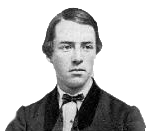
Tell the girls I have cut off my magnificent moustache and beard because they did not grow fast enough. How do you like my last photographs?
I forgot to mention that General Martindale’s headquarters are within 30 feet of General Porter’s, so that I should see as much as ever of my present staff. General M. is one of P.’s brigadier generals. . . .
[1] Miss Kate Chase, daughter of Chief Justice Salmon P. Chase; afterwards famous as the wife of Senator William Sprague of Rhode Island.
Sunday, March 2. —I went with the general and Mr. Foote to Stockton’s regiment, where we saw them inspected. We then went to Colonel Averell’s[1], where we had a lunch; then to Forts Woodbury and De Kalb, and from there home. A little while before we started for home, it began to snow furiously, and by the time we reached there, the snow was some two inches deep.
[1] William W. Averell, of the cavalry, afterwards brevet major general.
Saturday, March 1.— Mr. Foote, a brother-in-law of the general’s, came out to-day to spend a few days. We had a very pleasant day, and very like spring.
 Follow on facebook
 RSS
RSS email
email