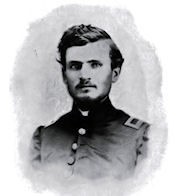
19th. Tuesday. Breakfasted at Johnstown. As usual boys went for chickens, corn and anything to eat. People have felt our march through their country. Report came that the enemy were at Osceola, 30 miles southeast. Continued our march Osceolaward. Stopped two or three miles from Johnstown and fed mules and ourselves—three hours. Moved on. Report came that Cloud’s advance was fighting with rear guard of the enemy. One man killed on the prairie, just buried. Changed our course towards Stubbleville. Reached that place in the morning, sunrise. In the afternoon my horse troubled me so getting away that I got on bareback. Got a saddle and rode all night. Very sleepy. Slept on my horse. Major Miner fell from his horse. Pat Collopy fell twice. It was almost impossible for the rear guard to get the sleeping ones awake and along.
War Diary of Luman Harris Tenney.
18th. Monday. After the moon rose, so that the teams could pick their way, we started on. Moved back on the same road we went up. Col. Cloud and Warren’s forces took another route and went faster than we. Passed through “Index” and “Rose Hill” and stopped after passing the big mill. Awful place for baggage to cross. Got a little supper. Hard bread and coffee, then moved on— the dismounted men and infantry on foot. The report came in that Cloud met the enemy at Johnstown—so Blunt hastened. Mules and horses tired out. As we marched boys would fall asleep, walk on and frequently tumble down. Major Burnett said he rode the whole length of train and every mule driver but two were asleep—most in their wagons. Train moved on well.
17th. Sunday. Breakfasted and under way at 5 A. M. Passed through Rose Hill, a very pretty little town. Hugh Watson and I went ahead and got apples, watermelons, plums and wild grapes. Had a good time. Passed through “Index,” another little town. Major rode with us in the wagon all day, good time. Reached “Lone Jack,” where the enemy were, at sundown an hour before. A man came up and reported 1500 enemy in our rear. Major Purington with rear guard, watched them and kept near them. Fired a good deal and tried to detain them. Proved to be the enemy retreating the way we had come. Major sent word for reinforcements. Some went but did not follow fast enough till dark set in. Commenced to rain. Command moved. Baggage soon could not go, it was so dark. So the enemy escaped us, so slickly through the gap. General Salomon had advised and entreated Blunt to keep flankers and scouts out through the woods near “Lone Jack.” They had intelligence from Warren that they were surely there, and we were passing within a mile. The ground was favorable for their retreat from the town—unseen. They kept a large picket about town and thus fooled our men. Warren could not believe that they had gone. So they left us, as a mouse from a trap. All the officers were enraged and disgusted with Blunt’s mistake, still hoped to overtake them. I went out a mile and got an old mare to ride. The history of the fight of the day previous was as follows: The day before, Quantrell, with 1200 men burned Independence and then skedaddled; Capt. Burns from Kansas City, with two companies of cavalry, four of infantry and two pieces of artillery, followed; at night overtook them and shelled their camp. They ran. The next morning Quantrell met Coffee and turned back. Lay in the brush and waited for them, coming through a lane. When the Feds came along they rose up and poured volley after volley into them. They hurried back to the village and there fought desperately. Finally overpowered, spiked one of the guns, destroyed the ammunition and ran. Warren, who had followed Coffee from Butler, watched them here that and the next day, till we came up confident that they would stand a fight. About 60 killed and many wounded on each side. Rebels burned ten of our wounded men in a house used as a hospital.
16th. Saturday. Kept up our march till morning at nine. Crossed the Osage. At nine A. M. stopped to feed and breakfast. Marched on through Johnstown. All the day the boys made for every melon patch, orchard or beehive to be seen. Had a good eat from melons and apples. Saw very few people. Encamped at sundown. For the first time had a night’s sleep. Very little water. Expected somewhat an attack before morning. Ordered to sleep on our arms. 1 slept soundly, as I usually do. Johnnie Devlin and I devoured a nice large watermelon. Enemy supposed to be six miles away.
15th. Stopped a little while in the morning to feed the horses. Moved on and passed through “Ball Town.” Stopped to get some breakfast. Received a letter from home. The prairie took fire several times and kept the boys busy fighting it. Colonel, Capt. Smith, Majors Miner and Purington rested under a tent fly we pitched. Marched again at 3 P. M. Passed Pappinsville. All these places in Mo. are little stingy trading posts. Over prairies and through woods and ravines we went. Sometimes slow, sometimes fast. Tired of jolting. Made a bed of the blankets. 2nd Ohio mounted and in advance under Major Purington. Stopped about 2 A. M. and fed horses. Roasted corn.
14th. Thursday. Put some stripes on my pants, and gave my poor wardrobe a good looking over and repairing. Should not like playing old bachelor for life—not any. Like company and society too well. In the afternoon orders came for the 2nd Ohio to be ready to march at 8 P. M. with 5 days’ rations. Under way at nine P. M. 1st Brigade and 6th and 9th Kansas marched from town at ten with the 2nd Ohio in the rear. The dismounted men and 9th Wisconsin rode in the wagons. Marched all night. I got Major’s permission and rode in baggage wagon. Most sick with the bloody flux. All were ignorant of our destination, but supposed and hoped to fight.
13th. Wednesday. Did very little in the morning. In the afternoon Lt. Carter was buried. Capt. Nettleton rode up to our tent and told me he would like to see me a minute. I went aside and he said he was going home. I asked him if he were going home for good. He said that was about the only way men could get out of the department at this time. Finally after deceiving me he told me he was going on regiment business. Wrote lines to Fannie and home.
12th. Tuesday. In the morning molasses was issued to the boys. Wrote a letter home. One boy from Co. G was buried. Wrote to Fannie and Uncle. Lt. Carter died. It must be a sad affliction for his poor mother who esteemed him her pet. Sergt. Daniels was wounded in the thigh by accident. Gen. Blunt held a council of all the officers in the division. Squashed the whole Wier fuss. I hope Wier won’t accept the terms. Many officers talk of resigning. Ladies about camp. Arrived yesterday. Mesdames Miner, Burnett, Ratliffe, Taylor.
11th. Monday. Read some in the June Atlantic. Nothing especially interesting. After dinner went down for Charlie and visited Delos per engagement. Had a splendid visit, real social time. Got some lemon syrup, talked over our old experiences at home and with “B. F.” In the evening went to town to hear Lane and Blunt. Lane did well enough for a border ruffian. Blunt criticised the course of our officers in arresting Wier. Referred to the whole thing as a conspiracy. 1st Brigade did not cheer much till Gen. Salomon’s name was heard. Then the boys grew wild with excitement and cheered heartily for him. Blunt found, I guess, that Wier had enemies and Salomon friends.
10th. Sunday. In the morning received a little treasure from Fannie at Richfield. Finished the story of the “Woman in White,” so well told. Like the style. Inspection at ten A. M. Our staff did not go. I went to the creek and bathed. Issued rations for five days. Delos came up from town and went with me to see Charlie. Had a good visit. Heard Will’s journal read. Received a good photograph of Will. Glad to get it. Chaplain preached in the evening, on the parade. Large numbers out to hear him. Good remarks, especially in reference to his visits at home. Enjoyed it.


