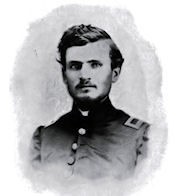
4th. Up at daylight. Sent telegram home. Moved up the Appomattox, our Div. in advance. Captured 300 or 400 prisoners, 5 guns and many wagons. Hill’s Corps and cavalry on our front. Near Bevil’s Bridge enemy made a stand at a crossroads to get a part of their column by. Artillery opened and rebs ran. Our regt. did not become engaged. Went out to pick up wounded. Quite a number of deserters. Camped on this ground. Richmond ours. God hasten peace. Clear and pleasant. Cavalry moved on up the Appomattox. 1st Div. in advance. Would that I could see mother now in her distress. Passed a part of the infantry. Made a feint towards Amelia C. H. Went into camp. 2nd on picket. Moved out again at 11 P. M. Returned to main road and marched all night.
War Diary of Luman Harris Tenney.
Monday, 3rd. Yesterday I wrote to mother and sisters.[1] The fighting of Saturday was most severe. The 2nd Ohio lost 35 killed and wounded in the two days. 5 officers. Trees completely riddled where we were. How so few fell I can not see. Brilliant affair—but oh the cost. Petersburg ours, too. It seems hard to lose dear friends when peace seems so near. Picket’s Div. captured nearly entire. Wrote the sad news home, also wrote Richard Bail’s people. Moved out at 9 A. M. Crossed the south side R. R. between Fords and Sutherlands. 5th Corps across. Very little firing heard today. 1st Div. struck the rebs near the river road. Firing after dark.
[1] Letter from L. H. Tenney to his Mother and Sisters
Oak Grove, Alabama, Sunday P. M., April 1, 1866.
My Dear Mother and Friends:
I wonder if nearly the same thoughts are not in your mind this P. M. which are in mine.
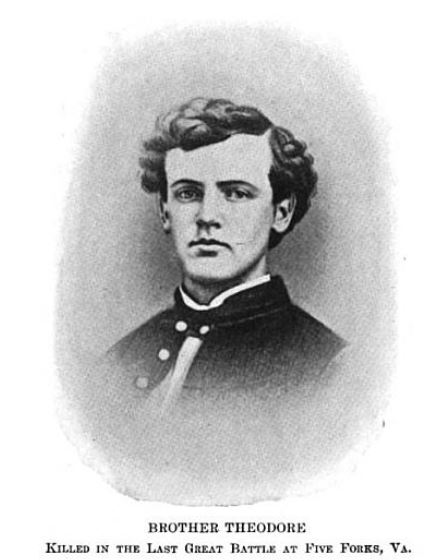
The sun is just about as low now at 6 o’clock as it was a year ago, when our noble boy, Theodore, fell in the thickest of the fight, face towards the enemy, there in the pine woods at Five Forks. How vividly everything of that sad and yet memorable day comes up to me.
March 31st was a hard day for us. The enemy had driven our cavalry (save one division) from Five Forks nearly back to Dinwiddie Court House. Our Division was sent for (it was behind, hard at work, getting the train through the mud) and went forward at a trot. As we neared the Court House and heard the volleys of musketry, the cheers of the rebels, and saw our men falling back—many straggling—we knew that there was work ahead. How quiet our boys were during the few minutes while we were regaining our organizations. Soon we went forward at a gallop. A half mile at this pace and we came to Custer’s and Sheridan’s colors near an unsupported battery and in sight of the rebel line.
Advancing across a small valley before us, our regiment in advance, we dismounted, formed line by battalions and on double quick started forward in less time, I believe, than I have been in telling it.
The brave Custer, with staff and orderlies, colors flying, went forward with us.
We gave one Second Ohio yell, perhaps a little more faintly than at other times, for the prospect looked dark, and other regiments took it up. The rebel line faced about, but though stragglers left hurriedly, marched slowly. I was afraid. We were within range. It seemed the only thing to do, for we were too few to form a line and hold our position. Another charge was ordered. The Div. colors were not behind. We had hardly started again with a yell, than that rebel line, Pickett’s Div. of Infantry in our front, faced about, fired a volley and came forward on the double quick.
My horse had been shot and I had taken position behind a tree. Thede was a short distance behind me. How well I remember how he exclaimed: “Oh what makes them run,” and then: “Lume, Luman, come, our men are falling back, we’ll get captured!”—and how closely he kept by me, always following me, as I went back slowly through the edge of the woods, my lungs troubling me. The sun had gone down and darkness came when we regained the ground where we had dismounted. We threw up rail breastworks and waited for the rebels. They were cautious, advanced skirmishers found our position and fell back to camp in sight of us. Volunteers were called for or rather “the best men” to a certain number were sent out as scouts to learn the whereabouts and whatabouts of the enemy. Thede was among the number. Without supper or sleep, we awaited the dawn of the day. Quite a number of our boys had fallen, among then Capt. Newton. We talked about our casualties, and the narrow escape of many, and wondered what the morrow would bring. We felt that the fighting was to be decisive, but knew not whether one day would bring victory.
Occasional shots were fired by skirmishers. Morning came. The scouts reported that the enemy had commenced falling back just before day. Sheridan came out with his colors. Our horses were brought up and we marched forward. After going a mile firing commenced on our flank. We countermarched, dismounted, formed line and advanced again, driving cavalry before us. We had missed breakfast, and the boys were weighed down with ammunition, so they left their haversacks upon their horses.
Theodore looked pale and tired—said his bowels were troubling him. It was afternoon before we reached the enemy’s position at Five Forks. We attacked and were repulsed. A gap between the Cavalry and Infantry was discovered, so that two hours were spent moving to the right and then to the left, in front of and in range of the enemy’s works. Here, weak, faint and hungry, we threw up sufficient works of logs, etc., to cover our bodies when lying down. Thede and I were together. He got some crumbs of crackers from my saddle.
It was now four o’clock when the bugles sounded the charge, and the boys, forgetting their weariness, jumped up and vied with each other in advancing to within a few rods of the works, dark with clouds of smoke and belching guns. How grim, savage and hateful everything looked in our front!
You remember well the rest—the next charge—the bravery of the boy, his fall, his devotion to duty, certainty of death, remembrance of his sins, and faith for their forgiveness through Christ—the kind messages to Ma—and then his falling so peacefully to sleep. I never can forget the firm but pleasant look upon his countenance, as he lay among the groaning, dying and dead at the hospital. Then his burial. I thanked God that his brother could be with him in his last moments and lay his remains away to rest till the final trumpet call.
My thoughts were sad as I groped my way through the dark woods to our camp. I thought particularly of the mourning at home. I knew that you would be sad to feel that the boy should be taken in his youth, the hope of his mother and joy of his friends, and yet I felt that you would inwardly thank God that his death had brought glory to Him and freedom to men. The dearer he was to his friends, the brighter his hopes, the greater the sacrifice was in the eyes of God. We ought to feel—I do—that we have a living interest in this great good accomplished and sealed by the blood of our dearest friends. And we certainly have reason to trust that Theodore’s inheritance is in Heaven, drawing us thither.
Luman H. Tenney.
_
Note—One year after the above letter, on April 16, 1867, Luman Harris Tenney and Frances Delia Andrews were married at Oberlin, Ohio.
And about a year and a half later when the brother and mother went to Virginia to look up the burial place of “Brother Theodore” the following letters were written to me in our home in Sandusky, Ohio.
F. D. T., Feb. 5, 1914.
_
Petersburg, Va., Nov. 12, 1868.
Thursday morning.
My Sweet Child:
We arrived here safely a few minutes ago. One of Ma’s first remarks after getting here was, “I wish Fannie, Minnie and Melissa could be here with us today.” I have made the same wish in regard to my darling wife every day since I left her and the dear baby. (Bernard.)
We reached Washington Tuesday evening rather late. Yesterday spent the morning in looking up records. Found that Theodore was buried here in National Cemetery, “Poplar Grove,” about two miles out.
Shall undoubtedly leave him.
Yesterday afternoon we drove over to Arlington Heights and the National Cemetery there, where some 13,000 soldiers rest—
“Sleep the sleep that knows not waking,
Dream of battlefields no more.”
We shall go early to the cemetery and probably to Richmond for the night. Much love, dear child, from
Your devoted husband,
Luman.
_
Washington, D. C., Nov. 14, 1868.
My Own Dear Fannie:
We reached here last evening after a very satisfactory visit at Petersburg and Richmond and pleasant trip back. * * * We found Theodore’s grave very pleasantly situated in the National Cemetery near Petersburg. Everything seemed very satisfactory to Ma. We got flowers and put on the grave. * * *
Shall probably reach home Thursday.
Kiss our sweet “da-da” treasure many times for me. Accept much love, dear Fannie, from
Your Luman.
1st. Saturday. At daylight, without supper or breakfast, advanced. Rebels in front fell back. 5th corps up. Advanced dismounted 5 miles to the rebel breastworks. Built temporary breastworks. Held them under fire till 4 P. M. when the 5th corps came up and charged. Advanced through the pines till in sight of works and guns with a yell. Repulsed. Formed line again and in 15 minutes charged again. Got under the works and laid down. Here Brother Thede, noble and brave boy, was struck through with a piece of shell. Helped him from the field. Suffered awfully. In answer to my questions he said: “Luman, I think my wound is mortal. I can not live. I have tried to do my duty today. Tell mother I only wish I had been a better boy. I hope that God will accept me and take me to Heaven.” He had his senses for 30 or 40 minutes when he sank away as we carried him along and died before we reached the hospital. I thought that he had fallen asleep. I spoke to him but received no answer. His pulse beat feebly. I knew then that he was going. The Doctor gave him some brandy, but no life appeared. I buried him in a rough box beneath a cedar tree in front of the house and across the road and cut the headboard with a knife. God sustain mother.
31st. Cleared up soon after sunrise, but did not remain so long. Very heavy firing. Musketry and artillery to the right of and beyond Dinwiddie C. H. Very uneasy to know how the day is going. God grant us victory. Success now, the capture of the Southside and the Danville R. R. must bring peace soon. We can leave the cause in God’s care. On to Dinwiddie—there at 6 P. M. 1st Div. all driven back. 3rd Div. engaged. 3rd N. J. ammunition exhausted. Go up at a trot, dismount and go in. Doublequicked half a mile—came upon infantry line which opened fire and charged. Had to fall back quickly. Horse wounded. Many good men lost. Fortified and lay on our arms.
30th. Rain continued. Lay in the mud till noon, then moved into the woods. Moved out just after getting fixed up comfortably. Moved 4 miles over awful roads and camped 5 miles from Dinwiddie C. H. Building a good deal of corduroy road. Put on picket. Barnitz uneasy all night. Allowed no rest.
29th. The whole night occupied in paying off the regt. Got very little money myself. Up early after a little nap. Boys sent their money home by Dr. Smith and Adj. Pike, who have mustered out of service. Went to Army Hdqrs. Moved out. Joined Div. near old picket line. Marched 4 miles beyond Reams and camped. Rained—awful roads.
28th. Rested in the morning. Charley Smith, Sergt., came over from the 60th Ohio. Went down to Hancock Station. Troops passing to the left. Orders to march tomorrow morning at 6. Work ahead. Broke up mess. In with Stearns.
27th. A beautiful day. Clear and warm and somewhat dusty. Crossed the Appomattox. Moved along the line to the Norfolk R. R. Seemed natural to hear the continuous firing once more. Few changes in appearance. Woods all gone.
26th. Had a very good view of McClellan’s defensive works. Good. Moved up the river and crossed at Deep Bottom. An occasional shot. Heard of taking in 2,700 rebs in front of Petersburg. Camped, at Bermuda Hundred.
25th. Ready to march at 6. Took my pockets full of mail to the landing. Dismounted men went by boats. Our regt. in rear of Div. and train. Crossed the Chickahominy on pontoons and reached Harrison’s Landing in evening. Fortifications.


