Monday, 10th. After breakfast—poor beef—went into town. Advance with secesh flag and a dozen rushed to it and showed passes from Raines and McDonald—one had taken an oath to shoot every picket, straggler, messenger or pilot he could. Citizens came in for protection. Several recruits came in with guns. 6th sang John Brown and Dixie. Got back to the Mills at noon—tired out and chafed up badly—without anything to eat to speak of but fresh beef—and that seldom enough. On a trot most of the time—tried to rest some. Letters from home and Fannie.
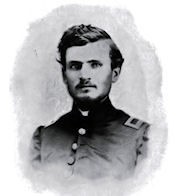
War Diary of Luman Harris Tenney.
Sunday, 9th. Recrossed the mountain, after a breakfast of hoecake of meal captured from the enemy. Went by another road direct for Fayetteville. Very rough roads and poor country most of the way. Encamped in sight of the town.
Saturday, 8th. Still southwest to Rhea’s Mills ten miles and then breakfast—fresh beef and no salt. Col. Philips here two nights before, two of his Indians shot. Two girls wounded severely by rebels firing into a house. After breakfast went to my own men with Capt. Gave Capt. Lucas detachment—the advance. Direction southeast. Rode 7 or 8 miles to Cane Hill—Boonsboro— hilly country. Pickets fired upon at Cane Hill. Captured a secesh saddle and equipments. Went into town. Col. made inquiries and moved on. Col. always with the advance. Went a couple of miles and bang, bang, went guns. Soon 60 or 70 men showed themselves in the woods on a hill half a mile to our left. Sharp’s rifles and carbines came into play—no effect—distance too great. Howitzers came up, cavalry fell back into the woods and shell went whizzing over the cornfield. They skedaddled. One fellow whom 8 or 10 men started for, ran forward and threw down the fence and then ran back behind a tree. Blue overcoat. Did not take him. Bold fellow. They took two or three prisoners. After some delay, Col. learned that the rebels, 400 or 500, were one mile farther on. Went on a mile, saw pickets on a distant hill. Sharpshooters advanced, and then command moved forward. Found camp just vacated—fires still burning. Went over the Boston mountains. Over the mountains at the foot, our extreme advance came in sight of rear guard of the enemy. A charge was ordered and away we flew with loose reins and set spurs, up hill and down hill, across and back again Cove Creek, a very rough road. After three miles we began to see stirrups, blankets, corn and a thousand things strewn along the road. The Col. was up with us. He commenced yelling, which was kept up by all the men. More things scattered along. After ten miles in the midst of excitement, back came a volley of shot and bullets from the bush at a point a little elevated just ahead of us. The extreme advance fell back a few rods. Up we rode upon a charge into the bush as we were ordered. We rode up and fired away. Still farther up into the road we were ordered. We hurried up and formed along the road facing the bush. The bullets whistled merrily for a season. Not over 20 or 25 were up. We fired all our rounds, then a sabre charge was ordered. We had our sabres drawn and ready for a charge, when Capt. Lucas’ horse was shot and the rebels were running by a byroad. The color-bearer was shot through the head and colors captured, 13 stars—two others were reported killed. Waited for signs of the enemy, but in vain. Went down and helped about unloading wagons and burned them. None of us harmed. Started back. Returned 4 or 5 miles and camped. All the boys got some little trap—baggage and equipments of Mo. Provost Guard commanded by Provost Gen. McDonald. Private correspondence of Col. Sevier of Marseilles, Mo. One excellent letter from his Aunt Phil on the war.
Friday, 7th. Capt. Quigg after examination released “Dr. Brissel” without a parole. Capts. Lucas and Nettleton and all the boys think the man fooled us—black hair and whiskers, good looking and very gentlemanly. Heard no mean expression. When I bade him good morning, three miles out, he shook hands with me, and said if we ever got into trouble, he would be glad to do what he could for us. At 11 A. M. got orders to march with two days’ rations, at 12 M. Had no bake kettles and no rations but beans and flour. Got me a canteen full of bean soup. Ready at noon. 25 2nd Ohio and 25 6th Kansas. Had charge of platoon of twelve—our boys. Went west, trotted most of the time. Got to the tannery at 3 P. M. 13th at work getting out the hides from the vats. Soon Col. Cloud with 250 or 300—and all went to work. A grand scene. Would like to see it represented in Leslie. Burned up twenty or twenty-five thousand dollars worth of property. Started in about dark—southwest. Went 15 or 20 miles, mostly on a trot. Then stopped at a field of corn and lay down by fires till 4 or 5 A. M. Changed platoons to get 2nd Ohio together. Capt. N. with Kansas platoons.
Thursday, 6th. In the morning went out with four men to forage three and one-half miles south. Load of oats for 6th and 2nd. The owner just up from Vanburen with two bushels of salt. Seemed to have considerable information, so took him in to Capt. Quigg. One of the boys met me with my horse to go with Capt. and 20 men on scout. Had to gallop a good distance to catch up. Within seven miles of Fayetteville, fifteen miles distant from camp, took a prisoner from Col. Armstrong’s conscripts. He was at home—on furlough—been sick. Out with horse saddled, talking with his wife washing by the clear stream of water. She seemed a very pretty lady, pitied her—innocent looking man. Before reaching Fayetteville two miles out, Capt. sent me with three men, Porter, Morgan and Shaw. After going a mile, found a fire; soon spied two mounted men with glistening guns around a point of woods, watching us and quietly disappearing. Sent back word. No answer and went on. After half a mile we got within sight of them, but did not know whether to shoot or not—no instructions. They took a final look and went pellmell down the hill. Sent word to Capt. No instructions again. Neared town—women and girls at windows and doors—perfectly ignorant! Didn’t know that there were any secesh in town. Passed by a large house. Big negro woman stood on the stoop, showing her teeth and pointing to town ominously, and shook her head. Such were appearances. By the tannery stood a grey horse, looking like the one the picket was riding; were discussing whether to take it or not, when two men came out, citizens apparently; said there were but two or three dozen in town. Capt. halted his command and overtook us and asked what we had learned. Told us not to go further for the present. Turn back if he whistled. After enquiries whistled and turned back. Porter and I kept in the rear in hope that they would follow us. Three miles out saw a man at a house near by. Rode out and learned that he had charge of a hospital at F. Had no papers to show it. Took him to Capt. He brought him to camp. Rode along beside him all the way in. Had been in the service one year last May, on Raines’ staff. Dressed in a field officer’s uniform, coat, black pants, neat gloves and cap and patent leather boots. Was perfectly sanguine of success eventually—perfectly posted in regard to our movements. A lady was out riding with him, out to see some sick. Very indignant. Waited at a private house with him for supper, while Capt. went to camp and back. Ladies very much pleased to see him. Very sure he is an officer of rank. Said he had no commission as surgeon. Showed an appointment as assistant surgeon by surgeon of 8th Div. Mo. State Guards.
Wednesday, 5th. Up at 3 A. M. After breakfast started for Jones’ Mills, with two companies of 6th Kansas. Some 10th Kansas—two howitzers. Pitched tents and made ourselves comfortable.
Tuesday, 4th. During the day got a report of horses in detachments. Bill and I washed some clothes. Before dark orders came for a company of 2nd O. V. C. to report to Col. Weir with 3 days’ rations. Capt. N. went with 40 men, I along. Reported and after waiting an hour or two returned till daylight the next morning. Got a good sleep. Caught some cold from damp clothes.
Monday, 3rd. Orders to march at 7. Up at 3 A. M. Breakfasted and in saddle at 7. Advance guard. Marched 8 or 10 miles to Osage Spring 5 miles south of Bentonville, Ark., on Burns’ farm. Got the lady to bake some bread. Went out and killed some chickens. Quite tired at night.
Sunday, 2nd. In the morning read Oct. Atlantic. In the P. M. finished Fannie’s letter. Detail came for Lt. or trusty Srgt. to go out with 30 men as escort to brigade forage teams. Officers said they proposed sending me. I agreed if they wished it, to start at 7:30 A. M.
Saturday, 1st. Lay in camp. Men save ours were mustered for pay. The boys went out and got the body of the Butternut, and buried him in the cornfield—shot in the neck. Wrote home. Bought a jacket of T. R. S. Saw Major P.’s ring we boys have bought for him—nice. Went to bed rather early. Commenced a letter to Fannie. Interrupted to go out scouting. In the P. M. Capt. Welch with Stewart and Lisering and 25 men went out seven or eight miles expecting to find some bushwhackers seen by a 9th Wis. Found nobody. Stopped at three houses and got horses. One girl, husband pressed into rebel army, plead so earnestly for her pony. It was touching. Finally the captain gave it back. Reached camp at 1 A. M.


