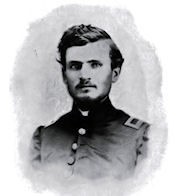
7th. Saturday. Letter from home. Sarah Felton.

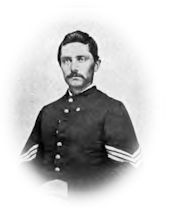
Saturday, 7th—This morning we found that during the night our ship was driven by the high wind upon a sand bar in the bay. Here we lay, a cold northwest wind blowing across our deck forty feet above the water. But we fared better than the boys below, for, on account of their being so sick, it was reported that their floor was difficult to stand on even after the ship had stopped. They ran a small side-wheel steamboat alongside of the ship and set a tall ladder on the wheelhouse, reaching up to our deck, and one by one we climbed down the ladder to the other boat, which hauled us to the shore. We were glad to leave that ship. Some of the boys declared that they would rather walk the entire distance than ride on any ship. We marched out about two miles from town and went into camp in a heavy pine timber. Here we have plenty of wood with which to build a good fire, as a cold rain commenced to fall this afternoon.

January 6th.—Cloudy and thawing.
No war news,—but it is known Sherman’s army is not quiet, and must soon be heard from in spite of the interdict of the government.
It is said Mr. Trenholm, Secretary of the Treasury, is in the market buying gold, and that the fall has already been from $50 to $30 for one.
Corn-meal has risen from $50 up to $75 per bushel. Flour to $500 per barrel.
Vice-President Stephens has not left the city, but presides in the Senate.
Messrs. B. Woolley, Hart & Co., Nassau, N. P., write most pressing letters for the liquidation of their claims against the Confederate States Government. Perhaps they are becoming alarmed after making prodigious profits, etc.
Conner’s brigade and other troops are en route for South Carolina from Lee’s army.
Judge Campbell, Assistant Secretary of War, was smoked out of his room to-day, and came into mine.
The judge, however, does but little more just now than grant passports into the enemy’s lines; permission to speculators to bring into the city supplies for sale, often under pretense of being intended for their own use; exemptions, details, etc. If he were disposed, he could realize a million of dollars.
It is said the Hon. A. R. Wright went North to get his son paroled, who is in prison there.
Judge Campbell talks of resigning.
Colonel Lyon’s Letters.
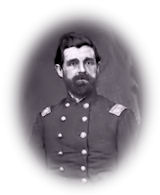
Huntsville, Ala., Fri., Jan. 6, 1865.—On Wednesday I went up the river to where Paintrock bridge was burned by the rebels on the Saturday before, which used up the day. On my return I found the Fourth Army Corps, commanded by General Wood, coming here for the purpose of refitting for the next campaign. It is about 12,000 to 15,000 strong, and is encamped outside the city. Helping to get them settled, assigning quarters to officers, etc., is what has kept me so busy. General Stanley is the permanent commander of this corps, but he was wounded at Franklin and is absent. I find General Wood a very pleasant gentleman. The presence of the corps here does not affect my command at all.
Company G loses 37 men captured at Paintrock bridge. The bridge will be repaired tomorrow.
I think the army will soon be reorganized, and I feel as though they ought to let us go into the field in the next campaign. I am satisfied that the 13th would be better off today had it gone with Sherman last spring than it is now.

Henry Adams, private secretary of the US Minister to the UK, to his brother, Charles.
London, January 6, 1864 [1865]
In one sense society is much more agreeable now than it used to be. I no longer feel any dread of conversation about our affairs. The name of Sherman has of late placed us who are abroad, in a very commanding position, and our military reputation is at the head of the nations. You can imagine that this relieves us of our greatest discomfort, and in fact we now receive compliments where we used to hear nothing but sneers. Even the Times is converted, and gives us a long leader full of praise of Sherman. The fall of Savannah is needed to complete the opinion of the world here, and I suppose Savannah will fall of its own weight very soon. Then the final struggle will begin, and these good foreigners will learn a new page in history. . . .
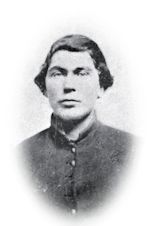
Nashville, Friday, Jan. 6. Disagreeable and rainy night. On guard. Wet slushy day. Spent it pleasantly writing and reading Ballou’s Monthly, received from Sanitary Commission. A little difficulty occurred in camp to-day. Quartermaster Malish visited stables. Found B. Reynolds refusing duty as guard. Ordered Dziewanowski, sergeant of the guard, to “tie him up” which he refused to do. It was reported to Captain Hood and ended in reducing “Coly” to the ranks, appointing Corporal Hutchinson sergeant of the 3rd Platoon, Ed Hayes corporal.
6th. Friday. Worked on house some. Uncomfortable day.
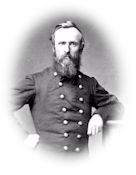
Cumberland, Maryland, January 6, 1865.
Dear Uncle: — We are getting into very pleasant quarters. The town is a fine one, plenty of parties, balls, etc., etc., for the beaux — fine mountain scenery — good water and wood convenient.
There are still odds and ends of business to be finished, and then no reason that I can see why I should not go home. I expect quite confidently to be at home within two weeks. . .
The reason for my promotion, etc., has been officially announced “for gallantry and meritorious services in the Battles of Opequon, Fisher’s Hill, and Cedar Creek” and dates from the Battle of Cedar Creek, October 19. All very satisfactory.
Sincerely,
R. B. Hayes,
S. Birchard.
Friday, 6th—We left our camp this morning at 8 o’clock and marched down to the coast about four miles below Savannah. At 2 o’clock we embarked on the transports for Beaufort, South Carolina. Our regiment is on board a ship built in England as a blockade-runner for the Southern Confederacy, but which was finally captured by our navy at Savannah. It rained all forenoon, but by noon it had cleared off with a high wind blowing in from the ocean. Our ship, not having enough ballast, rocked frightfully in the gale, upsetting tables in the dining room and frightening many of the boys lest we should be turned over. The sailors only smiled at our discomfiture. The rough sea made a great many of the boys sick, but our company being on the hurricane deck, did not become so sick. We reached Beaufort at 11 p. m., but cannot land, and so have to remain on the boats all night.
January 5th.—Clear and cold.
It is understood now that Gen. Hood has crossed to the south side of the Tennessee River with the debris of his army.
Gen. Butler has returned to Virginia from his fruitless North Carolina expedition. It is supposed we shall have active operations again before this city as soon as the weather and roads will permit.
But it really does seem that the States respectively mean to take control of all their men not now in the Confederate States armies, and I apprehend we shall soon have “confusion worse confounded.”
The President sends, “for his information,” to the Secretary of War, a letter from Gen. Beauregard, dated at Augusta, Ga., Dec. 6th, 1864, in relation to Gen. Sherman’s movement eastward, and Gen. Hood’s Middle Tennessee campaign. It appears from Gen. B.’s letter to the President that he (Gen. B.) had control of everything. He says he did not countermand Gen. Hood’s campaign, because Sherman had 275 miles the start, and the roads were impracticable in Northern Georgia and Alabama. But he telegraphed the Governors of Alabama, Georgia, etc., to concentrate troops rapidly in Sherman’s front, ordered a brigade of cavalry from Hood to Wheeler, etc., and supposed some 30,000 men could be collected to oppose Sherman’s march, and destroy him. He computed Sherman’s strength at 36,000 of all arms. The result shows how much he was mistaken. He will be held accountable for all the disasters. Alas for Beauregard! Bragg only played the part of chronicler of the sad events from Augusta. Yet the President cannot publish this letter of Beauregard’s, and the country will still fix upon him the responsibility and the odium. Gen. Beauregard is still in front of Sherman, with inadequate forces, and may again be responsible for additional calamities.
Old Mr. F. P. Blair and his son Montgomery Blair are on their way here, with authority to confer on peace and submission, etc.
Mr. Lewis, Disbursing Clerk of the Post-Office Department, on behalf of lady clerks has laid a complaint before the President that Mr. Peck, a clerk in the department, to whom was intrusted money to buy supplies in North Carolina, has failed to make return of provisions or money, retaining the latter for several months, while some of his friends have received returns, besides 10 barrels flour bought for himself, and transported at government expense. Some of the clerks think the money has been retained for speculative purposes. It remains to be seen whether the President will do anything in the premises.
The grand New Year’s dinner to the soldiers, as I supposed, has produced discontent in the army, from unequal distribution, etc. No doubt the speculators got control of it, and made money, at least provided for their families, etc.
Hon. J. R. Baylor proposes recruiting in New Mexico and Lower California. The Secretary of War opposes it, saying we shall probably require all the trans-Mississippi troops on this side the river. The President differs with the Secretary, and writes a long indorsement, showing the importance of Baylor’s project, etc. Of course the Secretary will “stint and say ay.” The President thinks Col. B. can enlist the Indian tribes on our side also.
There is a rumor that Mr. Foote, M. C., has gone into the enemy’s lines. He considered the difference between Davis and Lincoln as “between tweedledum and tweedledee.”
The prisoners of war (foreigners) that took the oath of allegiance and enlisted in the Confederate States service, are deserting back to the Federal service, under Gen. Sherman’s promise of amnesty.


