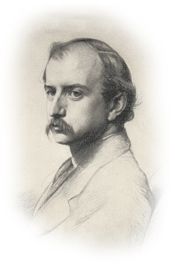
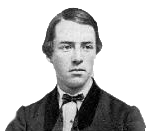
Henry Adams, private secretary of the US Minister to the UK, to his brother, Charles.
London, December 9, 1864
Of course Sherman’s march is creating great excitement here. The newspapers, one after another, and about every other day, prove conclusively that he must lose his army and fall a victim to “clouds of confederate cavalry on his front, flank and rear “; to “swarms of patriotic guerillas behind every bush”; to failure of supplies which are all to be destroyed as he moves; to the obstruction of roads, and finally to the army in his front. I will say however that the latest advices of the alarm existing in the rebel kingdom have made their friends here far less confident than they were. My consolation is that by this time the result must have been arrived at, one way or the other; and as I have as much faith in Sherman as I have in any individual of ancient or modern history or mythology, I keep a very stiff courage up and wait confidently the result.
December 9th.—Cold and cloudy; surface of the ground frozen.
Cannon heard below. More of Gen. Early’s corps arriving. The papers contradict the report that Howlett’s Battery has been taken. The opinion prevails that a battle will occur to-day.
It appears that but few of the enemy’s forces were engaged in the demonstration on the south side, below Drewry’s Bluff, and no uneasiness is felt on account of it.
We have nothing so far to-day from the enemy’s column marching toward Weldon.
Gov. Smith, in his message to the Legislature now in session, recommends the employment of negro troops, even if it results in their emancipation. He also suggests an act, putting into the army civil officers of the State under forty-five years of age. At the same time he is exempting officers (State) under forty-five, and there is no compulsion on him.
A dispatch from Gen. Lee last night states that from the great number of wagons taken by the enemy on the Weldon Road, the movement is formidable, and indicates a purpose of prolonged operations.
At night—and snowing—a terrible night for the poor soldiers in the field!
Port Gillem, Friday, Dec. 9. It was difficult work to sleep warm last night, and we pitied the poor boys in the front ditches last night without fire or tents, with a foe in front.
As soon as breakfast was over I was detailed to go with Corporal Goodwin after wood. It began sleeting as we started and continued all day. We first went to the wood yard and found that surrounded by more teams than could load all day. Sent us a mile further to the boat landing where we found two barges nearly empty of wood, and about fifty wagons waiting, so we had to go home. I walked back through town, stopped on business, and returned after dinner, quite stiff with sleet, clothes all glazed with it. It is now snowing very fast. Wagons went out and brought in two loads of rails for fire wood.
J. Rogers returned to the Battery. He left us at Cartersville. All quiet on the lines. No mail. Health good.
Same place, December 9, 1864.
The division lay in camp all day. Our regiment marched 12 miles on a reconnoisance, toward the Canoochie river, southwest.. Found nothing, but some good foraging. Cannonading at four or five different points, on our left and front. Citizens say the most distant is at Charleston, Savannah and Fort McAlister. It is said that Corse’s Division (4th), of our corps, had a fight east of the Ogeechee to-day and were victorious, taking 50 prisoners and one gun. Part of our 2d Division crossed at James’ Point to-day, and burned the Gulf railroad bridge and four miles of trestle-work west of the Ogeechee. They found very large rice plantations, which are flooded with tide-water. I guess Fort McAlister cannot be reached by infantry on account of the country around it overflowing. The men say that Kilpatrick has gone around Savannah and “cut the coast.” Big raid!
9th. Friday. In camp. Wrote to cousin Sarah in answer to letter received today. Drilled 3rd Batt. in rear formation.
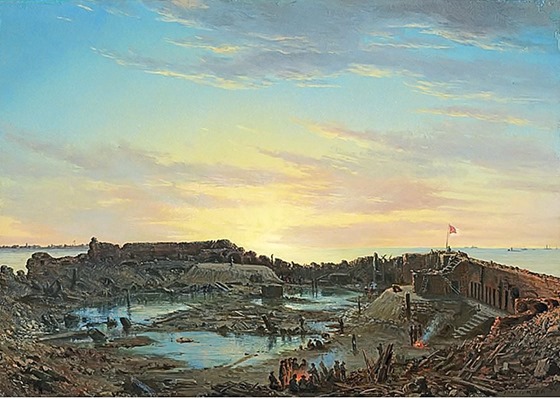
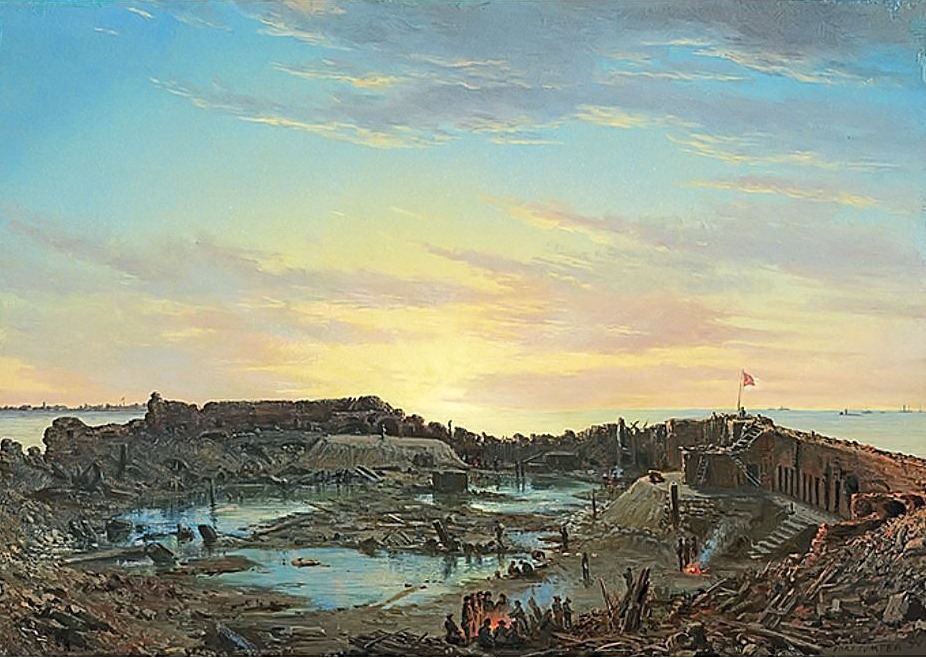
Painting by Conrad Wise Chapman.
“A scene at sunrise; it was cool in the early morning, and the negroes before starting to work would warm themselves at the fires; there was continual work to be done, getting ready sandbags for breaks in the fortifications.” – Conrad Wise Chapman, 1898
December 9th, 1864. —The poor, sick prisoner is sick and in prison no longer. He died this morning, died happy, too, for Mr. Craig, who sat up with him last night, says he could not see any harm in telling him the papers had come and now he was going home. He was so happy and he held Mr. Craig’s hand and made his plans to start next day; asked if he would not go with him to Port Royal, where Southern authorities took their prisoners for exchange. He talked of his mother, of his sisters and told Mr. Craig they would write and tell him how grateful they were. Poor fellow. He was buried at sundown today, in the spot reserved for those who die in the hospital. His grave is marked and if his family should wish it, he can be moved when the war is over.
Friday, 9th—It is cloudy with a strong northeast wind. We started early again this morning and after laying off ten miles went into bivouac. The Twenty-fifth New Jersey was on the skirmish line today, skirmishing commencing at 10 o’clock and continuing till dark. They lost four men killed and fifteen wounded. The First Division of our corps was in the front, and their quartermaster was killed by a ten-pound solid shot fired from a small cannon on a flat car which the rebels ran up and down the railroad. Our way today was through one continuous swamp, but we had a fine road, a high causeway which runs to Savannah. Our camp tonight lies within ten miles of Savannah.
Friday, 9th.—All quiet yesterday. Sleeting and snowing all day; went to picket late in the evening.
Thursday, December 8. — Day passed as usual. About 5 P.M. Major Griswold and a Mr. Isaacs came into the room. They had a list for exchange with them. My name was on it, thank God! Colonel Marshall, Colonel Buffum, Sterling, Captain Norris and Sherman were also on the list. Had a regular scrape-down all night. All of us were sorry for Captain Amory, whose name was not on the list.