Thursday, November 10. — Rode to Winchester; saw Hastings; he is better! Very great hopes of his recovery. Lincoln probably gets all the States but three! Good. General Duval returns improved from his wound.

November 10th. 1864.
Mr. Collier came over and spent the evening with me. His visits are highly prized by me. He brought his note book, and we sang “Sweet Home” together, and then, as usual, we talked of home. He is a singular being—a “specimen,” and a rare one, too. It is impossible to be long afflicted with the dumps when in his society. Like a bubbling spring, he overflows with mirth and good nature, and is sufficiently intelligent to be an agreeable companion. Goodness is natural to him. He neither chews, smokes, drinks whiskey or uses profane language. There is not a particle of deceit in his composition. Added to all these good qualities, and many more I might mention, he adores his wife and baby. All this I can say of him, after two years of intimate acquaintance. Spite of the contrast between us, and it is great, the strong attachment and friendship I feel for him is reciprocated.

November 10th.—Warm; rain and wind (south) all night.
Quiet below. One of the enemy’s pickets said to one of ours, last night, that Warren’s corps had voted unanimously for McClellan, and that New York City has given a majority of 40,000 for him. This is hardly reliable.
Mr. Foote offered a resolution, yesterday, condemning the President’s suggestion that editors be put in the ranks as well as other classes. Now I think the President’s suggestion-will be adopted, as Mr. Foote is unfortunate in his resolutions. Mr. Barksdale (President’s friend) had it easily referred to the Committee on Military Affairs.
Hon. J. A. Gilmer, North Carolina, is applying for many passports through the lines for people in his district. He applies to Judge Campbell.
Coal is selling at $90 per load, twenty-five bushels.
The vote referring Foote’s resolution (on the exemption of editors) was passed unanimously, which is regarded as favoring the President’s recommendation. Mr. Foote had denounced the President as a despot.
Bought two excellent knit undershirts, to-day, of a woman who gets her supplies from passing soldiers. Being washed, etc., they bore no evidences of having been worn, except two small round holes in the body. Such are the straits to which we are reduced.
I paid $15 each; the price for new ones, of inferior quality, is $50 a piece.
Enroute, Thursday, Nov. 10. A bright and beautiful day. On detail after rations in the morning. Cartersville presenting a very busy appearance, filled with teams. Our troops turning camp and garrison equipage over to be sent. Refugees of every age, color and description are on every corner. Now that a general abandonment of the line is apprehended all are anxious to avoid further misery in the Confederacy. Returned to camp to eat a hearty dinner, and then broke camp and went to town. Did not get loaded till 9 P. M. Everything put up in the smallest space. After we had filled our corner, several families of negroes and refugees stowed themselves away. Horses sent by land in charge of Sergeant Keeler.

10th. Thursday. Pleasant morning. Clear and mild. Moved back 2½ miles into camp.
Wednesday, November 9. — Lieutenant Gill sent in a letter for me and one for Captain Amory. Mine was from Dick Milton. Heard that several letters were sent to us from the stockade. Mackentire, who took the oath of allegiance to the South and who pretended to be an officer, was put in among the other deserters. He is accused of robbing a citizen.

Wednesday, 9th—It is still raining. I went out on picket this morning. We received orders to be ready to move at a moment’s notice, for the purpose of tearing up the railroad tracks. Citizens all around Atlanta, hearing that the Yankees are going to leave the place, are coming in larger numbers to go North. Women leave their homes and all they have, and with their children walk a distance of thirty miles, for the sake of getting to the North. Where both armies have been ravaging the country, the people are destitute—haven’t anything to eat—and therefore they have to leave their homes. No news from the North.
Wednesday, November 9. — Marched eleven miles to camp south of Kernstown. Whole army glad to move towards winter quarters. — Result of election in this division: Lincoln, 575; McClellan, 98.
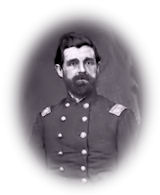
Colonel Lyon’s Letters.
Nov. 9, 1864.—I went up to the regiment yesterday and voted for Old Abe. I went as far as Larkinsville.
It looks less and less like leaving Huntsville, unless we are driven out, which we do not expect at present. I expect the Major down tomorrow to take command of the regiment. I have to work almost every minute of my time.
Dr. Evans is here. He has been appointed Medical Director of this district and ordered to establish a general hospital here. I have taken a female seminary for that purpose, and the ‘females’ are very sweet on me, hoping to induce me to rescind the order and take some other building. It can not be done, though.
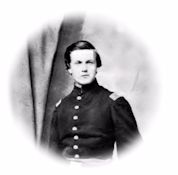
Chapin’s Farm, Va.,
November 9, 1864.
Dear Sister L.:—
My position in the quartermaster’s department does not afford the leisure I used to have when my business was to blow “Dan! Dan! Butterfield,” or even when I was in the company with the captain there. There is forage to haul and rations to issue. The colonel wants me to go to Bermuda Hundred for axes; the colonel wants logs hauled to build him a house, and he wants this and that, and the status of the poor quartermaster may be graphically described as “on the bob” from morning till night, and his letter writing must be put in edge-wise to all this work.
My experience is that there is a difference between navigating a ship on the ocean and guiding a mule team through Virginia woods and over Virginia roads, and the difference is in favor of the ship. There is a significance in the “Ya-a-a-e mool” and “Now git” of the American teamsters of African descent, that to a novice is unintelligible, but the animals with the ears seem to understand the animals with the gum and ivory, and from the mutual understanding results much good to the animals with the muskets.
I have a very limited idea of what is going on over at the Weldon railroad, but in this part of the army everybody is going into winter quarters. To be sure they are under the old orders to be ready to move at a moment’s notice, and line of battle is formed every morning an hour before light, but log houses continue to grow like mushrooms on a damp night. Generals and “two rows of buttons” generally are demolishing the residences of the “F. F. Vs.” and working them in with logs into cozy quarters. There is no certainty of their being occupied any length of time, but there is a possibility of it, and so they are built. Lieutenant Burrows and myself have been putting up a log stable for the brigade teams one hundred and eighty feet long, with two wings of forty feet each. It would not be considered in Broadway an imposing edifice, but it will impose an amount of comfort on the poor mules that they never dreamed of in connection with their fate in the army as “means of transportation.”
My health is not what it used to be. I am not sick abed any of the time, but I feel weak and lack energy. Any unusual exertion tires me out. My stay in the hospital did not seem to do me much good.
To-day I suppose there is almost as much excitement as yesterday. The returns from elections will be known, and at telegraph stations they will have the news—of Abraham’s election. We believe it here, but it will be vastly consolatory to have our belief confirmed.
I may have mentioned to you that I was trying to get Alf Ayres into the Eighth as second lieutenant. If he is as competent as I think he is, I could get him appointed on sight, if he could only come over and see our colonel. The colonel’s recommendation would secure his promotion, and I would like to see him in the regiment.


