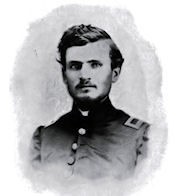
20th. Thursday. Pursued on back road 15 miles, picking up some prisoners. The victory complete. All worship Sheridan who turned a complete rout into the most complete victory of the war. Rebs panic stricken, not even forming at Fisher’s Hill. Our loss in killed and wounded heavy. Gen. Ramseur mortally wounded. At our old camp.

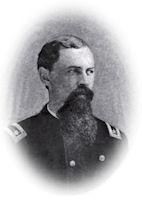
Alpine, Chatuga Valley, October 20, 1864.
Got here at dark last night, eight miles from Summerville. We seemed to be headed southwest. I have the sorest feet I have enjoyed for two years. Do you notice how accurately I miss it in every prediction I venture? I am a fair sample of the ignorance “Pap” keeps this army of his movements. He has shown his ability to keep us from divining his purposes, but he or any other general cannot keep us from guessing. Fine country here, for Georgia. An officer and 20 men are detailed daily for foragers.
They start ahead in the morning, and shoot hogs, sheep, gather sweet potatoes, apples, etc., and bring all out to the roadside. The hogs and sheep are cut into pieces of about 20 or 25 pounds. When the regiment comes along every man makes a grab as he passes at the pile, throws his chunk over his shoulder, and all without breaking ranks. You can imagine the appearance a battalion would make at nightfall.
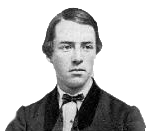
Thursday, October 20. — Received a letter from Mr. Garesché, saying that he had taken steps to find out Colonel Greene’s residence. Captain Amory received a letter from his mother and one by mistake from Ned Boit, intended for William Amory’s son, alluding to Charlie Bowditch. Lieutenant Belcher brought in a list of names from Richmond, of officers who had money there, in the hands of Quartermaster Moffatt. Mine was among them. A man escaped to-day by jumping over the fence behind the privy. Day pleasant.
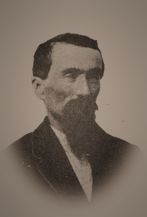
October 20 — The railroad ride that our Yankee friends so kindly furnished us last night was wearisome in the extreme, as we were shipped in box cars and had to strew ourselves on the floor like hogs. The night was cold and chilly, and although I tried to sleep some on the train, and knocked faithfully and perseveringly at the gates of dreamland, they failed to yield even for a respectable doze. At the Relay House, sometime about midnight, our train was side-tracked for about two hours, and in that time nine heavy freight trains passed us going west; our Yankee guard told us that the trains were all laden with supplies for General Sheridan’s army.
Little before day we arrived in the suburbs of Baltimore, left our box car cage and were marched to Fort McHenry, where we were turned into the fort yard like a herd of cattle. Then and there I unrolled my bed, and sunk down on Mother Earth to snatch a little sleep and have a few pleasant dreams about the thick gloriousness that floats around Uncle Sam’s prisoners of war. I slept until sunrise, and the first thing that my waking eyes beheld was a large three-masted ship, the City of New York, under full sail speeding like something alive across the harbor of Baltimore. That was the first ship I ever saw, and it was a beautiful and interesting sight; the thing moved as gracefully as a swan.
Fort McHenry is located on Whetstone Point near the City of Baltimore, and its guns command Baltimore Harbor. It is constructed of brick, and the present fort was built in 1799 and named in honor of James McHenry of Baltimore, who was President Washington’s first Secretary of War.
We remained in the fort grounds all day until this evening at sunset, when we boarded a little sidewheel steamer, name The Star.
October 20th.—Cloudy. There is a street rumor of a battle below, and on the Petersburg line. The wind is from the west, and yet we hear no guns.
The Secretary of the Treasury sent to the Secretary of War today an argument showing that, without a violation of the Constitution, clerks appointed to places created by Congress cannot be removed. We shall see what the Secretary says to that.
October—We have got the smallpox in prison, and from six to twelve are taken out dead daily. We can buy from prisoners rats, 25 cents each, killed and dressed. Quite a number of our boys have gone into the rat business. On the 11th of this month there were 800 sick prisoners sent South on parole.
Off For Home.
On the 5th of October, two days before the expiration of our term of service, an order came to Price’s creek, ordering all those who were entitled to muster out to turn over to the proper authorities our arms and equipments and report at the railroad station near Fort Spinola. This was just after dinner. Capt. Emery sent to the pickets across the creek for all those who had not re-enlisted to report at quarters. In a few minutes we were all there; the captain read the order and the boys cheered. I was all ready to comply with the order, and bidding faithful Spitfire a long and final farewell, I handed it to the captain. It was soon found out what was up, and for the next half hour the enemy was left to take care of themselves, and all hands gathered at quarters to say their good-byes and see us off. We went aboard the cars at Port Spinola and picked up others along the road, arriving at Morehead about dusk. There about 100 of us went aboard the steamer Dudley Buck, and soon after were sailing out the harbor of Beaufort, leaving behind us the scenes of our triumphs and hardships. The next morning we were around Cape Lookout and out to sea. Pretty soon we saw the officers come up out of the cabin, they were talking among themselves and seemed to wear a troubled look. It was soon discovered that there was a lot of citizens aboard coming down with yellow fever, and before noon one was brought up out of the cabin dead and laid in a boat that hung on the davits.
An Indignation Meeting.
The boys held an indignation meeting, declaring it was wrong and cruel on the part of the government or other authorities to allow these men to come aboard, and it seemed to be the evident intent of the government or some one else to murder us. They had just tried to drown us and failing in that had now, after having gone through one of the most unheard of campaigns, and as though were too obstinate to die, would give us one more chance, and smuggle aboard a lot of yellow fever stricken devils to go home with us. The captain disclaimed all knowledge of how they came aboard, but it was evident they were here and couldn’t have got here without the knowledge and consent of somebody. They still further declared that those citizens were of no earthly use nor hadn’t been of any, they were simply buzzards who had run away from the draft in New York, and were now running away from the yellow fever, and as a measure of safety and self-protection it was voted to throw them all overboard. The captain thought that would be most too summary a way of disposing of them, besides we would be liable to a charge of mutiny and murder at sea. It certainly was no lack of will, but only our better judgment that prevented their being thrown overboard. We reached Fortress Monroe on the forenoon of the 7th and were detained several hours by some quarantine regulations, but were finally permitted to resume our journey.
In Quarantine.
On the morning of the 9th we sighted Sandy Hook, and on getting nearer we could see quite a fleet of vessels lying there. This was the lower quarantine. We ran through this, arriving at the upper quarantine at Staten Island about 10 a. m. We were now in sight of New York, and were buoyant in hope that we should soon be there. As we neared a big steamer lying in the middle of the channel we were hailed with “Steamer ahoy!” We slowed down and ran alongside. Some kind of an official came to the middle gangway and said:
“Where are you from?”
“Beaufort, North Carolina,”
“Any sick aboard?”
“Yes, sir.”
“Any deaths?”
“Yes, sir.”
“How many days out?”
“Four.”
“How many deaths?”
“Four.”
“Four deaths in four days. About ship and go back to the Hook.”
Our hearts that a few moments before were buoyant with hope now sank within us. The Hook was a cold, dreary place, and there was no knowing how long we should have to stay, but it was easy enough to know that some of us wouldn’t stay there very long. We ran back to the Hook, and dropped anchor, not far from the large hospital ship.
After a little while we saw a gig lowered from the hospital ship; a man stepped in and was pulled alongside our boat; he climbed aboard and proved to be some kind of health officer. He looked us all over and then looked over the boat. He signaled a tug to run alongside, he hustled out those citizens, and put them aboard of it. He also took Samuel Champney of company D, whom he found lying down, and took them all over to the hospital ship. We bade Sam good-bye as he went over the side of the boat. We never saw him afterwards, and I have since learned that he died there. The next morning, when the gig was seen coming over, the call went over the boat: “All hands on deck; don’t be caught lying down; all out on deck!” When he came aboard he found us all fooling and knocking off caps. He looked us over and remarked that we didn’t seem to be ailing very much. He then looked the boat over and not finding any down took his leave, but if he could have looked through the side of the boat he would have seen half of us down by the time he was in his gig.
Capt. Denny of company K, who is in command of this detachment, and who is a genial, big-hearted man, said he would see what he could do for us. He went over to the hospital ship and a little while after we saw him on a tug going towards New York. I knew if there was any help for us, Capt. Denny was the man to do it. He is a good talker and great in diplomacy, and when he sets about a thing he is pretty sure to accomplish something. Tuesday night came but no Denny, and the question, “Where is Denny?” was oft repeated without an answer. I could but feel that the captain was working for us and no news was perhaps good news. Wednesday morning, the 12th, was a cold, bleak, cheerless morning, and we were growing weaker every hour, but all hands rallied on deck when that hospital fiend was seen coming. Noon came but no Denny. Where is Denny? What has happened to him? Can it be possible that he has deserted us? were questions that went unanswered. I said it was possible something may have happened to him, but I cannot believe he has deserted us. He is not that kind of a man, besides he would not miss taking us into Worcester for half the wealth of the city, but if he don’t come tonight, we will send Captains Parkhurst and Emery to see what has become of him.
About 3 p.m. we sighted a large tug coming through the narrows, and soon after it headed towards our boat. Long before it got within hail we saw a man in the bow, waving his cap. It was Capt. Denny. Deliverance had come, and I reckon when that hospital doctor heard our cheers, he must have thought we were not very badly affected with yellow fever. I had known Capt. Denny for several years before the war, but cannot remember when I was so glad to see him as I was that afternoon. The tug came alongside and we were not very long transferring ourselves aboard it and it was again heading for the city. We ran along the starboard side of the Norwich steamer, and boarded her at the forward gangway, and were bustled among the cotton bales and freight like so many lepers. We were not allowed abaft the forward gangway and were not troubled by visitors as no one cared to see the brave defenders. But we cared nothing about that so long as we were going towards home, and the accommodations were as good as we were accustomed to having..
We reached Norwich about 2 a.m. on the 13th, and went aboard the cars, arriving at Worcester at 4 o’clock. At this hour Worcester people were still wrapt in the arms of Morpheus and of course we didn’t meet with a very enthusiastic reception. Our little party formed on Foster street and noiselessly wended our way to the City Hall. A few stagglers who were around the depot reported our arrival and an hour after we received an invitation to go back to the depot refreshment room for lunch. This invitation was readily accepted and a famine was created in that refreshment room soon after our entrance. We had a good breakfast of hot coffee, cold meats, bread, pies, cakes, etc. After breakfast we returned to the hall to receive visitors, among the first of whom was Col. Pickett, whom was Col. Pickett, who warmly welcomed us, shaking hands with all. We were right glad to see our colonel, and learn that he was getting the better of his wounds received at Cold Harbor.
By 8 o’clock the hall was filled, and welcoming speeches were mad by his Honor Mayor Lincoln and others. After which it was proposed we make a parade and show ourselves over the city. This was objected to, not because we didn’t wish to please our Worcester friends, but because we were sick and tired, and had had enough of parades and marches; our thoughts were of home and we were in a hurry to get there. Free tickets were furnished us on all the railroads, and we were dismissed for a week or until our muster out. I arrived home at noon, agreeably surprising my family, who were not expecting me for a week to come.
On the 20th of October we again met in Worcester for muster out and discharge papers. I was once more a free man, having been under the care and keeping of others a little more than thirty-seven months.
Closing Scenes.
Two months later we again met in Worcester to be paid off. This was to be our last meeting, henceforth we should travel in different paths and our meetings would be only by chance if ever. Shaking hands and wishing each other all manner of good fortune, we said our good-byes and parted. I have been through it and have had a great experience. I shall have no regrets that I did not go and have brought back no sorrowing memories. I have done what I could to preserve the union of the states. I have met the enemies of the country face to face, and done what I could to roll back the tide of rebellion, and if I have been of any little service to the country, I am glad of it. With all the officers of the regiment my relations have always been on the most amicable footing, and I am vain enough to believe that they will all bear me witness that I have always cheerfully obeyed all their commands and done all the duty required of me; that I have always treated them politely and shown them all the respect due their rank. In my little sports and jokes I have shown no partiality, and I trust there is no one who bears any malice towards me on that account. I have brought from the field no resentments or animosities towards any, but shall always hold in pleasing remembrance all, both living and dead, with whom I have been associated.
Let him not boast who puts his armor on
Like him who lays it off, his battle done.
THE END.
October 19th. Early this morning, at daylight, we heard the guns at a distance. We knew by the sound that a hot battle was on, up the valley. We waited for a report but none came. We knew by the sound that our boys were falling back. It was an anxious time for us. Our regiment under arms, ready for duty as soon as called upon. There came a time when the firing seemed to cease, all was quiet. Later on the battle was on again. The sound became less. We could hardly hear it. Then we began to feel that our boys were driving the enemy. Quite late, reports came that a battle at Cedar Creek and Fisher’s Hill was on. At first our boys were surprised and driven back, but became victorious.
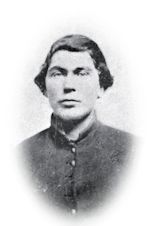
Etowah Bridge, Wednesday, Oct. 19. Day passed very quietly. Our quarters are all done except chimneys. Principal work done was playing chess and eating walnuts, which is the only game I indulge in at present. We have wild rumors that Hood has split his army, two corps retreating. One going north, Sherman following both, but nothing definite. Kilpatrick’s wagon-train and convalescents reached here to-day. His headquarters are at Stilesboro, fifteen miles west. Took a pleasant walk to town with Griff after retreat. Enjoyed myself well. But there is an aching void in my heart, which cannot be filled without news from home.
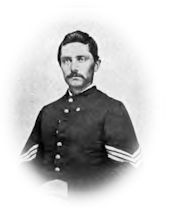
Wednesday, 19th—We entered Summerville at 10 o’clock and remained there till noon, when we started for Galesville, Alabama. After marching fifteen miles, we went into bivouac on the banks of the Ogeechee river. All is quiet in front. The valleys through which we are marching are quite rich and there are some fine plantations which afford good forage. It is fortunate for us, as we have to get most of our living that way while on this expedition. Sweet potatoes are plentiful and then we also get some fresh pork.


