Friday, September 23.— We had a rainy day. Went upstairs to see the officers there. Heard of the victory in the Valley. The deserters were sent away to-day.

September 23 — General Kershaw’s division of infantry arrived here to-day, from the Shenandoah Valley; I think it is en route for General Lee’s army at Petersburg.
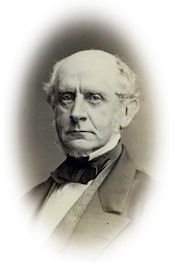
Charles Francis Adams, U.S. Minister to the U.K., to his son, Charles.
London, September 23, 1864
We were sufficiently edified by your report of the conferences with the various parties in authority. I am not much surprised by it. Human patience is not great. When I reflect that mine gives way so easily to the few applications, comparatively, that are made here to me, I can make allowances for those which spring out of an organisation dealing with men by the hundreds of thousands. It is an excellent thing to cultivate good manners as a habit, for thus comes an artificial rein on the passions that benefits all parties almost equally. I have constantly felt great sympathy with Mr. Stanton. Nobody has had a harder place. The responsibility for failures of all kinds is sure to come upon him, whilst the credit of success is apt to be monopolised by those immediately concerned in the operations. It was for this reason that I was rather glad to read the high compliment which Mr. Seward paid him in his admirable speech at Auburn. If he has been nervous and irritable, he has not been without plenty to make him so. What a set of military officers he has had to deal with; how many to set aside for incompetency, or vice, or crime; how many have failed to acquit themselves successfully of the trust reposed in them; how many unreasonable, complaining, exacting and faultfinding, either as agents or as advisers! This is the hard lot of every Minister who is destined to carry on a great war. . . .

23rd. Friday. Withdrew to Buckton across the South Fork. Had we only gone in yesterday, what success. Moved back near Milford. Camp at 12 P. M.

by John Beauchamp Jones
SEPTEMBER 23D. —Raining.
Our loss, killed, wounded, and taken in the battle nearWinchester, is estimated by our people at 2500. The enemy say they got 2500 prisoners. The enemy’s loss in killed and wounded amounted probably to as much as ours.
Gen. Lee writes that, in his opinion, the time has come for the army to have the benefit of a certain per cent. of the negroes, free and slave, as teamsters, laborers, etc.; and he suggests that there should be a corps of them permanently attached to the army. He says if we do not make use of them in the war, the enemy will use them against us. He contemplates staying where he is during the winter, and proposes building a railroad from his rear to the oak woods, as the pines do not answer a good purpose.
Gen. Hood telegraphs (dated yesterday) his intention to get in the enemy’s rear, and intercept supplies fromDalton.Sherman must either attempt to drive him from that position (north bank of theChattahoochee), or advance farther south with his supplies cut off and our army assaulting his rear.
Mr. Roy (clerk), cousin of Mr. Seddon, said to-day that he regarded the Confederacy near its end, and that theUnion would be reconstructed.
Our good friend Dr. Powell brought us a gallon of sorghum molasses to-day.
September 22d. This morning prisoners began to show up. They were guarded from here to Harper’s Ferry by a portion of our regiment, who relieved the cavalry escort, or guard. Our boys joking with them. Some of them we had been up against at Lynchburg, during Hunter’s raid. The wagon trains have left here, going on to Harper’s Ferry. Nothing for us to do here. Reported late tonight we leave here in the morning.
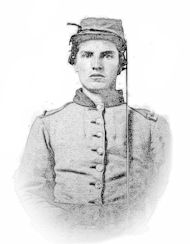
Thursday, 22d.—Colonel E. P. Wadkins took command of brigade.

Thursday, 22d—It is still raining, which makes the third day’s rain. My ward was broken up today and the sick boys were transferred to Ward D in hospital number 4. We worked all afternoon making the ward ready for the wounded from the field hospital. I tried to get permission to return to my regiment today, but the doctor would not let me go. But all who are able, if not needed here, are to be sent to the front tomorrow.
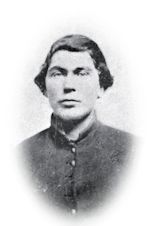
Etowah Bridge, Thursday, Sept. 22. Wet and dreary, but little life manifested till 3 P. M. when the news came that order releasing the old boys was at headquarters. Received with a cheer and everybody moving. Lieutenant Clark busy taking names preparatory to turning the Battery over.
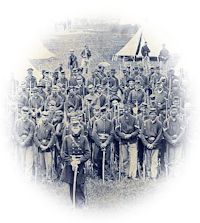
Blicks Station, Va.,
September 22d, 1864.
Blicks is the name of a station on the new railroad, near our camp. A spur runs from this road to each camp, and storehouses are being built. Nothing is being done here at present but building and drill. All hands are busy. Not an idle man in all this army, that is able to do duty. Old fortifications are being strengthened and new ones built, and drilling is pushed with as much vigor as fortifications and railroads. Barely enough men are left in the rifle pits to watch the enemy; the rest are drilling—drilling—in squads, by companies, battalions, brigades, and, twice a week, an entire division at a time.
This place has become a camp of instruction for recruits. Some regiments are nearly full. The Fifty-fifth Massachusetts has received over two hundred “Yankees” direct from Germany.
Glorious news from the “Valley” today. A dispatch was read to the men on drill, giving the news of the day up to 6 p. m. of yesterday. The air was rent with shouts that could be heard for miles. We fully understand the importance of a genuine, decisive victory in that quarter. I am waiting, with feverish anxiety, the details of Sheridan’s achievements. We are having beautiful weather—rain enough to lay the dust, but not enough to make the roads muddy.


