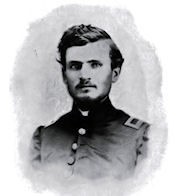
19th. Reached Pittsburg at 2 P. M. Left on Cleveland train at 3. Pittsburg in mourning. Rode in company with a Cleveland man, Briggs, I believe. Pleasant visit. Gave me a detail of the working of the carrier P. O. system. Passed through Cleveland at 10 P. M. Stayed over at Grafton. The funeral of the President took place today. Ceremonies throughout the Union. Johnson bound to deal roughly with traitors.


Chattanooga, Wednesday, April 19. A very hot sultry day. Drilled from 8 to 9, battery drill. Returned to camp to receive a bouncing mail, four letters for me, better than at furlough. News is still very uncertain and exciting. Mobile and Johnston both reported to be captured, but it needs confirmation.
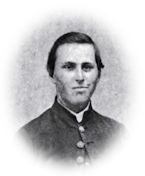
April 19th. All duty except guard and picket suspended since the assassination of Mr. Lincoln. These are days of mourning. Officers wear crape on the left arm and on the hilts of swords for thirty days. The funeral takes place today in Washington. The towns-people have arranged for a funeral parade and service to be held in the Court House. Our regimental band is engaged to furnish the music for the procession. On the march a coffin was carried, making a solemn appearance as the funeral procession marched to the cemetery where the coffin was buried. The whole thing was in charge of the towns-people. It was a very strange proceeding in the eyes of down-east Yankees. It was a very solemn occasion all through, to the burial of the coffin.
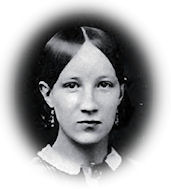
Wednesday evening, April 19, 1865.—This being the day set for the funeral of Abraham Lincoln at Washington, it was decided to hold the service today, instead of Thursday, as previously announced in the Congregational church. All places of business were closed and the bells of the village churches tolled from half past ten till eleven o’clock. It is the fourth anniversary of the first bloodshed of the war at Baltimore. It was said to-day, that while the services were being held in the White House and Lincoln’s body lay in state under the dome of the capitol, that more than twenty-five millions of people all over the civilized world were gathered in their churches weeping over the death of the martyred President. We met at our church at half after ten o’clock this morning. The bells tolled until eleven o’clock, when the services commenced. The church was beautifully decorated with flags and black and white cloth, wreaths, mottoes and flowers, the galleries and all. The whole effect was fine. There was a shield beneath the arch of the pulpit with this text upon it: “The memory of the just is blessed.” It was beautiful. Under the choir-loft the picture of Abraham Lincoln hung amid the flags and drapery. The motto, beneath the gallery, was this text: “Know ye that the Lord He is God.” The four pastors of the place walked in together and took seats upon the platform, which was constructed for the occasion. The choir chanted “Lord, Thou hast been our dwelling-place in all generations,” and then the Episcopal rector, Rev. Mr. Leffingwell, read from the psalter, and Rev. Dr. Daggett followed with prayer. Judge Taylor was then called upon for a short address, and he spoke well, as he always does. The choir sang “God is our refuge and our strength.”
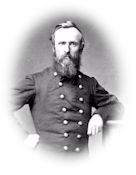
New Creek, West Virginia, April 19, 1865.
My Darling: — I have just returned from Cumberland to meet Dr. Joe from Winchester and to see the funeral ceremonies, etc., at department headquarters.
Had a good time. I feel the national loss, but even that is nothing compared to the joy I feel that this awful war is ended in our favor. Joe and I moralized over it, and agreed that no one man, not even so great a one as Lincoln, was anything by the side of the grand events of the month.[1] We are to leave the service hereafter when things take shape a little, if possible at the same time.
I asked you in a late letter to be ready to come to me on short notice. I, or somebody, will meet you at Parkersburg or somewhere. Come without much baggage ready to travel. We will perhaps take a journey of three weeks or so when I quit. Joe will go along and possibly two of my staff. Can we take Birch without Webb? Can you leave George?
I am so anxious to be with you. Your letter of the 5th, which I find here, is the first I have from you in a great while. I am so happy in the prospect of being with you for good soon. — Reply at once.
Affectionately, ever,
R.
Mrs. Hayes.
[1] Dr. Webb wrote his mother the next day (April 20) from Cumberland as follows: —
“We are all well. The time passes slow now that there is no work in view. The Rebels all feel disposed to quit; the women, if possible, more insolent than ever. It is a bitter pill for the First Families. Most of the ‘Gorillas’ have signified their desire to quit, but the Union people who have suffered from their atrocious acts, do not feel exactly disposed to receive the murderers back into their arms. The Union citizens who have suffered everything during this war feel outraged at the disposition evinced by the powers that be to take back as erring brethren these fiendish villains.
“While I think the President a good honest man, none better, I am not so certain that his loss at this time is so great a public calamity as many are disposed to think. He was entirely too forgiving. He appeared to have forgotten the thousands of honest, brave, and true men either in their graves or limping about cripples, etc.
“So we go, the world moves on, one man succeeds another. This country is too great, its aim too holy to fail at this period on account of the death of any one man.”
Wednesday, April 19. — Sheridan evidently did the decisive fighting at Five Forks; but for him it would have been a failure again.
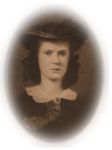
No. 211 Camp St.,
April 19th, 1865.
“All things are taken from us, and become portions and parcels of the dreadful pasts.” . . .
Thursday the 13th came the dreadful tidings of the surrender of Lee and his army on the 9th. Everybody cried, but I would not, satisfied that God will still save us, even though all should apparently be lost. Followed at intervals of two or three hours by the announcement of the capture of Richmond, Selma, Mobile, and Johnston’s army, even the stanchest Southerners were hopeless. Every one proclaimed Peace, and the only matter under consideration was whether Jeff Davis, all politicians, every man above the rank of Captain in the army and above that of Lieutenant in the navy, should be hanged immediately, or some graciously pardoned. Henry Ward Beecher humanely pleaded mercy for us, supported by a small minority. Davis and all leading men must be executed; the blood of the others would serve to irrigate the country. Under this lively prospect, Peace, blessed Peace! was the cry. I whispered, “Never! Let a great earthquake swallow us up first! Let us leave our land and emigrate to any desert spot of the earth, rather than return to the Union, even as it Was!”
Six days this has lasted. Blessed with the silently obstinate disposition, I would not dispute, but felt my heart swell, repeating, “God is our refuge and our strength, a very present help in time of trouble,” and could not for an instant believe this could end in an overthrow.
This morning, when I went down to breakfast at seven, Brother read the announcement of the assassination of Lincoln and Secretary Seward.
“Vengeance is mine; I will repay, saith the Lord.” This is murder! God have mercy on those who did it!
• • • • • • • •
Charlotte Corday killed Marat in his bath, and is held up in history as one of Liberty’s martyrs, and one of the heroines of her country. To me, it is all murder. Let historians extol blood-shedding; it is woman’s place to abhor it. And because I know that they would have apotheosized any man who had crucified Jeff Davis, I abhor this, and call it foul murder, unworthy of our cause — and God grant it was only the temporary insanity of a desperate man that committed this crime! Let not his blood be visited on our nation, Lord!
Across the way, a large building, undoubtedly inhabited by officers, is being draped in black. Immense streamers of black and white hang from the balcony. Downtown, I understand, all shops are closed, and all wrapped in mourning. And I hardly dare pray God to bless us, with the crape hanging over the way. It would have been banners, if our President had been killed, though!
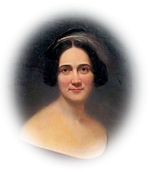
April 19th.—Just now, when Mr. Clay dashed up-stairs, pale as a sheet, saying, “General Lee has capitulated,” I saw it reflected in Mary Darby’s face before I heard him speak. She staggered to the table, sat down, and wept aloud. Mr. Clay’s eyes were not dry. Quite beside herself Mary shrieked, “Now we belong to negroes and Yankees!” Buck said, “I do not believe it.”
How different from ours of them is their estimate of us. How contradictory is their attitude toward us. To keep the despised and iniquitous South within their borders, as part of their country, they are willing to enlist millions of men at home and abroad, and to spend billions, and we know they do not love fighting per se, nor spending money. They are perfectly willing to have three killed for our one. We hear they have all grown rich, through “shoddy,” whatever that is. Genuine Yankees can make a fortune trading jackknives.
“Somehow it is borne in on me that we will have to pay the piper,” was remarked to-day. “No; blood can not be squeezed from a turnip. You can not pour anything out of an empty cup. We have no money even for taxes or to be confiscated.”
While the Preston girls are here, my dining-room is given up to them, and we camp on the landing, with our one table and six chairs. Beds are made on the dining-room floor. Otherwise there is no furniture, except buckets of water and bath-tubs in their improvised chamber. Night and day this landing and these steps are crowded with the elite of the Confederacy, going and coming, and when night comes, or rather, bedtime, more beds are made on the floor of the landing-place for the war-worn soldiers to rest upon. The whole house is a bivouac. As Pickens said of South Carolina in 1861, we are “an armed camp.”
My husband is rarely at home. I sleep with the girls, and my room is given up to soldiers. General Lee’s few, but undismayed, his remnant of an army, or the part from the South and West, sad and crestfallen, pass through Chester. Many discomfited heroes find their way up these stairs. They say Johnston will not be caught as Lee was. He can retreat; that is his trade. If he would not fight Sherman in the hill country of Georgia, what will he do but retreat in the plains of North Carolina with Grant, Sherman, and Thomas all to the fore?
We are to stay here. Running is useless now; so we mean to bide a Yankee raid, which they say is imminent. Why fly? They are everywhere, these Yankees, like red ants, like the locusts and frogs which were the plagues of Egypt.
The plucky way in which our men keep up is beyond praise. There is no howling, and our poverty is made a matter of laughing. We deride our own penury. Of the country we try not to speak at all.
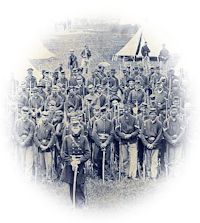
April 19th. 1865.
Yesterday afternoon we received sad news from our Nation’s Capital; news that caused each soldier’s cheek to blanch, as if in presence of some dire calamity. Our President is murdered; ruthlessly struck down by an assassin’s hand! The demon of Secession, in his dying agony, poured out the vials of its wrath on our Executive. Imagination cannot paint the whirlwind of revengeful wrath that swept over the army; the strong desire, openly expressed, to avenge his death by annihilating the people whose treason brings forth and nourishes such monsters. Woe to the armed Rebel, now and henceforth, who makes the least resistance.
To illustrate the feeling of the men, I will write down an incident that occurred in our regiment. We have one reptile left, and only one, to my knowledge. When the news reached us, he was heard to say, with an oath: “I’m glad of it. If I had been there, I would have helped to do it.”
Before his words had time to cool, he was seized by the men near him; a tent rope was thrown around his neck, and he was hustled toward a tree, with the intent to hang him. The officers interfered, and sent him under guard to the “bull pen.”
Tomorrow is to be observed as a day of mourning throughout the army. Never was man more sincerely mourned than will be Abraham Lincoln, and in history his name will be enrolled beside our Washington.
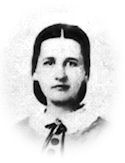
April 19th, 1865.—It is bedtime and I am writing in my own room; usually I write in the library, where Father sits, but tonight I want to be alone. Oft I have repeated, perhaps repeated boastfully, those brave lines:
“I am the master of my fate;
The captain of my soul.”
And now, I find I am but a broken reed, shaken by the wind. Let me write the day’s happenings while I can.
This morning we sat on the front porch watching the road. Father sat in his big rocker and Mother sat close beside him; Brother Amos and Sister Mag were sitting back in the vines, playing with little Rebecca, who was in her mother’s lap. Mattie was stretched out, full length on one of the porch seats, her beautiful golden curls falling to the floor. I sat on the steps and Eddie was spinning acorns beside me. Sister Mart is at Goodwood. For several days now the front porch has been the favorite place for the family to sit.
Mattie is wild to see her father and she rehearses their meeting, making it different every day.
I was watching Eddie and did not know there was anything to see, when Father said, “There they come.” Entering the front gate, too far for my near-sighted eyes to distinguish one from another, were three Confederate soldiers. Poor fellows; they were pitiful. Thin and so browned by exposure, until they were hardly recognizable. Footsore and weary, on they came, Captain Bernard, stepping quicker than his companions.
We rushed to greet them but Brother Junius, who was next called out, “Do not come near me—send Bill to my room” and then he went rapidly away in the direction of the room which was always known as his.
Mattie burst into tears—”Papa, you are crazy,” she wailed. Cousin Johnnie came last:; his face the saddest you ever saw. Falling on the steps, he put his face in his hands and cried like a child. Cousin Johnnie, who of all men we knew was the most reticent and reserved.
Dear Mother always knows just what is best to do and say and with her sweet words of welcome, her inquiries after the health of each one, the hot coffee and cakes which she has had ready day after day; all this helped to restore the composure of all.
Jordan took Captain Bernard home and Father had his buggy brought to the door and carried cousin Johnnie home himself. Father loves uncle Richard so dearly and I believe his sons are almost as dear to Father as if they were his own.
In the meantime none of us had seen Brother Junius. Bill had made sundry trips back and forth from the room in the yard and the kitchen; several kettles of hot water had been transported and then Bill got a pitch-fork and came out, bearing the clothes Brother Junius had worn, and proceeded to burn them.
An inkling of the truth must have come to Mother for she said, “Come in the house children, Mr. Taylor will be in after awhile.”
Then Bill sent Aunt .Morea to borrow the sharpest scissors. We did not see him until long after Father had returned and when he did get in the house he looked very different from the weary man whom we had caught a fleeting glimpse of. With his golden hair cut as short as Bill could do the work, his face clean shaven, dressed in a suit of civilian clothes, with immaculate linen and a white silk necktie, he was ready to be hugged and kissed and made much of by everyone, from Mother down to little Rebecca; though Mattie of course, came first. She was simply wild with joy.
Mother said he should not tell one word of happenings in Virginia until he had eaten a good, hot supper. She was right, as she always is. After supper we gathered ’round him in the library and he began by telling us of the trying times the army had been exposed to for weeks before the surrender; but not a soldier made complaint and not one listened with any show of patience, to the thought of laying down their arms.
On through the days, his story went until that fateful 9th saw the ragged remnant of the Army of Northern Virginia drawn up in line on either side of the road, to see their beloved Commander pass. He was mounted on “Traveler” and a splendid new uniform added to his fine appearance. His men cheered him all along the line and he acknowledged their greetings. Never had soldiers so loved a chieftain as these men in gray loved Lee.
The army waited; sometime passed and then they saw through unbelieving eyes, their general, riding slowly toward them. His head, usually held so proudly, was low on his breast and not once did he raise his eyes. He made no pause; no need for words to tell them what had happened. When the realization came to them those war-worn veterans wept like David, when the news of Absalom’s death was brought to him.
Gladly would they have followed him into the “jaws of death” but this—it was more than they could bear. After an hour or so officers from General Grant came, with an order to stack arms and prepare to deliver to the United States authorities all army equipment. The entire Army of Northern Virginia were prisoners of war.
Again officers came from General Grant; these men must make oath that they would not bear arms against the government of the United States until such time as they should be exchanged. Still they were not disbanded. Another officer issued paroles and told them that a government transport would sail on the 11th from Norfolk to Savannah. They could go to Norfolk the next day and sail, that is as many as the transport would accommodate. A detachment of Grant’s men went with them. The transport was old and did not look sea-worthy but they were hustled on board, until there was hardly standing room. They had no provisions, no money. To add to the misery of the situation the transport was fairly alive with I. F. W.’s and they, too, were hungry.
“This,” he said, “will explain why I needed Bill and so much soap and water. Bill burned everything I wore, even my shoes and hat. Fortunately my trunk was well filled with clothing. Never in all my life have I felt so desperate, and, when those disgusting creatures took possession of me, I completely lost my self respect.”
With this he laid his head on the library table and <em>sobbed</em>. Such sobs as I had never heard—dry, harsh, choking. The room shook with their violence. Oh! it was awful to see that great, strong, splendid man, so completely unstrung. Before his story was ended Mattie had left the room and when we found her she was doubled up on Mother’s bed, and she had cried herself to sleep.
I sit here and wonder, wonder if all the dear “men in gray” feel as crushed and disconsolate as these? Is the home-coming painful to them all? Will they ever be able to forget? Will the time ever come when they can remember the glory, the honor, the magnificent courage they have shown, and take comfort in that? God help them and help us all.
Tomorrow we will take up our every-day life again, and in the little ordinary things of daily life the tension may be loosed. I will do as Father says and try to be like Mother.


