Chattanooga, Monday, Feb. 27. A pleasant day, quite hot midday. Sergeant Hutchinson and twelve men gone to Mission Ridge to chop timber for quarters. The remainder of the Company clearing off our new camping ground most of the day. I was exempted, being on guard. One hundred and twenty new sabres for the guards and a load of quartermaster and ordnance stores drawn. Griff having sold our sugar, it falls upon me to invest it in bread to lengthen our rations. Lieutenant Sweet gave an order on Sanitary Commission for ten rations which I obtained at six cents per ration, cheap, plenty of bread now. No mail for me. Troubled considerably with rheumatism.

27th. Reveille at 3 A. M. Moved at 6. Moved through Winchester. Formed several times in crossing streams, etc. Seemed good to see Gen. Sheridan along on his black horse. Halted many times. Went into camp at 10 P. M. Very good rest. Woodstock. 28th. Reveille at 4 A. M. Brigade moved out in advance at 6. Waited at the Shenandoah for the pontoons to come up. Most of our brigade forded. One 3rd N. J. man drowned. Our regt. did nicely. Camped at Lacey’s Springs.
February 27th.—Bright and windy. The Virginia Assembly has passed resolutions instructing the Senators to vote for the negro troops bill—so Mr. Hunter must obey or resign.
It is authoritatively announced in the papers that Gen. J. E. Johnston has taken command of the army in front of Sherman (a perilous undertaking), superseding Beauregard.
Grant is said to be massing his troops on our right, to precipitate them upon the South Side Railroad. Has Hill marched his corps away to North Carolina? If so, Richmond is in very great danger.
The Examiner to-day labors to show that the evacuation of Richmond would be fatal to the cause The Sentinel says it has authority for saying that Richmond will not be given up. “Man proposes—God disposes.” It is rumored that Fayetteville, N. C., has fallen into the hands of the enemy.
I saw Col. Northrop, late Commissary-General, to-day. He looks down, dark, and dissatisfied. Lee’s army eats without him. I see nothing of Lieut.-Col. Ruffin. He always looks down and darkly. Gen. Breckinridge seems to have his heart in the cause— not his soul in his pocket, like most of his predecessors.
I saw Admiral Buchanan to-day, limping a little. He says the enemy tried to shoot away his legs to keep him from dancing at his granddaughter’s wedding, but won’t succeed.
Robert Tyler told me that it was feared Governor Brown, and probably Stephens and Toombs, were sowing disaffection among the Georgia troops, hoping to get them out of the army; but that if faction can be kept down thirty days, our cause would assume a new phase. He thinks Breckinridge will make a successful Secretary.
The President and Gen. Lee were out at Camp Lee to-day, urging the returned soldiers (from captivity) to forego the usual furlough and enter upon the spring campaign now about to begin. The other day, when the President made a speech to them, he was often interrupted by cries of “furlough!”
The ladies in the Treasury Department are ordered to Lynchburg, whither the process of manufacturing Confederate States notes is to be transferred.
A committee of the Virginia Assembly waited on the President on Saturday, who told them it was no part of his intention to evacuate Richmond. But some construed his words as equivocal. Tobacco, cotton, etc. are leaving the city daily. The city is in danger.
February—The smallpox is frightful. There is not a day that at least twenty men are taken out dead. Cold is no name for the weather now. They have given most of us Yankee overcoats, but have cut the skirts off. The reason of this is that the skirts are long and if they left them on we might pass out as Yankee soldiers.
Colonel Lyon’s Letters.
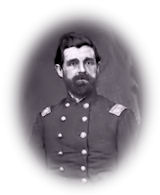
Huntsville, Ala., Feb. 26, 1865.—I took command of the post and brigade again yesterday. General Doolittle has taken command of the district. So I have plenty of work on my hands again and am likely to have for some time to come. I am getting my heart so set on your coming that I begin to feel almost nervous for fear that we shall be ordered away.

February 26.—All is at a stand-still again. Our people seem to have revived after our late disasters. The Tennessee army has scattered—many of its troops are here. As nearly all of its cannon were lost, many of the men of the batteries are here drilling as infantry; among them Garrety’s battery.
I am told that there is a good deal of dissatisfaction on account of this, as artillerymen do not like being taken from their guns. A lady friend told me the other day, that two or three members of a Louisiana battery had deserted on this account.
Fenner’s battery, from New Orleans, is here. It has been in active service nearly throughout the whole war, and has suffered much. On the retreat from Dalton three brothers in it were killed; two were shot down, at one time, along side of the third; and, as it was in the heat of battle, he could not leave his post to go to their rescue. Not long afterward he also fell, a martyr for his country. Alas I we have many such self-immolations to record in the pages of our history; and what more glory do we need than such records? None. These martyrs shall live in future story, and ages yet unborn shall sing their requiem. Youths shall listen, with quivering lip and glistening eye, to gray-haired sires, recounting their deeds of heroism, and tell how nobly freemen shed their blood in defense of liberty.
It is reported that General Johnston has taken command of the Tennessee army, or rather what is left of it. This has given universal satisfaction, but no one can tell for how long, as that hydra-headed monster—the people—is a little inclined to be fickle. I have been told that before General Hood took command, the people of Georgia sent many a petition to the president, asking him to remove General Johnston, as he was permitting the enemy to lay waste the country.
There is scarcely a town in the Confederacy where there has not been a meeting held, approving of the answer given by the peace commissioners, and passing resolutions never to yield while there is one man left to strike a blow.
Mobile has had a very large, enthusiastic meeting; and I see by the papers that Newnan has not been behind any in this respect. It is rumored that Vice-president Stevens has said he is fully convinced that there is but one way to have peace, and that is to conquer it.
Mobile never was as gay as it is at present; not a night passes but some large ball or party is given. Same old excuse: that they are for the benefit of the soldiers; and indeed the soldiers seem to enjoy them.
The city is filled with the veterans of many battles. I have attended several of the parties, and at them the gray jackets were conspicuous. A few were in citizen’s clothes, but it was because they had lost their uniforms.
The Alabama troops are dressed so fine that we scarcely recognize them. A large steamer, laden with clothes, ran the blockade lately, from Limerick, Ireland.
Notwithstanding the gayety, nearly all the churches are daily opened for special prayers, imploring the Most High to look down in pity on us, and free us from this fearful scourge.
“The Lord will not cast us off forever; but though he cause grief, yet will he have compassion, for he doth not afflict willingly nor grieve the children of men.”
Fullersville, S. C., Sunday, February 26, 1865.
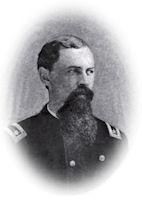
Sixty hours of rain terminated at daylight this morning, but it has not hurt the sandy roads a particle. We made 11 miles in four and one quarter hours, and are now waiting for a bridge to be completed over this creek, “Lynch’s.” We think now we are on the road to Wilmington. The map shows a good deal of railroad to be destroyed on the way, but I think we will get through by the 15th of March. Expect “you uns” are getting anxious about “we uns” again. This is, I think, a much longer thing than the Savannah campaign. Our 4th division took 103 prisoners here last night and our 2d took 200 more to-day. They are State Line Troops and muchly demoralized. It is a fact about that murdering yesterday. Sherman is out in a big retaliation order to-day. Wilmington is reported ours. Thunder and lightning last evening. Hear that the rain has raised the creek until it is three-quarters of a mile wide, and we won’t get across to-morrow. I think I’ll put down our principal campaigns:
1st. Dec, 1862, The Tallahatchie River Campaign 120 miles.
2nd. April, 1863, The Panola, Miss., 9 day’s march 180 miles.
3rd. July, 1863, Jackson, Miss., Campaign… 100 miles.
4th. Oct. & Nov., ’63, Memphis to Chattanooga, and in
5th. Dec. to Maryville, Tenn., and back to Scottsboro, Ala 800 miles.
6th. Jan., ’64, Wills Valley Campaign 100 miles.
7th. Feb. & March, ’64, Dalton, Ga., Campaign 300 miles.
8th. May until Sept., Atlanta Campaign 400 miles.
9th. Oct., 1864, Atlanta to Gadsden, Ala., and return 300 miles.
10th. Nov. & Dec, Atlanta to Savannah…. 300 miles.
Jan., Feb. & March, ’65, The Carolina Campaign 400 miles.
Total 3,000 miles.
A captain and seven men who went foraging yesterday are still missing, supposed to be captured or killed. And 20 men of the 97th Indiana who went out this morning are reported all killed by a 46th Ohio man, who was wounded and left for dead by the Rebels. He says the 97th boys paid for themselves in dead Rebels before they were overpowered. Our corps has now 500 prisoners, three times as many as we have lost.
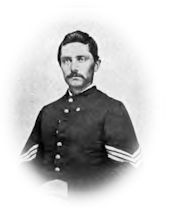
Sunday, 26th—We had another all-night rain, but it cleared off this morning. We started at 8 a. m. and marched ten miles, going into camp near the Big Lynches creek. Our division is still in the advance; the First Division did not yet come up with us. We have level country now, but for about twenty-five miles on each side of the Wateree river the land is very rough and covered with pine timber.
Chattanooga, Sunday, Feb. 26. A bright, beautiful day, affording us an opportunity to dry our clothes and blankets. On guard, second relief. Had to stay in camp. Griff went to church. The day passed quickly. Read Christian Enquirer which the mail brought me, and wrote to John. In the beautiful twilight the boys turned out to enjoy athletic, sports, jumping, running, etc. All apparently as merry as though a sorrow they knew not, a picture for the weeping ones at home.
26th. Every preparation made to move. Ordnance and Q. M. stores condemned and turned in. Several orders and circulars came around. All bustle and commotion. Wrote home.


