Following the American Civil War Sesquicentennial with day by day writings of the time, currently 1863.

June 2010

June 24, 1860.— Yesterday the Democrats put in nomination two tickets at Baltimore. Douglas and Fitzpatrick were nominated by the Northern wing and Breckinridge and Lane by the Southern. Lincoln and Hamlin, nominated by the Republican party, and Bell and Everett, candidates of the “Union” party, have been in the field several weeks. Four tickets for national offices. This is new in my day. My Republican friends are confident that Lincoln and Hamlin will be elected by the people. I have a good deal of apprehension on the subject. I fear the election will go to the House. Let me cipher. There are three hundred and three electoral votes; one hundred and fifty-two are required for a choice. We may count for Lincoln the States carried by Fremont in 1856— eleven States, one hundred and fourteen electoral votes. Add Minnesota four, one hundred and eighteen certain. Pennsylvania, probably, twenty-seven, Oregon, probably, three — one hundred and forty-eight. Four more votes are necessary to elect him. If California, New Jersey, Illinois, or Indiana should go for Lincoln, the vote of either State added to one hundred and forty-eight would elect. But all the following States should, perhaps, be counted doubtful. I will append my view of the chances.

New Jersey (7), Pennsylvania (27), Oregon (4?), Illinois (II), doubtful, but probably for Lincoln. Their vote added to that of the Fremont States would give Lincoln a total of 167 votes.

Indiana (13), California (4), Missouri (9), Delaware (3), doubtful, but probably for Douglas — 29 votes.

Certain for Bell, Kentucky (12), Tennessee (13), Louisiana (6), Maryland (8). Doubtful, but probably for Bell, Virginia (15), North Carolina ( 10). A total of 64 votes.

Certain for Breckinridge, Alabama (9), Arkansas (4), Florida (3), Georgia (10), Mississippi (7), South Carolina (8), Texas (4). A total of 45 votes.

Lincoln’s chance in New Jersey depends on having a small defection in favor of Bell, and an equal or larger defection from Douglas. The same in other States. That is, Douglas will carry almost the whole Democratic vote in all the Northwestern States I think certain. I estimate the defection from him to Breckinridge as follows: In Ohio, Illinois, New Jersey, and Connecticut, three to five thousand each; in Indiana, five to eight thousand; in Pennsylvania, twenty to thirty thousand; in New York, thirty to forty thousand.

On the whole I think Lincoln’s chance the best, but not a moral certainty; that Bell or Breckinridge will be next. All this is on the supposition that Breckinridge will remain a candidate. His withdrawal would change the programme toto cœlo.

Mr. Editor:  In this enlightened age, when it is the fashion to build castles in the air, invent beautiful and finely drawn theories; to explain facts beyond our comprehension, and give to all things of insignificances  an undue importance, it seems to me, that I will not be thought egotistical, nor bombastic, if I call attention to the modest merits of the above place.  Persons ignorant of its unparalleled advantages, in a commercial point of view, have passed by it without deigning to bestow upon it even a passing notice, till lately; and now, that they witness the prosperity of those now engaged here in business, are fain to leave their former localities and settle among us—we say come on.

No less important are its agricultural resources, (the basis of the former), being surrounded by fine lands, occupied by a thrifty and industrious set of farmers; who teem with abundance, and enough to spare, and still there is room for more.

Its locality is such, that it is bound to be the leading town in our county, (Pope), being situated on the route of the Little Rock and Fort Smith Railroad, and three miles from the Arkansas river.

Town property has increased in value, at least one hundred per cent in the last two years, and our citizens are improving their property rapidly.  A beautiful undulating prairie, interspersed here and there with timber in which the feathered tribes hold melodious comports, forms its cite, over which, the “bland breezes” blow in gentle zephyrs, bringing in contact with one’s olfactories the delicious odor of the beautiful flowers in spring.

We have two large dry goods houses doing more business, probably than any four similar houses in the neighboring towns; one lawyer living about half mile off, who could not make a living here, the people are so peaceable, and had to go to farming; four doctors, but poor devils, the people won’t get sick, and they don’t get to give but few pills; it is truly pitiable to see the poor fellows sitting all day long in their offices, waiting for a call till night, then get up, with a sleep looking expression, stretch themselves, yawn, go home and go to bed at night and dream of fat cases they never get; two insignificant groceries, but it is rare you ever see a man drunk at either of them, so we have none of that brawling, quarreling and fighting, so characteristic of small towns.

We also have two blacksmiths, and one wagon shop, and several carpenters, and if one may judge, from the sound of the “roaring bellows and sparkling anvil” they have plenty to do.  There is also a good school going on where the “young idea is taught to shoot,” and we have in contemplation the erection of a large building, for a male and female academy.  We have no old bachelors, those ‘poor old stags,” and “drones of society,” so we don’t have to bestow any sympathy upon such useless and worthless objects; but if any should have the hardihood to come among us, he would not boast of his single blessedness long, unless he had no heart at all, for the beauty and intelligence of our young ladies are so irresistible that no old bach, nor young one either, has ever been known to live here long without committing matrimony or taking his leave instanter to avoid it.

I fear I am occupying too much of your space, and shall save the rest for some future occasion; but before closing I would remark, that we are mostly dead out Hindman men here, and will give him a tremendous vote next August.

Arkansas.

(Especially confidential.)

SPRINGFIELD, ILLINOIS, June 19, 1860.

My dear Sir: Your very kind letter of the 15th is received. Messrs. Follet, Foster & Co.’s Life of me is not by my authority; and I have scarcely been so much astounded by anything, as their public announcement that it is authorized by me. They have fallen into some strange misunderstanding. I certainly knew they contemplated publishing a biography, and I certainly did not object to their doing so, upon their own responsibility. I even took pains to facilitate them. But, at the same time, I made myself tiresome, if not hoarse, with repeating to Mr. Howard, their only agent seen by me, my protest that I authorized nothing—would be responsible for nothing. How they could so misunderstand me, passes comprehension. As a matter, wholly my own, I would authorize no biography, without time and opportunity to carefully examine and consider every word of it; and, in this case, in the nature of things, I can have no such time and opportunity. But, in my present position, when, by the lessons of the past, and the united voice of all discreet friends, I can neither write nor speak a word for the public, how dare I to send forth, by my authority, a volume of hundreds of pages, for adversaries to make points upon without end? Were I to do so, the Convention would have a right to re-assemble, and substitute another name for mine.

For these reasons, I would not look at the proof sheets. I am determined to maintain the position of truly saying I never saw the proof sheets, or any part of their work, before its publication.

Now, do not mistake me. I feel great kindness for Messrs. F., F. & Co.—do not think they have intentionally done wrong. There may be nothing wrong in their proposed book. I sincerely hope there will not. I barely suggest that you, or any of the friends there, on the party account, look it over, and exclude what you may think would embarrass the party, bearing in mind, at all times, that I authorize nothing—will be responsible for nothing.

Your friend as ever,                                        A. LINCOLN.

Washington, June 13, 1860. “Robert Tyler.

Dear Friend:—I have hardly time now to say my prayers. Should they succeed at Baltimore in rejecting the regular delegates from the seceding States, and admitting those who are bogus, then Douglass will or may be nominated. In that event the unity and strength of the Democratic party is annihilated and Lincoln elected. This is not the worst. The Democratic party will be divided—sectionalized—and that, too, on the slavery issue.

Everything looks bad, not only for the party, but for the country.

JAMES BUCHANAN.

June.—James writes that he has seen the Prince of Wales in New York. He was up on the roof of the Continental Fire Insurance building, out on the cornice, and looked down on the procession. Afterwards there was a reception for the Prince at the University Law School and James saw him close by. He says he has a very pleasant youthful face. There was a ball given for him one evening in the Academy of Music and there were 3,000 present. The ladies who danced with him will never forget it. They say that he enters into every diversion which is offered to him with the greatest tact and good nature, and when he visited Mount Vernon he showed great reverence for the memory of George Washington. He attended a literary entertainment in Boston, where Longfellow, Holmes, Emerson, Thoreau, and other Americans of distinction were presented to him. He will always be a favourite in America.

June.—Mrs Annie Granger asked Anna and me to come over to her house and see her baby. We were very eager to go and wanted to hold it and carry it around the room. She was willing but asked us if we had any pins on us anywhere. She said she had the nurse sew the baby’s clothes on every morning so that if she cried she would know whether it was pains or pins. We said we had no pins on us, so we stayed quite a while and held little Miss Hattie to our heart’s content. She is named for her aunt, Hattie Granger. Anna says she thinks Miss Martha Morse will give medals to her and Mary Daggett for being the most meddlesome girls in school, judging from the number of times she has spoken to them to-day. Anna is getting to be a regular punster, although I told her that Blair’s Rhetoric says that punning is not the highest kind of wit. Mr Morse met us coming from school in the rain and said it would not hurt us as we were neither sugar nor salt. Anna said, “No, but we are ‘lasses.” Grandmother has been giving us sulphur and molasses for the purification of the blood and we have to take it three mornings and then skip three mornings. This morning Anna commenced going through some sort of gymnastics and Grandmother asked her what she was doing, and she said it was her first morning to skip.

Abbie Clark had a large tea-party this afternoon and evening—Seminary girls and a few Academy boys. We had a fine supper and then played games. Abbie gave us one which is a test of memory and we tried to learn it from her but she was the only one who could complete it. I can write it down, but not say it:

A good fat hen.

Two ducks and a good fat hen.

Three plump partridges, two ducks and a good fat hen.

Four squaking wild geese, three plump partridges, etc.

Five hundred Limerick oysters.

Six pairs of Don Alfonso’s tweezers.

Seven hundred rank and file Macedonian horsemen drawn up in line of battle.

Eight cages of heliogabalus sparrow kites.

Nine sympathetical, epithetical, categorical propositions.

Ten tentapherical tubes.

Eleven flat bottom fly boats sailing between Madagascar and Mount Palermo.

Twelve European dancing masters, sent to teach the Egyptian mummies how to dance, against Hercules’ wedding day.

Abbie says it was easier to learn than the multiplication table. They wanted some of us to recite and Abbie Clark gave us Lowell’s poem, “John P. Robinson, he, says the world’ll go right if he only says Gee!” I gave another of Lowell’s poems, “The Courtin’.” Julia Phelps had her guitar with her by request and played and sang for us very sweetly. Fred Harrington went home with her and Theodore Barnum with me.

Sunday.—Frankie Richardson asked me to go with her to teach a class in the colored Sunday School on Chapel Street this afternoon. I asked Grandmother if I could go and she said she never noticed that I was particularly interested in the colored race and she said she thought I only wanted an excuse to get out for a walk Sunday afternoon. However, she said I could go just this once. When we got up as far as the Academy, Mr Noah T. Clarke’s brother, who is one of the teachers, came out and Frank said he led the singing at the Sunday School and she said she would give me an introduction to him, so he walked up with us and home again. Grandmother said that when she saw him opening the gate for me, she understood my zeal in missionary work. “The dear little lady,” as we often call her, has always been noted for her keen discernment and wonderful sagacity and loses none of it as she advances in years. Some one asked Anna the other day if her Grandmother retained all her faculties and Anna said, “yes, indeed, to an alarming degree.” Grandmother knows that we think she is a perfect angel even if she does seem rather strict sometimes. Whether we are 7 or 17 we are children to her just the same, and the Bible says, “Children obey your parents in the Lord for this is right.” We are glad that we never will seem old to her. I had the same company home from church in the evening. His home is in Naples.

Monday.—This morning the cook went to early mass and Anna told Grandmother she would bake the pancakes for breakfast if she would let her put on gloves. She would not let her, so Hannah baked the cakes. I was invited to Mary Paul’s to supper to-night and drank the first cup of tea I ever drank in my life. I had a very nice time and Johnnie Paul came home with me.

Imogen Power and I went down together Friday afternoon to buy me a Meteorology. We are studying that and Watts on the Mind, instead of Philosophy.

Tuesday.—I went with Fanny Gaylord to see Mrs Callister at the hotel to-night. She is so interested in all that we tell her, just like “one of the girls.”

I was laughing to-day when I came in from the street and Grandmother asked me what amused me so. I told her that I met Mr and Mrs Putnam on the street and she looked so immense and he so minute I couldn’t help laughing at the contrast. Grandmother said that size was not everything, and then she quoted Cowper’s verse:

“Were I so tall to reach the skies or grasp the ocean in a span,

“I must be measured by my soul, the mind is the stature of the man.”

I don’t believe that helps Mr Putnam out.

Friday.—We went to Monthly Concert of prayer for Foreign Missions this evening. I told Grandmother that I thought it was not very interesting. Judge Taylor read the Missionary Herald about the Madagascans and the Senegambians and the Terra del Fuejans and then Deacon Tyler prayed and they sang “From Greenland’s Icy Mountains ” and took up a collection and went home. She said she was afraid I did not listen attentively. I don’t think I did strain every nerve. I believe Grandmother will give her last cent to Missions if the Boards get into worse straits than they are now.

In Latin class to-day Anna translated the phrase Deo Volente “with violence,” and Mr Tyler, who always enjoys, a joke, laughed so, we thought he would fall out of his chair. He evidently thought it was the best one he had heard lately.
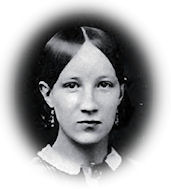
December 15th, I859.Miss Platt has gone—Last night a letter came in the mail for her. It was a little late but the children had not gone to bed so Lucy carried it upstairs and she came back so excited. Robert, who is Fannie’s little boy, eleven years old he is now, was in Miss Platt’s room; she was holding him in her lap and kissing him and crying over him. Mother went upstairs to see about this and it was just as Lucy said. Mother talked to her and explained that in our country we did not do things like this and advised her to refrain from all such in the future.

Mother told us not to mention this to anybody. Well we did not, but Miss Platt was caught trying to persuade the negroes to rise up and follow in John Brown’s footsteps, put the torch to the home of every white man and murder the people wholesale, sparing none. Jordan and Adeline had found it out and told it. I am so glad our black folks love us and are our friends. Mother says it is so near Christmas she will not try to get another governess until after the holidays.

note: Robert, Fannie, Jordan, and Adeline were all slaves.

washington_light_infantry

The Encampment at Orangeburg, South Carolina

We present our readers with a view of the encampment of the Washington Light Infantry, of Charleston, South Carolina.  The point chosen was in the village of Orangeburg, about eighty miles from the city.  This village is known as one of the most beautiful in the state.  The residences are spacious, and the lots varying size from four to twelve acres.  The shade trees form a striking feature, and add much to the attractions of the place.  In one of the most beautiful of these grounds the Infantry made their camp.  As will be seen by a glance at the picture, the immense shade trees and luxuriant shrubbery cause the tents to appear quite small; the opening through the centre of the encampment is the main avenue—thirty feet wide—which leads to the family mansion.  At the entrance of it stands the “guard tent” and near the house the “marquee” for the officers.  On either side are the tents, arranged in the order of a battalion encampment, in all twenty-four—twelve on the right and twelve on the left of the main street.  The tents are arranged in rows of six each, which face each other on streets of convenient width.

The company carried with them the “Eutaw flag,” the only standard of the Revolution which is known to exist in the state, and which was given to the corps by the widow of Col. William Washington.  The Washington Light Infantry was organized in 1807 during the excitement growing out of the “Leopard and Chesapeake affair” and is known as “the banner corps of South Carolina.  It is at present commanded by Captain Charles H. Simonton, a prominent lawyer of the city.

preston_brooks_attacking_charles_sumner

(Italicized text is from “Memoir of Charles Sumner”)

Returning to the U. S. Senate  four years after being severely beaten in the Senate Chamber by Preston Bookes – a congressman from South Carolina – Charles Sumner delivered a speech to the Senate titled, The Barbarism of Slavery, during the debate of the bill to admit Kansas as a free state.

Except for a couple of campaign style speeches in the House, it was the last speech on American slavery made in Congress until discussions on emancipation. The speech drew public attention more than any made in Congress or elsewhere during the year.  It was printed entire in the leading newspapers of the great cities East and West, and was issued in several pamphlet editions, one of which had the sanction of the National Republican Committee.  Whether regarded as timely or not, it was accepted as an exhaustive exposition of American slavery altogether unmatched in our history.

Southern members of Congress – such as Hammond of South Carolina, Hunter and Mason of Virginia, Brown and Davis of Mississippi – recently had not hesitated to defend slavery as a normal condition of society, beneficial to both races, even ennobling to the white race, and the just basis of republican justice.

Sumner thought the time had come to meet in the Senate these – and other – audacious assumptions once and for all, and to treat with absolute plainness and directness of language the principle, motive, and character of slavery, and its baleful effects as seen in the practices of slaveholders and the habits of slave society, — each statement to be supported by facts, the whole to be an argument which would defy answer at the time, or in any future discussion in Congress or elsewhere. It was in his mind to show to the country and mankind that what the pro-slavery party vaunted as the finest product of civilization was none other than essential barbarism. No such speech had as yet been made by any statesman; no one in Congress, not even Sumner himself, had hitherto attempted more than to treat the institution as related to a pending measure, or incidentally to emphasize one or more of its features. An assault on American slavery all along the lines in the Senate, where it was most strongly intrenched, required courage and rare equipment at all points in moral and political philosophy, in history and law. Such a treatment of the subject was, however, not at the time agreeable to Republican politicians; they feared, sincerely enough, that [click to continue…]

There are fifteen hundred negroes on the Island of Key West, recently captured from slavers by the vigilant officers of the Government.

1860. June 2.—Dined at Miss Gamble’s, Chevalier Wykoff’s grossly calumniated friend. She has fortune, is living nearly opposite to us in an exceedingly well-arranged and handsome house, and her dinner was irreproachable. Over the mantel-piece of the dining-room she had an interesting cast, given to her by the poet Rogers, of Mercury bearing Pandora in his arms to the earth.

An armistice between Garibaldi and the Neapolitans: the latter to quit Sicily with their twenty-five thousand men in a week.

Definite and full accounts to-day from the Republican Convention at Chicago. They have nominated Abraham Lincoln, of Illinois, for President, and Hannibal Hamlin, of Maine, for Vice-President: both of one geographical section, the free North. Lincoln is as absolutely self-made as our democracy could desire. He began life as a day-labourer, and took to making fence-rails.