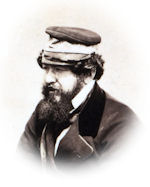
October 29th.—At ten started for the shooting ground; Carroll’s Island; my companion, Mr. Pennington, drove me in a light trap, and Mr. Taylor and Lamy came with Mr. Tucker Carroll (since killed in action fighting for the South at Antietam.), along with guns, &c. Passed out towards the sea, a long height commanding a fine view of the river; near this was fought the battle with the English, at which the “Baltimore defenders” admit they ran away. Mr. Pennington’s father says he can answer for the speed of himself and his companions, but still the battle was thought to be glorious. Along the posting road to Philadelphia, passed the Blue Ball Tavern; on all sides except the left, great wooded lagoons visible, swarming with ducks; boats are forbidden to fire upon the birds, which are allured by wooden decoys. Crossed the Philadelphia Railway three times; land poor, covered with undergrowths and small trees, given up to Dutch and Irish and free niggers. Reached the duck-club-house in two hours and a half; substantial farm-house, with out offices, on a strip of land surrounded by water; Gunpowder River, Saltpetre River, facing Chesapeake; on either side lakes and tidal water; the owner, Slater, an Irishman, reputed very rich, self-made. Dinner at one o’clock; any number of canvas-back ducks, plentiful joints; drink whisky; company, Swan, Howard, Duval, Morris, and others, also extraordinary specimen named Smith, believed never to wash except in rain or by accidental sousing in the river. Went out for afternoon shooting; birds wide and high; killed seventeen; back to supper at dusk. McDonald and a guitar came over; had a negro dance; and so to bed about twelve. Lamy got single bed; I turned in with Taylor, as single beds are not permitted when the house is full.
October 2011

Tuesday, 29th—A little reverse to record this morning. It is said that Colonel McDonald’s cavalry made an unfortunate retreat from Romney the other day, as the enemy approached. It may have been wise, as the enemy outnumbered us greatly.
Mr. _____ and myself have just returned from a delightful walk to Pagebrook. We were talking of our future, about which he will not allow me to despond. The Lord will provide, he says, and begins at once to count up our mercies. We constantly hear that our children and near relatives are well—none of them have been wounded, all mercifully spared; so that we would be ungrateful indeed to encourage or allow a feeling of despondency.

OCTOBER 29TH.—The election to take place during the ensuing month creates no excitement. There will be less than a moiety of the whole vote cast; and Davis and Stephens will be elected without opposition. No disasters have occurred yet to affect the popularity of any of the great politicians; and it seems no risks will be run. The battle of Manassas made everybody popular—and especially Gen. Beauregard. If he were a candidate, I am pretty certain he would be elected.
October 29.—Col. Burbridge, with two hundred and fifty men, and two pieces of artillery, having marched from Owensbero, in Kentucky, to Morgantown, within eighteen miles of Bowling Green, crossed the river at Morgantown in presence of a body of rebels formed upon the bank, drove the rebels into the town of Woodbury, attacked them to the number of four hundred in their camp, routed them, and took possession of the camp, with equipage for five hundred men, and all their camp utensils; but as he had no means of transportation, the entire camp was burned.—(Doc. 113.)
—At a public meeting held at Woolwich, England, Mr. Salomon, M. P., said: “The civil war now raging in America is full of importance to this country, and ought to be condemned. The North is now attempting to dominate over the South. (Cries of ‘No, no.’) We have a right to criticize the dreadful state of affairs now prevailing in America, although it would be dangerous to do so on the other side of the Atlantic. It is a most diabolical quarrel, of which we hear more from the North than the South, because the South knows how to keep its own counsel. Whatever is the result of this conflict, America will suffer from it; and if the North is able to subjugate the South, it will change the government of the country, which will then become a despotism similar to Russia. At the outset of the contest the North did not endeavor by every means to come to a peaceable settlement. (Expressions of dissent.) Why, Mr. Buchanan remained in office for three months, and did nothing to promote such an object, but rather to stir up the strife; and now he comes forward and sounds his penny whistle to induce a vigorous prosecution of the war. It is, however, the true policy of this country not to interfere in the strife, although we all wish to see it ended, and the Americans again resume their position as a purely peaceable and commercial people.”—London Post, Oct. 30.
—Letters of this date from New Orleans, represent that city as completely ruined by the rebellion.—N. Y. Times, November 11.
—The Richmond Examiner of this date says: By this time our able representatives abroad, Messrs. Mason and Slidell, are pretty well on their way over the briny deep toward the shores of Europe. We commit no indiscretion in stating that they have embarked upon a vessel which will be abundantly able to protect them against most of the Yankee cruisers they may happen to meet, and the chances are consequently a hundred to one that they will reach their destination in safety. The malice of our Yankee enemies will thus be foiled, and the attempt to capture them fail of success. Great will be the mortification of the Yankees when they shall have learned this result. Our ministers did not choose to leave at any other port than one of our own, or under any but the Confederate flag.
We anticipate from Mr. Mason’s presence in England a very happy effect upon our interests in that quarter. Mr. Mason is, in his points of character, a very good representative of the best qualities of the English people. He is frank, bold, and straightforward, disdaining all concealments or evasions. His diplomacy will consist in telling the truth in the language of a gentleman and a statesman. As the representative of a name linked with the earlier ages of the American Republic, an ex-Senator of the United States for many years, and the honored servant of the Confederate Government, he will wield an influence abroad such as perhaps no other man could hope to enjoy. He is the very best man we could send abroad to show foreign nations that the Southerner is a different type altogether from the Yankee—that he scorns like the latter to lie, to evade or dissemble, to fawn, or play the bully and the braggart; that the despicable traits of avarice, meanness, cant, and vulgarity which enter into the universal idea of a Yankee, were left behind us when we seceded from the Lincoln Government. We are glad to be able to contrast such a gentleman with Charles Francis Adams, the Puritan representative of freedom at the Court of St. James, and he knows little of British character who is disposed to set a slight value upon the advantages derived from the personal character of a representative in this matter. We believe that at no distant day Mr. Mason will have the pleasure of signing a treaty of amity, on behalf of the Confederate States, with one of the oldest and greatest dynasties of Europe, and thus cement these relations of commerce upon which our future so largely depends.
—Yesterday forty-five “contrabands” were brought into Fortress Monroe. They came oat of the Rappahannock in boats, which were picked up by the tug Rescue. Their story was, that they escaped in order to avoid being sent to Richmond to be sold South. Today forty more contrabands were brought in, who had escaped from Gloucester, opposite Yorktown, where, according to their reports, great destitution exists.—National Intelligencer, November 6.
—Capt. Hunter of the Confederate steamer Curlew reports that on this day, when near the inner buoy at Hatteras Inlet, he was fired upon by two or three Union steamers and the fort; that he “sighted a rifled gun at the Harriet Lane” and fired, and that the fort and steamers continued to fire at him as rapidly as possible. We fired, he says, six shells and the stern gun at them five times. It is uncertain whether the enemy sustained any injury. The Vandals fired twenty-three shells at us, only one of which came near.
“Feeling that I had carried out the spirit of my instructions I withdrew and waited within half a mile of the buoy, hoping to draw the steamer outside. When we fired the stern gun, the fort returned the shot. We stood back, fired another shell and took our departure. All hands displayed great enthusiasm, and seemed delighted, when one steamer began moving toward us.”—Richmond Examiner, November 4.
—Get. Rosecrans makes some interesting statements regarding the condition of the troops under his command, in a letter addressed to Governor Dennison, of Ohio, under this date. The soldiers in his department have been poorly clothed, because they were nearly all of them despatched hastily in answer to pressing calls, and since entering upon their duties they have changed their positions so frequently that supplies have not reached them regularly. Now, however, they are in very good condition. Gen. Rosecrans contradicts the statement that his force have suffered greatly from sickness. The number in hospital have averaged only four per cent. He recommends that supplies of clothing and other necessaries should be accumulated at some depot, so as to be made available when the troops shall go into winter-quarters.
—”Gentlemen from several counties” in Kentucky, assembled in Russellville, in that State, to confer “together in reference to the situation of the country, and the steps to be taken to better preserve domestic tranquillity.” Nearly all the prominent rebels of the State were present. Resolutions were passed which “bid defiance both to the Federal and State Governments,” and recommend the people to organize and arm, and resist every authority but that of the Confederate States.—(Doc. 118.)
—Two advertisements in reference to confiscation were published in the Washington papers. One, at the instance of the President of the United States, commands the Marshal to attach certain real and personal property of William Shields, and to give notice to all persons having any thing to say why the same should not be condemned to the use of the United States, to appear before the District Attorney on the 28th of November next.
The second advertisement, published by order of the court, is in accordance with the first, and sets forth that Wm. Shields, formerly of Washington, some months ago removed, with his family, to Richmond, where he has been residing ever since, and where he has been and is now engaged in the insurrection and resistance to the laws of the United States of America, now existing in said States, and in secret correspondence with the enemies of said United States residing in the city of Washington and elsewhere, transmitting to them money and other valuables, and receiving the same from them in return, which has been applied in part to aid and abet and promote the said insurrection and resistance to the laws.
—The great Southern Expedition sailed from Fortress Monroe, the Wabash leading, and the Cahawba bringing up the rear. The line of vessels, comprising nearly fifty, made a magnificent appearance.—N. Y. Tribune, October 31.
—A Great Union demonstration was made by a concourse of the citizens of Baltimore, Maryland, at the Front street theatre. The principal feature of the occasion was an address by Francis Thomas, formerly governor of Maryland.—(Doc. 115.)
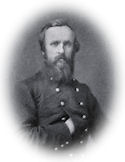
Camp Tompkins, Virginia, October 29, 1861.
Tuesday morning after breakfast.
My Dear Boy : — If I am not interrupted I mean to write you a long birthday letter. You will be eight years old on the 4th of November — next Monday, and perhaps this letter will get to Cincinnati in time for your mother or grandmother to read it to you on that day.
If I were with you on your birthday I would tell you a great many stories about the war. Some of them would make you almost cry and some would make you laugh. I often think how Ruddy and Webby and you will gather around me to listen to my stories, and how often I shall have to tell them, and how they will grow bigger and bigger, as I get older and as the boys grow up, until if I should live to be an old man they will become really romantic and interesting. But it is always hard work for me to write, and I can’t tell on paper such good stories as I could give you, if we were sitting down together by the fire.
I will tell you why we call our camp Camp Tompkins. It is named after a very wealthy gentleman named Colonel Tompkins, who owns the farm on which our tents are pitched. He was educated to be a soldier of the United States at West Point, where boys and young men are trained to be officers at the expense of the Government. He was a good student and when he grew up he was a good man. He married a young lady, who lived in Richmond and who owned a great many slaves and a great deal of land in Virginia. He stayed in the army as an officer a number of years, but getting tired of army life, he resigned his office several years ago, and came here and built an elegant house and cleared and improved several hundred acres of land. The site of his house is a lovely one. It is about a hundred yards from my tent on an elevation that commands a view of Gauley Bridge, two and a half miles distant — the place where New River and Gauley River unite to form the Kanawha River. Your mother can show you the spot on the map. There are high hills or mountains on both sides of both rivers, and before they unite they are very rapid and run roaring and dashing along in a very romantic way. When the camp is still at night, as I lie in bed, I can hear the noise like another Niagara Falls.
In this pleasant place Colonel Tompkins lived a happy life. He had a daughter and three sons. He had a teacher for his daughter and another for his boys. His house was furnished in good taste; he had books, pictures, boats, horses, guns, and dogs. His daughter was about sixteen, his oldest boy was fourteen, the next twelve, and the youngest about nine. They lived here in a most agreeable way until the Rebels in South Carolina attacked Major Anderson in Fort Sumter. Colonel Tompkins wished to stand by the Union, but his wife and many relatives in eastern Virginia were Secessionists. He owned a great deal of property which he feared the Rebels would take away from him if he did not become a Secessionist. While he was doubting what to do and hoping that he could live along without taking either side, Governor Wise with an army came here on his way to attack steamboats and towns on the Ohio River. Governor Wise urged Colonel Tompkins to join the Rebels; told him as he was an educated military man he would give him the command of a regiment in the Rebel army. Colonel Tompkins finally yielded and became a colonel in Wise’s army. He made Wise agree that his regiment should be raised among his neighbors and that they should not be called on to leave their homes for any distant service, but remain as a sort of home guards. This was all very well for a while. Colonel Tompkins stayed at home and would drill his men once or twice a week. But when Governor Wise got down to the Ohio River and began to drive away Union men, and to threaten to attack Ohio, General Cox was sent with Ohio soldiers after Governor Wise.
Governor Wise was not a good general or did not have good soldiers, or perhaps they knew they were fighting in a bad cause. At any rate, the Rebel army was driven by General Cox from one place to another until they got back to Gauley Bridge near where Colonel Tompkins lived. He had to call out his regiment of home guards and join Wise. General Cox soon drove them away from Gauley Bridge and followed them up this road until he reached Colonel Tompkins’ farm. The colonel then was forced to leave his home, and has never dared to come back to it since. Our soldiers have held the country all around his house.
His wife and children remained at home until since I came here. They were protected by our army and no injury done to them. But Mrs. Tompkins got very tired of living with soldiers all around, and her husband off in the Rebel army. Finally a week or two ago General Rosecrans told her she might go to eastern Virginia, and sent her in her carriage with an escort of ten dragoons and a flag of truce over to the Rebel army about thirty miles from here, and I suppose she is now with her husband.
I suppose you would like to know about a flag of truce. It is a white flag carried to let the enemy’s army know that you are coming, not to fight, but to hold a peaceful meeting with them. One man rides ahead of the rest about fifty yards, carrying a white flag—any white handkerchief will do. When the pickets, sentinels, or scouts of the other army see it, they know what it means. They call out to the man who carries the flag of truce and he tells them what his party is coming for. The picket tells him to halt, while he sends back to his camp to know what to do. An officer and a party of men are sent to meet the party with the flag of truce, and they talk with each other and transact their business as if they were friends, and when they are done they return to their own armies. No good soldier ever shoots a man with a flag of truce. They are always very polite to each other when parties meet with such a flag.
Well, Mrs. Tompkins and our men travelled till they came to the enemy. The Rebels were very polite to our men. Our men stayed all night at a picket station in the woods along with a party of Rebels who came out to meet them. They talked to each other about the war, and were very friendly. Our men cooked their suppers as usual. One funny fellow said to a Rebel soldier, “Do you get any such good coffee as this over there?” The Rebel said, “Well, to tell the truth, the officers are the only ones who see much coffee, and it’s mighty scarce with them.” Our man held up a big army cracker. “Do you have any like this?” and the Rebel said, “Well no, we do live pretty hard,” — and so they joked with each other a great deal.
Colonel Tompkins’ boys and the servants and tutor are still in the house. The boys come over every day to bring the general milk and pies and so on. I expect we shall send them off one of these days and take the house for a hospital or something of the kind.
And so you see Colonel Tompkins didn’t gain anything by joining the Rebels. If he had done what he thought was right, everybody would have respected him. Now the Rebels suspect him, and accuse him of treachery if anything occurs in his regiment which they don’t like. Perhaps he would have lost property, perhaps he would have lost his life if he had stood by the Union, but he would have done right and all good people would have honored him.
And now, my son, as you are getting to be a large boy, I want you to resolve always to do what you know is right. No matter what you will lose by it, no matter what danger there is, always do right.
I hope you will go to school and study hard, and take exercise too, so as to grow and be strong, and if there is a war you can be a soldier and fight for your country as Washington did. Be kind to your brothers and to Grandmother, and above all to your mother. You don’t know how your mother loves you, and you must show that you love her by always being a kind, truthful, brave boy; and I shall always be so proud of you.
Give my love to all the boys, and to Mother and Grandmother. Affectionately, your father,
R. B. Hayes.
Birchard A. Hayes,
Camp Tompkins, Tuesday morning, October 29, 1861. — A bright, cold October morning, before breakfast. This month has been upon the whole a month of fine weather. The awful storm on Mount Sewell, and a mitigated repetition of it at Camp Lookout ten days afterward, October 7, are the only storms worth noting. The first was unprecedented in this country and extended to most of the States. On the whole, the weather has been good for campaigning with this exception. Camp fever, typhus or typhoid, prevails most extensively. It is not fatal. Not more than four or five deaths, and I suppose we have had four or five hundred cases. Our regiment suffers more than the average. The Tenth, composed largely of Irish laborers, and the Second Kentucky, composed largely of river men, suffer least of any. I conjecture that persons accustomed to outdoor life and exposure bear up best. Against many afflictions incident to campaigning, men from comfortable homes seem to bear up best. Not so with this.
I have tried twenty cases before a court-martial held in Colonel Tompkins’ house the past week. One conviction for desertion and other aggravated offenses punished with sentence of death. I trust the general will mitigate this.
We hear that Lieutenant-Colonel Matthews, who left for a stay of two weeks at home about the 18th, has been appointed colonel of a regiment. This is deserved. It will, I fear, separate us. I shall regret that much, very much. He is a good man, of solid talent and a most excellent companion, witty, cheerful, and intelligent. Well, if so, it can’t be helped. The compensation is the probable promotion I shall get to his place. I care little about this. As much to get rid of the title “Major” as anything else makes it desirable. I am prejudiced against “Major.” Doctors are majors and (tell it not in Gath) Dick Corwine is major! So if we lose friend Matthews, there may be this crumb, besides the larger one of getting rid of being the army’s lawyer or judge, which I don’t fancy.
Colonel Baker, gallant, romantic, eloquent soldier, senator, patriot, killed at Edwards Ferry on the upper Potomac! When will this thing cease? Death in battle does not pain me much. But caught surprised in ambush again! After so many warnings. When will our leaders learn? I do not lose heart. I calmly contemplate these things. The side of right, with strength, resources, endurance, must ultimately triumph. These disasters and discouragements will make the ultimate victory more precious. But how long? I can wait patiently if we only do not get tricked out of victories. I thought McClellan was to mend all this. “We have had our last defeat, we have had our last retreat,” he boasted. Well, well, patience! West Pointers are no better leaders than others.
October 29, 1861. Evening. — This is the anniversary of the Literary Club — the society with which so much of my life is associated. It will be celebrated tonight. The absent will be remembered. I wish I was there. How many who have been members are in the tented field! What a roll for our little club! I have seen these as members: General Pope, now commanding in Missouri; Lieutenant-Colonel Force of the Twentieth, in Kentucky; Major Noyes of the Thirty-ninth, in Missouri; Lieutenant-Colonel Matthews,Twenty-third, in Virginia; Secretary Chase, the power (brain and soul) of the Administration; Governor Corwin, Minister to Mexico; Tom Ewing, Jr., Chief Justice of Kansas; Ewing Sr., the great intellect of Ohio; Nate Lord, colonel of a Vermont or New Hampshire regiment; McDowell, a judge in Kansas; McDowell (J. H.), a senator and major in Kansas; Oliver and Mallon, common pleas judges; Stanton, a representative Ohio House of Representatives; and so on. Well, what good times we have had! Wit, anecdote, song, feast, wine, and good fellowship — gentlemen and scholars. I wonder how it will go off tonight.
Queer world! We fret our little hour, are happy and pass away. Away! Where to? “This longing after immortality! These thoughts that wander through eternity”! I have been and am an unbeliever of all these sacred verities. But will I not take refuge in the faith of my fathers at last? Are we not all impelled to this? The great abyss, the unknown future, — are we not happier if we give ourselves up to some settled faith? Can we feel safe without it? Am I not more and more carried along, drifted, towards surrendering to the best religion the world has yet produced? It seems so. In this business, as I ride through the glorious scenery this loveliest season of the year, my thoughts float away beyond this wretched war and all its belongings. Some, yes many, glorious things, as well as all that is not so, [impress me] ; and [I] think of the closing years on the down-hill side of life, and picture myself a Christian, sincere, humble, devoted, as conscientious in that as I am now in this — not more so. My belief in this war is as deep as any faith can be; — but thitherward I drift. I see it and am glad.
All this I write, thinking of the debates, the conversations, and the happiness of the Literary Club. It has been for almost twelve years an important part of my life. My best friends are among its members — Rogers, Stephenson, Force, James. And how I have enjoyed Strong, McConkey (alas!), Wright, McDowell, Mills, Meline, and all! And thinking of this and those leads me to long for such communion in a perfection not known on earth and to hope that in the future there may be a purer joy forever and ever. And as one wishes, so he drifts. While these enjoyments are present we have little to wish for; as they slip from us, we look forward and hope and then believe with the college theme, “There is more beyond.” And for me to believe is to act and live according to my faith.
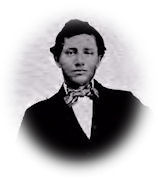
Monday, 28th—Nothing of importance today. All the boys of the company like to drill under Compton, our first lieutenant, for he can give the correct commands in the manual of arms, and he makes us toe the chalk line. He is not at all overbearing, as some of the officers are, but is kind to the men, especially to those who try to execute the commands.
October 28th.—Telegraphed to my friend at Baltimore that I was ready for the ducks. The Legation going to Mr. Kortwright’s marriage at Philadelphia. Started with Lamy at 6 o’clock for Baltimore; to Gilmore House; thence to club. Every person present said that in my letter on Maryland I had understated the question, as far as Southern sentiments were concerned. In the club, for example, there are not six Union men at the outside. General Dix has fortified Federal Hill very efficiently, and the heights over Fort McHenry are bristling with cannons, and display formidable earthworks; it seems to be admitted that, but for the action of the Washington Government the Legislature would pass an ordinance of Secession. Gilmore House—old-fashioned, good bed-rooms. Scarcely had I arrived in the passage, than a man ran off with a paragraph to the papers that Dr. Russell had come for the purpose of duck-shooting; and, hearing that I was going with Taylor, put in that I was going to Taylor’s Ducking Shore. It appears that there are considerable numbers of these duck clubs in the neighbourhood of Baltimore. The canvas-back ducks have come in, but they will not be in perfection until the 10th of November; their peculiar flavour is derived from a water-plant called wild celery. This lies at the depth of several feet, sometimes nine or ten, and the birds dive for it.
MONDAY, OCTOBER 28, 1861.
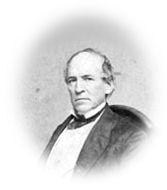
I was at the Pat office today. Visited the War office and the Head Quarters of Genl McClellan, corner of the Ave & 19th St. His privat Rooms are at the corner of H & 16th Sts. His “rooms” are not very “private” as they are always crowded with officers. I was at Home most of the day. Doct Barnes called and took dinner with us. Rcd a letter from Bro C.R. Mailed letters to various friends north. Chas & Sallie spent most of the evening with us. No particular news.

______
The three diary manuscript volumes, Washington during the Civil War: The Diary of Horatio Nelson Taft, 1861-1865, are available online at The Library of Congress.
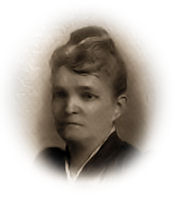
Oct. 28, 1861.—When I dropped in at Uncle Ralph’s last evening to welcome them back, the whole family were busy at a great center-table copying sequestration acts for the Confederate Government. The property of all Northerners and Unionists is to be sequestrated, and Uncle Ralph can hardly get the work done fast enough. My aunt apologized for the rooms looking chilly; she feared to put the carpets down, as the city might be taken and burned by the Federals. “We are living as much packed up as possible. A signal has been agreed upon, and the instant the army approaches we shall be off to the country again.”
Great preparations are being made for defense. At several other places where I called the women were almost hysterical. They seemed to look forward to being blown up with shot and shell, finished with cold steel, or whisked off to some Northern prison. When I got home Edith and Mr. D. had just returned also.
“Alex,” said Edith, “I was up at your orange-lots to-day and the sour oranges are dropping to the ground, while they cannot get lemons for our sick soldiers.”
“That’s my kind, considerate wife,” replied Mr. D. “Why didn’t I think of that before? Jim shall fill some barrels to-morrow and take them to the hospitals as a present from you.”

______
Note: To protect Mrs. Miller’s job as a teacher in New Orleans, the diary was published anonymously, edited by G. W. Cable, names were changed and initials were often used instead of full names — and even the initials differed from the real person’s initials.


