Following the American Civil War Sesquicentennial with day by day writings of the time, currently 1863.

November 2011

SATURDAY 23

Rained last night and was a rainy morning, but it cleared off about noon. I went to the Land office today and was examined as the law directs for all clerks, but it is very much of a “humbug.” If it is wanted to keep an applicant out, it is a very easy matter to do it. I go again on Monday to learn the nature of the report in my case. Perhaps I am to be humbuged as a Democrat does not, in reality, stand much chance for a place in that Department. “We shall see.”

______

The three diary manuscript volumes, Washington during the Civil War: The Diary of Horatio Nelson Taft, 1861-1865, are available online at The Library of  Congress.

November 23.—The bombardment of the rebel Forts McRae and Barrancas was continued from Fort Pickens and the National ships in Pensacola harbor. Fort McRae was completely silenced, and Barrancas and the Navy yard at Warrington very much damaged. The town of Warrington was destroyed, together with the rebel rifle works at that place. Fort Pickens sustained no damage beyond the disabling of one gun. The loss on the Union side was one killed and six wounded.—(Doc. 191.)

—Brig.-Gen. H. H. Lockwood, in command of the Union force on the eastern shore of Virginia, issued a proclamation, by which the various officers of the civil government in that locality were restored to the exercise of their functions interrupted by the ordinance of secession. This expedition accomplished important results without bloodshed. Ten pieces of cannon were captured, eight of them new and in good condition; also a thousand stand of arms, rebel flags, &c.—(Doc. 185.)

—The Confederate gunboat Tuscarora, on her way up the Mississippi from New Orleans, took fire about fifteen miles above Helena, Ark. A strong wind was blowing at the time, and it was found impossible to save the boat. An effort to save the magazine was successful, but the shells on board began to explode soon after the fire commenced. The explosion fired the negro quarters on Mr. Harbutt’s plantation, as well as the tops of trees on the bank of the river. The boat was burned to a wreck.—Memphis (Tenn.) Avalanche, Nov. 25.

—The Germans of Cincinnati, Ohio, turned out in large numbers to-night, to attend a meeting held at Turner Hall, in that city, for the purpose of expressing sympathy with Gen. Fremont in the course lately pursued toward him by the Administration. The meeting was called to order by Dr. A. Bauer; Frederick Werner was appointed secretary. Judge Stallo and the Rev. Mr. Eisenlohr addressed the assemblage in the German, and Rev. M. D. Conway in the English language. A series of resolutions in German censuring the Administration for the supersedure of Gen. Fremont was passed.—Cincinnati Gazette, Nov. 25.

—Some citizens of Frankfort, Ky., faithful to the Union, met in that city and passed a series of resolutions in which they condemn the doctrine set forth by Simon Cameron and John Cochrane, in relation to arming the slaves, and express their belief that such a course “would add to the calamities of the present civil war, the further horrors of servile insurrection, murder, rapine, and plunder.”—(Doc. 186.)

—Lieut. J. L. Barnes, Missouri Volunteers, met D. K. Barclay, Confederate Commissioner, in St. Louis, and arranged for the exchange of the Union men taken prisoners by the rebels at Lexington, and the rebels taken prisoners at Camp Jackson by Gen. Lyon.— St. Louis Democrat.

—The steamer Constitution and Forest City, with the van of Gen. Butler’s expedition, sailed from Portland, Maine.—Boston Post, Nov. 25.

—Public notice was given that Government “will give the pay of U. S. soldiers who are prisoners of war to persons presenting written authority from the prisoner to draw his pay, or, without such authority, to his wife, the guardian of his minor children, or his widowed mother.”—(Doc. 187.)

—Gen. Thomas, in command of the left wing of the Union army in Kentucky, advanced his entire force from Danville to Columbia in Adair Co.—The Fifty-ninth regiment N. Y. S. V., Col. W. L. Tidball, left New York City for the seat of war.—N. Y. Herald, Nov. 30.
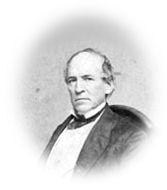
NOVEMBER 23D.—J. C. Breckinridge and Humphrey Marshall, of Kentucky, have been here; and both have been made brigadier-generals, and assigned to duty in the West. Although the former retained his seat in the Senate of the United States for many months after the war began, no one doubts that he is now with us, and will do good service.

Abby Howland Woolsey to Georgeanna and Eliza.

November.

Bessie Wolcott’s wedding came off very brilliantly. Carry went out to Astoria the day before. Mother and Hatty drove out together. Mary is said to have looked very handsome in white silk trimmed with black lace and white silk ruches. Hatty wore her crimson silk with white valencienne spencer or waist, and mother was very resplendent in velvet and feathers, stone cameos and black lace shawl. . .  Charley drove out and back with his pony as rapidly as possible, as they had to drill for evacuation day, Charley’s first appearance in a procession. We all stood on the curbstone and we winked, and he winked, and Captain Ben Butler and others twinkled and winked, not daring to do more, so precise and martial was their array. . . .  Have you received a large brown bale that you didn’t know what to make of? It is black curled hair. Eliza said whole pillows were much needed—underscoring the words. I don’t know what she means, unless that mere empty tickings to be filled with straw don’t answer. I have thought that the best way was to send you the hair, as it can be packed far closer than any number of ready-made pillows would be. The tickings are all made and will be along in Washington soon.

Saturday, 23. — Rode up to Captain Mack’s (Regular-army artillery officer) ten miles up N[ew River] and near our old Camp Ewing. Business: To appraise under order from General Rosecrans damage done citizens by our men. Board consisted of Colonel McCook, self, and Captain Mack. Met McCook mending road. [He] said he would sign what we should agree to. Did the work and slept with Captain Mack in his new Sibley tent, warmed by a stove. A good institution, if [tent is] floored, for winter.

Friday, 22. — Rode alone down to Gauley over Kanawha and Gauley Rivers, up New River, and stayed at headquarters of General Rosecrans. Always treated well there. Ate pickled oysters immoderately and foolishly; drank mixed drinks slightly but foolishly. But spent an agreeable night with General Rosecrans, Major Crawford, and Captain Reynolds and Major Jos. Darr. Good men all. Cold, desperately windy night; slept coldly in Captain Hartsuff’s tent.

November 22nd.—All the American papers have agreed that the Trent business is quite according to law, custom, and international comity, and that England can do nothing. They cry out so loudly in this one key there is reason to suspect they have some inward doubts. General McClellan invited all the world, including myself, to see a performance given by Hermann, the conjuror, at his quarters, which will be aggravating news to the bloody-minded, serious people in New England.

Day after day passes on, and finds our Micawbers in Washington waiting for something to turn up. The Trent affair, having been proved to be legal and right beyond yea or nay, has dropped out of the minds of all save those who are waiting for news from England; and on looking over my diary I can see nothing but memoranda relating to quiet rides, visits to camps, conversations with this one or the other, a fresh outburst of anonymous threatening letters, as if I had anything to do with the Trent affair, and notes of small social reunions at our own rooms and the Washington houses which were open to us.

Nov. 22. The first death in our regiment occurred this morning. John Shepard of Company B died of typhoid fever. His remains will be sent to his home in Milford for burial.

FRIDAY 22

Saw the Sec’y this morning and presented Mr Lincolns letter. He was rather obstinate, could not restore me to the place I occupied in the Patent office at present possibly, but would give me a 2nd Class Clerkship in the Land Office for the present if I would accept of it. It is $1400 pr year. That is certainly better than no business in this extravagant City and I shall take it till I can do better. In that office I can take out patents.

______

The three diary manuscript volumes, Washington during the Civil War: The Diary of Horatio Nelson Taft, 1861-1865, are available online at The Library of  Congress.

Friday, 22d—New troops are arriving all the time, and there are something like forty thousand men in the barracks at present. This camp has the appearance of being nearer the seat of war. It is a novel experience for us country boys to see so many men all armed for war, some on guard duty, others leaving for the front, while still others are arriving. The commissary work of the camp is thoroughly organized. Each company has a detail of cooks which serves a week at a time and then is relieved by another shift. The cooks go to the quartermaster and get the rations for five days at a time. The food is cooked in kettles hung in a row in the rear of the barracks, and is served on long stationary tables, each accommodating a full company. Our rations are about the same as at Camp McClellan, except that we have our first taste of “hard-tack” instead of bread.