Following the American Civil War Sesquicentennial with day by day writings of the time, currently 1863.

January 2012

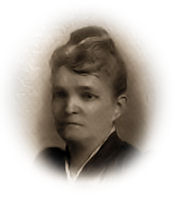
Jan. 2, 1862.—I am glad enough to bid ‘61 goodbye. Most miserable year of my life! What ages of thought and experience have I not lived in it.

Last Sunday I walked home from church with a young lady teacher in the public schools. The teachers have been paid recently in “shin-plasters.” I don’t understand the horrid name, but nobody seems to have any confidence in the scrip. In pure benevolence I advised my friend to get her money changed into coin, as in case the Federals took the city she would be in a bad fix, being in rather a lonely position. She turned upon me in a rage.

“You are a black-hearted traitor,” she almost screamed at me in the street, this well-bred girl! “My money is just as good as coin you’ll see! Go to Yankee land. It will suit you better with your sordid views and want of faith, than the generous South.”

“Well,” I replied, “when I think of going, I’ll come to you for a letter of introduction to your grandfather in Yankee land.” I said good-morning and turned down another street in a sort of a maze, trying to put myself in her place and see what there was sordid in my advice.

Luckily I met Mrs. B. to turn the current of thought. She was very merry. The city authorities have been searching houses for fire-arms. It is a good way to get more guns, and the homes of those men suspected of being Unionists were searched first. Of course they went to Dr. B.’s. He met them with his own delightful courtesy. “Wish to search for arms? Certainly, gentlemen.” He conducted them through all the house with smiling readiness, and after what seemed a very thorough search bowed them politely out. His gun was all the time safely reposing between the canvas folds of a cot-bed which leaned folded up together against the wall, in the very room where they had ransacked the closets. Queerly, the rebel families have been the ones most anxious to conceal all weapons. They have dug pits quietly at night in the back yards, and carefully wrapping the weapons, buried them out of sight. Every man seems to think he will have some private fighting to do to protect his family.

______

Note: To protect Mrs. Miller’s job as a teacher in New Orleans, the diary was published anonymously, edited by G. W. Cable, names were changed and initials were often used instead of full names — and even the initials differed from the real person’s initials.

JANUARY 2D.-The enemy are making preparations to assail us everywhere. Roanoke Island, Norfolk, Beaufort, and Newbern; Charleston, Savannah, Mobile, Pensacola, and New Orleans are all menaced by numerous fleets on the sea-board, and in the West great numbers of iron-clad floating batteries threaten to force a passage down the Mississippi, while monster armies are concentrating for the invasion of Tennessee and the Cotton States. Will Virginia escape the scourge? Not she; here is the bull’s-eye of the mark they aim at.

January 2.—This morning, about half-past nine o’clock, the rebels reappeared in the woods near Port Royal Ferry, S. C, whence they had been driven yesterday. A sharp firing was kept up for some time by the Union gunboats, to keep them in check, throwing shot and shell into the woods. Before ten o’clock the Union troops crossed the Coosaw River, under cover of the boats, and proceeded down the river en route for Port Royal Harbor.—(Doc. 2.)

—In the Confederate Congress at Richmond, Va., Daniel P. White, of Kentucky, appeared, was qualified, and took his seat.

—The steamship Ella Warley, formerly the Isabel, from Nassau, ran the blockade, and arrived at Charleston, S. C, at daylight this morning. She was chased and ineffectually shelled by the blockaders. She brings a valuable assorted cargo and passengers, including Mr. Bisbie, formerly a delegate in the Virginia Legislature from the city of Norfolk. Mr. Bisbie is a bearer of important dispatches from Mr. Yancey, and has started for Richmond.—Charleston Mercury, January 3.

—General Stone, at Poolesville, Md., issued an order cautioning the troops under his command against encouraging insubordination and rebellion among the slaves, and threatening punishment to such as might violate his orders.— (Doc. 3.)

—An experiment was tried this morning for the purpose of determining whether the rebel battery at Cockpit Point, on the Potomac River, could be attacked, and if so, in what manner with the greatest hopes of success. At ten o’clock, the gunboat Anacostia approached the battery, and took up a position somewhat above and opposite Mattawoman creek. She threw in a number of shells, several of which were seen to explode into the rebel battery. The steamer Yankee then got under way, and stood for the battery, ranging herself right opposite. She commenced by firing two shells from her bow-gun, a sixty-four-pounder, and afterwards continued to pour in her fire on the enemy from her after-guns, consisting of a thirty-two-poundcr, and twenty-four-pounder brass howitzer, and a twelve-pounder brass rifled cannon. The enemy replied to the Yankee, for the Anacostia was so placed that the batteries could not hit her, throwing four shots, the second of which struck the Yankee, entering the forecastle on the portside, her head being up the river, and knocking away a knee entirely; passing to the starboard-side, the shot smashed another knee and dropped on the floor, its force being spent.—Philadelphia Press, January 4.

—The Memphis Argus of this date gives the following picture of the situation of affairs at the South: Price is in full retreat southward. Price will probably continue in full retreat, for there are several—indeed no less than three—Union armies, each as large, better armed, and better equipped, converging upon him. His past victories have been rendered valueless. Union forces have been massed in Kentucky too great for a man of Sydney Johnston’s calibre to venture to attack, and the paralyzing of Price through the withdrawal of McCulloch, has rendered the overrunning of Missouri, to the Arkansas frontier, an easy task to the Unionists.

We’re forced back out of Missouri — checkmated in Kentucky. Chase has obtained his money in Wall street. The blockade is unbreakable by us as yet. In one word, we’re hemmed in. We’ve allowed the moment of victory to pass. We were so anxious watching the operations of England, that we stand aghast, on turning our eyes homeward again, to find ourselves ten times worse off than we were ere the commencement of Price’s last forward march, and that accursedly used sensationalism, the arrest of Messrs. Mason and Slidell.

Day follows day, and in lieu of being weakened, we find the Federal armies at all points being strengthened, almost every article of manufacturing and domestic necessity quadrupled in price, and our money will soon be exceeding scarce for lack of paper and pasteboard wherewith to make it. We pay fifteen cents apiece for sperm candles, and we are told we ought to be glad to get them at that.

Our twelve-months soldiers’ time will soon be up; and we can not help asking, as they do themselves, what have they been permitted or led to do? It is an old and ever-proven truism that when two nations are at war, that which has the least means must find success in early and rapid action, for it can gain little by time, while the other finds in time the power to bring into efficient use its more varied means.

Cabined, cribbed, confined as we were, and evidently would be, our shortest, clearest and most noble policy was to find in the rapid use of our early revolutionary enthusiasm an overmatch for the slower and less spirited, but more enduring North. Where shall we ask relief; where should we ask it save in the camps on whom we have lavished our heart’s blood, our hopes, our wealth, our whole; where but upon the banks of the Potomac? When will we see an end of the farce there being enacted, at our expense?

Indirectly every mouthful we eat is taxed; our babies wear taxed caps and shoes; our boys write on taxed paper; our girls wear taxed calicoes; our men do a taxed business, and hopelessly ride in a taxed hearse to a taxed grave, and we, forsooth, are hurting “the cause” if we dare to turn from Messrs. Mason and Slidell to look at the country we were born and bred in, and, having looked, we are hurting the cause if we dare tell what we sea Our cause is right, it is holy.

Our suffering may be God’s price of success, but who, seeing what might have been, and knows what is being suffered through its being undone, can refrain from cursing the selfishness or idiocy that stopped the conquering Beauregard, that arrested the march of Price, that checked the gallant Jackson? We have gazed imploringly on the lion, while the fox has been weaving his toils. Our press and our people have trusted far enough. We now ask, are we to continue hemmed in for another six months and lack all things, or shall our armies on to Washington and lack nothing?

—Despatches were received at St. Louis, Mo., announcing the capture of the notorious Jeff. Owens, Colonel Jones, and fifty of their bridge-burning gang, near Martinsburg, Adrian county, by General Schofield, commander of the State militia, and that the various guerrilla bands along the North-Missouri Railroad had been pretty thoroughly scattered.—National Intelligencer, January 4.

January 1st 1862

This has been a warm pleasant day, rather too warm in the middle of the day with an overcoat on. Called in the morning upon Rev J C Smith, our pastor, and went from there up to the Presidents, found an immence crowd there outside. Could not get in on account of the crowd, found my Jersey City friend J Burrows Hyde there. We left and began our calls on the Secys, Mr Seward first, Cards rcd below four policeman at the Door. Cards rcd below and the Reception upstairs. Mr S., Frederick S. & Lady name announced at the parlor door. Mr S in good spirits and received us very cordialy. No refreshments at any of the Secretaries. Called next upon Comodore Wilkes of the San Jacinto. Then Sec’y of War, D[itt]o Navy, and all the rest of the Cabinet officers. Then at Genl McClellans, he was sick, confined to his room. Genl Blenker and Staff in the most Brilliant Uniforms I have seen today. Went the “rounds.” Refreshments were furnished at all the houses of those who rcd calls, the “ardent” generaly found. I called upon Comr Holloway before I came home. Col Merrick was not able to go out with me today. There was a heavy cannonading heard last night and it was thought that there was certainty [sic] a “fight” over the River. It proved to be a wake up of a German Regt for the New Year. It is said that they sent over and purchased 150 lbs powder and 200 kegs of “Lager” for the occasion. The Regt of “Lancers” presented a marked feature of the day in the City as it marched through. Lances about 9 ft long, carried upright with a small red flag to each, 1000 strong. Went down 7th street with Willie after his Magic Lantern. Got home after dark. Willie & “Tad” Lincoln were here to dinner and the boys H N & Holly went home with them. The day has passed off pleasantly and peacefully all over the City.

______

The three diary manuscript volumes, Washington during the Civil War: The Diary of Horatio Nelson Taft, 1861-1865, are available online at The Library of Congress.

Jan. 1st. Wrote, rode and read some. In the morning went over to Company I’s quarters. Wrote to Ella Clark. Made some resolutions for the future.

A Dull Day.

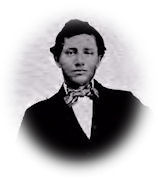
Jan. 1, 1862. The new year is ushered in with a light fall of snow and very cold weather. There is just snow enough to prevent drills or any sports the boys may have been anticipating. Altogether the day will be a dull one. The sutler, anticipating our removal, has not much to sell or steal. The sutler is regarded as the common enemy of the soldier, and when forced contributions are levied on him it is considered entirely legitimate and rather a good joke. The boys will have to content themselves with card playing and writing letters home. We have just got a new stove running in my tent, and Long Tom is detailed today to supply it with wood. I think we shall make a comfortable day of it, if Tom does his duty. Things certainly begin to look like leaving; the harbor is full of vessels, transports, gunboats and supply ships. Appearances indicate that somebody will hear it thunder somewhere along the southern coast before very long.

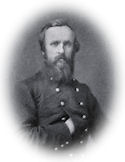
Camp Union, Fayetteville, Virginia, Wednesday, New Year’s Day, 1862. — Sun shone brightly an hour or two; mild winter weather, then windy and threatening. Rode with Colonel Scammon four or five miles southwest of town. Wind blew all day as if a storm were by brewing, but no rain or snow. I set it down as a pleasant day. Number 1 for January 1862.

At dinner, speaking of naming my boy, I said: “The name was all ready if I had heard that a daughter was born.” “Fanny Lucy” or “Lucy Fanny” — linking together the names of the two dear ones, wife and sister. Dear Fanny! what an angel she was, and, may I hope, now is.

Heard from home. Sergeant [John] McKinley, with letter and watch — tight, drunk, the old heathen, and insisting on seeing the madame! I didn’t dream of that. He must be a nuisance, a dangerous one too, when drunk. A neat, disciplined, well-drilled soldier under rule, but what a savage when in liquor! Must be careful whom I send home.

Wednesday, 1st—I am back with the company again. The boys are having a big chicken dinner today, Lieutenant Compton having bought four dozen chickens and presented them to the company for a New Year’s dinner.

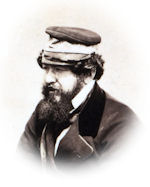
Lord Lyons has evinced the most moderate and conciliatory spirit, and has done everything in his power to break Mr. Seward’s fall on the softest of eider down. Some time ago we were all prepared to hear nothing less would be accepted than Captain Wilkes taking Messrs. Mason and Slidell on board the San Jacinto, and transferring them to the Trent, under a salute to the flag, near the scene of the outrage; at all events, it was expected that a British man-of-war would have steamed into Boston, and received the prisoners under a salute from Fort Warren; but Mr. Seward, apprehensive that some outrage would be offered by the populace to the prisoners and the British Flag, has asked Lord Lyons that the Southern Commissioners may be placed, as it were, surreptitiously, in a United States boat, and carried to a small seaport in the State of Maine, where they are to be placed on board a British vessel as quietly as possible; and this exigent, imperious, tyrannical, insulting British Minister has cheerfully acceded to the request. Mr. Conway Seymour, the Queen’s messenger, who brought Lord Russell’s despatch, was sent back with instructions for the British Admiral, to send a vessel to Providence town for the purpose; and as Mr. Johnson, who is nearly connected with Mr. Eustis, one of the prisoners, proposed going to Boston to see his brother-in-law, if possible, ere he started, and as there was not the smallest prospect of any military movement taking place, I resolved to go northwards with him; and we left Washington accordingly on the morning of the 31st of December, and arrived at the New York Hotel the same night.

To my great regret and surprise, however, I learned it would be impracticable to get to Fort Warren and see the prisoners before their surrender. My unpopularity, which had lost somewhat of its intensity, was revived by the exasperation against everything English, occasioned by the firmness of Great Britain in demanding the Commissioners; and on New Year’s Night, as I heard subsequently, Mr. Grinell and other members of the New York Club were exposed to annoyance and insult, by some of their brother members, in consequence of inviting me to be their guest at the club.

RINALDO, Provincetown Harbor, January 1, 1862.

[Lord LYONS, Washington.]

MY LORD: I have the honor to inform your lordship that I left New York on the 30th ultimo and arrived at Provincetown early this morning, and waited until evening when Messrs. Mason and Slidell and companions came on board from an American tug-boat from Boston.

According to your lordship’s instructions I received them without form or ceremony.

Although the barometer is falling considerably I intend putting to sea at once and making the best of my way to Halifax.

I have, &c.,

W. HEWETT.

P. S.–The gentlemen remarked that their only wish was to proceed to Europe.

W. H.