Feb. 10. The prisoners are a motley looking set, all clothed (I can hardly say uniformed) in a dirty looking homespun gray cloth. I should think every man’s suit was cut from a design of his own. Some wore what was probably meant for a frock coat, others wore jackets or roundabouts; some of the coats were long skirted, others short; some tight fitting, others loose; and no two men were dressed alike. Their head covering was in unison with the rest of their rig; of all kinds, from stovepipe hats to coonskin caps; with everything for blankets, from old bedquilts, cotton bagging, strips of carpet to Buffalo robes. The Wise legion are a more soldierly looking set; they wear gray cloth caps of the same pattern, and long sheep’s gray overcoats with capes. Most of the officers are smart, good looking young men, wearing well-fitting gray uniforms, not unlike those of our own officers.
It is not dress altogether that makes the man or the soldier. I find among these chaps some pretty good fellows. I came across one young man from Richmond; he was smart appearing and very loquacious. In some talk I had with him he said; “This has turned out not as I wished, but not different from what I expected when we saw the force you had. In fact we had no business staying here after seeing your strength. We have met the enemy and we are theirs. I accept the situation and am glad it is no worse. I am Secesh clear through, and after I am exchanged, shall be at you again. We are now enemies, but in peace friends, and when this little dispute is settled, if any of you fellows ever come to Richmond, hunt me up. If alive, you will be welcome as long as you choose to stay, and when you leave, if you don’t say you have had as right smart a time as you ever had, call me a liar and I will call you gentlemen.” The fellow gave me his card and said his father owned a plantation just out of the city.
I met one fellow, a long, lank, lean, long-haired, sullen, cadaverous looking chap, and asked him what he was doing here. “Well,” he said, “not much; but you ‘uns was right smart to get through that swamp. We thought the devil couldn’t get through it.” “So you think what the devil can’t do, Yankees can’t, do you? You mustn’t take the devil for your guage in estimating Yankees; if you do you will always get beat. We can give him points, and bent him every time.” He looked a little incredulous, but did not seem inclined to go into any argument about it.
These fellows threw away a good many pistols and knives which they carried, many of which our boys have found. The knives are large, coarse, ugly looking things, forged at some country blacksmith shop, by a bungling workman, out of old rasps, scythe-points and anything containing steel. I asked one fellow what they carried those knives for, what use they put them to? “Oh!” he said, “them’s Yankee slayers.” “Yankee slayers? And have you slain many Yankees with them?” “Wal, no, but we thought they mought come handy in close action.” “And did you think you would ever get near enough to the Yankees to use them?” “Wal, we didn’t know but we mought.” “Well, sir, those knives are too heavy to carry, and you don’t need to carry them, for long before you would ever get near enough to the Yankees to use them the places that now know you would know you no more forever.”
The boys are mixing in among the prisoners, talking over the fight, trading jack-knives, buttons and such small notions as they happen to have, and getting acquainted with each other. The weather is warm and pleasant, like May. The robins and other birds are singing as in summer. The robins seem like old friends and neighbors and I cannot help thinking that perhaps some of them had their nests last summer in the trees and bushes which grow in our own door yards and gardens at home.
Our gunboats have wiped from the face of the earth that part of the Confederate navy which prowled around these waters. They chased them up the Pasquotank river to Elizabeth City, where, after less than an hour’s engagement, the enemy set their boats on fire and fled.


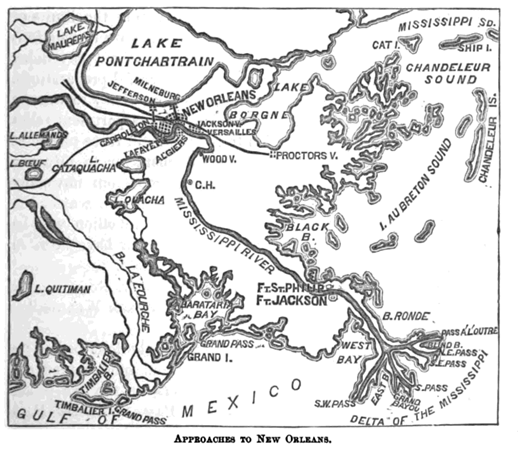 It is reported that nineteen feet of water can be carried over the bar. If this be true, the frigate Mississippi can be got over without much difficulty. The Colorado draws about twenty-two feet; she lightens one inch to twenty-four tons; her keel is about two feet deep. The frigate Wabash, when in New York in 1858, drew, without her spar-deck guns, stores, water casks, tanks, and coal (excepting thirty tons), aft twenty feet four inches, forward sixteen feet, or on an even keel eighteen feet four inches. This would indicate a very easy passage for this noble vessel, and, if it be possible to get these two steamers over, and perhaps a sailing vessel also, you will take care to use every exertion to do so. The powerful tugs in the bomb flotilla will afford the necessary pulling power. The tops of these large steamers are from thirty to fifty feet above the fort, and command the parapets and interior completely with howitzers and musketry. The Wachusett at Boston; the Oneida, Richmond, Varuna, and Dakota at New York; and the Iroquois from the West Indies, are ordered to report to you with all practicable dispatch, and every gunboat which can be got ready in time will have the same orders. All of the bomb-vessels have sailed, and the steamers to accompany them are being prepared with great dispatch. It is believed the last will be off by the 16th instant.