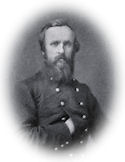
Sunday, 16, A. M. — Another change — a snow-storm; March fuss and fury. Received a note from Lieutenant-Colonel Jones, directing vigilance and to be in readiness for an attack by the enemy or for a forward movement, — the abandonment by the Rebels of eastern Virginia on the Potomac rendering it likely that the enemy will come here or we go there!! . . .
March 2012
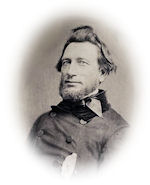
An observation from 2012: The march back to Alexandria was likely on the 15th. Please see discussion in Ron Baumgarten’s comment below. – Mike Goad, 3-18-2012
Alexandria, 16th.—Received orders last night to march at 4 this A. M. Simultaneously with the receipt of the order came a northeast wind and heavy clouds. The clouding up kept pace with our preparations to march, and such a day of rain I have not witnessed in Virginia. To-night, after a march of twelve miles through mud and rain, the men lie out without shelter, except the little tents debris, which in time of rain are good for nothing. I shudder when I think of them, exposed, after a hard day’s march, to the driving storm. And whilst they are thus exposed, I feel almost guilty that I am in a fine hotel, by a fine coal fire, “comfortable and cozy.” But sickness brought me here. For three nights I have not slept, and last night I had an attack of cholera morbus. This morning, being sick and worn out, I asked permission to return to Vienna, (two and a half miles), and come in by rail. Permission was denied me. Sick or well, I must march, and look after the management of ambulances, and transportation of hospital stores. Arose at three o’clock, working part of time, and the rest cholera-morbus-ing till four. Started with the Brigade, but at Fairfax, for the first time since I entered the army, had to fall out. Went to bed, slept two hours, arose, took a cup of coffee, mounted my horse, and pressing my way through dense masses of the army for five or six miles, overtook the Brigade. When within a few miles of this city I was so sick that I insisted on being permitted to seek lodgings out of the weather, and having received permission, came on here. Have got dry and warm, and am now feeling better. I am gratified to learn to-night that my two poisoned boys are doing well, though it will be a long time before they entirely recover.
When I left Fairfax this morning the scene was grand beyond description. The soldiery, densely filling the road, leading from the town, had been pouring steadily forward for more than two hours. I looked back, and as far as the eye could reach down the two roads coming in, the dense body blocked them in both directions. The three roads presenting a long blue line rendered more striking by the glare of the bayonets, which at a short distance looked like a solid body of glittering steel over the blue bulk below. How far back the lines extended, I could not see, but I pressed forward for six miles, through the dense crowd. Verily, the army is now in motion.
16th.—’Tis Sunday morning. Returned to my regiment this morning; found all quiet. No one yet knows our destination. But from the fact that some forty river steamers await us, we infer that we are not going to sea. A singular fact, worthy of note: On our arrival here to embark, not a steamer had coaled, and there was no coal to take on!!— Why is this? ‘Tis terrible to even suspect that treason may be at work in the very heads of our departments.
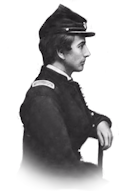
(March 16, 1862)
On the 14th the cavalry, accompanied by the Fifty-seventh, started along the Orange and Alexandria railroad to Cedar Run. They had a brush with the enemy’s pickets in the evening near Cedar Run, driving them off the ground. On the 15th the infantry advanced to Catlett’s Station, where they exchanged shots for the first time with the rebs. Two men were lost by the temporary bridges giving way, and I suppose they were picked up by the rebel cavalry.
General Stoneman, finding out what every one believed, that the rebel army had wholly disappeared from our front, returned to camp, and the following day left us. He was very complimentary to Zook, and gave him the following note, written on the field note book of his adjutant.

Headquarters cavalry corps,
Army of the Potomac, March 16, 1862.
Colonel Zook, Fifty-seventh New York Volunteers: Allow me to return you and the officers of your fine regiment, my sincere thanks for the very handsome manner in which each and all performed the severe duty imposed upon them, and more particularly that portion employed upon scouts and advance guard. I shall take the first occasion to express my sentiments to the general commanding. Please express my sentiments to your command and much oblige.
Yours Very Truly,
Genl. Geo. Stoneman,
Chief of cavalry, commanding.
_______
Note: This part of the “diary” is more of a recollection than a day by day diary. I am splitting it up for posting on Daily Observations from the Civil War at what appear to be appropriate points; these may differ somewhat from actual historical records.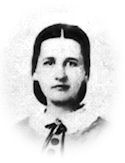
March 16th, 1862.—The entire family wrote to Brother Amos this morning, he will surely find out he has a young daughter. As scarce as paper is Eddie had to have a whole sheet to write his letter on. He looked so in earnest that I asked what he was writing? He said, “I is sayin’, Father come home and wear de beautiful cloes.” He admires the gray and gold as much as the rest of us do.

March 16.—This day Gen. Garfield defeated a body of rebels, intrenched on the summit of the Cumberland Mountains, in Eastern Tennessee. The National troops, numbering six hundred men, detailed in about equal numbers from the Forty-second and Fortieth Ohio, and Twenty-second Kentucky regiments and McLaughlin’s cavalry, left their camp on the fourteenth, destined for Pound Gap. That point was reached to-day after a march of thirty-seven miles, performed in some thing less than two days. The enemy were taken by surprise, dislodged from their stronghold, and driven routed and discomfited from the field. The entire camp, with its equipage, consisting of numerous log-huts, canvas tents, subsistence stores, wagons, and all the trappings of camp life, together with some three hundred squirrel rifles, fell into the hands of the Unionists. In the absence of means of transportation, all but what the troops could carry on their backs was submitted to the flames. It was a brilliant success, and the entire detachment returned without loss or damage to a man.—(Doc. 96.)
—This day a battalion of the Fourth Illinois regiment had a skirmish with a squadron of rebel cavalry, near Pittsburgh Landing, resulting in the defeat of the latter with some loss. Four of the Nationals were wounded.—The bark Glen, which had been blockaded in the harbor of Beaufort N. C, for some time, was set on fire by the rebels, and completely destroyed.
—The Nashville (Tenn.) Times suspended publication, owing to the restriction of its “independence” by Gov. Andrew Johnson.—N. Y. Times, March 28.
—Gen. Wright, Commander of the Department of the Pacific, instituted martial law in San Francisco, and issued an order dated February second, by which Major Hiram Leonard, of the United States Army, is appointed Provost Marshal.— N. Y. Herald, March 28.

15th.—Our army has fallen back to the Rappahannock, thus giving up the splendid Valley and Piedmont country to the enemy. This, I suppose, is right, but it almost breaks our hearts to think of it. Winchester was occupied last Wednesday! Lord, how long shall our enemies prosper? Give us grace to bear our trials.
Saturday Night.—Spent to-day at the hospital. Heard of the shelling of Newbern, N. C., and of its fall. My heart sickens at every acquisition of the Federals. No further news from Arkansas. Yesterday evening I went to see the body of our dear Bishop; cut a piece of his hair; kissed his forehead, and took my last look at that revered face.
March 15 — This morning the enemy advanced with cavalry and artillery. We put our battery in position at our camp on a hill half a mile above Newtown. We fired some eight or ten rounds; then fell back to Cedar Creek. Quartered in an old house on the hillside near Cedar Creek bridge.
Saturday March 15th
The River is full of Steam Boats for transporting troops down the River, probably to “Old Point”. It has rained incessantly and this evening it pours. Col D. is well (he says). We went down to “Browns,” saw Maj Williams, Maj Fletcher & other officers. Col Durkee came in about 8 o’clock and is to stay all night. Our House for the time being seems to be the Head Quarters. Col Dutton is acting Brigadier Genl.
______
The three diary manuscript volumes, Washington during the Civil War: The Diary of Horatio Nelson Taft, 1861-1865, are available online at The Library of Congress.
Vienna, March 15th.—Did not lie down last night, but worked in separating and disposing of my sick. Most of them I have brought to this place to embark such as cannot march to Alexandria, by rail. The Brigade did not meet me here, as I expected, and I got to it at Flint Hill (where I left it) last night. I cannot look upon our possession of this place and the railroad without deeply feeling how much we have been outwitted. Here we have been held still with 150,000 to 200,000 men, since July last, by a little village mounting wooden guns. Poor McClellan, I fear a wooden gun will be the death of him yet, though his failure here may be attributable to the interference of others. I will not hastily condemn him.


