Following the American Civil War Sesquicentennial with day by day writings of the time, currently 1863.

March 2012

MARCH 11TH.—I have summed up the amounts of patriotic contributions received by the army in Virginia, and registered on my book, and they amount to 31,515,898.*

The people of the respective States contributed as follows:
North Carolina $325,417
Alabama, 817,600
Mississippi 272,670
Georgia 244,885
South Carolina 137,206
Texas 87,800
Louisiana 61,950
Virginia* 48,070
Tennessee 17,000
Florida 2,350
Arkansas 950

* Virginia undoubtedly contributed more than any other State, but they were not registered.

Tuesday, 11th—We lay at the wharf all night, loading the quartermaster’s supplies. At 8 a. m. we left St. Louis for Cairo, Illinois. Our entire regiment is on the one boat, a side-wheeler. Company E is quartered on the hurricane deck, and a cold wind blowing makes it rather disagreeable for us. We lay up for the night one hundred miles below St. Louis. We have big times getting our rations cooked, for there is but one place to get boiling water to make coffee, and only one place at the fire where we can broil our bacon. Each man slices his bacon, puts it on the ramrod, and holds it close to the fire under the boilers. We all have to take our turn, and since there are eight hundred men, there is some one at the fire all day and part of the night. The captain of the boat declared that we were “the d____st set of men to eat” that he had ever seen in his life.

March 11—At ten o’clock this morning we heard that the Yankees were advancing in force. We received orders to move toward Winchester, to go within one mile of town and await further orders. Immediately after we arrived within a mile of town we were ordered to return down the pike, to check the enemy’s advance guard. We went about two miles below town and put one gun [the howitzer] in position, and awaited the approach of the Yanks. Our first position was nearly two miles in advance of Jackson’s army, which was then near Winchester.

We did not have to wait long before we saw the enemy, an immense force steadily advancing on the Martinsburg road, and a column of infantry with waving banners winding along the hillsides west of the pike, like some huge shiny snake in a coat of mail, reflecting the bright afternoon sunlight that flashed with shattered splendor from thousands of glittering muskets and burnished trappings. The magnificent splendor of the scene was truly fascinating, yet danger lurked in the approaching panoramic sheen.

The cavalry was in front in solid column, which once or twice threw out bodies of skirmishers that scoured the woods and fields on their left. The infantry marched in splendid order in columns of four, close in rear of the cavalry. Now and then I saw little bunches of white smoke rising from their line of sharpshooters as they sped their bullets at some daring Rebel cavalrymen that ventured too near the coming warish anaconda.

They advanced cautiously and slowly. As soon as their cavalry came within range of our gun we fired two shell at them, then fell back to the fair ground, taking a position which we held till after dark. It was nearly sunset when we arrived at the fair ground, and just as the sun was sinking behind the hills Jackson’s men began to move in various maneuvers, marching and counter-marching around the fair ground and through the fields at the north end of Winchester.

When the twilight began to grow into dusk I saw some of the infantry regiments march into the breastworks on the hill west of town. We remained at the fair ground with our guns in battery ready for action at a moment’s warning until some time after dark. Then, all being quiet in our front, we retired slowly through the silent streets that were soon to echo the martial tread of the invaders. We fell back to Milltown Mills on the Valley pike, and remained until midnight, then retired to Bartonsville. From all appearances Winchester is evacuated, and will be occupied by the enemy to-morrow morning.

Jackson’s forces are retreating up the Valley. Their camp-fires are blazing all along the pike south of Kernstown by Bartonsville and toward Newtown.

It is now nearly two hours after midnight, and the air is cold and chilly. A few moments ago I saw General Jackson bending over a dying camp-fire by the roadside warming his hands. After standing there a while apparently in deep meditation, and as silent as the glow that was playing over the embers, he drew his faded cap closer over his brow, mounted his horse, and rode slowly away toward Newtown.

Here at Bartonsville, which is six miles from Winchester, we, at two o’clock in the morning, wrapped our blankets around us, weary and fatigued, and dropped on the bosom of Mother Earth to snatch a few hours of balmy sleep.

March 11th. After failing to get up the river at this Pass we to-day steamed round to South-West Pass to try the depth of water there. We found the U. S. steam frigate Colorado here, besides several transports. On the following day the Brooklyn went over this bar and anchored on the other side. The Hartford followed on the 13th and all proceeded to Pilot Town, a little settlement just above the mouth of the Pass. Here it was decided to strip the ship for action; this occupied the 14th. We sent a guard of marines ashore to protect our property, and the flag which was raised on the lookout by Lieut. Kautz, Lieut. Broome of the marines, and Mr. Osbon; the guns were all shotted, and preparations made for any demonstration of the enemy.

Sunday, 11th. Issued rations. Wrote a letter to Theodore and read some. Commenced a letter to Fannie. Helped bring wood.

March 11. This morning the clink of the windlass is again heard from all the boats hoisting their anchors. We steam out of Croatan into Pamlico sound; so here we go for new conquests.

The Burnside expedition, it did not end in smoke:

It captured Elizabeth City, and the isle of Roanoke.

About 11 a. m., the New York went onto a shoal and came to a dead halt. Here was a pretty fix, stuck right in the middle of Pamlico sound. We had the schooner Skirmisher in tow, with companies K and I aboard, but they thought they would leave us and go it alone. Accordingly they hauled in their hawser, hoisted sail and left us, sailing with a fair breeze gallantly down the sound. Three large steamers hitched on to us, to pull us off. After a good deal of hard work, lots of swearing and breaking hawsers, they finally succeeded, about 4 p. m., in hauling us off. We again started and dropped anchor at Hatteras inlet at 10 p. m.

Tuesday 11. — A warm bright day. Dined at the hospital with our excellent assistant surgeon, Dr. McCurdy. Sent Company E to Raleigh. The last of the Twenty-third quartered in Fayette is gone. Camp Hayes, Raleigh, headquarters henceforth.

Heard of the evacuation of Manassas by the Rebels. If so, it is evidence of a breaking away that almost decides the contest. But how did they do it undisturbed? What was McClellan doing? A great victory over the combined forces of Van Doren, Price, McCulloch, and McIntosh reported to have occurred in Arkansas.

March 11, 1862.—The serpent has entered our Eden. The rancor and excitement of New Orleans have invaded this place. If an incautious word betrays any want of sympathy with popular plans, one is “traitorous,” “ungrateful,” “crazy.” If one remains silent, and controlled, then one is “phlegmatic,” “cool-blooded,” “unpatriotic.” Cool-blooded! Heavens! if they only knew. It is very painful to see lovable and intelligent women rave till the blood mounts to face and brain. The immediate cause of this access of war fever has been the battle of Pea Ridge. They scout the idea that Price and Van Dorn have been completely worsted. Those who brought the news were speedily told what they ought to say. “No, it is only a serious check; they must have more men sent forward at once. This country must do its duty.” So the women say another company must be raised.

We were guests at a dinner-party yesterday. Mrs. A. was very talkative. “Now, ladies, you must all join in with a vim and help equip another company.”

“Mrs. L.,” she said, turning to me, “are you not going to send your husband? Now use a young bride’s influence and persuade him; he would be elected one of the officers.” “Mrs. A.,” I replied, longing to spring up and throttle her, “the Bible says, ‘When a man hath married a new wife, he shall not go to war for one year, but remain at home and cheer up his wife.’” …

“Well, H.,” I questioned, as we walked home after crossing the lake, “can you stand the pressure, or shall you be forced into volunteering?” “Indeed,” he replied, “I will not be bullied into enlisting by women, or by men. I will sooner take my chance of conscription and feel honest about it. You know my attachments, my interests are here; these are my people. I could never fight against them; but my judgment disapproves their course, and the result will inevitably be against us.”

This morning the only Irishman left in the village presented himself to H. He has been our woodsawyer, gardener, and factotum, but having joined the new company, his time recently has been taken up with drilling. H. and Mr. R. feel that an extensive vegetable garden must be prepared while he is here to assist or we shall be short of food, and they sent for him yesterday.

“So, Mike, you are really going to be a soldier?”

“Yes, sor; but faith, Mr. L., I don’t see the use of me going to shtop a bullet when sure an’ I’m willin’ for it to go where it plazes.”

______

Note: To protect Mrs. Miller’s job as a teacher in New Orleans, the diary was published anonymously, edited by G. W. Cable, names were changed and initials were often used instead of full names — and even the initials differed from the real person’s initials.
Georgeanna’s Journal.

March 11.

So the great move was made, the thing we had been looking forward to for so many months. The entire army was in motion, troops on the other side the river advancing, troops on this side taking their place. All day Monday and far into the night regiments marched over the bridges into Virginia,—50,000 over the Long bridge, they say, and to-day we drove up to the Chain bridge, and they told us 15,000 crossed there yesterday. We walked down towards the Long bridge to-day; crowds of people were collected on 14th street to see the move. As we crossed the canal, mother, Charley and I, swinging along with the rest, three large army wagons brought up the rear, marked T. E., carrying the telegraphic apparatus for the Engineers, and the wires must have been laid last night, for this morning General Williams had the announcement from McClellan (who slept at Fairfax Court House), that our troops are in possession at Manassas.

March 11th.—A freshman came quite eager to be instructed in all the wiles of society. He wanted to try his hand at a flirtation, and requested minute instructions, as he knew nothing whatever: he was so very fresh. “Dance with her,” he was told, “and talk with her; walk with her and flatter her; dance until she is warm and tired; then propose to walk in a cool, shady piazza. It must be a somewhat dark piazza. Begin your promenade slowly; warm up to your work; draw her arm closer and closer; then, break her wing.”

“Heavens, what is that—break her wing?” “Why, you do not know even that? Put your arm round her waist and kiss her. After that, it is all plain sailing. She comes down when you call like the coon to Captain Scott: ‘You need not fire, Captain,’ etc.”

The aspirant for fame as a flirt followed these lucid directions literally, but when he seized the poor girl and kissed her, she uplifted her voice in terror, and screamed as if the house was on fire. So quick, sharp, and shrill were her yells for help that the bold flirt sprang over the banister, upon which grew a strong climbing rose. This he struggled through, and ran toward the college, taking a bee line. He was so mangled by the thorns that he had to go home and have them picked out by his family. The girl’s brother challenged him. There was no mortal combat, however, for the gay young fellow who had led the freshman’s ignorance astray stepped forward and put things straight. An explanation and an apology at every turn hushed it all up.

Now, we all laughed at this foolish story most heartily. But Mr. Venable remained grave and preoccupied, and was asked: “Why are you so unmoved? It is funny.” “I like more probable fun; I have been in college and I have kissed many a girl, but never a one scrome yet.”

Last Saturday was the bloodiest we have had in proportion to numbers.¹ The enemy lost 1,500. The handful left at home are rushing to arms at last. Bragg has gone to join Beauregard at Columbus, Miss. Old Abe truly took the field in that Scotch cap of his.

Mrs. McCord,² the eldest daughter of Langdon Cheves, got up a company for her son, raising it at her own expense. She has the brains and energy of a man. To-day she repeated a remark of a low-country gentleman, who is dissatisfied: “This Government (Confederate) protects neither person nor property.” Fancy the scornful turn of her lip! Some one asked for Langdon Cheves, her brother. “Oh, Langdon!” she replied coolly, “he is a pure patriot; he has no ambition. While I was there, he was letting Confederate soldiers ditch through his garden and ruin him at their leisure.”

Cotton is five cents a pound and labor of no value at all; it commands no price whatever. People gladly hire out their negroes to have them fed and clothed, which latter can not be done. Cotton osnaburg at 37½ cents a yard, leaves no chance to clothe them. Langdon was for martial law and making the bloodsuckers disgorge their ill-gotten gains. We, poor fools, who are patriotically ruining ourselves will see our children in the gutter while treacherous dogs of millionaires go rolling by in their coaches—coaches that were acquired by taking advantage of our necessities.

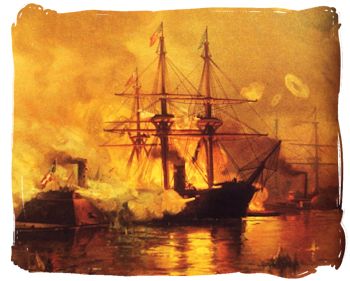
This terrible battle of the ships—Monitor, Merrimac, etc. All hands on board the Cumberland went down. She fought gallantly and fired a round as she sank. The Congress ran up a white flag. She fired on our boats as they went up to take off her wounded. She was burned. The worst of it is that all this will arouse them to more furious exertions to destroy us. They hated us so before, but how now?

In Columbia I do not know a half-dozen men who would not gaily step into Jeff Davis’s shoes with a firm conviction that they would do better in every respect than he does. The monstrous conceit, the fatuous ignorance of these critics! It is pleasant to hear Mrs. McCord on this subject, when they begin to shake their heads and tell us what Jeff Davis ought to do.

______

¹ On March 7 and 8, 1862, occurred the battle of Pea Ridge in Western Arkansas, where the Confederates were defeated, and on March 8th and 9th, occurred the conflict in Hampton Roads between the warships Merrimac, Cumberland, Congress, and Monitor.

² Louisa Susanna McCord, whose husband was David J. McCord, a lawyer of Columbia, who died in 1855. She was educated in Philadelphia, and was the author of several books of verse, including Caius Ciracchus, a tragedy; she was also a brilliant pamphleteer.