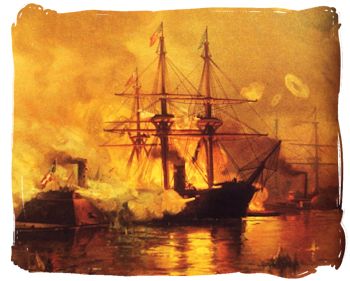
March 9th. The Brooklyn tried all day, but with no effect, to cross the barrier before us. Capt. Bell went up the river in the gunboat Winona on a reconnoissance, and this evening came down with five prisoners, who were duly examined by the flag-officer, who after examination discharged them as neutrals.
March 2012
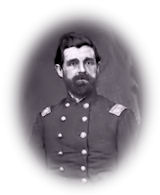
To Mrs. Lyon
Mound City, Sunday, March 9, 1862.—How lucky now that you did not come to me. I got orders last night to join the regiment, which is 20 miles west of Bird’s Point. We are all packed up and expect the boat every hour. I presume we shall go to New Madrid. If you hear of a fight, keep cool until you have the particulars, and then throw up your hat, for we shall whip them.
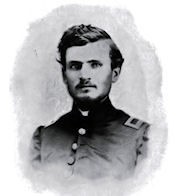
9th. Left Butler at 8 A. M. Major Wilson of our regiment marched the rest of the distance to Fort Scott, under arrest by order of the General for drunkenness. Rode by the side of Nettleton. Crossed one of the branches of the Osage, Marais des Cygnes, very swift. Great time crossing with the mules led by ropes—one team rolled down the bank. Encamped by a little stream on the prairie. Found considerable muddy road during the day along the river bottom.
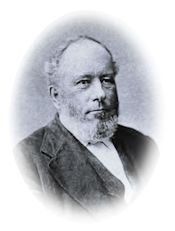
March 9. A beautiful Sabbath morning, not a ripple disturbs the smooth surface of the sound, Religious services this morning in the saloon; in the afternoon on the promenade deck. All the troops, except one or two regiments, left to garrison the island, are again afloat, and the talk now is that Newbern is the next point of attack.
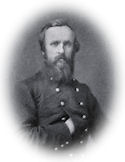
Fayetteville, March 9, 1862. Sunday P. M
Dearest : — I received your letter last night — sent by Mr. Schooley. You wrote it a week ago. A rainy, gloomy day here too, but made rather jolly by Dr. Joe’s good nature, with Avery and Bottsford to help me laugh. Dr. Joe is in his best humor these days and makes all around him happy. Today is a lovely spring day — but getting lonely here. I am a hen with one chicken. All but one company, I have sent to Raleigh since Colonel Scammon left. We have been here almost four months. The men are pleased to go. I shall start in a day or two when the hospital goes. No sickness — not a man who can’t go about, and only four who need a hospital. Eight hundred well men here and at Raleigh. There is a real gloom among the men caused by a report that I am to be colonel of the Sixth. It is no doubt a repetition of an idle rumor I heard in Cincinnati, But as the thing may come up, I wish you and Stephenson to know that I would not want the place unless it was agreeable generally that I should have it. Young Anderson is probably entitled to it, and I would not want it in opposition to him or his friends. The place is, perhaps, not preferable to my present position and I do not desire it, unless it is all smooth — particularly with Anderson. If I were sure of continuing my present command of the Twenty-third, I would not wish a colonelcy of any other regiment; but in the present uncertainty I am willing to take a certainty in any good regiment.
My new horse performs beautifully. I am in the best of health. There is only one thing: You are not here. Don’t you think I love you as much as you do me? Why, certainly. There, I have fixed this letter so you can’t show it to “Steve.” I’ll write him a note. . . .
Affectionately,
R. B. Hayes.
Mrs. Hayes.

March 9.
A day of great excitement, for beside the news of the evacuation of Leesburg and the capture of Cockpit Point battery, we have the great naval fight at Fortress Monroe. The great demon ship, the Merrimac, came down from Norfolk toward Newport News and attacked our ships Congress and Cumberland, destroying both. She split the latter in two and sank her, and burned the Congress to the water’s edge. The Minnesota meantime was aground and perfectly useless, as well as several others of our vessels.
This ended the first day’s fight—a victory for the rebels and a terrible disaster for us; but early this Sunday morning, when the Merrimac came out again, expecting to finish her little affair by defeating the Minnesota and then running out to sea, she found the new Ericsson iron-plated steamer, the “Monitor,” all ready to receive her. From 8 A. M. till noon the two fought hand to hand, their sides touching, and then the Merrimac was towed off towards Norfolk, supposed to be in a sinking condition, while the “Monitor” was unhurt. The submarine cable from Fortress Monroe was laid just in time to bring the news. The cable was finished at 4 P. M. and the news flashed over it at 7.

March 9.—Early yesterday afternoon, the rebel iron-plated steamer Merrimac came out of Norfolk harbor, moved slowly down the channel leading to Newport News, and steamed direct for the United States sailing frigates Cumberland and Congress, which were lying at the mouth of the James River. The Cumberland opened fire on her, but the balls had no effect. In the meantime the rebel steamers Yorktown and Jamestown, came down the James River and joined in the engagement The Merrimac ran against the Cumberland, striking her about midships and laying open her sides. This movement was repeated, and then the steamer started for the Congress. The latter surrendered, and in the evening it was fired. The Minnesota attempted to engage in the conflict, but run aground not far from Newport News.
The St Lawrence fired a number of shots, but was unable to get near the rebel steamers. The gunboat Oregon was disabled by a shot in her boiler, and the gunboat Zouave was also damaged to some extent The new Ericsson iron-clad battery, the Monitor, arrived in the roads at ten o’clock in the evening, and at once went to the protection of the Minnesota. This morning the contest was renewed, and from eight o’clock to twelve o’clock, the two iron-clad steamers fought, part of the time touching each other. At last the Merrimac retired, having sustained serious injuries. The Monitor was uninjured.—(Doc. 82.)
— A Brigade of United States troops from Cairo, Ill., occupied Point Pleasant, Mo., about ten miles below New-Madrid, thus cutting off the communication of the rebels with the main confederate army further down the Mississippi River. At Point Pleasant the National troops took possession of a rebel transport loaded with flour, and scuttled her.—Cincinnati Gazette.
—The citizens of Shelbyville, Bedford County, Tenn., burned a large quantity of confederate stores, to prevent their falling into the hands of the rebel troops under A. Sydney Johnston, who were in full retreat from Murfreesboro’.
—Cockpit Point, Va., was occupied by the National troops. About two P.M., the rebels commenced to retreat, and fired their tents and other property difficult of removal. They also burned their steamer George Page, and all the other craft which they had in the creek.
The National gunboats opened fire on the battery about three o’clock P.m., and at half-past four a force was landed, and ran up the Union flag over the rebel works.—(Doc. 83.)
—Great excitement existed throughout the seaboard cities and towns of the Northern States, concerning the possibility of the rebel gunboat Merrimac’s escaping from Hampton Roads and visiting them.
—This morning at daybreak, the camp of Gen. McCook, situated on the Franklin Turnpike, three miles south of Nashville, Tenn., was attacked by a party of rebels, and a corporal of the First Wisconsin regiment killed. — Louisville Journal, March 12.
—A skirmish took place to-day at Burk’s Station, near Fairfax Court-House, Va., between a detachment of the Linconn cavalry, consisting of fourteen men, under command of Lieut. Hidden, and about one hundred and fifty rebel infantry.
The cavalry charged upon the rebels and drove back the majority of them, with the loss, however, of Lieut. Hidden. The remainder fought desperately on both sides, three rebels being killed, five wounded and eleven taken prisoners. The members of the Lincoln cavalry were commanded by Corporal Eugene Lewis, after Lieut. Hidden fell.—(Doc. 84.)
—Two powder-mills, on the opposite side of the river, at New-Orleans, were blown up, and five workmen were killed. The loss of property was principally in machinery. There was only about three thousand pounds of powder on hand. —New-Orleans Crescent, March 10.

March 8 — To-day we moved four miles below Winchester, on the Martinsburg pike. Quartered in a house.
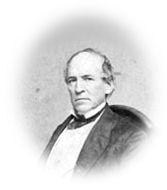
Saturday March 8th
The weather is now fine & the roads are drying up. Troops are coming into the City and crossing over the River. Rumors afloat of fighting today near Mt Vernon. Nothing is published and little is known publicly of War operations. The prospect now is that there will be a desperate Battle near here soon. The Rebels will try to retrieve their recent losses, and will fight with desperation. McClellan is well prepared and has an immense army near here all ready and anxious for a fight. Went up to Franklin Square with wife & the boys after dinner. Wife & myself continued our walk to Lafayette Square pass [sic] Genl McClellans home. He was standing at the Window. I did not go down to the Ave tonight, got a “Tribune” of the news boy & read Carl Shurze Speech at the Cooper Institute NY.
______
The three diary manuscript volumes, Washington during the Civil War: The Diary of Horatio Nelson Taft, 1861-1865, are available online at The Library of Congress.

MARCH 8TH.—Gen. Winder has appointed Capt. Godwin Provost Marshal


