Following the American Civil War Sesquicentennial with day by day writings of the time, currently 1863.

March 2012

Friday March 7th 1862

A beautiful clear day but rather cool out, in the office as usual. Nothing new in the city that I hear of tonight. I have been down to Charleys. He has been doing some writing for me, my work in the Land office. Troops are coming into the City and moveing about a good deal. We may expect lively times soon over the River. All seems to be quiet now.

______

The three diary manuscript volumes, Washington during the Civil War: The Diary of Horatio Nelson Taft, 1861-1865, are available online at The Library of Congress.

7th.—Received orders to-day to draw rations for my hospital force for five days. This kind of an order is unusual. The roads are improving. Perhaps the dumb watch is nearly old enough to run.

MARCH 7TH.—Gen. Winder has established a guard with fixed bayonets at the door of the passport office. They let in only a few at a time, and these, when they get their passports, pass out by the rear door, it being impossible for them to return through the crowd.

Friday, 7th—Orders came for us to get ready to leave for St. Louis, and everybody is happy. Drill was discontinued for the day.

7th. Passed through the village and again struck the prairie. Pleasant day, enjoyed the ride very much indeed. Rode by the side of Lieutenant Nettleton, enjoyed visiting with him much.

March 7th. Weighed anchor for the mouth of the Mississippi River; arrived in the evening, where we found the Pensacola and Brooklyn at Pass a l’Outre on the blockade. Our object in coining here was to go up the river, with the subsequent view of capturing New Orleans. Preparations were immediately made to cross the bar, a constantly shifting mud bank at the mouth of each pass of the Mississippi.

March 7th.—Mrs. Middleton was dolorous indeed. General Lee had warned the planters about Combahee, etc., that they must take care of themselves now; he could not do it. Confederate soldiers had committed some outrages on the plantations and officers had punished them promptly. She poured contempt upon Yancey’s letter to Lord Russell.¹ It was the letter of a shopkeeper, not in the style of a statesman at all.

We called to see Mary McDuffie.² She asked Mary Preston what Doctor Boykin had said of her husband as we came along in the train. She heard it was something very complimentary. Mary P. tried to remember, and to repeat it all, to the joy of the other Mary, who liked to hear nice things about her husband.

Mary was amazed to hear of the list of applicants for promotion. One delicate-minded person accompanied his demand for advancement by a request for a written description of the Manassas battle; he had heard Colonel Chesnut give such a brilliant account of it in Governor Cobb’s room.

The Merrimac³ business has come like a gleam of lightning illumining a dark scene. Our sky is black and lowering.

The Judge saw his little daughter at my window and he came up. He was very smooth and kind. It was really a delightful visit; not a disagreeable word was spoken. He abused no one whatever, for he never once spoke of any one but himself, and himself he praised without stint. He did not look at me once, though he spoke very kindly to me.

______

¹ Lord Russell was Foreign Secretary under the Palmerston administration of 1859 to 1865.

² Mary McDuffie was the second wife of Wade Hampton.

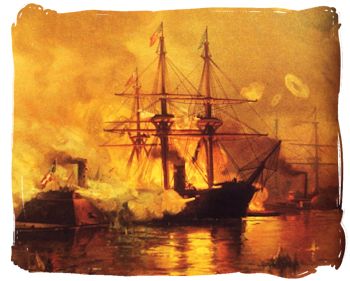
³ The Merrimac was formerly a 40-gun screw frigate of the United States Navy. In April, 1861, when the Norfolk Navy-yard was abandoned by the United States she was sunk. Her hull was afterward raised by the Confederates and she was reconstructed on new plans, and renamed the Virginia. On March 2, 1862, she destroyed the Congress, a sailing-ship of 50 guns, and the Cumberland, a sailing-ship of 30 guns, at Newport News. On March 7th she attacked the Minnesota, but was met by the Monitor and defeated in a memorable engagement. Many features of modern battle-ships have been derived from the Merrimac and Monitor.

March 7.—The Eighth regiment of Vermont volunteers, under the command of Col. Stephen Thomas, passed through New-York on the way to the seat of war. It is composed of one thousand and sixty men, fully uniformed, armed with Enfield rifles, and equipped. They have been recruited from among the hardy sons of the Green Mountain State, and arc unusually strong and robust, mostly between the ages of twenty and thirty-five years.

Accompanying the regiment are two light batteries of six rifled six-pounders each, the two companies numbering one hundred and seventy-five men each. They are commanded respectively by Capt Geo. W. Duncan and Capt. Sales.

—In the English House of Commons, Mr. Gregory, pursuant to notice, called the attention of the House to the blockade of the Southern ports, and moved for a copy of any correspondence on the subject, subsequent to the papers already before the House. He expressed his strong sympathy for the struggle going forward in the confederate States, and declared that a separation of the South from the North, and a reconstruction of the Union, were the only means by which they could hope to see slavery abolished in America.

—The rebel steamer Sumter still remained at Gibraltar, the United States gunboat Tuscarora watching her.

—A brisk cannonading took place on the Lower Potomac at four o’clock this morning, when the Freeborn, Satellite, Island Belle, and the Resolute opened fire on the line of batteries extending from opposite Liverpool Point to Boyd’s Hole, including three at Aquia Creek. The rebels returned the fire, but without striking any of the National vessels. Proceeding up to Wade’s Bay in the afternoon, in which direction heavy firing had been heard during the day, the Island Belle and the Satellite again opened fire on the railroad depot and some trains of cars filled with rebel troops that were constantly arriving from Fredericksburg. The depot was riddled by the shot and shell. The enemy returned the fire from a battery on the water-line and another on a hill a little back. Their shots fell thickly around the vessels, but not one of them took effect. The troops at Aquia Creek were constantly receiving reinforcements. The batteries at Cockpit Point and Shipping Point opened fire on Professor Lowe’s balloon, when in the air near Budd’s Ferry, but the balloon was not hit on either side. —Gov. Andrew Johnson, with his staff, accompanied by Messrs. Etheridge and Maynard, left Washington this evening for Nashville, to enter upon their charge of the new government of Tennessee.

—The Richmond Examiner, of this date, has the following: “What has become of the enormous number of arms stored in Southern arsenals at the beginning of this war? Into what proportions have the cargoes said to have been brought in from time to time, by rumor, dwindled through official count? They are certainly not in the hands of soldiers now in the field, nor are they still in the arsenals, nor have they been captured by the enemy. Admit that in the hands of prisoners taken by the enemy there were twenty thousand stand, that half as many more have been broken or lost in marches and hospitals, the total that should be subtracted from the original sum is still too small to account for the present scarcity of muskets and of bayonets.

“But a vast quantity have undoubtedly gone with the sixty days’ men, the four months’ men, the six months’ men; a still greater loss is attributable to the many useless and unprofitable assemblages of the militia. It is certain only that the ordnance department has not the arms for the new levies. There are many more soldiers at the government’s command than muskets. It could find employment for five hundred thousand stand of arms that it has not in possession or in prospect. Under these circumstances no wiser measure could have been adopted by the government than the call for the guns in the hands of the citizens as private property. There are a million of guns possessed by the citizens of the South in this manner, and the country has a right to every one of them now. Most shot-guns will carry a ball, and all of them are good for buckshot. They are as effective as any smooth bore, and are much better made than the musket. Troops armed with double-barreled shot-guns need no bayonets; for any line that attempted to charge them would be annihilated by the second load, which will always be retained, and can be delivered at twenty paces. It is hoped that the government will inexorably enforce its regulation; and no sincere patriot will be unwilling to assist its execution to the utmost of his power.”

—John Park, Mayor of Memphis, Tenn., this day issued the following proclamation:

“To The People or Memphis: Much has been said in regard to the burning of our city. I have, as John Park, (not the Mayor,) to say this to our citizens: That I will, under any and all circumstances, protect the city from incendiaries, and he who attempts to fire his neighbor’s house — or even his own, whereby it endangers his neighbor —I will, regardless of judge, jury, or the benefit of clergy, hang him to the first lamp-post, tree, or awning. I have the means under my control to carry out the above individual proclamation.”

—An excitement occurred in the town of Dover, Del., this day. It appears that two companies of Home Guards had been raised in the town, one called the Hazlet Guards, and the other simply denominated Home Guards. The Hazlet Guards were equipped by the State, but the other organization by the Government. The Government called on the Hazlet Guards to give up their arms, which they refused to do. Persisting in this determination, two hundred Government troops were immediately sent to the town from Cambridge, Md., under the command of Col. Wallace. Five of the ringleaders were arrested, but three were afterward released, Capts. Pennington and Wise only remaining in custody. The town numbers about two thousand persons, and the whole place is now under strict martial law.—N. Y. Commercial Advertiser, March 11.

—The rebel chief, Quantrel, with a party of his troops, entered Aubry, Kansas, this day, killing five Unionists, and carrying off fifteen horses.— N.Y. Times, March 11.

—The United States Senate this day confirmed the following as Brigadier-Generals of Volunteers: Major Laurance Graham, of Second cavalry; Eleazer Paine, of Illinois; William A. Richardson, of Illinois; Daniel Butterfield, of New-York; W. T. Ward, of Kentucky; Major George Sykes, of the Thirteenth infantry; Captain David Stanley, of the Tenth cavalry; Thomas A. Davies, of NewYork; Col. Philip St. George Cooke, Second cavalry; Major George Stoneman, Fourth cavalry; Capt. Joseph B. Plummer, First regiment of infantry, for gallant conduct at Springfield and Fredericktown, Mo.

The Senate also confirmed Henry Van Renssalear to be Inspector-General, with the rank of Colonel, and Thomas Hillhouse, of New-York, to be Assistant Adjutant-General of Volunteers, with the rank of Major.
Note: This letter—a document written in 1862—includes a term that may be offensive to many today.  No attempt will be made to censor or edit 19th century material to today’s standards.

Near New Madrid, Mo., March 6, 1862.

What oceans of fun we are having here. Here goes for all of it to date, and I’ll be lucky if I’m able to tell you the finale. We went down to Commerce the 26th of February. Troops were scattered everywhere over the town and vicinity for 15 miles about. Could form no idea of the number there, but it was variously estimated at from 15,000 to 45,000. On the 28th we started, our regiment in advance, and camped that night at Hunter’s farm, the same place we stopped last fall when going to Bloomfield under Oglesby. We reached Hunter’s at 2 o’clock p.m., and at 11 the same morning Jeff Thompson had been there waiting for us with six pieces of cannon. He skedaddled, but still kept in the neighboring swamps. The next morning we again started in advance and after a ride of five miles heard firing about the same distance ahead. We let the horses go and in a very short time were within the limits of the muss. We came up with a company of cavalry from Bird’s Point standing in line at the end of a lane, about a mile down which we could see Thompson’s forces drawn up with his artillery “in battery.” He saw us about as quick as we got up, and limbered up in double quick and scooted. Then the fun commenced. We chased him for 15 miles over a splendid straight, wide, level road, which he strewed with blankets, guns, hats, and at last dropped his artillery. A dozen of our boys kept up the chase until within a half mile of New Madrid, where they captured a wagon load of grain and a nigger, and returned at leisure. We caught a captain, 1st. lieutenant and some privates. Next day, the 2d of March, our regiment went down to New Madrid to reconnoiter. A regular colonel went along to draw a map of the country. We went it blind right into the edge of town, where we ran onto a lot of infantry. As fighting wasn’t the object, we filed off to the left into a cornfield to get a new view of town. We were going slowly down on the town in line of battle, when a battery opened on us right, smartly. We got out of that, but in good order. Only one shell touched us and that burst right under a horse’s nose. One piece bruised the horse a little and knocked the rider off, but did not hurt the man at all, and the horse is now fit for duty again. Almost miraculous, wasn’t it? There were lots of shell and balls fell around us. On the 3d the whole army got here and we again marched on the burg. The gunboats opened on us and we had to draw back. That day three 64-pound shells burst within 30 yards of me. We have been lying, since then, about two miles from town. They throw a shell over here occasionally but haven’t hurt any body yet at this distance. To-day the cavalry have been out again to see if the gunboats have left, (that’s all that keeps us from taking the town). The boats were still there and again shelled us, killing one man and a horse in the Michigan 3d. They killed one man on the 3d in the 39th Ohio, and the same shell wounded several others. Yesterday 2,000 or 3,000 men went around New Madrid down the river ten miles to Point Pleasant, but were kept off by the damned gunboats, just like we are here. If two or three of our gunboats could only slip down far enough to see their gunboats (two of them) and steamboats coming and going with their secesh flags flying. They have burned a half dozen houses in town since we came here. Don’t know what for. Brigadier General Pope who is in command here has been made a major general. The colonel has just come from his quarters, and reports that Foote will be here with his gunboats day after to-morrow at farthest. We have been scouting all afternoon and I’m blamed tired. I took four men and went it alone. Had a good time but got lost and didn’t get back until 8 p.m. Captured a lot of ginger snaps, and had a good talk with a handsome widow, while the boats were firing at the Michigan cavalry on our left. These shells don’t scare a fellow half as much as the thoughts of them do. Why you really don’t mind it at all. I don’t like the idea of those musket balls, but maybe that is also worse than the reality.

6th.—To-day we saw Bishop Wilmer consecrated— Bishop Meade presiding, Bishops Johns and Elliott assisting. The services were very imposing, but the congregation was grieved by the appearance of Bishop Meade; he is so feeble! As he came down the aisle, when the consecration services were about to commence, every eye was fixed on him; it seemed almost impossible for him to reach the chancel, and while performing the services he had to be supported by the other Bishops. Oh, how it made my heart ache! and the immense crowd was deeply saddened by it.