
April 23.—A young man whom I have been attending is going to have his arm cut off. Poor fellow! I am doing all that I can to cheer him. He says that he knows that he will die, as all who have had limbs amputated in this hospital have died. It is but too true; such is the case. It is said that the reason is that none but the very worst cases are left here, and they are too far gone to survive the shock which the operation gives the frame. The doctors seem to think that the enemy poisoned their balls, as the wounds inflame terribly; but I scarcely think that they are capable of so great an outrage. Our men do not seem to stand half so much as the northerners. Many of the doctors are quite despondent about it, and think that our men will not be able to endure the hardships of camp-life, and that we may have to succumb on account of it; but I trust that they are mistaken. None of the prisoners have yet died; this is a fact that can not be denied; but we have had very few of them in comparison with the number of our own men.
April 2012
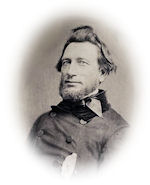
23rd.—A week ago to-day was the battle at Lee’s Mill, and though there has been daily fighting ever since, and calls to arms almost every night, sometimes two or three times a night, there has been no battle worthy of the name. The artillery have been firing at long range, with occasional infantry firing. Two Federal officers, Col. Cassiday and Major Crocker, deserted to the enemy to-day. Charles F., of Company K, had his leg shattered by a musket ball—the first man of our Regiment seriously hurt by the enemy, although we have now been in the field nearly eight months. Whilst I was dressing his wound a little circumstance occurred illustrative of the tender sympathies which some military officers feel for their men. Gen. H was passing and looked in. ” How are you, my man?” asked the General. “Oh, General, I am suffering terribly; but just set me up before the damned rebels, and I’ll fight whilst I breathe.” “I am sorry to see you wounded my man. We need your services in these times.” That’s it; not a word of sympathy for his “suffering terribly;” not a word of approbation for his bravery; no thanks for his having done his duty like a man. All sorrow for loss of service. He has fought his fight, and henceforth is a useless appendage to the army. “Poor old horse, let him die!”
The newspapers, containing accounts of last Wednesday’s fight are now being received by us. They state our loss at thirty-two killed, and speak of our artillery as “mowing down the enemy by acres.” Now, this is all stuff. We might as well tell the truth. Our cause does not need the bolstering aid of falsehood. I have myself seen over fifty of the killed. And, then, I was by the side of our batteries during the hottest of the fight, within five hundred yards of the enemy’s fort, not a twig intervening, and at no time could there be seen an average of fifteen men to “the acre.” What ever others there might have been there were so concealed in rifle pits and behind parapets as to be entirely secured against the “mowing down” process of our artillery. This system of falsifying and exaggerating is a positive injury to our cause. The soldiers are losing confidence in reports, and even in official statements. Even the newsboys are being infected, though I heard one this morning, wittily burlesquing the reporters by crying “Morning Republica-a-n. Great battle in Missouri. Federals victorious. Their troops retreating in good order! Wonder if it will not awaken the reporters to a sense of their ridiculous statements.
If we have another battle here, it will be a desperate one. No stronger position could have been selected by the enemy, and they are well fortified. Jeff. Davis is here, and in the field. Magruder is here, and they are being rapidly reinforced. I do not like this way of marching up to an enemy, and then sitting down quietly and waiting for him to get ready before we attack him. ‘Tis not the Napoleonic style. But there may be good reasons for it which I do not comprehend. I am not a military man, and shall be careful how I condemn the plans of my superiors; but I do not like that style of fighting. Would it not be singular if Yorktown should decide the fate of this revolution, as it did that of “our revolution?”
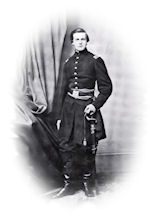 On picket, April 23, 1862. I felt so unwell that I could not finish my letter yesterday, and I have resumed it this morning. Our regiment came out at 3 o’clock this morning for picket duty, and as I wanted to see the fun I came along. Now I wish I could tell you just how everything looks here, or better still, that you could just look in and see us. In a deep wooded hollow you might see seven or eight hundred men, their arms stacked in a glistening line down the middle, knapsacks and haversacks lying round and the men lounging in groups smoking, joking or telling stories. Little brush houses are scattered here and there and the sun is just coming up and making everything look so bright and pleasant that it seems more like some holiday gathering than it does like a gathering of men armed to the teeth and ready to engage in deadly conflict at a moment’s notice. This is historical ground. As long ago as 1781 Yorktown was surrendered, and here is the very place it was done. Just back of me is a long bank of earth now overgrown with trees, a breastwork thrown up by Washington’s men, and, if you could creep with me so as to just look over the top of it, and be out of range of secesh bullets, we could see more. Away across a level field three-quarters of a mile off, just in the edge of a wood, you might see a yellow line of earth. That is a rebel fort. Farther to the right is another, and still farther another and a larger one. A few rods from me are two large siege guns, and a little way on the other side a battery of Parrott guns. Now for a little amusement—a heavy report at the rebel fort, a wreath of white smoke curls gracefully up from the yellow bank and a ten-inch shell comes hissing and screaming through the air directly toward our siege guns. The gunners jump aside and fall flat on the ground; the shell strikes a dozen rods behind them and harmlessly explodes. Up they spring, with “All right, boys.” “Give ’em two for that.” They step to their loaded guns, step back a pace, pull a string, and, Boom! Boom! two reports that make the earth tremble and two shells go screaming back in reply to the rebel missile. They have kept up this cannonading ever since we came here on the 5th, and there is scarcely ten minutes in the day when we do not hear the report of cannon. We are getting used to it so we pay no more attention than to the birds singing, unless the firing is unusually sharp. They have tried several times to drive in our pickets, but they have not succeeded yet. I almost forgot to tell you about the posted men. Nine men are put on a post. They stay twelve hours, for they cannot be relieved oftener for fear of revealing their position. They are posted behind a clump of bushes or in a rifle pit in the open field. Three watch while the others rest, taking turns, and they watch every rod of ground in sight. If a rebel shows himself in range, they blaze away at him.
The guns are popping and cannon thundering away now, and I’ve got my foot on a six-inch shell that was thrown over here this morning and did not burst. I am glad there are no women here, for I am afraid they would make me nervous. Every time a shell exploded they would jump and think “there goes death and misery to some poor fellow,” but we have grown so careless and hardened that we don’t heed them. I have seen some fellows who had narrow escapes. One had his knapsack shot off his back by a solid shot and was not hurt. One had a ball through a cup that he was just about to drink from. One had a Minie ball pass through fifteen thicknesses of cloth (a knot in his cape) and lodge against a rib. Another had the tassel shot off his cap.
The boys have just captured something about a foot long that looks like an alligator.
Glad to hear of Daniel’s success in raising stock. Mine is improving. Woke up the other morning and found a snake and a lizard in my bed.
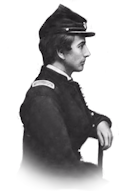
April 23d. I was at brigade headquarters this morning and had a friendly talk with the general. He thinks the siege will be long and troublesome and is not very happy over the notion of spending half the summer here. In the afternoon, received a series of maps showing the enemy’s position, and our line of investment, with instructions to make ourselves familiar with the situation. They are very nicely done, from surveys and drawings made by the engineer corps. After dress parade, joined a large party of mounted officers for a view of the town and had a fine gallop, but did not see much.

April 23d.—On April 23, 1840, I was married, aged seventeen; consequently on the 31st of March, 1862, I was thirty-nine. I saw a wedding to-day from my window, which opens on Trinity Church. Nanna Shand married a Doctor Wilson. Then, a beautiful bevy of girls rushed into my room. Such a flutter and a chatter. Well, thank Heaven for a wedding. It is a charming relief from the dismal litany of our daily song.
A letter to-day from our octogenarian at Mulberry. His nephew, Jack Deas, had two horses shot under him; the old Colonel has his growl, “That’s enough for glory, and no hurt after all.” He ends, however, with his never-failing refrain: We can’t fight all the world; two and two only make four; it can’t make a thousand; numbers will not lie. He says he has lost half a million already in railroad bonds, bank stock, Western notes of hand, not to speak of negroes to be freed, and lands to be confiscated, for he takes the gloomiest views of all things.
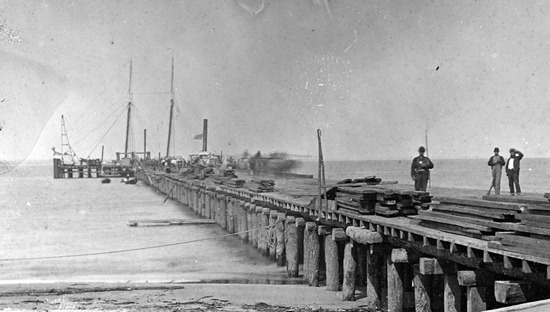
Hilton Head, S.C. Dock built by Federal troops; April 1862; photo by Timothy H O’Sullivan.
Library of Congress Prints and Photographs Division
This drawing is located here on the Library of Congress website.
April 23.—A party of National infantry despatched from Romney, Va., to look after guerrillas, was attacked by a squad of rebels, on Grass Lick, near Wash River. The National troops lost three killed, but drove the rebels, who took refuge in the house of a confederate. A reenforcement of cavalry was then sent out, under the command of Lieut.-Col. Downey, but the rebels fled at his approach, carrying off several dead and wounded. Col. Downey burned the house, and in pursuit captured five prisoners.—(Doc. 145.)
—The resolution adopted by the Maryland Legislature, signed by Governor Bradford, appropriating seven thousand dollars for the relief of the families of the killed and disabled men of the Massachusetts Sixth regiment by the secession mob in Baltimore, on the nineteenth of April, 1861, was read this afternoon in the Massachusetts House of Representatives, and referred to the Committee on Federal Relations. The resolution caused a marked sensation, and its reading was followed by hearty applause.—Boston Post, April 24.

APRIL 22D.—Dibble, the traitor, has been captured by our soldiers in North Carolina.

Tuesday, 22d—It is quite pleasant again after some rain— thunder showers. The wheat fields are looking fine.
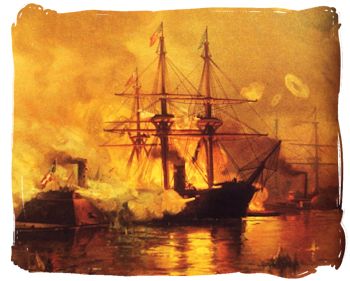
April 22d. A serious accident occurred this evening severely wounding five of our crew. A submerged vessel drifted upon our cable with such force as to tear it from its fastenings, breaking the pawls from the capstan. As this chain was connected with the capstan, and the bars shipped, they were whirled around with great velocity, knocking down several men. These men sustained severe contusions; one suffered the fracture of the forearm, and another was struck in the stomach, nearly killing him outright. Fire rafts appeared to-night, but did no damage.


