Following the American Civil War Sesquicentennial with day by day writings of the time, currently 1863.

April 2012

To Mrs. Lyon

Five miles above Pittsburg Landing, Miss., April 22, 1862.—We are still on the boat. I started out this morning to find the 16th Wisconsin, and after wading five miles, part of the way in mud nearly to my knees, I found it, and to my inexpressible joy found Sperry [Sperry Northrup, a brother-in-law] alive and well. They had a terrible fight on Sunday, the 6th, being under fire from sunrise to 5 o’clock p. m., and losing, killed, wounded and missing, at least 200 men. His company went in 59 strong and came out with 28 only. The roads for miles are full of troops. The trees are all cut up by the shot. The woods are full of graves. Governor Harvey was drowned a few miles below here Sunday night at Savannah.

We also visited the 18th. It was cut up more than the 16th, especially in officers. The Colonel, Major, acting Adjutant and several captains were killed, Lieut. Colonel badly wounded. The Lieut.-Colonel of the 16th, Cassius Fairchild, is badly wounded in the thigh. One of the last acts Governor Harvey did was to appoint Captain Gabe Bouck, Colonel, and me, Major of the 18th. I do not know that I shall accept. I think I will stay with Company K for awhile.

22nd. General Doubleday and bodyguard and a few officers came. In the evening a man came in saying Union man was shot by jayhawkers. Thirty men of Co. “D”, Major, Adjutant, Assistant Surgeon and I, with three or four others started at noon for Horse Creek, twenty miles away. Took a backwoods road. Found no enemy. Orders from the General to burn the house. Major gave the wife and two daughters at home time to take out their valuables. Wife was sick. Declared her husband’s innocence. Finally concluded for the women’s sake not to burn the house. The scene of the women crying and the desolation the boys were spreading about the premises was painful. Two men from Price’s rebel army came up and were taken prisoners. Their horses and arms were taken and they were told to leave. When not more than three rods off, the boys, instigated by Major Purington, commenced shooting at them. They ran. Boys mounted and gave chase, shooting. Lieutenant Pike probably fired the fatal shot. One of the fellows not killed, was brought into the house. Two daughters—one married. Feared her husband was killed. At 8 P. M. we started back. Arrived in camp at 3:30 A. M. Wednesday morning.

April 22.—All the patients are being sent away on account of the prospects of a battle; at least, those who are able to be moved.

We have had a good deal of cold, wet weather lately. This is the cause of much sickness. Dr. Hereford, chief surgeon of Ruggles’s brigade, has just informed me, that nearly our whole army is sick, and if it were not that the Federals are nearly as bad off as ourselves, they could annihilate us with ease. The doctor related an incident to me, which I think worthy of record. Before the battle of Shiloh, as the brigades and divisions were in battle array, with their banners flaunting in the breeze, Dr. H. discovered that General Ruggles’s brigade had none. He rode up to him and asked him the reason; just at that moment a rainbow appeared; the general, pointing to it with his sword, exclaimed, “Behold my battle-flag!” Every one is talking of the impending battle with the greatest indifference. It is strange how soon we become accustomed to all things; and I suppose it is well, as it will do no good to worry about it. Let us do our duty, and leave the rest to God.

It is reported that Fremont is about to reinforce the Federals; I am afraid that it will go hard with us.

22nd.—Nothing of general importance to day. There was an alarm, and in anticipation of an attack we were held in line of battle for about half an hour in a driving rain, then dismissed to quarters.

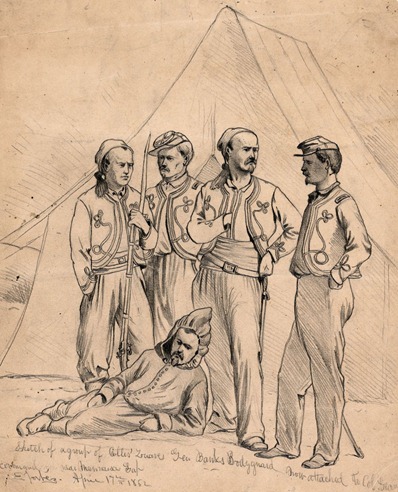
Sketch of a group of Collis' Zouaves--Gen. Banks bodyguard, now attached to Col. Geary command, near Manassas GapSketch of a group of Collis’ Zouaves – Gen. Banks bodyguard, now attached to Col. Geary command, near Manassas Gap.

“Officers & non-commissioned officers of Collis’ Zouaves. General Banks’ bodyguard. Camp Pardee, near Upperville, Va.” on mount.

1862 April 17 by Edwin Forbes.

Morgan collection of Civil War drawings (Library of Congress)

Library of Congress Prints and Photographs Division

This drawing is located here on the Library of Congress website.

April 22.

Your letters of the 13th and 14th came last night as I expected. I passed about as uncomfortable a night as I have seen lately. It had been raining all day, but at night it commenced to pour down, and the water ran through our tent, round it, and under it, and we just had to lie in a puddle of it all night. There was no dodging it; scarcely a dry spot in the tent. To-day I don’t feel very keen, so, if my letter is not interesting, you will see my excuse. You certainly deserve credit for giving me a good long letter. I like to receive such, but, if I don’t mention that I noticed such and such items, charge it to want of space, for this is my second sheet and I can’t get in but three. One thing, however, you made a mistake in, and that was in giving me an inventory of your wardrobe. Haven’t you known me long enough to know that I never can remember what color the ribbon on a bonnet is long enough to get out of church to talk about it? And all those details about the black broadcloth dress trimmed with traveling goods, the para matta cloak, the black satin congress gaiters, the white bonnet with yellow crossbars and flowers and all those things— why, I can hardly remember them now long enough to write them. I have no doubt but you looked well in them though, for you always do.

Well, the Tribune said that Porter’s division made the attack. Did they, and we have been in a battle, have we? To be sure, we led the column, and our brigade the division, but there was not much infantry fighting. Our batteries opened on them at long range and we came up in line of battle to support them. They replied with spirit from their forts and their first shell killed two brave fellows in Follett’s battery, which was planted in the very spot where the rebels had been practicing at target. The firing was heavy on both sides till dark and we lost some eight or ten, and a good many horses. We all expected that Sunday would prove a bloody day, but it was very quiet and the great battle has not come off yet, though there is considerable firing every day and some skirmishes.

April 21st and 22d. It rained nearly all the past two days, so we have been unable to do anything outside of office work. No new developments, but the work of mounting guns and advancing parallels goes on, rain or shine. Towards evening, the weather cleared, and the brigade paraded for inspection.

Joe Howland to Eliza Woolsey Howland.

York River, April 22

Here we still lie awaiting orders, without a word of news and nothing to do. The boat is so crowded and dirty that life is becoming intensely disgusting, yet there does not appear any prospect of getting away. Last night there was heavy firing towards Yorktown and we could see the flashing of the guns; but we do not know what it was.

April 22.—The special committee of the United States Senate made a report to-day on the resolution instructing them to inquire into the allegations of disloyalty made against Senator Starke, of Oregon, whose case had occupied the Senate some time, but resulted in his admission as Senator. The special committee considered the same evidence that was before the Committee on the Judiciary, and also heard Mr. Starke at great length in reply. In this he assumed that he was loyal, and intimated that the committee had better inquire into the character and allegations of his assailants in Oregon. The committee arrived at the following conclusions:

First. That for many months, prior to the twenty-first of November, 1861, and up to that time, Mr. Starke was an ardent advocate of the cause of the rebellious States.

Second. That after the formation of the Constitution of the confederate States, he openly declared his admiration for it, and desired the absorption of the loyal States of the Union into the Southern Confederacy under that Constitution, as the only means of peace, and warmly avowing his sympathy with that cause.

Third. That the Senator from Oregon is disloyal to the Government of the United States.

—The first boat-load of cotton and tobacco from the Tennessee River since the commencement of the rebellion arrived at Pittsburgh, Pa., having left Nashville last week, and will pass over the Pennsylvania Railroad to-day.—N. Y. Evening Post, April 22.

—This day the rebels came out from their rifle-pits in front of Lee’s Mills, Va., killing one of the National pickets. After he was dead about thirty of them fired their pieces into his head, completely riddling it with bullets. The officer then commanding the reserve ordered his men to charge on the rebels, which was willingly responded to, resulting in several of them being killed and one taken prisoner. Two men were killed on the National side and one mortally wounded.—Ohio Statesman, April 25.

—The rebel Congress at Richmond adjourned, to meet again in August. The Richmond Whig says: For fear of accidents on the railroad, the stampeded Congress left in a number of the strongest and newest canal-boats. These boats are drawn by mules of approved sweetness of temper. To protect the stampeders from the snakes and bull-frogs that abound along the line of the canal, Gen. Winder has detailed a regiment of ladies to march in advance of the mules and clear the tow-path of the pirates. The regiment is armed with pop-guns of the longest range. The ladies will accompany the stampeders to a secluded cave in the mountains of Hepsidam, and leave them there in charge of the children of the vicinage, until McClellan thinks proper to lot them come forth. The ladies return to the defence of their country.

—The National steamer Yankee ascended the Rappahannock River this day to Fredericksburgh, Va., having passed the obstructions placed in the river seven miles below the town in safety.—The Potomac flotilla captured seven rebel schooners — one with a valuable cargo of dry goods, medicines, and saltpetre—and also two small steamers. —Baltimore American, April 23.

—This afternoon the National gunboat Anacostia, on her way down the Potomac River, when near Lowry’s Point was fired into by a party of rebel infantry, who were dispersed by a couple of shells from the gunboat — N. Y. Tribune, April 26.

—Col. Donnelly, of Gen. Banks’s forces, made a reconnoissance this day toward Harrisonburgh, Va. When approaching he was fired on by the rebel cavalry scouts. Two companies of the Ohio cavalry were deployed on the left, toward Gordonsville turnpike, the same number of the Vermont cavalry on the right, and the Michigan cavalry on the centre; Hampton’s battery and the Connecticut Fifth formed the reserve.

The rebel cavalry, after the first fire, retreated to the town, where they joined their command, and when escaping by the Gordonsville route, were passed by the Ohio cavalry. Seven men and eleven horses were captured — the rest escaped. The town was then entered and occupied by Col. Donnelly and the cavalry. Jackson’s Winchester hostages, whom he released near Shenandoah, on their parole of honor, were found in the town. Two had died of fatigue and want of attention.—N. Y. Commercial, April 24.
21st.—The ladies are now engaged making sand-bags for the fortifications at Yorktown; every lecture-room in town crowded with them, sewing busily, hopefully, prayerfully. Thousands are wanted. No battle, but heavy skirmishing at Yorktown. Our friend, Colonel McKinney, has fallen at the head of a North Carolina regiment. Fredericksburg has been abandoned to the enemy. Troops passing through towards that point. What does it all portend? We are intensely anxious; our conversation, while busily sewing at St. Paul’s Lecture-Room, is only of war. We hear of so many horrors committed by the enemy in the Valley—houses searched and robbed, horses taken, sheep, cattle, etc., killed and carried off, servants deserting their homes, churches desecrated!