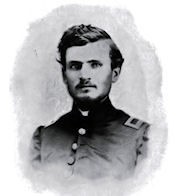
13th. Sunday. In the morning cleared up to my disgust. In the afternoon had my horse shod and visited hospital, very neat and clean. There seems to be so much need of female nurses. Went down and saw Indians (Delawares and Osages) in their savage state—had heavy beads and rings in their ears—wore buckskin leggings and red blankets, faces all painted and marked. Good visit with A. B. N.
April 2012
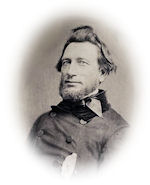
13th.—I have been made very glad by the receipt of a letter this morning from my dear M――. It is older than her letters used to be when they reached me; but whether old or new, her letters never lose their freshness. They are like the beautiful evergreens, standing in mid-winter amid the bare and ragged oaks. When I cannot get a new one I often go back to one of the old, and always read it with pleasure and instruction. But she does ask so many questions for me to answer. * * * *
At Fortress Monroe and at Norfolk lie the Merrimac and the Monitor, in sight of and watching each other, like two dogs with a bone between them, each wanting and neither daring to take it. By the side of the Monitor lies the Mystic, (now named the Galena,) and the little model of Stevens’ battery —all iron-clad. By the side of the Merrimac lie four ironclad gun boats. Either of these miniature fleets, unwatched by the other, could in a few days destroy the whole wooden fleet of the other party, and burn its principal cities. Either one, unwatched by the other, could change the whole aspect of the war, and work a revolution which would shake the world and indelibly stamp its future. For these reasons they do not fight. There is too much at stake for either to venture. Suppose a fight in which the Merrimac should prove successful; the mouth of the James and the York Rivers would be effectually closed to us, our supplies entirely cut off, this army starved out in a week, captured or destroyed, the iron fleet of the enemy free to go where it pleased, and, in twenty days, the destruction of Washington, Philadelphia, New York, Baltimore and Boston, would be as certain as that the enemy should wish to destroy them. The stakes are too large. We dare not risk the wager.

Fort Barnard, Va., Apr. 13, 1862.
There are few military movements around here. A regiment now and then goes up the road. I suppose they think the army is regulated and are now ready to fight. Mr. Wilson was here this afternoon and gave us a short discourse on strong drink and profane language. At dress parade he gave each man a tract. He is out here to take the money of the men home, if we ever get any. Now I must write out some passes and fill out a blank for discharge. Yours truly,
L. B., Jr.
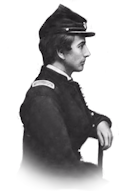
April 13th. Sunday morning. Awoke from an unusually refreshing sleep, jumped into the bath tub (another half barrel) and had a glorious wash, then dressed and went outside to enjoy the magnificent spring morning and sniff the balmy breeze. The weather is so fine now, it makes one impatient of this slow siege, but I suppose we can’t hurry matters any more than we are doing. In the afternoon, the major and I rode out for an airing again; the gray in splendid condition, full of life and anxious to jump every fence and ditch we came across. He is a magnificent little horse; never tires, and is without a fault. I got a great bargain in him, surely.
Heavy fatigue party under Captain Gott returned, and joined the regiment tonight.
 Sunday, April 13.—Enjoyed a very good night’s rest upon some boxes. We all slept below stairs, in the front room— our baggage separating us from the front part of it, which is the clerk’s office, and sleeping apartment of some dozen men. It was a laughable sight to see Father Miller fixing our beds for us. Poor man! He tried so hard to make us comfortable. Some slept on shelves. I slept so soundly that I did not even dream, as I was completely worn out with the labor of the day. I could realize how, after a hard day’s marching or fighting, a soldier can throw himself upon the ground, and sleep as soundly as if he was on a bed of down. A number of persons arrived last night, looking for their relations. One very pretty lady, with her parents, is in search of her husband, a colonel, who is reported badly wounded. I have since heard that she has found him at a farmhouse, and ho is much better off than she had been informed. Her mother, on leaving, presented me with some very nice sperm-candles.
I have just seen my brother. He looks rather the “worse for wear.” But, thank God, he is safe! This was his first battle, and I have been told that “he was brave to a fault.” The company distinguished itself on that eventful day; and Mobile may well be proud of the gallant men who compose it.
I have been told by a friend that the night of the first day’s battle he passed by a wounded Federal, who requested him to bring him some water from a spring near. On going to it, he was much shocked to see three Federals lying with their heads in it. They had dragged themselves to the spring to slake their thirst, and there they had breathed their last. There is no end to the tales of horror related about the battlefield. They fill me with dismay.
“O shame to men! Devil with Devil damn’d
Firm concord holds; men only disagree,
Of creatures rational, though under hope
Of heavenly grace: and, God proclaiming peace,
Yet live in hatred, enmity, and strife
Among themselves, and levy cruel wars,
Wasting the earth, each other to destroy:
As if (which might induce us to accord)
Man has not hellish foes enow besides,
That, day and night, for his destruction wait.”
.
The confusion and want of order are as great as ever. A great many doctors are here, who came with the men from the different regiments. The amount of good done is not near what it might be, if things were better managed. Some one is to blame for this state of affairs. Many say that it is the fault of Dr. Foard, the medical director. But I suppose that allowance must be made for the unexpected number of wounded. I trust that in a little time things will be better.
One of the doctors, named Little, of Alabama, told me to-day that he had left his young wife on his plantation, with more than a hundred negroes upon it, and no white man but the overseer. He had told the negroes, before he left, if they desired to leave, they could do so when they pleased. He was certain that not more than one or two would go.
I have conversed with some of the wounded prisoners. One of them, quite a young man, named Nott, is very talkative. He says that he dislikes Lincoln and abolitionism as much as we do; declares that he is fighting to save the Union, and nothing more. All of them say the same thing. What a glorious Union it would be!
Quite a number of bunks arrived today, and we are having the most severely wounded placed on them. I am so glad, as we can have some of the filth taken off the floors. A doctor requested me to go down stairs and see if there was a bunk with a Federal upon it, and if so have him taken off, as he had a badly wounded man that needed one. I went and asked Mrs. Royal, from Mobile, whom I had heard talk very bitterly. She knew of one, but would not tell me where it was. Her true woman’s nature showed itself, in spite of her dislike. Seeing an enemy wounded and helpless is a different thing from seeing him in health and in power. The first time that I saw one in this condition every feeling of enmity vanished at once. I was curious to find out who the Federal was, and, as Mrs. R. would not tell me, I wont in search of him. I found him with but little trouble; went to the men who were upon the bunks, and asked them where they were from. One, quite a youth, with a childish face, told me that he was from Illinois. I knew in a moment that he was the one. I asked him about his mother, and why he had ever left her. Tears filled his eyes, and his lips quivered so that he was unable to speak. I was deeply moved myself, spoke a few words of comfort, and left him. I would not have had him give up his bunk for the world. Poor child! there will be a terrible day of reckoning for those who sent you on your errand, and who are the cause of desolating so many hearts and homes.
As I was passing one of the rooms, a man called me, and begged me to do something for him and others who were with him. No one had been to see them that morning, and they had had no breakfast. I gave them something to eat, and got a nurse to take care of them. About eight were in the room, among them Mr. Regan of Alabama and Mr. Eli Wasson of Texas, both of whom had lost a leg. I paid these special attention, as they were worse than the others. They were very grateful, and thanked me all the time. Mr. W. said that he knew that he would get well now. They are both unmarried, and talk much of their mothers and sisters, as all men do now. “Home, sweet home,” is the dearest spot on earth to them, since they are deprived of its comforts. Mother, wife, and sister seem to be sweeter to them than any words in the English language.
We eat in the kitchen, surgeons and all. It is not the cleanest place in the world, and I think, to use a Scotch phrase, would make even Mrs. McClarty “think shame.” Hunger is a good antidote for even dirt. I am aware that few will think so except those who have tried it.
 April 13, 1862.—This morning I was sewing up a rent in H.’s garden-coat, when Aunt Judy rushed in.
“Laws! Mis’ L., here’s Mr. Max and Mis’ Annie done come back!” A buggy was coming up with Max, Annie, and Reeney.
“Well, is the war over?” I asked.
“Oh, I got sick!” replied our returned soldier, getting slowly out of the buggy.
He was very thin and pale, and explained that he took a severe cold almost at once, had a mild attack of pneumonia, and the surgeon got him his discharge as unfit for service. He succeeded in reaching Annie, and a few days of good care made him strong enough to travel back home.
“I suppose, H., you’ve heard that Island No. 10 is gone?”
Yes, we heard that much, but Max had the particulars, and an exciting talk followed. At night H. said to me, “G., New Orleans will be the next to go, you’ll see, and I want to get there first; this stagnation here will kill me.”

______
Note: To protect Mrs. Miller’s job as a teacher in New Orleans, the diary was published anonymously, edited by G. W. Cable, names were changed and initials were often used instead of full names — and even the initials differed from the real person’s initials.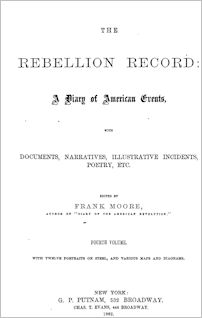
April 13.—The United States steamer Hercules, under the command of Lieut. Thomas S. Dungan, captured the rebel sloop Velma, this day. On searching the vessel there was found a large mail, many of which were addressed to persons in Baltimore, and a larger number to persons in various parts of Maryland. On searching the crew there was also found two thousand dollars in old Virginia Bank notes. The Velma had some time previously been cleared from Baltimore for Pokomoke Sound, Va., with a cargo consisting of provisions of various kinds. This cargo, instead of being discharged in a Maryland port, was taken over to Great Wicomico River and there discharged within the boundaries of Virginia. The sloop in ballast was coming back to get a new cargo. The rebel captain, Samuel D. Lankford, previous to being captured, burned his commission in the fire, the remnants of which being found among the ashes, he acknowledged the fact, and also that he had been engaged in the battle of Manassas, and before he would take the oath of allegiance he would rot in prison.— Baltimore American, April 14.
—In general orders Gen. Halleck thanked the officers and men of the United States army for the heroism displayed in the two days’ battles at Pittsburgh Landing, Tenn.— (Doc. 139.)
—A force of four thousand men on five transports left Pittsburgh Landing, Tenn., last night, accompanied by the gunboats Tyler and Lexington, and proceeded up the Tennessee River to a point near Eastport, Miss., where they landed this morning, and proceeded inland to Bear Creek Bridge, and destroyed the two bridges on the Mobile and Ohio Railroad, one measuring one hundred and twenty-one and the other two hundred and ten feet in length. A cavalry force of one hundred and fifty men was found there, who, after having four killed, made good their retreat The expedition returned to-night, without having lost a man.—National Intelligencer, April 17.
—In Baltimore, Md., at all the Roman Catholic churches, special prayers were recited by order of the Most Reverend Archbishop Kenrick, in accordance with the request of the President of the United States, and were responded to with very general unanimity.—Balt. American, April 14.
—A Gunboat fight took place this day at Needham’s Cut Off, on the Mississippi River, forty-five miles below New-Madrid, Mo., between the National flotilla, under the command of Commodore Foote, and five rebel gunboats, in which the latter were compelled to retire.—Louisville Journal.
—Lieut. Shoemaker, of company H, Fourth Ohio cavalry, on an reconnoitring expedition, this day, with a small body of men, about fifteen miles west of Decatur, Ala., came upon sixteen rebel cavalry, who immediately fled to a swamp and, dismounting, left their horses and plunged into the thicket Ordering his men to dismount, Lieut. Shoemaker followed the rebels on foot, killing one, capturing five, and returning to camp with his prisoners and a dozen extra horses.— Cincinnati Gazette.
—Major-General Halleck, in a despatch to Secretary Stanton, dated Pittsburgh, Tenn., said: “It is the unanimous opinion here that Brig.-Gen. W. T. Sherman saved the fortune of the day on the sixth, and contributed largely to the glorious victory of the seventh. He was in the thickest of the fight on both days, having three horses killed under him, and being wounded twice. I respectfully request that he be made a Major General of volunteers, to date from the sixth instant”
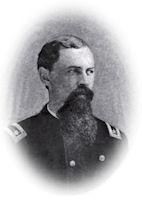
“It will take full 60 boats to hold us all.”–Army Life of an Illinois Soldier, Charles Wright Wills.
Camp New Madrid, Mo., April 12, 1862.
I have the extreme happiness to inform you that there is at last a hope of my dating the next letter from Memphis or vicinity. Our regiment has for several days been alone at Point Pleasant and we enjoyed it very much. When we are under a general of an infantry division we are run to death or thereabouts, for whenever anything is to be done the cavalry is sure to be called on. Yesterday we were ordered to report here immediately to General Granger, commanding cavalry division which numbers full 4,000. There are two brigades in this division; Colonel Kellogg commands the 1st brigade and therefore is now a brigadier general. There have been about 25 steamboats arrived here since 4 p.m. yesterday and the army will probably commence embarking to-day. It will take full 60 boats to hold us all. The rain has been falling in torrents ever since we started from the Point yesterday, and you can imagine the time we had pitching tents in a cornfield, and yet we are comfortable now as we can wish. I have faith to believe that they (or anybody else) can’t keep me from being comfortable under any circumstances, if my hands are loose and I can walk. I think that Pope’s hurry is caused by his fear that Grant and company will reach Memphis before him. We hardly think that the Rebels will make a stand at Pillow, Randolph or Memphis if the news from Corinth is correct. I’m almost afraid to look over the list of dead that fight was made. Sid. says he is sure Billy Stockdale is killed. We received papers of the 10th last night but are not sure the victory is a complete one yet. I can’t think of the point where the enemy will make another stand if they are perfectly whipped at Corinth.
I know as many people here as in Fulton, almost, and I have yet to hear the first insulting speech or word to me. “What are they going to do with Island No. 10 I wonder; I am afraid that Commander Foote and his gunboats are a humbug.” Aren’t you ashamed of that speech? Damn the New York Tribune. I do believe in McClellan and nearly all the rest of our leaders. If those Tribunes, big and little, were where any regiment in this army could get at them they wouldn’t stand fifteen minutes. McClellan knows his business and we don’t know a thing about it. Now old Pope here is as mean a man as ever lived, curses every man that comes within a hundred yards of him and nobody knows a thing of his designs, but we all have the utmost confidence in him. I’ve never seen him and wouldn’t go in sight of him for a horse, but he’s my man for a’ that.
Orders have just arrived for embarking this p.m. Will be under way down the river to-night. Wish us a pleasant voyage.
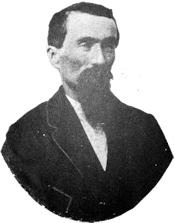
April 12 — Went on picket. After we were at our picket a while, which is on the Valley pike a mile from Edenburg, Colonel Ashby came riding from some of his places of observation up the creek and said to Captain Chew: ” I want you to take a gun up the creek about half a mile,— I will show you where I mean,— and fire five shell in as little time as possible into an infantry camp of the enemy’s. Get your five shell ready, and as quick as you fire them, retire.”
We proceeded to the place indicated by Colonel Ashby. It was an open field from which we plainly saw, half a mile away, a Yankee camp of infantry that was to be stirred up. We did it effectively and in double-quick time. When we went in position there was a band playing in an old barn that stood in the camp. Our first greeting shell cruelly cut the music short off, to be concluded, I suppose, at a healthier and more convenient season. After we fired the five shell and started away a Yankee battery opened fire on us and gave us a few parting shell for spoiling their band music and making their infantry go through with the intricate evolutions of a sure enough war dance.

APRIL 12TH.—The committee (Congressional) which have been investigating the Roanoke Island disaster have come to the conclusion, unanimously, and the House has voted accordingly, and with unanimity, that the blame and guilt of that great calamity rest solely upon “Gen. Huger and Judah P. Benjamin.”


