Saturday, 12th—It is still raining every hour and the floors of our tents are very wet.1 Our camp has become very muddy, which, with constant rain and the braying of mules day and night, makes it a very gloomy time.
April 2012
Camp Hayes, Raleigh, Virginia, April 12, 1862. Saturday. — Windy, cold, and cloudy — another storm impending. Cleared up towards noon. Had two good drills. A first-rate ride,— new horse getting up to it.
Further news confirms the victory at Pittsburg or Corinth. The first day, last Sunday, our men [were] surprised and badly whipped; the second day, the fresh troops redeemed the day and gained a great victory. Island Number 10, a most important capture; now said to have taken six thousand prisoners.
Nothing as to our future movements. Perhaps we are waiting to see what effect these victories will have. — Blowing up a storm again.
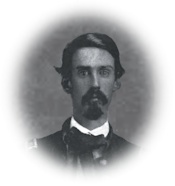
(To Horace Barnard)
Beaufort, S. C. April 12th, 1862.
I hardly know how, writing from peaceful Beaufort, I can find themes so exciting as to gratify the tastes of the public, used to tales of victories purchased at bloody rates; yet the importance of the work now quietly being wrought at Beaufort must not be underrated.
Here too, as well as on the splendid fields of the West, the spirit of John Brown is marching on. Toward the close of last autumn our troops entered Beaufort, then deserted by its inhabitants, and looking sad and desolate. Now the winter has passed away and the spring is far advanced. Nature has put on her most lovable hues. The dense dark foliage of the pine and the magnolia harmoniously mingle with the bright new leaves of the forest. The streets of the city are once more busy with life. Vessels float in the harbor. Plantations are being cultivated. Wharves are being built. Business is prosperous. And the quondam proud resort of the proudest of Aristocrats is being inundated with Yankees acquainted with low details regarding Dollars and Cents. There are all sorts of Yankee ventures in town, from the man with the patent armor recommended by McClellan, which no one buys, to the enterprising individual who manufactures pies in the old Connecticut style, and who has laid the foundation of an immense fortune. Even the “one only man of Beaufort,” catching the spirit of trade, displays a few dingy wares in a shop-window. “But why,” the impatient public asks, “is our Army so far away from Savannah?” “Strategy, my dear public,” I answer. Can anything be more beautiful than the strategy of our Leaders, which strips war of its terrors and makes it so eminently safe? Tell me, if Mars chooses to beat his sword into a ploughshare, and devote himself to the cultivation of sea-island cotton, and invites live Yankees to assist him therein, ought not the satire of the thing to please the restless spirit of John Brown and excite it to renewed efforts in its great performance of marching on? Now there is no doubt that our Army ought long ago to have been in possession of both Charleston and Savannah. Common sense teaches us that much, although we know nothing whatever of military affairs forsooth, and still less of the peculiar circumstances which happen to govern the action of our Generals. Well, when we see matters in this condition, common sense teaches us that the proper remedy is to decapitate incompetency, and to put the “right man in the right place.” The proper time for doing this is when, after long and earnest labor, a Commander is seen to be ready to strike a blow. Then is the moment to clamor loudly for his dismissal, and insist that another be put in his place, and when this one shall reap the harvest his predecessor sowed, we will all nod our heads approvingly at such evidence of our own ineffable wisdom. This is decidedly the most pleasant mode of proceeding for a public unacquainted with military matters but governed by common sense, and it is so satisfactory to all parties concerned, excepting perhaps the poor devil that gets decapitated. This, however, is a digression, intended possibly as a sort of “hæc fabula docet” derived from the recent capture of Pulaski. So, to return —
Oh, darn it all, my dear Horace, I’ll send the subscription price of the Evening Post without further delay. Here I’ve been floundering around, using up whole reams of paper trying to work up a newspaper style, but I have only succeeded in getting together a vast amount of material to kindle fires with. I thought I was doing beautifully when I commenced this, but, becoming disgusted with myself, I have concluded to give you the benefit of the production and spare the public. Thanks many times for your long, kind letter. You don’t know how enjoyable it was. It has got to be late at night and soldiers must rise early you know. I have just been reading over this epistle and see that I have been making a feeble effort to be funny. Prithee forgive me. I didn’t mean to. Give my love to Cousin Lou, Miss Hattie, Anima Mia, Miss Alice (if it be proper), and friends upon Murray Hill.
Very affec’y.,
Will Lusk.
12th.—Am not well to-day. Have diarrhœa, and at midday had high fever. How much I miss the tender care of my family in sickness. Am much better to-night, but feel sad. Have been reading Ernest Linwood, and, by contrast, it has recalled pleasant family scenes, which I miss in my sickness. I wish I had not written my last letter to my family. I felt badly when I wrote it, and spoke harshly of officers. ‘Twas wrong, but I cannot recall it. Oh, if every thought is a material thing, an entity, and goes forth to make a part of the great mental and moral atmosphere, how is it possible that, with the great preponderance of evil imaginations there can be moral or mental advancement? We should be as careful of our thoughts as of our acts.
Since the sailing of the great expedition from Annapolis, Francis Bacon had been on active duty with the troops on the coast of South Carolina and Georgia, and at the reduction of the two forts at Port Royal, and of Fort Pulaski, April 11th. At the siege of the latter he was on duty with the battery nearest the fort, and was requested by General Gilmore to keep an account of the shots fired from our batteries and from the rebel guns within the fort. Here he stood in a scarlet-lined cloak with Gilmore’s long, shining, double-barrelled field-glass in his hand for two days,—a fine mark for the enemy. After the fight he went about the fort with the rebel officer who surrendered it, and who said, as they came to a big gun, “I commanded here, and sent a large number of shots at a man who stood at the corner of that cistern, and wore a cloak, and had some long shining thing in his hand. I wonder if I hit him!”

General Franklin’s wife to Eliza.
April 12.
My dear Mrs. Howland: Last night (late) I was informed as a great secret that General Franklin’s Division was to go to General McClellan after all! I was wondering when I awoke this morning if I might not go and tell you. . . . General Meigs was one of the authorities given for the truth of the report—so I think we may believe the good news. . . .
I have a favor to ask, which is, if you decide to go down to Alexandria to try and see your husband on his way through, will you let me know? as I would like very much to go too.
I feel as if it would be a great comfort to see them before they start South.
Love to your mother and sisters. It is truly a mercy from above to have the Division relieved from the false position they were placed in, and now we have only to pray for their safety.
Yours aff’ly,
Anna L. Franklin.
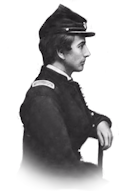
April 12th. Another delightful morning: Continuous streams of troops still arriving and marching to the front. Stores and guns too, are landing now, and the siege train is getting ready for its terrible work.
Detailed four hundred and fifty men for fatigue duty in the trenches before Yorktown, with Captain La Valley to command them. They greatly enjoyed the change from road building to making forts, all hoping to get a view of the enemy. Enjoyed myself immensely to-day, having entirely recovered my health. In the afternoon, Major Parisen and I rode out to see the country, and on our way stopped at one of the two houses in the neighborhood. We found an old lady and a young one, who were both glad to have some one to talk to. The girl told us her lover was in the rebel army, as was every other young man belonging in that part of the country, and she hoped they would soon drive us all away. She seemed to have no doubt of their ability to do this, thinking them much better soldiers than we are. We gathered from what they said, that they have had communication with some of the rebels, their friends, since we landed, which would be an easy matter in this thickly wooded country at night.
April 12th.
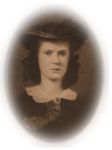 Day before yesterday, just about this time of evening, as I came home from the graveyard, Jimmy unexpectedly came in. Ever since the 12th of February he has been waiting on the Yankees’ pleasure, in the Mississippi, at all places below Columbus, and having been under fire for thirteen days at Tiptonville, Island No. 10 having surrendered Monday night; and Commodore Hollins thinking it high time to take possession of the ironclad ram at New Orleans, and give them a small party below the forts, he carried off his little aide from the McRae Tuesday morning, and left him here Thursday evening, to our infinite delight, for we felt as though we would never again see our dear little Jimmy. He has grown so tall, and stout, that it is really astonishing, considering the short time he has been away. . . . To our great distress, he jumped up from dinner, and declared he must go to the city on the very next boat. Commodore Hollins would need him, he must be at his post, etc., and in twenty minutes he was off, the rascal, before we could believe he had been here at all. There is something in his eye that reminds me of Harry, and tells me that, like Hal, he will die young.
And these days that are going by remind me of Hal, too. I am walking in our footsteps of last year. The eighth was the day we gave him a party, on his return home. I see him so distinctly standing near the pier table, talking to Mr. Sparks, whom he had met only that morning, and who, three weeks after, had Harry’s blood upon his hands. He is a murderer now, without aim or object in life, as before; with only one desire — to die — and death still flees from him, and he Dares not rid himself of life.
All those dancing there that night have undergone trial and affliction since. Father is dead, and Harry. Mr. Trezevant lies at Corinth with his skull fractured by a bullet; every young man there has been in at least one battle since, and every woman has cried over her son, brother, or sweetheart, going away to the wars, or lying sick and wounded. And yet we danced that night, and never thought of bloodshed! The week before Louisiana seceded, Jack Wheat stayed with us, and we all liked him so much, and he thought so much of us; — and last week — a week ago to-day — he was killed on the battle-field of Shiloh.
 April 12.—I sat up all night, bathing the men’s wounds, and giving them water. Every one attending to them seemed completely worn out. Some of the doctors told me that they had scarcely slept since the battle. As far as I have seen, the surgeons are very kind to the wounded, and nurse as well as doctor them.
The men are lying all over the house, on their blankets, just as they were brought from the battle-field. They are in the hall, on the gallery, and crowded into very small rooms. The foul air from this mass of human beings at first made me giddy and sick, but I soon got over it. We have to walk, and when we give the men any thing kneel, in blood and water; but we think nothing of it at all. There was much suffering among the patients last night; one old man groaned all the time. He was about sixty years of age, and had lost a leg. He lived near Corinth, and had come there the morning of the battle to see his two sons, who were in the army, and he could not resist shouldering his musket and going into the fight. I comforted him as well as I could. He is a religious man, and prayed nearly all night.
Another, a very young man, was wounded in the leg and through the lungs, had a most excruciating cough, and seemed to suffer awfully. One fine-looking man had a dreadful wound in the shoulder. Every time I bathed it he thanked me, and seemed grateful. He died this morning before breakfast. Men who were in the room with him told me that he prayed all night. I trust that he is now at rest, far from this dreary world of strife and bloodshed. I could fill whole pages with descriptions of the scenes before me.
Other ladies have their special patients, whom they never leave. One of them, from Natchez, Miss., has been constantly by a young man, badly wounded, ever since she came here, and the doctors say that she has been the means of saving his life. Many of the others are doing the same. Mrs. Ogden and the Mobile ladies are below stairs. I have not even time to speak to them. Mr. Miller is doing much good; he is comforting the suffering and dying, and has already baptized some.
This morning, when passing the front door, a man asked me if I had any thing to eat, which I could give to some men at the depot awaiting transportation on the cars. He said that they had eaten nothing for some days. Some of the ladies assisting me, we took them hot coffee, bread, and meat. The poor fellows ate eagerly, and seemed so thankful. One of the men, who was taking care of them, asked me where I was from. When I replied Mobile, he said that Mobile was the best place in the Confederacy. He was a member of the Twenty-first Alabama Regiment; I have forgotten his name. I have been busy all day, and can scarcely tell what I have been doing; I have not taken time even to eat, and certainly not time to sit down. There seems to be no order. All do as they please. We have men for nurses, and the doctors complain very much at the manner in which they are appointed; they are detailed from the different regiments, like guards. We have a new set every few hours. I can not see how it is possible for them to take proper care of the men, as nursing is a thing that has to be learned, and we should select our best men for it—the best, not physically, but morally—as I am certain that none but good, conscientious persons will ever do justice to the patients
April 12.—The Nineteenth Regiment of South Carolina volunteer State troops, reached Augusta, Ga., to-day, on their way to the West. After reaching the Georgia Railroad depot, a large number of them—variously stated at one to three hundred—refused to proceed further, alleging that they were enlisted to serve the State of South Carolina, and were willing to fight in her defence, but that they would not go out of the State. Some declared that they would have gone if they had been consulted before starting, but that their officers had not notified them that they were to leave the State. Others had furloughs, and desired to see their families. The officers urged in vain the stigma that would rest upon them for refusing to go where their country most needed their services, and the reproach they would bring upon the State of South-Carolina, which had been foremost in the work of resistance. Their appeals were unavailing, and the malcontents returned to the Carolina depot Some of the officers telegraphed to Adjt-Gen. Gist for instructions, and that his reply was: “Arrest them— they are deserters of the worst character.” Gen. Ripley sent similar instructions. About thirty of the mutinists belonged to the command of Capt Gregg, Graniteville. He was proceeding to execute the order of Gen. Gist, when many of his men and others that refused to go on in the morning, took the evening train which conveyed the Tenth regiment, Col. Manigault.
“We deem it proper to make this statement of the facts of this unfortunate affair,” says the Constitutionalist, “leaving the press and public sentiment of South-Carolina to assign the proper position to all parties concerned. It was at best a melancholy spectacle to see the sons of our gallant sister State turning their backs upon the region threatened by the invader’s tread, and if there is any circumstance to palliate their conduct which we have not stated, we shall be glad to make it public.”—Augusta Constitutionalist, April 13.
—Lowry’s Point batteries on the Rappahannock River, Va., were evacuated by the rebels this day.—New-York Commercial, April 18.
—The Nassau (N. P.) Guardian of this day contains a “complete list” of all the arrivals at that place from confederate ports since the commencement of the National blockade. “It is not with the view of expatiating on the effectiveness of the blockade,” says the Guardian, “that we have compiled this table, but to show to our merchants the importance of the trade that has recently grown up, and which, if properly fostered, may attain much wider proportions. The majority of the vessels mentioned have again run the blockade into confederate ports, but of these we need not present a record.
“It is a notable circumstance that the arrivals from the Southern States are far more numerous than those from the North, with which our intercourse is free and unrestrained.”—(Doc. 131.)
—At Fort Pulaski, Ga., this day, the following general order was issued by command of Major-Gen. David Hunter, U.S.A.:
“All persons of color lately held to involuntary service by enemies of the United States, in Fort Pulaski and on Cockspur Island, Ga., are hereby confiscated and declared free, in conformity with law, and shall hereafter receive the fruits of their own labor. Such of said persons of color as are able-bodied, and may be required, shall be employed in the Quartermaster’s Department, at the rate heretofore established by Brig.-Gen. W. T. Sherman.”
Gen. Hunter also addressed to Mr. Pierce, the Treasury Agent in charge of the Sea Island plantations, a letter asking for “the names of the former owners, and the number of persons formerly held to involuntary service,” in charge of the Government agents. On receiving this information, it is the intention of Gen. Hunter to afford said owners a reasonable time to prove their fealty to the Government, and then in case of their failure to do so, and upon sufficient proof of their treason, he will at once restore these slaves to freedom.—Cincinnati Gazette, April 23.
—Pocahontas, Ark., was taken possession of by a body of Indiana cavalry, under the command of Capt. G. P. Deweese.— (Doc. 137.)
—This morning two expeditions were started from Huntsville, Ala., in the cars captured by Gen. Mitchel yesterday. One under Col. Sill, of the Thirty-third Ohio, went east to Stevens, the junction of the Chattanooga with the Memphis and Charleston Railroads, at which point they seized two thousand of the enemy, who were retreating, without firing a shot, and captured five locomotives and a large amount of rolling stock.
The other expedition, under Col. Turchin, of the Nineteenth Illinois regiment, went west, and arrived at Decatur in time to save the railroad bridge, which was in flames. General Mitchell now holds a hundred miles of the Memphis and Charleston Railroad.—Philadelphia Press, April 15.
—Commodore Foote, with the Western flotilla and mortar-boats, en route for Fort Pillow, left New-Madrid, Mo., accompanied by a large body of National troops.—New-York World, April 16.
—Four companies of the Connecticut Eighth Regiment had a skirmish this day with a force of rebels of one hundred and fifty men that made a sortie from Fort Macon, the rebels driving in the Union pickets. After a sharp engagement the rebels were driven back to the Fort. Capt. Schaffer and one private of company II, of the Eighth Connecticut, were severely wounded.
The rebels were seen to take four of their men into the Fort, one of them supposed dead. During the engagement Fort Macon fired seventy shots at the engaging forces.—New- York Herald.
—This day a party of Union soldiers sent from Kansas City in search of Quantrel’s band of outlaws, came upon them near the Little Blue River, in Jackson County, Mo., and after a hard fight, succeeded in killing five, and capturing seventeen of them. Quantrel had his horse shot from under him, and made his escape by swimming the Missouri River.—St. Louis News, April 17.
—Brig.-Gen. Shields, at Woodstock, Va., issued the following general order: “The General commanding the division directs that the special thanks of himself and command be tendered to Capt Ambrose Thompson, Division Quartermaster, for the energy, industry, and efficiency with which he has conducted the affairs of his Department previous to and during the battle of Winchester, and in his untiring and successful efforts since to employ every means which judgment and activity could devise to furnish this division with every thing required to render it efficient in the field. This order will be published to the command as an assurance of our appreciation of his ability, and a copy of the same will be furnished Capt. Ambrose Thompson.”
—The United States revenue steamer Reliance arrived at Baltimore, Md., this morning, with four prize vessels — the schooners Hartford, Bride, Whig and Two Brothers—all captured in Wicomico River, between the mouths of the Potomac and Rappahannock Rivers, Va. They had all been landing coffee, salt, flour, flannel and whiskey for the rebels.—New-York Herald, April 13.
—Near Monterey, Va., the rebels about one thousand strong, with cavalry companies and two pieces of artillery, attacked the National pickets this morning about ten o’clock, and drove them some two miles. Gen. Milroy sent out reenforcements consisting of two companies of the Seventy-fifth Ohio, two companies of the Second Virginia, two companies of the Thirty-second Ohio, one gun of Capt. Hyman’s battery, and one company of cavalry, all under Major Webster. The skirmishing was brisk for a short time, but the rebels were put to flight with considerable loss. The casualties on the National side were three men of the Seventy-fifth badly wounded. The men behaved nobly.—Gen. Milroy’s Despatch.

11th.—The “Virginia” went out again to-day. The Federal Monitor would not meet her, but ran to Fortress Monroe, either for protection, or to tempt her under the heavy guns of the fortress; but she contented herself by taking three brigs and one schooner, and carrying them to Norfolk, with their cargoes. Soldiers are constantly passing through town. Every thing seems to be in preparation for the great battle which is anticipated on the Peninsula.
Fort Pulaski has surrendered to the enemy’s gun-boats. The garrison fought until several breaches were made. They then surrendered, and are now prisoners. Lord, have them in thy holy keeping!


