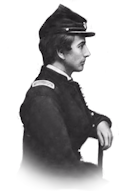
April 11th. After much rain, the weather has become fine, and to-day is perfect. All our energies are bent upon road building, while the troops still arriving are mostly sent to the front, to invest historic Yorktown. I have been unwell during the last two days, but got through with a good deal of work; made field returns, and quarterly returns of deceased soldiers; in the evening felt something better.
April 2012
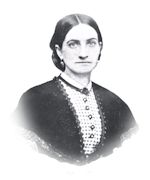 April 11.—Miss Booth and myself arrived at Corinth to-day. It was raining when we left Mrs. Henderson’s, and as her carriage was out of repair, she sent us to the depot in an open wagon. We enjoyed the novel ride, and began to feel that we were in the service in reality. My heart beat high with expectation as we neared Corinth. As I had never been where there was a large army, and had never seen a wounded man, except in the cars, as they passed, I could not help feeling a little nervous at the prospect of now seeing both. When within a few miles of the place, we could realize the condition of an army immediately after a battle. As it had been raining for days, water and mud abounded. Here and there were wagons hopelessly left to their fate, and men on horseback trying to wade through it. As far as the eye could reach, in the midst of all this slop and mud, the white tents of our brave army could be seen through the trees, making a picture suggestive of any thing but comfort. My thoughts wandered back to the days of ancient Corinth, and the time it was besieged by the brave and warlike Romans, when the heroic Greeks had to succumb through the fault of their commander. I think of this only in contrast; for the Federals are as unlike the former as our fate will be unlike that of the latter. We have not a Diæus commanding, but the dauntless Beauregard and patriotic Bragg, who, knowing their rights, dare and will maintain them, though the whole North be arrayed against them. I am certain of one thing: that neither the Roman nor Greek armies, brave as history has portrayed them, were composed of more high-souled and determined men than those of ours.
Corinth is at the junction of the Memphis and Charleston and the Mobile and Ohio Railroads, about one hundred and twenty miles east from Memphis, and three hundred miles north from Mobile.
The crowd of men at the depot was so great that we found it impossible to get to our place of destination by ourselves. Mr. Miller was not there to meet us. I met Mr. George Redwood of Mobile, who kindly offered to pilot us. We found Mr. Miller and all the ladies busy in attending to the wants of those around them. They had not been assigned to any particular place, but there is plenty for them to do. We are at the Tishomingo Hotel, which, like every other large building, has been taken for a hospital. The yellow flag is flying from the top of each. Mrs. Ogden tried to prepare me for the scenes which I should witness upon entering the wards. But alas! nothing that I had overheard or read had given me the faintest idea of the horrors witnessed here. I do not think that words are in our vocabulary expressive enough to present to the mind the realities of that sad scene. Certainly, none of the glories of the war were presented here. But I must not say that; for if uncomplaining endurance is glory, we had plenty of it. If it is that which makes the hero, here they were by scores. Gray-haired men—men in the pride of manhood—beardless boys—Federals and all, mutilated in every imaginable way, lying on the floor, just as they were taken from the battle-field; so close together that it was almost impossible to walk without stepping on them. I could not command my feelings enough to speak, but thoughts crowded upon me. O, if the authors of this cruel and unnatural war could but see what I saw there, they would try and put a stop to it! To think, that it is man who is working all this woe upon his follow-man. What can be in the minds of our enemies, who are now arrayed against us, who have never harmed them in any way; but simply claim our own, and nothing more! May God forgive them, for surely they know not what they do.
This was no time for recrimination; there was work to do; so I went at it to do what I could. If I were to live a hundred years, I should never forget the poor sufferers’ gratitude; for every little thing, done for them—a little water to drink, or the bathing of their wounds—seemed to afford them the greatest relief.
The Federal prisoners are receiving the same attention as our own men; they are lying side by side. Many are just being brought in from the battle-field. The roads are so bad that it is almost impossible to get them moved at all. A great many ladies are below stairs: so I thought that I had better assist above. The first thing which I did was to aid in giving the men their supper, consisting of bread, biscuit, and butter, and tea and coffee, without milk. There were neither waiters nor plates; they took what we gave them in their hands, and were glad to get it. I went with a lady to give some Federal officers their supper, who were in a room by themselves; only one or two of them were wounded. One, a captain from Cincinnati, had a broken arm. Before I went in, I thought that I would be polite, and say as little as possible to them; but when I saw them laughing, and apparently indifferent to the woe which they had been instrumental in bringing upon us, I could not help being indignant; and when one of them told me he was from Iowa, and that was generally called out of the world, I told him that was where I wished him, and all like him, so that they might not trouble us any more.
April 11.—Fort Pulaski surrendered to the National arms. Yesterday morning the preparations for its bombardment, under Brig.-Gen. Gilmore, were completed, and a communication under a flag of truce was forwarded to Col. Olmstead, the commander of Fort Pulaski, demanding the unconditional surrender of the place. To this Col. Olmstead replied in a very gentlemanly and witty note, stating that he was placed there “to defend, not to surrender the Fort.” Upon receipt of this, the batteries on Tybee opened fire. After firing a few rounds from the several batteries, a chance shot carried away the halliards on Pulaski, and the confederate flag fell to the earth. At this point the fire slackened, the Nationals not knowing but that the occupants of the Fort had concluded to succumb. Presently, instead of the white flag, the stars and bars were once more seen waving from a temporary flag-staff on the parapet. The batteries on Tybee recommenced with redoubled vigor, and the firing continued without cessation during the remainder of the day. Toward night, Gen. Gilmore being satisfied, from the effects of the Parrott guns and James’s projectiles during the day, of the practicability of breaching the Fort, again slackened the firing, in order to make arrangements for the planting of more guns at the Goat Point batteries, that point being the nearest to Pulaski, distance one thousand six hundred and eighty-five yards. From sunset till twelve o’clock, midnight, no firing was heard; from then until daylight an occasional shot was fired, and this morning two small breaches were visible at the distance of two miles, on the south-east face of the Fort. By twelve o’clock M., these, under the heavy and well-directed firing from the Goat Point batteries, had assumed most wonderful proportions, and at eighteen minutes past two P.m., the confederate flag was hauled down and a white flag displayed. A boat was then sent to Pulaski, and a surrender of the Fort was made. Col. Olmstead stated that it was impossible to hold out any longer, as the rifle shots were fast working their way into the magazines, and a goodly number of his guns were disabled, and ha was therefore compelled to comply with General Hunter’s demand; accordingly, the Seventh Connecticut, colonel Terry, was thrown into the Fort, and the munitions of war, provisions, etc., were turned over to the credit of the Union. Union loss—one killed and one wounded slightly. Confederate loss—three wounded. Amputation necessary, and performed in each case. Prisoners, three hundred and eighty-five, including officers. —(Doc. 126.)
—The Bill to emancipate slaves in the District of Columbia was passed by the House of Representatives of the United States. During the debate upon it, John J. Crittenden, of Kentucky, made a powerful speech, entering, in the name of his constituents, a protest not only against the bill, but against any measure calculated to agitate the question of slavery.
—Lieut. J. G. Baker, U.S.N., with an armed crew, on board the rebel prize schooner Bride, captured the rebel sloop Wren, at Shark’s Point, Va., after a chase of over two hours. The crew escaped.—Baltimore American, April 14.
—Huntsville,[1] Alabama, was this day occupied by the National forces under the command of Gen. Mitchel, without much resistance. Gen. Mitchcl’s official despatch says: “After a forced march of incredible difficulty, leaving Fayetteville yesterday at twelve, noon, my advanced guard, consisting of Turchin’s Brigade, Kennett’s cavalry, and Simonson’s battery, entered Huntsville this morning at six o’clock. The city was completely taken by surprise, no one having considered the march practicable in the time. We have captured about two hundred prisoners, fifteen locomotives, a large amount of passenger and box-platform cars, the telegraph apparatus and office, and two Southern mails. We have, at last, succeeded in cutting the great artery of railway communication between the Southern States.”—(Doc. 129.)
—The Adams Army Express carried away from Newbern, N. C, four hundred and thirty thousand dollars, the contributions of Burnside’s soldiers to their families at the North.—Newbern Progress, April 11.
—The Nashville (Tenn.) Union of this date has the following: “For several days the office of Governor Johnson, in the capital, has been thronged with secession men and women from the city and adjacent country, earnestly interceding for their sons who have been or are now in the rebel army, and expressing the utmost willingness and even anxiety to take the oath of allegiance to the good old Government, and faithfully discharge the duties of law-abiding and loyal citizens. Some of these distressed parents, for whom we feel the deepest sympathy, say that their sons were virtually forced into the rebel service by taunts and menaces, others that their pride led them to volunteer lest they should be subjected to the degradation of the draft, and others from various malign influences so hard to be resisted by the thoughtless adventurers and ambitious young men. Many instances of the most affecting nature could be adduced, but we forbear to intrude upon the sanctity of private grief
“The improvement in the state of the public mind is most gratifying, and will be hailed with rapture by every patriotic heart. The work of restoration progresses most cheeringly. The spell of treason is broken, and the demon of enchantment lies powerless at the feet of our country’s genius.”
—The rebel iron-clad steamer Merrimac made her second appearance in Hampton Roads, Va., this day, in company with six smaller vessels, two of which were the Jamestown and Yorktown. After manœuvring in the Roads, and capturing three small vessels belonging to Unionists, the rebel fleet returned to Elizabeth River.—(Doc. 130.)
—The Secretary of War makes public acknowledgment to the Governors of Massachusetts, Indiana, and Ohio, and the Board of Trade of Pittsburgh, Pa., for their prompt offers of assistance for the relief of the officers and soldiers wounded in the late great battle on Tennessee River. Their offers have been accepted. It is understood that similarly humane and patriotic service has been rendered by other city and State authorities, and which have not been reported to the department, but are thankfully acknowledged. — War Order.
—To-day, while the Twelfth New-York volunteers, in command of Major Barnum, were on picket-duty in front of the enemy’s works near York River, Va., a regiment of rebels came out from under cover and advanced in line of battle. The Major rallied about three hundred of his men to receive them at musket-range, pouring in a deadly fire of Minie-balls, when the enemy retired, leaving behind their dead and wounded, which they afterwards removed in ambulances. Later in the day the rebels advanced in considerable force from another point, drove in the National pickets, and burnt a dwelling used by the Federal troops. During both these skirmishes the Unionists had three men slightly wounded.
The Fifty-seventh and Sixty-third Pennsylvania regiments had also a brisk skirmish with the rebels near Yorktown, Va., in which we had two men killed and four wounded. The killed were E. Cross and James Thompson, company A, Sixty-third Pennsylvania regiment The wounded are Thomas Brooks, company C, Sixty-third regiment; D. R Lynch, company E, Sixty-third regiment; Sergt. Samuel Merunie, company E, Fifty-seventh regiment, and John Cochrane, company F, same regiment—Baltimore American, April 14.
—Grave complaints against Assistant-Surgeons Hewitt and Skipp having reached the War Department, they were suspended from duty, and ordered to report themselves. A negligent or inhuman surgeon is regarded by the department as an enemy of his country and of his race, and will be dealt with according to the utmost rigor of military law.—Secretary Stanton’s Order.
[1] Huntsville is the shire town of Madison County, Alabama. It is on the Memphis and Charleston Railroad, one hundred and fifty miles north north-east from Tuscaloosa, and one hundred and sixteen miles in a southerly direction from Nashville. The town contains many handsome buildings, and a court-house which cost forty-five thousand dollars, and a bank building which, cost eighty thousand dollars. The town contains six churches, a federal land office, three newspaper offices, and two female seminaries. It is in the midst of a fine farming region, and among the south-western spurs of the Alleghany range.
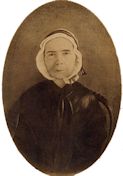
10th.—Spent yesterday in the hospital by the bedside of Nathan Newton, our little Alabamian. I closed his eyes last night at ten o’clock, after an illness of six weeks. His body, by his own request, will be sent to his mother. Poor little boy! He was but fifteen, and should never have left his home. It was sad to pack his knapsack, with his little gray suit, and coloured shirts, so neatly stitched by his poor mother, of whom he so often spoke, calling to us in delirium, “Mother, mother,” or, “Mother, come here.” He so often called me mother, that I said to him one day, when his mind was clear, “Nathan, do I look like your mother?” “No, ma’am, not a bit; nobody is like my mother.” The packing of his little knapsack reminds me of

THE JACKET OF GRAY.

Tenderly touch it, look on it with pride,
For dear must it be to our hearts evermore,
The jacket of gray, our loved soldier-boy wore.
Who rose in defence of our dear Southern land,
And in his bright youth hurried on to the fray—
How proudly he donned it, the jacket of gray?
Commending to Heaven the child of her love;
What anguish was hers, mortal tongue may not say,
When he passed from her sight in his jacket of gray.
Though costly the sacrifice placed on its shrine;
Her heart’s dearest hopes on the altar she lay,
When she sent out her boy in his jacket of gray.
Unsheathed was the sword, and lighted the brand;
We heard in the distance the sound of the fray,
And prayed for our boy in the jacket of gray.
The glad shout of victory rang in our ears;
But our treasured one on the battle-field lay,
While the life-blood oozed out on the jacket of gray.
Tenderly touch it, look on it with pride,
For dear must it be to our hearts evermore,
The jacket of gray our loved soldier-boy wore.
The cold lifeless form to his home by the shore:
Oh, dark were our hearts on that terrible day
When we saw our dead boy in the jacket of gray.
Was the garment which once he so proudly wore;
We bitterly wept as we took it away,
And replaced with death’s white robes the jacket of gray.
And ‘graved on the marble we placed o’er his head,
As the proudest of tributes our sad hearts could pay,
He never disgraced the poor jacket of gray.
Tenderly touch it, look on it with pride,
For dear must it be to our hearts evermore,
The jacket of gray our loved soldier-boy wore.
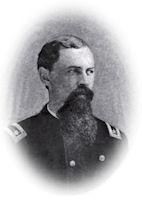
April 10.—The Rebels have run and left Island 10, and our boys have taken some 2,000 of them prisoners below here. They passed up on a boat this morning. We will be paid off to-day or to-morrow.
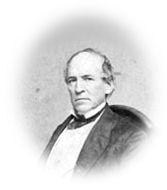
Thursday 10th
The weather is more settled today. Nothing in particular has occured. We are getting more of the particulars of the great Battle at Pittsburgh Landing, it was the most desperate fight of the War so far. There is nothing from Yorktown, to which all eyes are now turned. Both parties are in great force there. There must be another desperate encounter there. Our troops are flushed with Victory. The rebels are desperate.
______
The three diary manuscript volumes, Washington during the Civil War: The Diary of Horatio Nelson Taft, 1861-1865, are available online at The Library of Congress.
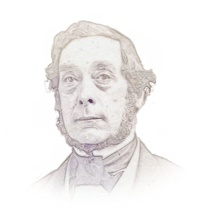
APRIL 10TH.—The condemned spies have implicated Webster, the letter-carrier, who has had so many passports. He will hang, probably. Gen. Winder himself, and his policemen, wrote home by him. I don’t believe him any more guilty than many who used to write by him; and I mean to tell the Judge Advocate so, if they give me an opportunity.

Thursday, 10th—We are still burying the dead. The lieutenant of Company F was buried today. Nearly all of the dead have been buried now, but there are some of the wounded still dying. I was detailed with two others to bury three of the rebels’ dead. We went out about a half mile north of the camp to a stony knoll where one body lay, and worked all forenoon, the ground being so hard and stony, to dig even a shallow grave into which we rolled the body and covered it the best we could. In the afternoon we dug a double grave for two who had died of mortal wounds.
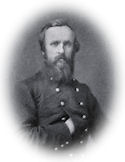
April 10. Thursday. — A. M. Ground whitened with snow; still threatening bad weather.
3. P. M. Captain Haven, Company G, and Lieutenant Bacon, Company K, have just returned. They bring fifteen prisoners and about fifteen horses, with a number of saddles and bridles. They were captured over New River in Monroe County.
At 8 P. M. F. M. Ingram (the silent telegrapher) came in saying we had gained a victory at Corinth; Major-General Lew Wallace killed; [Albert] Sidney Johnston, ditto; Beauregard lost an arm. Later told me that Island Number 10 was taken with six thousand prisoners. Glorious, if true! Night, clear and cold.
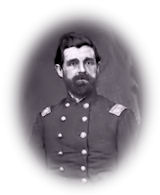
To Mrs. Lyon
Cairo, April 10,1862.—Since the capture of Island No. 10 our regiment has moved to New Madrid and I have received orders to join it forthwith. I came from Sikeston to make necessary arrangements for leaving. We shall march from Sikeston on Saturday. Think we shall get through by night.
The fighting at No. 10 was all done by the navy and artillery. The infantry had nothing to do but look on. Not so at Pittsburg Landing. There on the Tennessee a terrible battle has been fought. Our loss is very heavy. The 16th Wisconsin was in the fight. I can get no definite intelligence of its fate.


