Following the American Civil War Sesquicentennial with day by day writings of the time, currently 1863.

April 2012

Tuesday 8th

This has been a most dismal day, rain or Sleet has been falling all the time. I am all the time thinking of the Thousands of Soldiers who are now out in the storm without tents or shelter. Such must be the condition of Genl McDowells Division, which has advanced into Virginia on their way to Richmond leaving their tents behind, and also those who are now besieging Yorktown. The news tonight is that Island No 10 and the Shore Batteries have been surrendered to our troops. We shall get particulars tomorrow, probably. Genl McClellan is having a desperate time of it at Yorktown. The Rebels under McGruder are, it is said, Thirty thousand strong, but they must capitulate or run and run they cannot very easily. We are expecting news of a great battle at or near Corinth every day betwen Halleck and Beauregard. Each have over a hundred thousand men. It will be the great Battle of the war I think. Nothing has been heard from the Merrimac as yet.

______

The three diary manuscript volumes, Washington during the Civil War: The Diary of Horatio Nelson Taft, 1861-1865, are available online at The Library of Congress.

APRIL 8TH.—Col. Bledsoe has been appointed Assistant Secretary of War by the President. Now he is in his glory, and has forgotten me.

April 8th. Was signalized by the mortar fleet, twenty-two in number, arriving from Pilot Town, where they ha d gone to be stripped of their rigging. They looked very pretty as they ranged along the shore in line of battle, with their flagship, the Harriet Lane, at their head. We look for a great noise from them before long.

Camp Hayes, Raleigh, Virginia, April 8, 1862.

Dear Uncle : — We are getting ready to move south. Our first halt, unless the enemy stops us, will be at Princeton, forty-two miles from here, the county-seat of Mercer County. We shall stop there for supplies, etc., etc., and to suppress Rebel recruiting and guerrilla bands probably a fortnight, then on to the railroad at Wytheville, Dublin, or some other point. The enemy will try to stop us. They will do their best, as the railroad is of the utmost importance to their grand army in eastern Virginia.

Colonel Scammon has a brigade consisting of [the] Twenty-third, Thirtieth, and Thirty-seventh Ohio Regiments, a fine battery of eight pieces, and a small force of cavalry. I command the Twenty-third which has the advance. General Cox commands the division consisting of three brigades. At present only one brigade (ours) moves up this side of New River.

We should move tomorrow, but heavy rains yesterday and today have filled the streams so that they can’t be forded. I have got two companies cut off by the freshet, and have been taxing the Yankee ingenuity of a company from Ashtabula in getting grub to them. I think it has succeeded.

It is much pleasanter carrying on the war now than last campaign. Now the people, harried to death by the Rebel impressment of provisions and also of men, welcome our approach, receive us gladly, send us messages to hurry us forward, and a few turn out to fight. Guides are plenty, information furnished constantly, etc. All which is very different from carrying on an invasion of a hostile people.

I can’t think that the new armies of the South will fight as well as the old ones. Besides being raw, large numbers are unwilling. Our troops have improved beyond all expectation. Our regiment is now a beautiful sight. The Thirtieth too has become, under the drilling of the last two months, a capital body in appearance. The Thirty-seventh is a German regiment — has companies from Toledo, Sandusky, and Cleveland. I have not yet seen it.

I prefer Lucy should let the house remain empty this summer, or rented to some [family] to take care of it with my name on the door, etc., and in the fall we will see as to permanent arrangements.

The war will certainly last another campaign — I mean through this summer and until next fall. Even with victories on the Potomac and at Corinth and Memphis, it will take months, if not a year or two, to crush out the Rebellion in all quarters.

Sincerely,

R. B. Hayes.

S. Birchard.
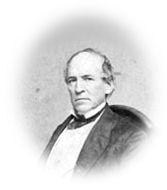
Tuesday, 8. — A. M. Still raining! Have borrowed “Jack Hinton” to read to pass time. Rained all day. At night heard a noise; found the sutler was selling whiskey; ordered two hundred bottles poured out.

8th. —There is almost a mutiny this morning. No rations, and unless there should be better things before night, I shall not be surprised at any violence. Before leaving Newport News I laid in a supply for myself and servant for two weeks, but for two days I have been dividing with my hospital attendants, and my supply is about exhausted. When I awoke this morning, my fire was surrounded by men and officers clamoring for something to eat. They had some how got it into their heads that the hospital should be able to remove all the ills that flesh is heir to. I cooked what I had, and distributed till all was gone. Although hungry, I think I feel better to-night, than if I had permitted my mess chest to have remained locked by the key of selfishness. At night—a few boxes of hard bread have partially calmed the angry storm which has been rising. But two or three hard crackers to a man who has not had a meal for three days, is but small satisfaction. We are promised, however, beef, pork, bread, sugar and coffee in the morning, and how many hungry men are hopefully looking for the morning, that the cravings of exhausted nature may be gratified. The rain still pours, and if it continues another day the roads will be impassable for teams, and we shall be compelled to fall back to some point where we can be provisioned by water. We are within four miles of two of the finest navigable rivers in the world. The mouths of both of them are held by us, and that of neither is twenty miles away; and here we are, almost starving for want of transportation. This all seems to me an indication of an unaccountable oversight somewhere—” shiftless!” If we had, before coming here, on our way, conquered twelve miles of one of these rivers, we should have had good water transportation for all our rations. But holding the mouths, we have advanced, satisfied to permit the enemy to hold the rest. What a climate for mud and rain; and what a country and people for poverty and indolence. Though we are almost in sight of the historical cities of Yorktown and Jamestown, the country is not half so far advanced in improvements and culture as the new State of Wisconsin, or even the still newer and wilder Minnesota. What a curse is slavery! I do not like the brigadeship. It places too great a distance between the sick and the Surgeon.

April 8.—Arrived at Okolona, Miss., this morning. We are still sixty miles from Corinth. When we alighted at the depot, we were told that there were no hotels to go to. As it had been raining for some time very hard, all about us looked as cheerless as possible. Our prospects, as may be supposed, were gloomy enough. While in this perplexity, each one giving an opinion as to what we had best do, word was brought us that the citizens of the place, hearing of our arrival and mission, had opened their houses for our reception, and many sent carriages to take us to their homes.
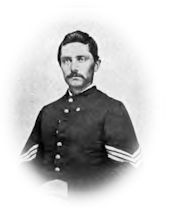
As the good people of Mobile have provided us with comforts and delicacies of all kinds for the soldiers, our failure to reach Corinth is a sad disappointment. The stories which we hear of the suffering and almost starving condition of our men aggravate it still more.

The people here can tell us little or nothing about the battle, except that one has been fought. How our forces have come out of it, they have not learned.

Several of our party, myself included, are domiciled with an excellent family by the name of Haughton, consisting of an old lady, her young daughter Lucy, and two pretty girls, her granddaughters. They are extending to us true southern hospitality.

We were all exhausted by loss of sleep, disappointment, and anxiety, and hence did not go to the cars when they passed at 11 A. M. Mrs. H’s two granddaughters went down, and, upon their return, informed us that the cars were filled with the wounded on their way to Mobile and other points. Among other items, there is a report that Captain Ketchum is killed, and all his men are either killed or captured; that the Twenty-first Alabama Regiment has been cut to pieces. I was never more wretched in my life! I can see nothing before me but my slaughtered brother, and the bleeding and mangled forms of his dying comrades, and the men of the gallant Twenty-first Alabama, whom I had seen leave Mobile but a few weeks ago so full of life and hope—many of whom were mere boys. The battle was fought at Shiloh, about twelve miles from Corinth. We had gained a victory, but at a great sacrifice. I tried to comfort myself and trust in God, assured that he was doing all for the best. O, if they would only let us go on! I feel certain that we could help the poor wounded sufferers.

It is raining in torrents. Nature seems to have donned her most somber garb, and to be weeping in anguish for the loss of so many of her noblest sons.

About midnight a train came down. I jumped up, and awoke Miss Mary Wolf. Hurriedly dressing ourselves, we took a servant and started down to see if we could hear any thing. I felt confident we should meet other ladies there as anxious as ourselves. I was not mistaken, for we had not gone far when we met a number returning from the train. It was a car sent down to get negroes to build fortifications.

Tuesday, 8th—We formed a line of battle early this morning and remained in line about two hours.[1] So many men throughout the camp were firing off their loaded rifles, preparing to clean them, that the officers thought a battle was in progress out in front. About 9 o’clock word came in from the front that there was no rebel in sight, and we were ordered back to our quarters. We spent the day in burying the dead, both our own and those of the rebels.
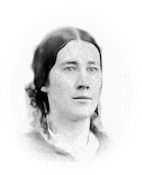
Our battle line had been at the south end of Jones’ Field, where a few days before we had cleared the timber for a review ground. This place was fought over so often by both armies and the dead lay so close that one could walk on dead bodies for some distance without touching the ground. There were over three thousand five hundred dead on the battlefield, and something like five hundred dead horses. Seven hundred bodies of the rebels were put into one grave. It is an awful sight to see the dead lying all about. It rained this forenoon, but cleared off this afternoon. The heavy rains have soaked the ground, making it very muddy. About five thousand of our forces arrived today.


[1] It has been said by some that from General Grant down to the commonest private in the ranks of the entire Army of the Tennessee, all the men cared for on Monday afternoon, the second day of the battle of Shiloh, was to get back to their camps. I cannot believe the statement, for on Tuesday, the 8th, when we were ordered into line of battle, on that gloomy, rainy morning, and a cold wind blowing from the northwest, I know by the sentiment of the boys in my own company, that they would have gone to the front then if ordered to do so. We felt that the loss in our company was too great not to follow up the victory.—A. G. D.

Abby Howland Woolsey to Georgeanna.

New York, April, ‘62.

I notice what you say of bed sacks. The Sanitary Commission furnished thousands to the Burnside Division for its hospitals at Roanoke. Charley says not one of these was ever filled or used, there not being a wisp of hay or straw or moss or anything, except what was brought there for forage. The men all lay on the board floors. At Fort Monroe it might be easy to send down from Baltimore ready-made mattresses, or the material for filling, but I question whether anyone on the spot would take the trouble of seeing them applied. You could mention the instance of Roanoke to the Sanitary Commission to prove to them that mere sacks are not enough. .. .

Yesterday when I came in from Mary’s, I found “Robert Anderson, U. S. A.” ’s card on the table again. John said he bade him say General Anderson called in person to thank Miss Carry Woolsey for the flowers. . . . James Gibson writes from Belfast that “England did not want war with America, and special prayer meetings for peace were held”; but wasn’t it Earl Shaftesbury who refused to attend, saying such an act would place him in hostility to his government? If England did not mean war, why did she fly to arms in that indignant and indecent haste! Why did Lord Palmerston suppress the nature of the despatch from Seward, read to him by Mr. Adams, and even allow it to be contradicted in his organ the Post? No; two things will always stand on record as showing the hostility of the governing class in England toward America in its life and death struggle;—this hurry to make a casus belli of what ought to have been a question for diplomacy to settle; and that first great wrong done us in the outset, when the English ministry, while Adams was on the railway train, the very day he was on his way from Liverpool to London, last May, hastened to declare the North and South equal belligerents. They confound the law-power and the law-breaker; they call the police and the burglar brother-rogues. . . .

It is just as Mr. Scharff’s father said at the very beginning of the war, “Well, John, I don’t know what part England will take in this matter, but I am very sure of one thing, it will be the meanest part, possible.” . . .

Jane Stuart Woolsey to Mother in Washington.

Thursday Evening.

Dear Mother: Your letter, or rather Georgeanna’s, Eliza’s check, etc., arrived this morning, with the important item inscribed, as usual, on the flap and disfigured in opening. We are very sorry to hear that Hatty doesn’t get on faster. Perhaps if, instead of a “good old soul” of a doctor, she had an enlightened young one, she might get sooner rid of her sore throat. I believe much more devoutly in modern than in ancient doctors . . .

Sarah, Abby, Carry, Miss Parsons, Charley and Robert have all gone to the “Reception” of the Cumberland’s men to-night. It was time to show some interest in them. The Chamber of Commerce has got this up. I hope it will be a success. You remember the officer calling to the half-drowning men, “Shall we give her another broadside, boys?” and the “Aye, aye, sir,” and the final volley, as the water rushed in at the portholes. We have had two visits lately from Prof. Hitchcock on the subject of a ladies’ committee of visiting; auxiliary to the gentlemen’s committee of the New England Soldiers Relief Association. He asked us to collect some names of ladies willing to serve (visiting only), and we have enrolled six or eight: Mrs. Gurden Buck, Mrs. H. B. Smith, Miss Annie Potts, Margaret Post, etc., etc. I fancy there will be little to do really, as there is a resident superintendent and wife, and, I believe, nurses, in the house corner of John st. and Broadway. You will see the details of the arrangement in the papers. . . .

All the flags are out again for the Western victories and the Western heroes. Col. Bissell, the officer who made a river 12 miles long to flank the rebel position, is Mrs. Dr. Parker’s brother, a man of extraordinary energy and perseverance. .. .

Mrs. Bacon told Sarah that Frank had 700 sick men under his care and made a point of seeing every man every day, so never wrote, leaving that business to Theodore. We sent, him and Mr. Withers each, another bundle of papers by the last mail.