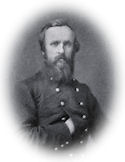
Flat Top Mountain, May 24, 1862. Saturday. — Cold, rainy, and windy, — an old-fashioned storm. Men bivouacking! Colonel Crook, of [the] Third Brigade, was attacked yesterday morning by General Heth with the same force which drove me out of Giles. Colonel Crook had parts or the whole of three regiments. He defeated Heth and captured four of his cannon. Our loss, ten killed and forty wounded. Enemy routed and one hundred prisoners. What an error that General Cox didn’t attack Williams and Marshall at Princeton! Then we should have accomplished something.
May 2012
Near Corinth, Miss., May 24, 1862.
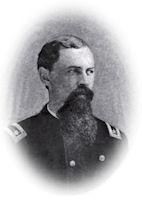
I returned last night from a two day’s scout. Our orders were to scour the country along the Tennessee river to near Eastport and return through Iuka, Burnsville and Glendale. A Michigan colonel commanded the party and skipped Iuka three miles. There were little bands of Rebels in sight nearly all the time we were in that vicinity, so that I could not gallop off to the place alone, and of course the colonel wouldn’t let me have men to go with me.
We rode all day yesterday through a steady rain and over roads that were for miles obstructed by felled trees and bridges burned. We came back through Pope’s division yesterday. Think he is as about as well fortified as Beauregard can be. ‘Tis astonishing how much ditching he has done within a week. Has also cut down enough trees (to make his left unapproachable) to last all of Illinois ten years for firewood. There’s no site for a Bull Run here. Confederate scrip goes among the people here freely. If a man refuses to take it they lynch him. Not the citizens but soldiers do the dirty work. The people here all say that the seceded States will have to go back where they started from.
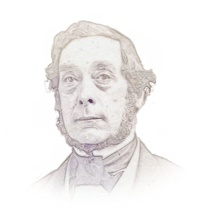
MAY 24TH—Every day the two armies are shelling each other, more or less; and every gun can be heard from the Hospital Hill, north of the city, whither many repair to listen.
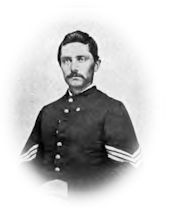
Saturday, 24th—The Eleventh Iowa went out on picket at 5 o’clock this evening. It was reported in camp that General Beauregard is moving all of his heavy ordnance and his entire army to the south with a view of evacuating Corinth. The report says that teams loaded with munitions of war are leaving Corinth every day.
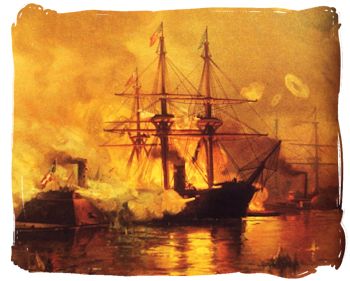
May 24th. We left Grand Gulf on the 23d, at which time the Flag Officer joined us, and arrived four miles below Vicksburg at four o’clock, P. M., where we found several gunboats awaiting our arrival. We swelled the number here to eleven vessels of war. The city is situated on a bluff perhaps sixty feet high, and they have a battery on the hill, and another one below, but we do not know the number of guns mounted; they also have a ram to protect them, besides large numbers of troops behind the city. The Kennebec, with the several captains of the fleet, went up to reconnoitre, and on returning was saluted by the ram with a shot which fell far short.
24th. Saturday. Reveille at 4 A. M. Breakfasted, loaded wagon and horsed at six A. M. Grazed about five miles. Splendid prairie view. But one little bunch of woods in sight. Reached Iola about three o’clock. Good visit with the boys.
24th.—Another day of inaction near Gaine’s Mill, on the Chickahominy. An instance of petty despotism occurred to-day. I was sick, confined to my bed. We were approaching Richmond, with prospect of a fight. The Division Surgeon procured an order from General Smith, detailing me to organize and take charge of a hospital at Liberty Hall. I reported sick. The order was repeated; the report was repeated. The order came the third time, with the same result. General ______ took the matter in hand, and ordered me from my quarters, as a non-effective, to this hospital, or house, unorganized, without any provivisions for the sick, now packed full of soldiers, suffering with infectious diseases of the worst kind. From this order I had to appeal to the Division Commander, who at once had it rescinded, and the “amiable General H______” was cheated of his victim.
Cold Harbor, Powhite Swamp, Va..
Saturday, May 24, 1862.
Dear Brother and Sister:—
My duty as bugler exempts me from guard and picket duty. While at Yorktown bugles and drums were not used and I had nothing to do, so I went into the ranks again and volunteered to do picket duty and work in the trenches, and took my regular turn in all the work of the regiment except camp guard which I always had an aversion to and wouldn’t do when I was not required to. We had a corps of twelve buglers when we left Fort Monroe and I was the leader, but, finding that a good many more than was necessary, the colonel dismissed all but two, Lederer and myself. Now, I’ll just give you an idea of our duties. At sunrise buglers at brigade headquarters sound the “brigade call” and the “reveille” (rev-el-lee is camp pronunciation). The buglers of each regiment as quickly as possible assemble on the color line, give their regimental call and repeat the reveille. The fifes and drums follow and awake the men. This is the signal to rise and fall in for roll call.
You may guess that the buglers of an army of 30,000 men all within sound of each other, make some music. At sunset we have another call, “The Retreat.” At half past eight the “Tattoo,” at nine the “Extinguish Lights.” Then there are calls “To Strike Tents,” “To Assemble,” “To the Color,” “Sick Call,” “Officers Call,” “Church Call,” etc. It is our duty to repeat all such calls that are first sounded at headquarters. On the march, the order to march, or halt, or lie down and rest, etc., in fact, all orders are given by the bugle.
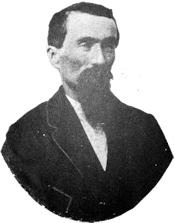 May 24 — This morning we started from camp at three o’clock. It was very dark, but we passed on through the darkness and arrived at Front Royal by sunrise. Front Royal is situated near the western base of the Blue Ridge, one mile from the Shenandoah River, twenty-five miles below Luray, and eighteen miles from Winchester. Yesterday evening we heard cannon in the direction of Front Royal. We learned this morning that it was a Yankee battery shelling our cavalry near town.
This morning I saw about four hundred prisoners that were captured yesterday.
Captain Sheetz of Ashby’s Cavalry, a gallant, daring, and brave officer, was killed at Waterlick, a station between Front Royal and Strasburg on the Manassas railroad. I saw his body this morning in Front Royal.
We crossed the Shenandoah near Front Royal on a bridge that the Yankees built. They attempted to burn it yesterday, but our men pressed them so hard they failed to destroy it.
We went in pursuit of the enemy on the Winchester pike some six or seven miles, then returned to the Shenandoah River without seeing any Yanks. Then we were ordered to Middletown, on the Valley pike, at which place we arrived about two o’clock this afternoon. Before we got in sight of the pike we saw a line of Yankee skirmishers. We fired on them, and at the first fire they ran away like wild men. When we came in sight of the pike we saw heavy clouds of dust rising all along the road, which we soon learned was caused by a hastily retreating army — with cavalry, artillery, infantry, wagons, ambulances, and sutler shops all in one mixed-up caravan—fleeing toward Winchester like clouds scudding before a driving storm. At a half mile range we opened on the flying mixture with all four of our guns, and as our shells plowed gap after gap through the serried column it caused consternation confounded, and vastly increased the speed of the hurrying mixed fugitive mass. When we first attacked the enemy at Middletown we had a company of the Eighth Louisiana Regiment of infantry, in which were some of the Mississippi Tigers, as a support, and sharpshooters for our battery. When we opened fire a Yankee captain of cavalry left the fleeing fugitives, jumped his horse across a fence, flourished his saber, and beckoned to his comrades to follow him, but his mixedup troop kept on down the pike as if they were deeply impressed with the idea that the safest and surest way to save their country’s flag was to run away with it.
The Tigers saw the Yankee captain when he jumped into the field. They opened fire on him with their long-ranged rifles. I saw him fall soon after, and heard some of the Tigers say, “That will do him. Fire at the others in the road.”
It was fun for the Tigers to fight cavalry, but it looked a shame to shoot down the lone Yankee captain as he was vainly trying to rally his men, to defend the running remnant of Banks’ army, but alas! such is war. Immediately after the last Yanks passed Middletown we double-quicked to the pike and pursued them, firing on them from every available position until we arrived at Newtown, which is five miles below Middletown. In the pursuit I saw abandoned baggage wagons, commissary wagons, wagons laden with medical stores, sutler goods, and all sorts of army equipments strewn along the track of the hastily retiring enemy.
Just above Newtown in a field on the west side of the pike I saw where a whole regiment shelled off their knapsacks and left them lying in a well-formed line and apparently in good order. A little below Middletown and about six hundred yards to our left, in the edge of a woods, we saw a company of Yankee cavalry under a Confederate flag. They were behaving themselves nicely, and no doubt making observations and taking bearings. As quickly as Captain Chew convinced himself that they were Yanks he ordered me to unlimber and fire on them. I did so, and that was my maiden shot, my first effort at gunnery, and a lovely maiden it was. The shell I fired was way too high and went at least half a mile beyond the Yanks, and exploded, but it surely made the Yanks “git.”
It was drawing toward sunset when we arrived at Newtown, and as our horses had not been fed since three o’clock this morning we halted in town and fed them in the street. But before our horses were done eating some Yankee infantry rallied just below town, threw out a line of sharpshooters, and advanced on us. We fired on them with one piece from the street, but we had no support and their sharpshooters were creeping up along fences and behind sheds and houses, which rendered our surroundings a little dangerous and our situation hazardous and unhealthy, as we had no support of either cavalry or infantry. Our Tiger support had not come up yet, and I do not know just where our cavalry was at that time. All the events that transpired in the last five hours came in quick succession.
When we found that we could not hold our position in town against the advancing sharpshooters, we retired to a hill just south of town, went in position and fired on the line of sharpshooters, which was still advancing and firing on us. They had long-range rifles, and made it a little too sickly for us on the first hill, and as we limbered up and started away I saw a sharpshooter in the middle of the street drop on one knee and shoot at us at a distance of nearly half a mile. When he fired I heard the bullet whiz close by my head. It struck the lead driver to my team and went clear through him, from back to breast, but it did not kill. We put him in a farmhouse near by.
Just after we left our position Jackson’s infantry came up and drove the enemy back in a sort of double-quick style. About a mile below Newtown the Yanks attempted to rally for the special purpose of defending some commissary wagons that were disabled, but Jackson’s men pressed them so hard in a skirmish that sounded very much like a young battle that the enemy hastily turned the wagons over to the yelling Rebels and fell back toward Winchester. This last skirmish of the day occurred after dark. After Jackson’s infantry came up and passed to the front and while our battery was awaiting orders, a few of us got permission from the proper authority to go on a twenty-minute pilfering raid among the debris and spoils scattered all along the road of Banks’ routed army.
The first prize we struck was a wagon standing in a wheat field, loaded with large square boxes full of military clothing. The first box we opened was full of dark blue frock coats with brass eagle military buttons.
I got four coats, but they were too blue for a Rebel to wear on the field, and too bulky to carry, so after all I had nothing but a blue elephant on hand. I saw plenty of knapsacks strewn over the fields and road. However, the most of them had already passed through the raking process thoroughly applied by Confed. snatchers. After a real ragged Rebel rifles a knapsack I would not give a cancelled postage stamp for what he leaves.
Nearly all the wreckage was strewn on the west side of the pike, yet we found one wagon on the east side that was standing with the fore wheels in a deep impassable ditch. When we got to it a lone cavalryman was standing in the hind part of the wagon, pounding on a barrel head with a stone. Our first conclusions were that the barrels contained pickled pork, and awaited patiently the cavalryman’s successful assault in gaining access to its contents, as a good chunk of pickled pork would have been a very acceptable and highly appreciated prize, for my external haversack was entirely empty and the internal one almost in the same fix. It did not take long for our gallant beating cavalryman to “strike ile.” When I heard the barrel head splash into something liquid the delighted cavalryman exclaimed, “Whisky, by George!” and I saw him bow down a willing worshiper at this lowly shrine of Bacchus, and he sampled without cup or canteen the mirth-inspiring contents of a full barrel. There were ten barrels in the wagon. I did not want any to be joyful on an empty stomach, I had no canteen, my twenty minutes’ leave of absence had about expired, and the rosy glow of fading twilight was fast changing into the sable shades of night, so I struck a bee-line for the battery, with nothing but four blue coats that I had no use for.
At the lower end of Middletown I saw a dead Yankee lying against a stone fence, with a splendid-looking watch chain hanging from his vest pocket. From its appearance I am almost confident it was gold. I had a good opportunity to snatch it, but there was a kind of restraining superstition playing through my mind, which seemed to whisper dogmatically that it is unalloyed sacrilege to rob the dead. I heeded the silent monitor and left the chain and Yankee untouched. I am confident that there was a watch in the vest pocket. We are camped for the night at Newtown.
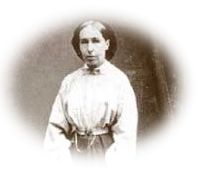 “Spaulding,” May 24.
Dear Mother, — I seize five spare moments for you, as I have not written for three days. Last night we half filled this ship with the worst cases from the shore hospital. She will probably fill up to-day from the “Elm City,” and sail to-morrow. The men are mostly very sick, but no deaths occurred last night. Oh! what stories I shall have to tell you one of these days. Instances of such high unselfishness happen daily that, though I forget them daily, I feel myself strengthened in my trust in human nature, without making any reflections about it. Last night a wounded man, comfortably put to bed in a middle berth (there are three tiers, and the middle one incomparably the best), seeing me point to the upper berth as the place to put a man on an approaching streteher, cried out: “Stop! put me up there. Guess I can stand h’isting better ‘n him.” It was agony to both.
There is great discussion among the doctors as to the character of the fever; some call it typhoid, others say it is losing that type and becoming malarial remittent. It matters little to me what it is; the poor fellows all look alike, — dry, burned-up, baked, either in a dull stupor or a low, anxious delirium. They show little or no excitement, but are dull, weary, and sad. The percentage of sickness is thought to be small for an army on the march through such a region.[1]
We are all well, and cheerful now that our work begins once more. Idleness depressed us a little. We now have over one hundred very sick men on board. Mrs. Griffin and I have just finished our morning’s work below; Mrs. M. and Georgy have taken our places, and we have come on deck for a mouthful of fresh air. This morning, before I was up, I heard a crash and a cry, and the bowsprit of a large vessel, which the tide had swung upon us, glanced into the port-hole at the foot of my bed, tore through the partition, and, I believe, demolished the berth on the other side of it. The captain, who takes great pride in his ship, and has employed these leisure days in getting her painted, is now leaning over the side, looking at the defaced and splintered wood-work with a melancholy air.
Good-by. Called off.
[1] The death-rate of the British forces during the first year of the Crimean War was: July, August, September, 1854, 293 per 1000 men; October, November, December, 511 per 1000 men; reaching in January, 1855, the fearful rate of 1174 per 1000 men, of which 97 per cent was from disease, — in other words, a rate at which it would be necessary to replace a dead army by a living one in 10¼ months. Then it was that the British Government established sanitary operations; and as soon as their influence was felt — May, June, July, 1855 — the death-rate fell to 250 per 1000, and from that time rapidly diminished, till in January, 1856 (one year from its culmination), it was 25 per 1000 men. The mortality of the United States army during the campaign in Virginia of 1862 was 165 per 1000 men. To what was this difference owing? Not to the fact that our troops brought a greater amount of health into the service, for their mortality during the preceding period of inaction was much greater than that of the British army during a like period. It was owing in part, undoubtedly, to lessons learned from the Crimean War; but it was also in a great degree owing to the Sanitary Commission, to its careful inspection of recruits, camps, regiments, and to the advice which the military authorities so wisely allowed it to give on all sanitary and hygienic subjects to the regimental commanders. Surely the Commission has a right to point to the comparatively small mortality of our forces (small when we consider the nature of the climate and the unseasoned condition of volunteers), and claim a part, at least, of the credit of it.


