Following the American Civil War Sesquicentennial with day by day writings of the time, currently 1863.

May 2012

May 24th.—The enemy are landing at Georgetown. With a little more audacity where could they not land? But we have given them such a scare, they are cautious. If it be true, I hope some cool-headed white men will make the negroes save the rice for us. It is so much needed. They say it might have been done at Port Royal with a little more energy. South Carolinians have pluck enough, but they only work by fits and starts; there is no continuous effort; they can’t be counted on for steady work. They will stop to play—or enjoy life in some shape.

Without let or hindrance Halleck is being reenforced. Beauregard, unmolested, was making some fine speeches— and issuing proclamations, while we were fatuously looking for him to make a tiger’s spring on Huntsville. Why not? Hope springs eternal in the Southern breast.

My Hebrew friend, Mem Cohen, has a son in the war. He is in John Chesnut’s company. Cohen is a high name among the Jews: it means Aaron. She has long fits of silence, and is absent-minded. If she is suddenly roused, she is apt to say, with overflowing eyes and clasped hands, “If it please God to spare his life.” Her daughter is the sweetest little thing. The son is the mother’s idol. Mrs. Cohen was Miriam de Leon. I have known her intimately all my life.

Mrs. Bartow, the widow of Colonel Bartow, who was killed at Manassas, was Miss Berrien, daughter of Judge Berrien, of Georgia. She is now in one of the departments here, cutting bonds—Confederate bonds—for five hundred Confederate dollars a year, a penniless woman. Judge Carroll, her brother-in-law, has been urgent with her to come and live in his home. He has a large family and she will not be an added burden to him. In spite of all he can say, she will not forego her resolution. She will be independent. She is a resolute little woman, with the softest, silkiest voice and ways, and clever to the last point.

Columbia is the place for good living, pleasant people, pleasant dinners, pleasant drives. I feel that I have put the dinners in the wrong place. They are the climax of the good things here. This is the most hospitable place in the world, and the dinners are worthy of it.

In Washington, there was an endless succession of state dinners. I was kindly used. I do not remember ever being condemned to two dull neighbors: on one side or the other was a clever man; so I liked Washington dinners.

In Montgomery, there were a few dinners—Mrs. Pollard’s, for instance, but the society was not smoothed down or in shape. Such as it was it was given over to balls and suppers. In Charleston, Mr. Chesnut went to gentlemen’s dinners all the time; no ladies present. Flowers were sent to me, and I was taken to drive and asked to tea. There could not have been nicer suppers, more perfect of their kind than were to be found at the winding up of those festivities.

In Richmond, there were balls, which I did not attend— very few to which I was asked: the MacFarlands’ and Lyons’s, all I can remember. James Chesnut dined out nearly every day. But then the breakfasts—the Virginia breakfasts—where were always pleasant people. Indeed, I have had a good time everywhere—always clever people, and people I liked, and everybody so good to me.

Here in Columbia, family dinners are the specialty. You call, or they pick you up and drive home with you. “Oh, stay to dinner!” and you stay gladly. They send for your husband, and he comes willingly. Then comes a perfect dinner. You do not see how it could be improved; and yet they have not had time to alter things or add because of the unexpected guests. They have everything of the best—silver, glass, china, table linen, and damask, etc. And then the planters live “within themselves,” as they call it. From the plantations come mutton, beef, poultry, cream, butter, eggs, fruits, and vegetables.

It is easy to live here, with a cook who has been sent for training to the best eating-house in Charleston. Old Mrs. Chesnut’s Romeo was apprenticed at Jones’s. I do not know where Mrs. Preston’s got his degree, but he deserves a medal.

At the Prestons’, James Chesnut induced Buck to declaim something about Joan of Arc, which she does in a manner to touch all hearts. While she was speaking, my husband turned to a young gentleman who was listening to the chatter of several girls, and said: “Ecoutez! ” The youth stared at him a moment in bewilderment; then, gravely rose and began turning down the gas. Isabella said: ” Ecoutez, then, means put out the lights.”

I recall a scene which took place during a ball given by Mrs. Preston while her husband was in Louisiana. Mrs. Preston was resplendent in diamonds, point lace, and velvet. There is a gentle dignity about her which is very attractive; her voice is low and sweet, and her will is iron. She is exceedingly well informed, but very quiet, retiring, and reserved. Indeed, her apparent gentleness almost amounts to timidity. She has chiseled regularity of features, a majestic figure, perfectly molded.

Governor Manning said to me: “Look at Sister Caroline. Does she look as if she had the pluck of a heroine?” Then he related how a little while ago William, the butler, came to tell her that John, the footman, was drunk in the cellar—mad with drink; that he had a carving-knife which he was brandishing in drunken fury, and he was keeping everybody from their business, threatening to kill any one who dared to go into the basement. They were like a flock of frightened sheep down there. She did not speak to one of us, but followed William down to the basement, holding up her skirts. She found the servants scurrying everywhere, screaming and shouting that John was crazy and going to kill them. John was bellowing like a bull of Bashan, knife in hand, chasing them at his pleasure.

Mrs. Preston walked up to him. “Give me that knife,” she demanded. He handed it to her. She laid it on the table. “Now come with me,” she said, putting her hand on his collar. She led him away to the empty smoke-house, and there she locked him in and put the key in her pocket. Then she returned to her guests, without a ripple on her placid face. “She told me of it, smiling and serene as you see her now,” the Governor concluded.

Before the war shut him in, General Preston sent to the lakes for his salmon, to Mississippi for his venison, to the mountains for his mutton and grouse. It is good enough, the best dish at all these houses, what the Spanish call “the hearty welcome.” Thackeray says at every American table he was first served with “grilled hostess.” At the head of the table sat a person, fiery-faced, anxious, nervous, inwardly murmuring, like Falstaff, “Would it were night, Hal, and all were well.”

At Mulberry the house is always filled to overflowing, and one day is curiously like another. People are coming and going, carriages driving up or driving off. It has the air of a watering-place, where one does not pay, and where there are no strangers. At Christmas the china closet gives up its treasures. The glass, china, silver, fine linen reserved for grand occasions come forth. As for the dinner itself, it is only a matter of greater quantity—more turkey, more mutton, more partridges, more fish, etc., and more solemn stiffness. Usually a half-dozen persons unexpectedly dropping in make no difference. The family let the housekeeper know; that is all.

People are beginning to come here from Richmond. One swallow does not make a summer, but it shows how the wind blows, these straws do—Mrs. “Constitution ” Browne and Mrs. Wise. The Gibsons are at Doctor Gibbes’s. It does look squally. We are drifting on the breakers.
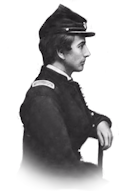
May 24th. Rained hard most of the day, putting a stop to all military work. In the afternoon Captain McKay and I made an inventory of the effects of poor McKibben, our late jovial quartermaster, who died of a fever contracted at Ship Point, on the 17th ult. We all regret him very much, for his amiable disposition, and excellent abilities. Broom will now be commissioned in his place; he has been acting as such since McKibben was taken sick. Wrote home (as did almost every man in camp I think), and told them how close we are to the enemy, and what they may expect very soon. Camp dull and cheerless to-night, all anxious for the rain to stop, so that we may continue the forward movement.

boggs_charles_thumb[7]

May 24.—A skirmish took place at Craighead Point, near Fort Pillow, Tennessee, between a party of Federal pickets and a large body of rebel infantry. After the two parties had exchanged a few shots, the Union gunboat Benton opened fire upon the rebels and brought on an engagement with the batteries at Fort Pillow, which was closed by the Benton retiring to her position with the Union fleet.—New-York World.

—Five companies of the Fourth Michigan regiment, under Bowen, of the Topographical Engineers, and Lieutenant Cusher, of the Fifth cavalry, acting with the Topographical corps, crossed the Chickahominy a short distance above New-Bridge. At Cold Harbor a small command of thirty men, of the Fourth Michigan, succeeded in getting between four companies of the Fifth Louisania regiment, who were out on picket-duty at the bridge, and a brigade of rebels who were supporting them.

In the mean time, the rest of the regiment and the squadrons of cavalry approached the bridge, thus attracting the attention of the four Louisiana companies. The first knowledge the rebels had of the near presence of an enemy, was the firing from thirty muskets at pistol-shot range, making havoc in the ranks and causing a serious panic, while the main body advanced in front and opened a deadly fire.

The result was, that thirty-seven of the enemy were taken prisoners, fifteen wounded, and between sixty and seventy left dead on the field. Among the prisoners was a lieutenant. Lieut. Bowen had his horse shot under him during the skirmish.[1]—(Doc. 45.)

— A Union meeting was held at Murfreesboro, Tenn., at which speeches were made by Andrew Johnson and others. — Louisville Journal, May 26.

— Yesterday General Stoneman’s brigade and the brigade of General Davidson, of Smith’s division, advanced from New-Bridge up the Chickahominy to Ellison’s Mills, on Bell’s Creek. Here they encountered four regiments of the enemy’s infantry, with nine pieces of artillery and a command of cavalry. Of these, two regiments of infantry and three pieces of artillery were on the opposite side of the creek. The rest of the infantry, composed of the Eighth and Ninth Georgia regiments, under General Howell Cobb, were posted in a favorable position to resist McClellan’s advance to Mechanicsville.

Fitlar’s and Robertson’s batteries of the Second artillery, were quickly brought into action, and after firing some one hundred and fifty rounds the rebels withdrew, with their guns — not however, until one of them had been dismounted — to the village, covered by their infantry and cavalry. Four regiments of General Davidson’s brigade, with Wheeler’s battery, were then sent around, but night coming on, they went into camp, within six hundred yards of the enemy.

This morning at daylight, the batteries on both sides opened, Wheeler confining his guns to shelling the houses behind which the enemy’s infantry were concealed. The fire was too hot for the rebels, and they left the village, a portion retiring across the Chickahominy, the remainder falling back to the railroad. The Thirty-third New York regiment were the first to enter the village. The houses showed unmistakable evidences of the accuracy of the artillery, some of them being riddled in a dozen places. The rebels carried off their killed and wounded, one man excepted. The Union casualties were two killed and four wounded. Colonel Mason, of the Seventh Maine, was slightly injured by the explosion of a shell.

General Stoneman then sent two squadrons of the Eighth Illinois cavalry under Major Clendennin, three miles further up the river, and caused to be destroyed the bridge of the Richmond and Fredericksburgh Railroad.

—The British steamer Stettin was captured this morning while attempting to run the blockade of Charleston, S. C.—Charleston Mercury, May 27.

— A reconnoitring party from Pope’s command had a skirmish near Corinth, Miss., resulting in a complete rout of three rebel regiments, with loss of knapsacks, blankets, and haversacks, several were killed and wounded, and six prisoners were taken. The regiments fled in confusion across the creek. The national loss was four wounded.

— A party of National troops from the Fifth Virginia regiment, and Captain Fish’s company of Connecticut cavalry, under the command of Lieut.-Colonel Latham, surprised a guerrilla band on Snuff’s Mountain, Randolph County, Va., and put them to flight, capturing most of their arms and equipments, and without any loss on the National side.— Wheeling Intelligencer, May 27.

— The steamer Swan, laden with one thousand bales of cotton, and eight hundred barrels of rosin, was captured off the coast of Cuba by the United States brig Bainbridge, and bark Amanda, and sent to Key West, Florida, for adjudication.—National Intelligencer, June 2.

—A reconnoissance in force was this day made from General Keyes’s headquarters, for the purpose of ascertaining the strength of the rebels in the neighborhood of ” the Pines,” some eight and a half miles from Richmond, Va.—(Doc. 115.)


[1] A despatch to the War Department from General McClellan mentions this affair as follows:

“Three skirmishes to-day. We drove the rebels from Mechanicsville, seven miles from New-Bridge. The Fourth Michigan about finished the Louisiana Tigers. Fifty prisoners and fifty killed; our loss ten killed and wounded.”

Flat Top Mountain, May 23, 1862. Friday. — Warm and dry; getting dusty!! Mr. French lies here wounded — his thigh bone shattered by a ball that passed clear through his leg. Dr. McCurdy thinks he will not survive more than three or four weeks. . . . Our regiment elected him chaplain a week or two ago to date from the day of battle, May 1, 1862. I hope the Governor will commission [him] promptly. . . .

The Commercial is reported as saying that people may “act as if they had heard some very good news” from General Halleck’s army.

It is dusty!! A cold wind blowing. The plan of going to Packs Ferry and crossing New River, uniting with Colonel Crook, and thence through Union to Christiansburg, is not yet fixed upon.

Written from the Sea islands of South Carolina.

[Diary] May 23.

Ellen is coming at last. I felt sure no one could stop her. Mr. McKim is also to come as Philadelphia agent, and I am free.

We have been for three days going to various plantations, once to Mr. Zacha’s at Paris Island, once to Mrs. Mary Jenkins’, Mr. Wells’ and to Edgar Fripp’s, or to Frogmore, Mr. Saulis’; also to Edding’s Point and one other place. At the three places of Mr. Jenkins, Mr. Fripp, and Edding, the wretched hovels with their wooden chimneys and the general squalor showed the former misery. One woman said the differences in the times were as great as if God had sent another Moses and a great deliverance — that it was heaven upon earth and earth in heaven now. They all seemed to love Mr. Wells. We saw there one woman whose two children had been whipped to death, and Mr. Wells said there was not one who was not marked up with welts. He had the old whip which had a ball at the end, and he had seen the healed marks of this ball on their flesh — the square welts showed where it had taken the flesh clean out. Loretta of this place showed me her back and arms to-day. In many places there were ridges as high and long as my little finger, and she said she had had four babies killed within her by whipping, one of which had its eye cut out, another its arm broken, and the others with marks of the lash. She says it was because even while “heaviest” she was required to do as much as usual for a field hand, and not being able, and being also rather apt to resist, and rather smart in speaking her mind, poor thing, she has suffered; and no wonder Grace, her child, is of the lowest type; no wonder she is more indifferent about her clothes and house than any one here. She says this was the cruelest place she was ever in.

The happiest family I know here is old Aunt Bess’s Minda and Jerry and herself. They are always joking and jolly but very gentle. When I go there at night to dress Bess’s foot I find her lying upon her heap of rags with the roaches running all over her and little Leah or some small child asleep beside her.’ Jerry got me some of the pine sticks they use for candles. They hold one for me while I dress the foot.

It is very interesting to observe how the negroes watch us for fear we shall go away. They are in constant dread of it and we cannot be absent a single day without anxiety on their part. It is very touching to hear their entreaties to us to stay, and their anxious questions. They have a horrible dread of their masters’ return, especially here where Massa Dan’l’s name is a terror.

They appreciate the cheapness of our goods and especially of the sugar at the Overseer house, and are beginning to distrust the cotton agents who have charged them so wickedly.

The scenes in the cotton-house used to be very funny. Miss W. would say to some discontented purchaser who was demurring at the price of some article, “Well, now, I don’t want to sell this. I believe I won’t sell it to-day. But if you want to take it very much at a dollar and a half, you may have it. Oh, you don’t? Well, then, I can’t sell you anything. No, you can’t have anything. We are doing the best we can for you and you are not satisfied; you won’t be contented. Just go — go now, please. We want all the room and air we can get. You don’t want to buy and why do you stay? No, I shall not let you have anything but that. I don’t want to sell it, but you may have it for a dollar and a half,” etc., etc. This is one of many real scenes. The people are eager, crazy to buy, for they are afraid of their money, it being paper, and besides, they need clothes and see finer things than ever in their lives before. Except when they are excited they are very polite, always saying “Missus” to us, and “Sir” to one another. The children say, “Good-mornin’, ma’am,” whenever they see us first in the day, and once I overheard two girls talking just after they had greeted me. One said, “I say good-mornin’ to my young missus [Miss Pope] and she say, ‘I slap your mouth for your impudence, you nigger.'” I have heard other stories that tell tales.

The white folks used to have no cooking-utensils of their own here. They came and required certain things. The cooks hunted among the huts and borrowed what they needed till the family went away, of course straining every nerve to get such cooking as should please. “I would do anything for my massa,” Susannah says, “if he would n’t whip me.”

On May 7, as Mr. Pierce stepped off the boat at Hilton Head and walked up the pier, a Mr. Nobles, chief of the cotton agents here, came forward saying that he had a letter for him. Then he struck him upon the head, felled him, and beat him, saying that Mr. P. had reported him to the Secretary of the Treasury and had got a saddle and bridle of his. Mr. Pierce got up with difficulty and took only a defensive part. Some soldiers took Mr. Nobles off. Mr. Pierce had really mentioned this man and his agents, which was his duty as guardian of these people, for they were imposing upon the negroes shamefully. They, of course, hate this whole Society of Superintendents, etc., who will not see the negroes wronged. So Mr. P. has had his touch of martyrdom.

The Philadelphia consignment of goods — in all $2000 worth — would have done immense good if it had come in season. The people of these islands, whom Government does not ration (because there is corn here) had nothing but hominy to eat, were naked, were put to work at cotton, which they hated, as being nothing in their own pockets and all profit to the superintendent, who they could not be sure were not only another set of cotton agents or cotton planters; and so discontent and trouble arose. Mr. Pierce said to them that they should be fed, clothed, and paid, but they waited and waited in vain, trusting at first to promises and then beginning to distrust such men as were least friendly to them.

The first rations of pork — “splendid bacon,” everybody says — was dealt out the other day and there has been great joy ever since, or great content. If this had only come when first ordered there would have been this goodwill and trust from the first. They even allow the removal of the corn from one plantation to another now without murmuring, and that they were very much opposed to before.

May 23 — We renewed our march this morning down the Luray Valley. We passed some of Jackson’s infantry this afternoon. They were marching toward Front Royal. We are camped eight miles above Front Royal.

MAY 23D.—Oh, the extortioners! Meats of all kinds are selling at 50 cts. per pound ; butter, 75 cts.; coffee, $1.50; tea, $10; boots, $30 per pair; shoes, $18; ladies’ shoes, $15; shirts, $6 each. Houses that rented for $500 last year, are $1000 now. Boarding, from $30 to $40 per month. Gen. Winder has issued an order fixing the maximum prices of certain articles of marketing, which has only the effect of keeping a great many things out of market. The farmers have to pay the merchants and Jews their extortionate prices, and complain very justly of the partiality of the general. It does more harm than good.

Friday, 23d—We formed a line of battle at 4 o’clock this morning, but the rebels did not make their expected attack. The army generally now forms a line of battle every morning at 4 and remains in line until about 6 o’clock. It rained some today, and on account of the wet weather it was only at times that there was activity along the lines.

23rd. Started at 8 A. M. for Iola. Marched fifteen miles. Saw George. Shaved by Charlie Fairbanks. Encamped out in the open air by Turkey Creek. A. B. and I cooked our suppers. Happy time. A grand ridge of mounds surrounds us.

23rd.—No movement. Should this journal, after I am gone, fall into the hands of persons, who shall undertake to read it, and shall complain that these everlasting records of “no movement,” “all quiet,” and “thunder storms,” are dry food for the mind, I answer them now : That the hardships which we suffer in this world, instead of awakening a sympathy for others in the same condition, are more apt to call up unworthy comparisons, with a remark, that “they need not complain; they are no worse off than we are.” And just so at this moment, I find the physical man of the army answering the complaints of mental man in civil life, finding fault with the dullness of these records. Try, says he, long camping and disappointed expectations, amid the swamps of the Chickahominy, living on half rations of hard crackers and salt beef, and you will then be able to appreciate the hardships of dry food, and the difficulty of assimulating from it moist ideas.

But, at 5 P. M.,—an event. Our Balloon is up, with Professer Lowe and General McClellan, taking observations of the enemy and his movements. Boom—speaks a big gun from away beyond the Chickahominy. Bang—a little cloud of smoke just over the balloon, and the fragments of a shell hiss and screech in all directions around it! Ah, General, are yon thinking. Eight hundred feet above the earth, how quickly that shell, or the one this moment coming in search of you, by a passing touch with the gossamar web which holds you suspended above your fellow men, would extinguish all the hopes and bright visions of political or military glory, which sometimes form the brightest jewel in the crown of patriotism? Or are you reflecting on the solicitude with which you are now watched by the tens of thousands of humble but anxious men, praying, without one selfish feeling, to the God of the patriot, to protect and preserve you, on whom they feel now rests the solution of the greatest problem, in the moral as well as the political history of the world? I wish I knew your thoughts just now. I wish I could know that they are as far above the grovelling, selfish ambition of some of those now watching you, as you this moment swing higher than they.

And now, oh General! look down, I beseech you, from your airy height, on your little army below, and devise means to preserve it from the temptations of the world, the flesh and the devil. Particularly guard from those evils, your officers; and most particularly your journeyman Generals. Teach them that it requires more than accidental promotion, or even accidental success without merit, to make great men of little ones. Teach them, I beseech you, the folly of vanity; whilst you inculcate the fact that many of your officers are doubly blessed with permission to carry all their brains in their shoulder straps, leaving their heads unincumbered, and to be used for substantial purposes.

Teach your men to be not only obedient and respectful, but submissive to the whims of then- superiors; that they have no right to any of the comforts to be gathered by the wayside; that should they find the fishes, the fruits, the poultry and other delicacies of the country guarded against their approach, for the comfort of their Generals, to remember that these Generals were never confined to hard bread and dried beef, on long marches, and can therefore never appreciate the wants and the sufferings of the common soldiers, who are; and that their might gives right to appropriate all these to themselves. Teach them that when, at the close of a hard day’s march, through mud and rain, should a “double quick” be required of them, their commander, being well mounted, can know nothing of the impossibility of obedience, and that terribly profane oaths are at such times the only gentlemanly invigorators known to Generals. Teach them that obedience from submission, and not from principle or affection, is the only rule to be recognized in your army; that in becoming soldiers they ceased to be men; and all for thy glory and thine honor.