May 22 — We left camp at noon to-day and crossed the Massanutten Mountain, and are camped this evening at Luray, fourteen miles east of New Market. Jackson’s forces went down the Luray Valley, and this is the first time that we marched in the rear of an advancing army.
May 2012

MAY 22D.—There is lightning in the Northwest, and the deep thunder of avenging guns is heard at Washington! Gen. Jackson, sent thither by Gen. Lee, is sweeping everything before him, defeating Shields, Banks, Fremont, and one or two other Yankee major-generals, with his little corps d’armée! And his coadjutor, Ewell, is worthy of his companionship. He has swept them out of the valley, scattering their hosts like quails before the fowler. They fly in every direction; and the powers at Washington are trembling for the safety of their own capital. Glorious Jackson! and he gives, as is justly due, the glory to God.
Thursday, 22d—Things were a little more quiet this forenoon, but there was some very heavy cannonading off on the left flank this afternoon. Skirmishing is still going on between the pickets. There are not many men being killed on either side, since they are well protected by their respective fortifications; it is when they have to advance on skirmish in the open that they suffer losses.
22nd. Drew rations. Archie grazed both horses. We washed our clothes.
22nd.—A quiet day in military matters. No movement of the army. Ballooning all day; discovered large force in front of us. Unless the fear of McDowell or Banks, in the rear, should induce an evacuation, we must expect hard fighting here. Heavy thunder storm this P. M.
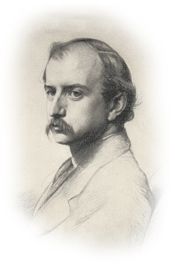 London, May 22, 1862
We are still in great anxiety to know the results of the Yorktown business, having as yet arrived only as far as Williamsburg and West Point. On McClellan’s success in dispersing the Southern army and capturing all the means for carrying on a war will depend more than I like to think of. If we can disperse them, too, we can immediately reduce our army one-half, and all our expenses on the same scale. I dread the continuance of this war and its demoralizing effects more than anything else, and happy would be the day when we could see the first sign of returning peace. It’s likely to be hard enough work to keep our people educated and honest anyway, and the accounts that reach us of the wholesale demoralization in the army of the west from camp-life, and of their dirt, and whiskey and general repulsiveness, are not encouraging to one who wants to see them taught to give up that blackguard habit of drinking liquor in bar-rooms, to brush their teeth and hands and wear clean clothes, and to believe that they have a duty in life besides that of getting ahead, and a responsibility for other people’s acts as well as their own. The little weaknesses I speak of are faults of youth; but what will they become if America in its youth takes a permanent course towards every kind of idleness, vice and ignorance?
As for our position here, it is all that could be wished. Everyone congratulates us on the success of our arms and there is no longer any hint at even a remonstrance, though there are questions between the Governments which in our bitter state of feeling may bring difficulty. I am very anxious to avoid anything of this sort. We must have peace for many years if we are to heal our wounds and put the country on the right track. We must bring back or create a respect for law and order and the Constitution and the civil and judicial authorities. The nation has been dragged by this infernal cotton that had better have been burning in Hell, far away from its true course, and its worst passions and tastes have been developed by a forced and bloated growth. It will depend on the generation to which you and I belong, whether the country is to be brought back to its true course and the New England element is to carry the victory, or whether we are to be carried on from war to war and debt to debt and one military leader to another, till we lose all our landmarks and go ahead like France with a mere blind necessity to get on, without a reason or a principle. No more wars. Let’s have peace, for the love of God.
England will truckle to us low enough when we regain our power, and we can easily revenge ourselves on the classes of English who have been most venemous, without fighting them all. It is but to shut out their trade and encourage our own development. I am now a protectionist of the most rabid description. I want to see us developing our mines, manufactures and communications, with the most success possible. There is England’s vulnerable point; but we shall have committed a blunder of the worst sort if we allow our personal prejudices to affect our national policy to the extent of a war….
The last week we have had that whited sepulchre General Cameron here, and as we were to have our first large dinner on Wednesday, he was invited to it. Then last night I took him to Monckton Milnes, where he was the object of considerable interest. I can’t say that I was proud of my charge, nor that I like his style. Thurlow Weed is quite as American, and un-English, but is very popular and altogether infinitely preferable. We all like Mr.Weed very much, and are sorry that he is going home this week. As for Cameron, I hope he will vanish into the steppes of Russia and wander there for eternity. He is of all my countrymen one of the class that I most conspicuously and sincerely despise and detest….
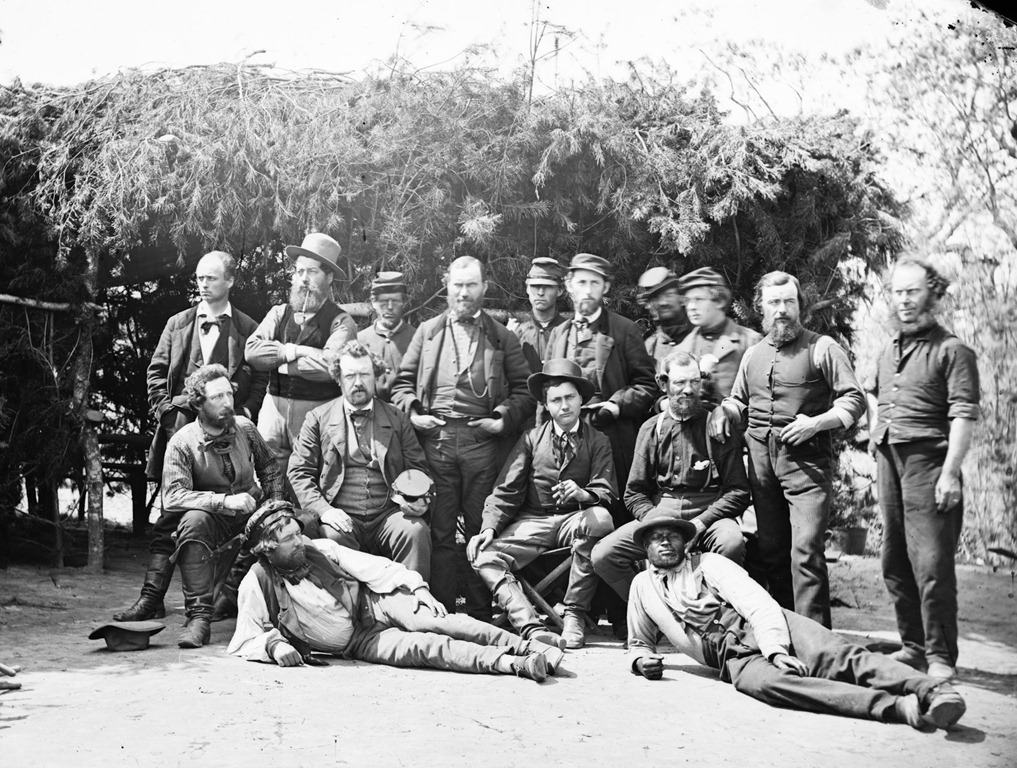
Cumberland Landing, Virginia.
Title is from Civil War caption books. A letter by Robert Pinkerton in the LOC collections file has additional information:
In the back row, left to right: H.B. Seybolt, Paul H. Dennis, (unidentified provost guard), Allan Pinkerton, (provost guard), George H. Bangs, (provost guard), John Babcock, Robert Pinkerton. In the front row, left to right: Paul Dennis, D.G. McCaulvey, William Pinkerton, Sam Bridgman. Lying down in front on the left is William B. Watts, chief wagon-master, and on the right is Sam Washingtin, cook.
Photograph from the main eastern theater of war, the Peninsular Campaign
Photographed by James F. Gibson
Part of Civil War glass negative collection. Library of Congress Prints and Photographs Division Washington, D.C. 20540 USA
Record pages for this image:
- negative http://www.loc.gov/pictures/item/cwp2003005949/PP/
- stereo card http://www.loc.gov/pictures/item/2011661152/ – misidentifies location as Cumberland, Maryland. The photographer was with the Peninsula campaign in May 1862 and took a good number of photos at Cumberland Landing on the York River.

May 22.—No battle occurred yesterday. Every one is confident that if the enemy would only fight, we would whip them soundly. They are digging intrenchments eloser and closer, and could shell Corinth at any hour. Some are not more than two and a half miles from us. We are beginning to feel a little nervous at the prospect of a shell waking us up some morning; certainly not a pleasant one to contemplate.
A prisoner is here, who eats at the table with us. He is a Presbyterian minister. He makes some very provoking remarks. Dr. Smith has advised us to take no notice of them, and say as little as possible. This appears hard, as nearly every one at the table has suffered some wrong at the hands of him and his people; nearly all their homes are in the hands of the enemy.
Dr. Sizemore has just received word of a young brother who has died in a northern prison, and of the ill treatment of the chaplain of his regiment, an inoffensive old man of more than seventy years, who had gone with the regiment more as a father than any thing else. This old man was imprisoned as if he were a common felon. Dr. S., knowing all this, has to endure the presence of this man, and see him treated as if he were one of our best friends. I must say that we are carrying out the commands of our blessed Savior; and how proud I am of it! May we be enabled to do the same to the end; and, above all things, not to retaliate upon the innocent, for God has said, “Vengeance is mine, and I will repay.” I was seated next to the prisoner to-day. He says that he is an Englishman. I would like to think that he is telling an untruth, as few Englishmen side with tyranny. But I expect that he has been long enough with the Yankees to imbibe some of their barbarous notions. He expressed the opinion that the southern people were not united. I remarked that if he would go through the state of Mississippi alone, he would change his mind, as I believed that if the men did not fight, the women would. But there will be no need of the latter, as the men will not fail to do their duty.
We requested Dr. Smith to permit us to pay him back for the impertinent remarks he had made to us. He granted permission, and stated that he would reprimand us in his presence. As soon as the foe made his appearance, some of the ladies commenced on him. Dr. S. said, “The ladies are very hard on you.” He replied with a very submissive air, “If it pleases them, I have no objection.” Mrs. Glassburn, who was at the head of the table, observed, “It does not please us; but I will tell you what will: when we know that every Yankee is laid low in the ground, then we will be pleased indeed.” He made no reply, and must have felt the force of the remark. At any other time it would have been a barbarous one; but at the present it was charitable, and one that we all felt, if realized, would not only be a blessing to us, but to humanity.

Eliza Woolsey Howland to her husband, Joe.
Floating Hospital, Spaulding,
Off White House, May 22.
We are to go on shore presently to see what we can do for the large field hospital there. Two of our doctors, Ware and Draper of New York, spent the day yesterday trying to organize it and make the men tolerably comfortable. They furnished from the Commission nearly a thousand mattresses, secured them fresh water in hogsheads (which they were entirely without) and saw that all who needed medicine got it. System and food seem to be the great wants, and to-day we ladies will attend to the latter, take them supplies and show the hospital cooks how to prepare them. There are 1,200 or more sick men there, and until the Commission took hold they were in a most wretched plight, lying on the damp ground without beds, without food or water, and with little or no care. … I hope you take all necessary precautions in this wretched climate. Don’t give up your quinine. . . .
Later. — Directly after I wrote you this morning Georgy and I went to the shore to breakfast the men we had dinnered and teaed yesterday, and there we had a little house nearby, which Dr. Ware had found, nicely cleaned out for a hospital or resting-place for the sick when the other overflows. The floor of one of the rooms up stairs is six inches deep in beans. That makes a good bed for them. . . . Meantime Mrs. Griffin and the others got this boat in order for sick, and this afternoon fifty odd have been brought on board. To-morrow it will fill up and leave for New York.
May 22.—An enthusiastic meeting was held at Portsmouth, Va., at which resolutions were adopted expressive of devotion to the cause of the Union, and condemnatory of the heresy of secession. Johannes Watson was elected President and R. S. Staples, Secretary.—(Doc. 101.)
—This morning while the Seventy-sixth New York regiment was marching through the city of Washington a number of civil officers provided with judicial papers, seized two negroes and soon placed them beyond the possibility of rescue.
An effort was made to arrest six or eight other alleged fugitive slaves, when many of the soldiers interposed, pointing their muskets at the police and warning them of the danger of persistence. They therefore retired — the negroes departing under the protection of their military friends.
—The foreign consuls at Galveston, Texas, in view of an expected attack upon that place by the United States forces, communicated with Captain Eagle of the Santee, with a purpose of fixing upon some point that might be respected in the bombardment, as a point of refuge for foreign subjects; when Captain Eagle replied:
“Let me assure you, gentlemen, that no person can deplore more than myself the misery that would result from the bombardment of the town of Galveston, and its fortifications, yet it is a duty that will become necessary to enforce its surrender. It is not in my power to give you any assurance of security during the bombardment, for it is impossible to tell what direction the shot and shell will take.”—Houston Telegraph, May 23.
—General Prentiss’s troops, captured at the battle of Pittsburgh Landing, Tenn., were paroled by the rebels at Montgomery, Alabama.—Mobile Register, May 27.
—This day company I, of the Seventeenth Massachusetts, left Newbern, N. C., on a scouting party to seize a quantity of cotton which the rebels were reported to have stored near Pollocksville, for the purpose of burning or carrying off as opportunity favored them. The party had proceeded but a few miles beyond the Union outposts, when, at the fork of the roads leading to Trenton and Pollocksville, they were suddenly met with a brisk discharge of musketry from every side. The woods all round suddenly became brilliant with the flashing of the pieces, and the party, deeming it probable that the rebels were too numerous and strongly posted to hazard any thing like a determined resistance, withdrew after firing a few rounds. The loss of the Nationals was three killed and eight wounded.— N. Y. Herald, May 30.
—The Court of Impeachment for the purpose of trying West H. Humphreys, late District Judge of the United States for the second district of Tennessee, on charges of treason presented by the House of Representatives, was organized in the Senate Chamber at Washington, D. C., this day.
—Six rebel pickets were captured near Battery Island, on the Stono River, S. C., by a small reconnoitring party from the United States coast survey steamer Bibb.


