Following the American Civil War Sesquicentennial with day by day writings of the time, currently 1863.

May 2012

Cold Harbor, Powhite Swamp,Va..

Friday, May 23, 1862.

Dear Sister L.:—

I think I have not written to you since we left Yorktown. Doubtless you have plenty of papers and have heard all about that long ago. We went on board a steamer there and landed at West Point, the head of York river, the day after the battle and camped three days on the battlefield. We then followed the “river road” up the Pamunkey to Kent Court House, Cumberland and White House landing, Tunstall’s, Hanover, etc., on the road to Richmond. We are now within ten miles of the rebel capital. What lies beyond I do not know, but suspect that the enemy is in considerable force not far off. General Butterfield sent me an order this morning not to give the reveille with the bugle, and the bugles and drums are as silent to-day as they were before Yorktown. We have had all the varied experiences of the soldier in the field since leaving Yorktown, marching through rain and shine, mud and dust, wading through creeks and drawing artillery and baggage wagons out of the sloughs. We make slow but sure progress.

The country is as beautiful a section as I ever saw. Lovely scenery, glorious landscapes, everything is beautiful and “only man is vile.” Great clover fields in full bloom spreading away over gentle swells of ground and broad fields of wheat all headed out abound. We stopped three days at the “White House” on the Custis estate. This is a large plantation, seven thousand acres of very productive land on the Pamunkey river, late the property of the rebel General Lee. It is the old homestead of the Custis family and occupied by them in the days of Washington. Here Washington first met Martha Custis, and here, on the very spot where Lee’s White House now stands, they were married. There are several hundreds of slaves on the estate and we had the opportunities we wanted to talk with them. Oh, they were a happy set of darkies when they learned that they were free. They were most of them born on the place. I saw one old Uncle Tom, over sixty years old, who had never been five miles from the place in all his life. He had worn his life away on these fields. Contrabands are pouring in on us every day. Almost every officer has one or two along now. They hardly know what to do with themselves on learning that they will never be returned to their masters.

The white inhabitants of the country are a miserable set. Every house exhibits the white flag as our troops pass. They are mean enough to take advantage of such protection and refuse a drink of water to our troops almost suffocated with heat. We have had some days when we could scarcely march half a mile without resting. Some of the boys went to fill their canteens at a well near the road. The woman of the house came out and stood by the well and told them they might go to the river to drink. She wasn’t going to have the d—d Yankees drink out of her well. It was well for her she was a woman. Our boys would have knocked a man endways who would insult them in that way and perhaps put a bayonet through him. The men are just as mean as the women, but a little more discreet. I went to one of the white flag houses and said to the man who stood in the yard, “Where do you get water?” “No water here, sir, I have to tote all I use right smart o’ two miles.” “I couldn’t see” any such yarn as that, so I made a reconnoissance and found a splendid spring not a dozen rods behind the house. I filled my canteen, and. when I went up showed it to him, with, “What do you call that but water?” “Oh,” says he, “we don’t never use that.” Says I, “What kind of a flag do you call that?” “Flag— flag—Oh, that’s a white flag.” “What is that a sign of?” “It’s a sign of truth.” “Don’t you think it would look better for a little more coloring?” “Well, I don’t know but it would, but I hadn’t anything handy to color it with.” “Well, I think you better get it down as soon as possible and fix it over as near like that one as you can” ( pointing to our regimental colors). “Well, I guess I will if I can find anything about the house to color it with.” (Mem. I guess he won’t.) I bought a secesh bill of him, and, thinking possibly you haven’t seen any, I’ll send it to you. It is a specimen of Confederate States art, beautiful to see but “not worth a red” to spend. Save it as a memento of the war.
“Spaulding,” May 23.

Deab A.,—Your welcome letter came yesterday. It is great happiness to know that you enter into the thing so heartily. You are right; it is worth five years of other life, setting aside the satisfaction of doing something directly for the cause. We are still on board this ship, comparatively idle. Yesterday sixty men were sent down from the front; but the surgeon of the Shore hospital refused £o take them, alleging that he had no room. A tremendous thunder-storm came up, in the midst of which we ran up to the landing-place in our little tug, the “Wissahickon,” and found the men, who were lying on the ground by the side of the railway. We gave them brandy and water, tea and bread, washed them a little, brought off a dozen of the worst cases, and left the others comfortable for the night, with blankets and quilts, in two covered freight-cars. This morning we went up with their breakfast, and had the satisfaction of seeing them off in ambulances for the Shore hospital, owing to Mr. Olmsted’s strong remonstrances.

This vessel, the “Spaulding,” is filling today, and sails for New York on Sunday. We shall then go on board the “Elm City,” and the hospital company of that boat, including two ladies, Miss Whetten and Mrs. Strong, will take charge of this one. Mr. Olmsted has the greatest difficulty in preventing the authorities from forcing on our pity by their neglect the sick men who are now here and coming down daily. These men ought to be taken care of in tents ashore. If forced upon us and a battle occurs, our boats will be off with men who ought not to go, and we shall have no accommodation for the wounded. Yesterday and today we have heard cannonading at the bridge over the Chickahominy; and these slight skirmishes send us down a dozen or two of wounded daily, who are placed at once on board the “Elm City.”

General Van Vliet, Quartermaster-General of the Army of the Potomac, came to see us today, accompanied by Captain Sawtelle, Assistant-Quartermaster. The General was full of kindness and gallantry, — quite bubbled over with it; and offered us a railway-car to take us into Richmond as soon as it is occupied! We heard last night that McDowell’s pickets had met ours: God grant it may be true! There is little doubt that McDowell’s not being allowed to co-operate at Gloucester prevented the overthrow of the Rebellion at Yorktown; and yet this McClellan keeps on with a sunny heart, and, as General Franklin said, “does his best alone!”

On Wednesday we were invited on board the “Sebago,” Captain Murray. A gun-boat is very interesting. She carries two large guns and a few howitzers. The large guns (Parrotts, these were) stand in the middle of the deck, one aft, and the other forward, and turn on pivots in every direction. The bulwarks can be turned down, to allow the guns free range; they are turned up for a sea-voyage: but even then these boats ship a great deal of water. It was delightful to be on a trig man-of-war. The officers seemed so clean and fresh, after the dusty, thread-worn look of the army-officers. It is easy to keep neat on board ship, but very hard to do it on the march, especially through the red clay soil of Virginia. The “Sebago” was the gun-boat which, accompanied by a tiny propeller with one hundred and fifty infantry on board, ran a few miles farther up the Pamunky the other day, — at sight of which the enemy burned two steamers and twenty schooners.

Not much has happened to interest us out of our own world. To us the arrival of our various steamers, and the consequent visits, inquiries, and thefts, are matters of great importance. We go on board some newly arrived ship, and find up the parties in charge of the invoice: “Sixteen pails! we’ll take eight” “Essence of beef! we want all that;” “What! fifty cans?” “Fifty! we must have a hundred,” — and so on through sugar, arrowroot, farina, spices, lemons, whiskey, brandy, etc.; while the doctors make a raid of the same kind on the dispensary. Kleptomania is the prevailing disease among us. We think nothing of watching the proprietor of some nicety out of the way, and then pocketing the article. After such a visit, Georgy’s unfathomable pocket is a mine of wealth as to nutmeg-graters, corkscrews, forks and spoons, and such articles. I, being less nimble at pilfering, content myself by carrying off tin pails with an abstracted air. Perhaps our visits do not give the keen satisfaction to others that they do to us. But they are going back where they can get more; while to us who remain here, such articles are as precious as if they were made of gold.

I am perfectly well. To please others, I “prophylac” with the rest. I drink coffee in excess, and whiskey (with quinine) occasionally, and eat alarming dinners. We shall be thankful to get off this ship, where we have green velvet chairs to sit upon, and are unable to get proper cooking arrangements for the sick. “We regret our dear “Wilson Small,” where we lived on a permanent picnic, which was in keeping with our business and our spirit.

To-day Mr. Olmsted invited Mrs. Griffin and me to row with him along the shore. You know I dread little boats; but it was a prospect of enjoyment, and I could not forego it. The start was lovely. Mr. Olmsted rowed us close in shore, where the knotted roots of the outermost trees made a network, or paling, behind which drooped or glowed in their spring beauty the lovely trees of this region, among them the magnolia, the flowering catalpa, and the beautiful white fringe-tree. Presently some quartermaster hailed us, and we turned back to the “Spaulding,” which had swung to her anchor in the mean time, making the business of getting on board again so dreadful to me (Mrs. Griffin did not seem to mind it) that that moment is laid aside to come into play some day when I have brain-fever; and then I shall see the huge, black, bulging sides of the great ship hanging over me as I pop up and down in a paper boat.

Mrs. Griffin looked to-day so like a mediaeval Madonna, with her heavenly complexion, her golden hair, and the extremely angular appearance which we persist in keeping up without our hoops, that I was forced to suggest the idea to Mr. Olmsted, who entered thoroughly into it.

May 23rd. At seven o’clock I rode out and withdrew the picket line under Jones, and when the brigade came along, we fell in to form the advance. It is by all odds the best position in a large army; one has first chance at everything, and there is a great fascination in leading an advancing army through an unknown, hostile country, especially when the armies are close together; although so near to Richmond at the start, we managed to make a long and tiresome march, roads dusty, and the day hot; about noon filed off the road into a field to the left, and went into bivouac. The pioneers put my office tent up and I went to work making out sundry reports. We are close to the Chickahominy now, and the rebels are within four miles of us, entrenched on the other side. On the 20th, Casey’s division, of the fourth army corps, crossed the river at Bottom bridge, and to-day the remainder of the corps is crossing. Franklin’s corps is on our right, with Porter’s in reserve; our second corps has the centre, and Keys the left; Stoneman and the cavalry are on the extreme right, about New Bridge; all facing the left bank of the river. We commenced bridging the river as soon as we got our tents up, and I suppose as soon as it is done, we shall cross over and attack. In the afternoon I packed up a large box of records, regimental books, and also the two silk guidons, and turned it over to the quartermaster to send to Washington for safe keeping; this diary goes with it, for no man can guess what the next few days may bring forth. Other preparations all indicate the near approach of the deadly struggle for supremacy. Three days’ rations are ordered to be prepared, and constantly maintained; sixty rounds of ammunition were served to each man at parade to-night, and all unnecessary camp equipage turned in to be sent away. One can easily see that something of great importance is near at hand by the quiet demeanor of the troops; they are evidently doing a good deal of thinking.

Abby Howland Woolsey to her sister, Eliza Howland.

Dear E. : The returning Spaulding takes to you 12 Boston rockers, 6 boxes of brandy (if it gets there), 1 package of mosquito bar (getting very scarce), a bundle and a basket, and chewing tobacco, for Charley to distribute ! . . . Tell him the 22d marched in splendid order; their own uniforms and long yellow leather leggings. The cheers and fireworks and interest all along the line were as great as the 7th ever elicited. Carry and Charles Johnson sat on a stoop on Broadway, till ten o’clock night before last, to see them pass. We hear that they are ordered to Harpers Ferry.

May 23.—Have had two very nice men here, wounded—a doctor and a captain. They are friends of Mrs. G. Dr. Smith sent them to Rienzi, where the Mobile ladies are. Mrs. G. visited them, and came back perfectly delighted with the hospital arrangements there. She says that Mrs. Ogden is an excellent manager. I am glad of this, as she has had a great deal of opposition from surgeons, as all of the ladies have who have desired to go into hospitals. I can not see what else we can do, as the war is certainly ours as well as that of the men. We can not fight, so must take care of those who do.

I think as soon as surgeons discover that ladies are really of service, that prejudice will cease to exist. The patients are delighted to have us, and say that we can cause them to think of the dearest of places to them now—home.

Miss Marks is a little better, and has been sent to Okolona. The other two ladies who were sick have returned to Mobile.

Every corner of the hospital is clean, and ready for patients. The last of my patients died this morning. He was a German, named Ernest; was wounded at Shiloh. He wandered a good deal in his mind; but just before he died he sent for Dr. Smith, and requested him to write to his wife, and send her all the money he had. She lived on Magazine Street, New Orleans.

One of the saddest sights witnessed are two Federals, who have been here since the battle of Shiloh. One has had his arm, the other his leg amputated. They are seventeen and eighteen years of age, respectively. They look very pitiful, dying among strangers, far away from their homes and relatives. They have been cared for the same as our own; but that is not all that is wanted. They need sympathy, and of that character which it is impossible for us to extend to them, as they came here with the full intention of taking all that is dear to us. They may have been conscientious, and thought that they were doing their duty, but we are of a different opinion, and it will be some time before we change. They will soon die; both are religious. I never look at them without thinking of the thousands of our poor men who are in the same condition in the North. I do sincerely trust that they are as well treated as these poor fellows have been.

Dr. Nott, with several other surgeons, has examined the hospital. He looked well. He has lost a son in the war.

Abby Howland Woolsey to her sisters Georgeanna Woolsey and Eliza Howland.

May.

My Dear Children : . . . Doesn’t Charley want something? Mother is racking her brain to think what it can be, as he no doubt does want something, going off in the hurry he did. She is afraid, too, that he is exposed to illness— running risks from the climate, from contact with soldiers’ clothing, from the atmosphere of the hospital ship, etc., etc.

Yesterday, Jane, Carry, Mrs. Buck, and Col. Bliss and a few others, started from Park Barracks for Bedloe’s Island on a committee of investigation. They chartered a little steam tug at ten dollars an hour, and went from the Battery, not staying very long, and quite enjoying the trip. They found the hospitals extremely comfortable. Some sick in the brick barracks, and some in three large hospital tents— close on the shore, with the sea breeze driving through them, and the waves rippling up close by. The men they saw were as pleased with their accommodations as could be, and everything looked ten times better ventilated and more hopeful than at the City Hospital, for instance. They have about a hundred men on Bedloe’s Island— mostly from the Ocean Queen— and not many now are alarmingly ill. The ladies took down four large baskets of oranges, jelly, towels, etc. —some of the abundant supplies that have been pouring in at the Park Barracks— and we are to get together next week some books for a library. Jane says she has seen what does her heart good at the City Hospital— some tidy, sensible, once-upon-a-time-fashionable ladies, nursing men every day in the fever wards — Mrs. Charles Strong, Miss Irving, and four or five others ; they went down and offered their services, which were accepted — such was the great number of sick, and the necessity of an immediate increase of nurses ; and they go down every morning at seven and go away at seven, taking their meals down there. Hired nurses, men, watch at night. Here was an excellent chance to put some of the port wine uncle E. sent us, into use. Jane came right up for a jug and put it in Mrs. Strong’s charge, and it has been of inestimable use already to some of the patients. These ladies must have served a week or ten days now, and will continue daily. They do everything for the men, under the direction of the doctors, administering food and medicine. It is really most praiseworthy and delightful, and, as in the case of your young doctors whom you like so much, gives you a better idea of human nature — their human nature, at all events. I cannot say so much for the young doctors of the New York Hospital as you do for yours. They made a strike the other day for increase of salary, writing the Trustees quite an impudent letter, reminding them what advantages the State now offered to volunteer surgeons at Yorktown, etc., and requesting an immediate answer. They did have a very immediate one. The gentlemen assembled next morning and sent the young doctors word that they could have just so many hours to pack up and quit,— an answer that astonished and mortified them. You see it was very mean, for it was just when the largest number of sick that the house could contain were being brought in. The Trustees intended to increase the corps of surgeons, but that these residents would not listen to, “they were fully competent to do all.” Jane went down this morning with Mrs. Professor Hitchcock, Mrs. Smith, and Mrs. Buck, to take their turn at 194, but found that the last week’s committee and their friends to the number of twenty, were so firmly established still, that they refused all hints about “relinquishing the keys,” being “tired of the service,” etc., etc. ; “Oh, no ; we are as fresh and interested as possible:” and indeed they were, though they were at the rooms until one last night, when Colonel Howe chartered an omnibus and sent them home. They had received all those who came yesterday afternoon by cars from Baltimore, and had worked faithfully, and hated to give up to the new set.

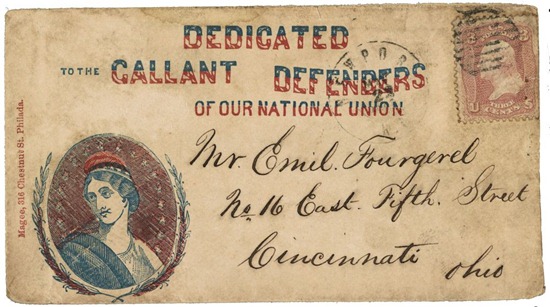
Civil War envelope showing bust of Columbia encircled with laurel branches

Civil War envelope showing bust of Columbia encircled with laurel branches bearing message “Dedicated to the gallant defenders of our National Union”

Addressed to Mr. Emil Fourgerel, No. 16 East Fifth Street, Cincinnati, Ohio; postmarked Newport, R.I., May 23; bears 3 cent stamp.

Collection: Liljenquist Family Collection of Civil War Photographs (Library of Congress)

This envelope and additional information may be found here at the Library of Congress

May 23.—Colonel Kenly’s command of infantry and cavalry, in General Banks’s department, was driven from Front Royal, with considerable loss, by a large body of rebels.—(Doc. 43.)

—Captain Tilford, stationed with forty men on the east side of the Rio Grande, seven miles below Fort Craig, N. M., received a summons to surrender from a band of two hundred Texans. He refused; but after fighting for three hours, was obliged to retreat to Fort Craig with the loss of three wounded.—Denver Herald.

—Portions of the army of the Potomac crossed the Chickahominy River in two places, at the Railroad Bridge and at Bottom’s Bridge.

—The battle of Lewisburgh, Va., was fought this day. The rebel Colonel Heath attacked Col. Crook with three thousand infantry and cavalry, and six cannon. After a spirited fight of an hour, the rebels were put to flight in utter confusion, and their flight soon became a rout. Col Crook captured four rifled cannon — one so near his position that it was loaded with canister—and caissons, and eight rounds of ammunition.

The rebels, in the early part of the fight, carried off their killed and wounded, but left on the field thirty-eight dead, including several officers, and sixty-six wounded. A hundred prisoners were captured, among them Lieutenant-Colonel Finney, Major Edgar, and others. Three hundred stand of arms were taken. In the evening, to secure their retreat, they burned Greenbrier bridge, beyond which they could not be pursued. Crook’s victory was won only by hard fighting against greatly superior forces. The Nationals lost fourteen killed, sixty wounded, and five pickets captured. Some of the wounded were shot in the streets of Lewisburgh, as they were returning to the hospital, by the citizens of the town.—(Doc. 44.)

—The town of Grand Gulf, Miss., was shelled by the Union gunboats Richmond and Hartford. Considerable damage was done to the town, but no person was injured.

The reason assigned for the shelling was, that two United States transports loaded with soldiers were fired into by a masked battery of four guns in the vicinity of the town.—Jackson Mississippian, June 4.

Camp Flat Top Mountain, May 22, 1862.

Dearest : — I have written you one or two letters which I suspect fell into the hands of the enemy, but ere this, I do not doubt, you have received dispatches and word by Thomas which relieves you of all trouble on my account.

We have had a good deal of war this month. More than half the time during two weeks we were in the presence of the enemy. Most of the time they [we] were either pursuing them or they were crowding us. The number killed and wounded, considering the amount of firing, was not large. I suppose the total loss of this army would not exceed two hundred. Our force is not strong enough to do the work before us. We have so many points to garrison and so long a line of communications to protect, that it leaves a very small force to push on with. . . .

Before this reaches you, the great battles of the war will probably be fought. If successful, we shall not meet with much determined opposition hereafter. I was sent to meet a flag of truce sent by General Williams and Humphrey Marshall this morning. The officers talk in a high tone still, but the privates are discouraged, and would be gladly at home on any terms.

Affectionately,

R.

Mrs. Hayes.

Camp Flat Top, May 22, 1862. Thursday. — Today Colonel Scammon with a small escort went over to Packs Ferry to look after affairs with Major Comly and his boat-builders. A Captain Jenkins, of Kentucky, came from General Williams to negotiate as to exchange of prisoners. General Cox detailed Lieutenant-Colonel Hines and myself to meet him. After some reflection, I suggested that it was honoring Captain Jenkins too much to send two lieutenant-colonels, and the programme was changed.

I have caught a bad cold, the worst I have had since I came into the army, caused chiefly by changing underclothes and stockings from thick to thin.

Called on Colonel Moor of the Twenty-eighth. The German officers are neater and more soldierly in dress and accoutrements than ours. The Twenty-eighth has a fine band, twenty or twenty-four musicians. Wrote to Lucy a short letter — no flow in it; but how I love my wife and boys! All the more tenderly for these separations.