Following the American Civil War Sesquicentennial with day by day writings of the time, currently 1863.

May 2012

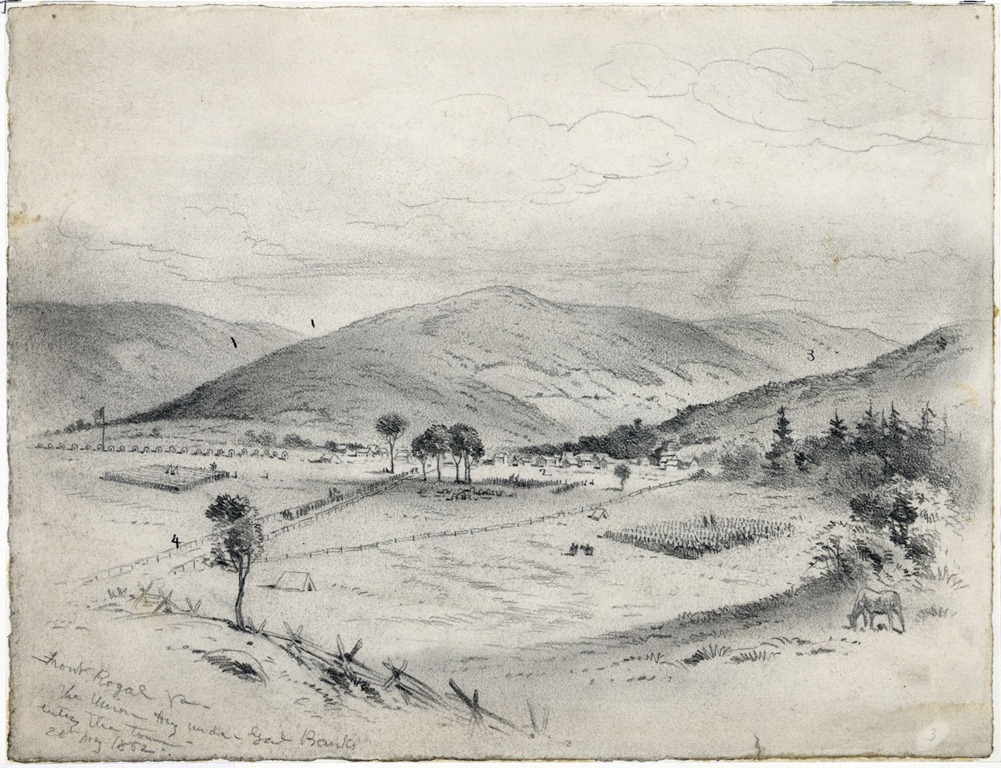
Front Royal Va.--The Union Army under Banks entering the town

“Front Royal, Va. Occupied by the Union Army commanded by Genl. N.P. Banks” on mount.

artist: Edwin Forbes.

Part of Morgan collection of Civil War drawings..  Library of Congress Prints and Photographs Division Washington, D.C. 20540 USA

Record page for this image: http://www.loc.gov/pictures/item/2004661888/

May 21st. The regiment drilled to-day for the first time since we left Yorktown; the colonel put us through many movements, completely tiring the men out. Towards evening while enjoying our otium cum dig, after the fatigue of the drill, and laying out plans for the evening sport, orders came to strike tents and march at once. By five o’clock we were en route, and to our surprise and disgust, marched till twelve o’clock, over circuitous, poor wood roads, mostly running through dark pine woods. At midnight we debouched into an opening, at the junction of two railroads and bivouacked for the rest of the night. Just as we were preparing our bivouac, an order came for the regiment to go out on picket duty, in front of the division, so we fell in again, and marched out about a mile in front, and established a line of pickets just inside the cavalry videttes; reserves were posted at convenient distances, and then selecting an immense tree, on the side of a hill, near a house, for headquarters, we posted a sentry, wrapped ourselves in our blankets, and went to sleep. At daylight our people built a fire, and the cook served a good breakfast. The colonel and I rode out immediately afterwards, inspected the whole line, and made a sketch of the country, dotting down the picket line upon it. At the foot of the tree, our headquarters, there is the finest spring I ever saw; the water is as clear as crystal, and cold as ice, so cold in fact, one cannot wash in it; it bubbles out in great volumes; rushing down the hill, emptying into a fine brook, in which I counted six trout. When the colonel and I came in from the inspection of the lines, he proposed we go down to the spring and take a bath, I got undressed first, and jumped in and was almost frozen, so the colonel concluded not to try it, contenting himself with a good sponging. In the course of the day the colonel, McKim and I called at the house and looked over it, and also the garden, which is a very fine one. All the white people were gone, leaving the place in charge of negroes; they told us the cavalrymen had been there and carried off almost everything of value, but we thought the house had been very little disturbed. It belongs to a doctor, and is luxuriously furnished throughout. There is an excellent library, containing many standard works, and lots of Latin and Greek books. The beds in some of the rooms were covered with silk and satin covers, and hung with silk curtains. Many of the cabinets had been broken open, but perhaps the niggers had been at them themselves. In the garden, were beds of asparagus, onions, lettuce and peas; plenty of currant and gooseberry bushes, and delightful beds of flowers. We stationed a guard at the house, to keep the men away. One of the colored women gave us some fresh milk, and on our return home, the doctor made it into a punch. At two P. M. a terrific thunder shower came up, soaking us to the skin before we could find shelter. It lightened terrifically, making it mighty dangerous to be near the lines of stacked muskets. It soon cleared off, however, and was very hot afterwards. Just before turning in for a little sleep, we received orders to be ready to march at eight o’clock in the morning. There is a mile stone at the railroad junction, which says fourteen miles to Richmond, so we cannot make many more marches without coming in front of the forts.

May 21.—News has just reached us that the battle has commenced in earnest. A number of our surgeons have been ordered to the battle-field. May God give us the victory! I feel confident that if we could gain one here the war would soon be over, and that we would be recognized by foreign nations. I can not see why they do not now recognize us. We certainly can and will be free. My only wish for them to do so is to stop bloodshed, as I think, if they would do it, the North would be compelled to let us alone.

I have just been informed that the Yankee gunboats have passed Fort Morgan. I hope, if true, that Mobile will be laid in ashes before the foot of the vandal foe is permitted to desecrate it. They have not the same excuse that the people of New Orleans had—a large population of women and children; and then we have an outlet which they did not have.

Miss Marks is still very low. I feel very sorry to see her die in this terrible place; but it matters little where we die, so that we are prepared.

From Dr. Hugh Lenox Hodge.

On Board Hospital Ship “Whilldin,”

Chesapeake Bay, May 21, 1862.

Dear Georgy: We are again on the Bay on our way to join the army. I was very sorry that we moved up to Queen’s Creek for the wounded of Williamsburgh before Eliza and yourself examined the Commodore. For a few days we were very busy. Some 1,500 wounded men passed under our charge.

I was home for a day or two and saw Hatty. Mother enjoyed her visit very much. I send this to you, though I do not know where you are, simply to announce that I hope soon to see you. As we both have the same object in view, may we arrive at the same spot again, no matter where that may be.

May 21.—To-day the battle of Philips’s Creek, Mississippi, was fought by the second division of General Halleck’s army, commanded by Brig. Gen. Thomas A. Davies. The rebels were routed, leaving a good many prisoners, guns, haversacks, blankets, etc., in the hands of the Unionists.—(Doc. 113.)

—Commodore Prentiss, with the United States steamer Albatross, penetrated the interior waters of South-Carolina as far as Georgetown, and up the Waccamaw River ten miles above the city, but having an insufficient force, he did not make an attack.

—General Stoneman, in company with Prof. Lowe, made a balloon reconnoissance this morning, from Gaines’s Mills, Va., and reaching«n altitude of five hundred feet, obtained a complete view of Richmond with the aid of a glass. Very few rebel troops were visible within the limits of the city, but at the left of it, on the line of the road leading to Bottom’s Bridge, a large number were seen.

—At one o’clock, to-day, two mortars opened on Fort Pillow, and the firing was kept up at intervals of five minutes, until six in the evening. It was returned three or four times by guns from the rebels, either from the fortifications or from their mortar-boats, their shells bursting wide of the mark, and doing no damage.

Deserters from Fort Pillow state that one hundred and eighty dead bodies were removed from the rebel rams and gunboats on their return from the late naval engagement On the Mexico, whose boilers were exploded by a well-directed shot from the Benton, every man was either killed or so badly scalded as to render recovery doubtful. None of the rebel vessels, according to this story, were entirely sunk, but three of them were so badly disabled as to be rendered almost useless. The impression at the fort was that they had been badly whipped.

—Three regiments, consisting of the First, Second and Twentieth Kentucky, under command of Col. Sedgewick, made a reconnoissance near Corinth, Mississippi, for the purpose of ascertaining the position of the enemy. After some sharp fighting, which lasted for about two hours, in which he had some thirty men wounded, Col. Sedgewick, being completely successful, returned to camp.—(Doc. 114.)

—Recruiting offices which had been previously closed were reopened by order of the United States Government.

—Brigadier-General I. P. Hatch, commanding the cavalry in Gen. Banks’s division, on his retreat, with a detachment of one hundred and fifty of the Fifth New-York cavalry, attacked a large body of Ashby’s cavalry near Strasburgh, Ya,, killed six, captured the same number, and “drove the remainder before them several miles at a full gallop, without the loss of a man.”

—General McClellan sent the following despatch to the Secretary of War:

“I have just returned from Bottom’s Bridge. Have examined the country on the other side, and made a reconnoissance on the heels of the enemy, who probably did not like the skirmish of yesterday. The bridge will be repaired by to-morrow, and others built as the camps have advanced to-day.”
Camp On Flat Top Mountain,
May 20, (Tuesday), 1862.

Dearest : — Here we are “back again” — fifty or sixty miles in rear of the advanced position we had taken. The short of it is, since the Rebel disasters in eastern Virginia they have thrown by the railroad a heavy force into this region, forcing us back day by day, until we have gained a strong position which they are not likely, I think, to approach. I do not think there is any blame on the part of our leaders. We were strong enough to go ahead until recent events changed the plans of the enemy, and made it impossible [for us] to reinforce sufficiently. I was much vexed at first, but I suspect it is all right. We have had a great deal of severe fighting—fragmentary — in small detachments, but very severe. We have had narrow escapes. My whole command was nearly caught once; the Twenty-eighth barely escaped. General Cox and staff got off by the merest chance. Colonel Scammon’s brigade was in close quarters, etc., etc. And yet by good luck, we have had no serious disaster. We have lost tents and some small quartermaster stores, but nothing important. In the fighting we have had the best of it usually. The total loss of General Cox’s command is perhaps two hundred to three hundred, including killed, wounded, prisoners, and missing. The enemy has suffered far more. In my fight at Giles, the enemy had thirty-one killed and many wounded; our total casualties and missing, about fifteen. We shall remain here until reinforced or new events make it possible to move.

I see the Thirty-third, not the Twenty-third, gets the credit of taking Giles. Such is fame. No Thirty-third in this country. [The papers also said] Major Cowley not Comly, and so on. Well, all right. General Fremont complimented me for “energy and courage” and the Twenty-third for “gallantry” to this division. So it is all right.

Jim is here in our brigade (the Twelfth Regiment) looking very well. Dr. Joe well. Adjutant Avery is to take this to Raleigh only twenty miles off. We are connected by telegraph with you too, so we are near again for a season.

Affectionately,

R.

Show this to Steve [Stephenson].
Mrs. Hayes.

Camp On Flat Top Mountain On Line Between
Mercer And Raleigh Counties, May 20, 1862.

Dear Uncle: — The last three weeks has been a period of great activity with us — severe marching, sharp fighting, and all sorts of strategy and manoeuvring. I had command of the advance southward and marched to within ten miles of the railroad, seventy miles south of this. This was ten days ago. On the morning of the 10th the enemy attacked us in greatly superior numbers and with artillery. In obedience to orders we have been falling back ever since. I was much vexed that we were not reinforced. Perhaps I was wrong. It is now believed that the enemy, since their reverses in eastern Virginia, have been sending heavy bodies of troops this way; that our force is wholly inadequate to its task, and must wait here until largely strengthened. I am not sure about this, but accept it without much grumbling. As I had command of the advance, I also had command of the rear-guard during the two most perilous days of the retreat. I am glad to know that nobody blames me with anything. Perhaps nobody ought to be blamed, certainly not if the force of the enemy is correctly reported. We have got off very well, having the best of all the fighting, and losing very little property in the retreat, and conducting it in good order.

General Cox and staff narrowly escaped capture. My command had a narrow escape. With any common precautions we should have been captured or destroyed, but luckily I had mounted pickets two miles further out than usual and got notice of the trap in time. The total loss of my command up to yesterday since May 1 inclusive is seven killed, six missing, and thirty-five wounded. We have killed forty to fifty of the enemy, captured about fifty, and wounded a large number. We have captured and destroyed many arms, and lived on the enemy’s grub a week. We also took several teams and waggons. We have lost our tents (except headquarters) and part of our mess furniture.

We shall remain here and hereabouts some time to get reinforced and to get supplies. We are in telegraphic communication with the world and only sixty miles from navigation.

Dr. James Webb is now in this brigade, assistant surgeon of the Twelfth Regiment O. V. I. Dr. Joe is brigade surgeon. We shall enjoy a few days’ rest here. The Twenty-third is a capital set. They always stood up squarely to the work and enjoyed it. A vast difference between raw troops and those who have tried it enough to be at home.

Love to all. Good-bye.

R. B. Hayes.

S. Birchard.

Camp on Flat Top Mountain, May 20, 1862. — Monday, 19th, marched from camp on Bluestone River to this point (yesterday) — a hot dry march — with knapsacks. I supposed we were to go only five miles; was disappointed to find we were retreating so far as this point. Being out of humor with that, I was out of sorts with all things; scolded “some” because the column was halted to rest on the wrong side of a stream which had to be crossed single file; viz., the near instead of the opposite side; mad because Colonel Scammon halted us in the sun half an hour — no water — without telling us how long we were to halt, etc., etc. But got good-humored again soon. Must swear off from swearing. Bad habit. Met Dr. Jim Webb, assistant surgeon of [the] Twelfth, yesterday as we approached here. March fourteen miles.

[Today], Tuesday, 20th, rains occasionally — a cold rain. No tents, some trouble, but men are patient and hardy. Heard of Ike Nelson’s wounds, four to six in number and twenty bullet holes in his clothing. Left for dead but got well.

Avery and Captain Drake go to Raleigh this morning. We are holding on, waiting for supplies in the place of the tents, etc., we have lost. No news yet of Richmond’s having been taken, but it is likely soon to fall unless we are defeated.

London, May 20, 1862

It has rained every day at some time in the day for eight or ten days. People begin to look dismal and croak about the crops. To Great Britain every day of sunshine lost is equal to an expense of just so many thousand pounds. The islands never produce bread-stuffs sufficient for the consumption of the people annually. They must beg some millions of quarters of wheat at any rate. In bad years they buy just so much more. Hence it is that at this season every bad day sensibly affects the price of stocks. No country ever had a more sensitive thermometer of the weather. But if this be true in ordinary times, how much more so in this season. The supply of cotton is rapidly and steadily declining. And the poor operatives of Lancashire are coming nearer and nearer to the time of starvation for want of work. If upon the top of this there should come a dearth of bread, it is not difficult to understand the extent of the social distress that may ensue. So there are miseries quite as acute as those of war which now afflict us.

In the meanwhile things are looking better rather than worse with us. The game of secession looks as if it might be nearly played out. The country is just putting forth its power whilst the rebel armies are gasping for breath. I have been here now more than a year, during which time I have gone through nearly every variety of emotion in connection with this war. The time is approaching, I trust, when this anxiety will disappear, and with it the uncertainty of my own situation. Doubtless others may succeed, of an equally serious nature. We shall have upon us the dangerous and critical task of restoration of the civil and a diminution of the military power. All this is very likely. But at any rate that condition presents a different face to external nations. It does not materially impair the entireness of the national position. I shall therefore accept the transition with cheerfulness and accommodate myself to the new state with more cheerfulness than to the old….

MAY 20TH.—The President, in response to the Legislative Committee, announced that Richmond would be defended. A thrill of joy electrifies every heart, a smile of triumph is on every lip. The inhabitants seem to know that their brave defenders in the field will prove invincible; and it is understood that Gen. Lee considers the city susceptible of successful defense. The ladies are in ecstasies.