Following the American Civil War Sesquicentennial with day by day writings of the time, currently 1863.

May 2012

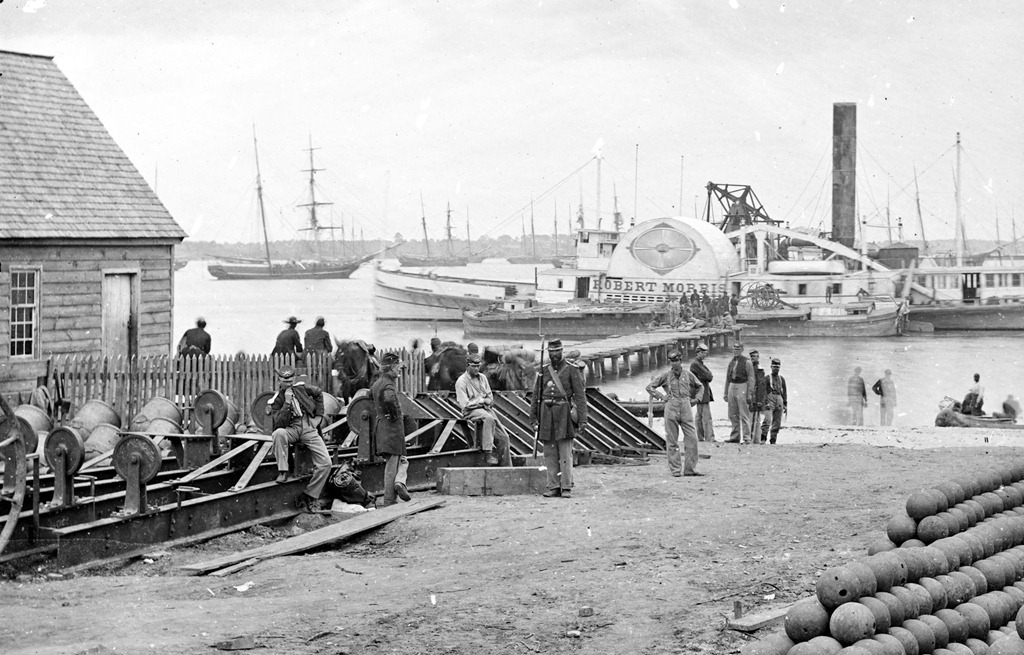
Union soldiers and supplies including stacks of cannon balls at the dock in Yorktown

Embarkation for White House Landing, Va. from Yorktown; Stereograph showing Union soldiers and supplies including stacks of cannon balls at the dock in Yorktown, Virginia. Steamships in the distance will transport the supplies to White House Landing Virgina.

Photograph from the main eastern theater of war, the Peninsular Campaign

Brady & Co. (Washington, D.C.), photographer

Part of Civil War glass negative collection. Another version in stereograph card collection.  Library of Congress Prints and Photographs Division Washington, D.C. 20540 USA

Record page for this image: http://www.loc.gov/pictures/item/cwp2003000047/PP/ and http://www.loc.gov/pictures/item/2011660458/

May 19—The battery was reorganized to-day, officers elected, and non-commissioned officers appointed.

Chew was re-elected captain. We might search over the whole State, and it is very doubtful whether we could find his equal in every respect as a commander of artillery. For competency and skill in handling a battery on the field his equals, according to my judgment, formed by observation, are few and difficult to find. He is gallant and brave, a strict disciplinarian without the least sign or flavor of arrogance or overbearing haughtiness, as calm and cool on the battle-field as on dress parade, and generous and impartial to his men, always manifesting a care for their welfare on the battle-field as well as in the camp and bivouac. All these characteristics are of much importance to men on the field and in camp, and are hardly ever found in one bunch, consequently he has now the esteem and utter confidence of every man in the battery.

I was appointed first corporal, which means first gunner in the battery. I know very little about gunnery — in fact, nothing except that a gun in good health never shoots backward. This gunnery business is something new to me, and will be a new field for my brain to browse in. I am afraid it will take a dogwood mallet to beat even the elementary principles of efficient practical gunnery into my skull. I heard it thunder, and do not know where, but the echo of the reverberation seemed to whisper strange words to me, like these: “The trajectory of projectiles, the windage of shot or shell during their flight, application of scientific principles to practical gunnery on the field.” All these strange things will come crowding on my brain in one flock when the next Yankee battery opens on us, if I am called on to direct the response. Yet I can plainly see that if I ever acquire any efficient knowledge of practical gunnery it will have to be gathered on the battlefield, a rather dangerous place for experimenting with fireworks in the hands of a rawish green tyro. If any Yanks should happen to get hurt by my first attempts at gunning, it will be their fault, not mine.

Near Corinth, Miss., May 19 ,1862.

Our regiment now is acting as a kind of rear guard for Pope’s division. The enemy’s cavalry in bodies of from 1,000 down have been running around our left flank and threatening to interfere with our trains. Every day we send out six companies to patrol between here and the river and forward. Yesterday (Sunday) I was out. We went to Red Sulphur Springs, one of the most romantic, beautiful places I have ever seen. There are about 40 double cottages for families, and stables, kennels and quarters for the servants, hounds and horses. The buildings are in good repair, though the place has not been frequented much for the last three or four years. White Sulphur Springs are four miles from the Red and more fashionable. I am going there to-morrow. There were about a dozen real ladies at the springs yesterday, and they were quite sociable and so interesting that I could not help staying an hour after the column left. We were the first of our soldiers that the party had seen and they were much surprised that our boys behaved so well. None of them had ever been North, and they occupied about all the time I was with them in asking questions, principally though, about the conduct of our army. About a mile before we got to the springs we passed a house where there were as many as six young ladies in full dress. The major sent me to make some inquiries of the man of the house, and I noticed the party were in something of a flurry but ascribed it to the presence of our men. Of course Sunday was an excuse for the finery and there being so many together. After we had advanced a little way one of our captains took a squad, went ahead and passed himself for a Rebel officer just from Corinth. By his figuring he found out that at this house I have spoken of they were expecting some Rebel officers and men, 14 in all, from Corinth to dinner and a visit. We set a trap for them, but they heard of us through the citizens and sloped. They came within a mile of us and then their tracks showed they had gone off through the woods and a swamp on a run. We got one of their horses, a beauty, fully equipped. It being a hot day the owner had strapped his coat on his valise and not having time to take it off we got it. A dozen of our boys went back and ate the dinner, but without the company of the ladies who had flown. Our line has now closed to within two and one-half miles around the north and east sides of Corinth. Our men have thrown up breastworks within that distance along nearly the whole line. The cannons play on each other occasionally, say as an average four times a day, a half hour each time. Our line is, I think, nine or ten miles long; am not sure. The Rebels are suffering for rations, not more than half rations having been served for the last ten days. Hundreds are deserting from them. One battalion that was raised in this county, over 500 men, have all deserted but about 90. The commander himself ran off. Of a 100 men that deserted from them probably five come within our lines. The rest all go to their homes. If Porter takes Mobile, and Farragut and Davis get Memphis, I think in ten days afterward there will not be enough Rebels left in Corinth to oppose our regiment. There is no doubt that they have more men now than we have but they lack discipline. Success at the points above named will leave them without any railroad communication whatever or telegraph either. I’m afraid that our gunboats got the worst of that little affair at Pillow the other day. An army is the slowest moving animal. Here we’ve been over a month making 20 miles. I think I shall run off to McClernand’s division this p.m. and see some of the 17th and 8th boys.

May 19th. The division moved this morning to St. James Church; when the column was formed, the colonel ordered me back to the White House, to tell Broom to fetch up the regimental wagons. I rather liked the idea of riding back, although the road was lonesome and a little risky for a man alone; about half way, I met the colonel’s brother traveling in search of the regiment, half scared to death through fear of being captured. He was delighted to see me, and so we dismounted, and over a beverage he detailed all the news and gossip from the rear; amongst other things, he says that our forces in the valley are being roughly handled, and that at Washington there is quite a scare. Jackson has been detached from Lee’s army, and is making things lively there. What a shame it is McClellan does not pitch into them here promptly, and take advantage of Jackson’s absence. After a comfortable chat we parted company, and I rode along, meeting no one, until close to the White House, where I passed an immense drove of cattle, and apparently an endless string of wagons; by good luck, I ran across Quartermaster Demarest, of the Sixty-sixth, in charge of the brigade train, and asked him to send our wagons up to the regiment, which he promised to do. After taking a look at the immense piles of stores, and prodigious number of wagons. I rode back, overtaking Doctor McDermot, of the Sixty-sixth, on his way to join the regiment, which belongs to our brigade, and so we rode together. He is a rollicking, jovial, drinking, Charles O’Malley style of surgeon, and made the journey back most agreeable. We lost our way once, and had a narrow escape from running into the enemy’s mounted pickets, whom we saw uncomfortably close, but arrived in camp safely, about four o’clock.

The regiment is encamped around St. James Church, situated about a mile north of the Chickahominy. It is a very ancient and interesting little church, built of brick brought from England, in shape a parallelogram, having a small belfry at one end and a heavy porch and entrance at the other. There are many simple tablets on the walls, commemorating the virtues of some of the early settlers in these parts, and under the floor and in the church yard, many vaults and tombstones. Upon one of these I read the date 1725, which is quite old for this country. Some of the natives here claim Washington was married in this church, and frequently attended worship in it; I do not know whether this is true or not; now the poor old church is doing duty as a stable for cavalry horses, the pews having been taken out and piled up on the ground. Of course, they are gradually disappearing and will soon be all burned up.

May 19.—A gloom seems to hang over every body, as if something dreadful was going to happen. No news of a battle yet. It would not surprise me if none took place here. We will be compelled to leave soon, as this place is becoming daily more sickly.

Mr. Smith has just left for one of the hospitals below. He is rapidly improving. So much for the opinions of doctors! but the best of us may be mistaken sometimes.

Georgeanna Wolsey to her Mother.

May 19.

We are lying in the Spaulding just below the burnt railroad bridge on the Pamunkey. It is startling to find so far from the sea a river whose name we hardly knew two weeks ago, where our anchor drops in three fathoms of water, and our ship turns freely either way with the tide. Our smoke stacks are almost swept by the hanging branches as we move, and great schooners are drawn up under the banks, tied to the trees. The Spaulding herself lies in the shade of an elm tree, which is a landmark for miles up and down. The army is encamped close at hand, resting this Sunday, and eating its six pies to a man, so getting ready for a move, which is planning in McClellan’s tent.

May 19.—Gen. Stoneman’s brigade of McClellan’s army advanced to within fourteen miles of Richmond, Va. They left their encampment near White House at daybreak this morning, and preceded by the signal corps, pushed on to a point six miles above Tunstall’s Station. Soon after they reached a position within four miles of the Chickahominy, where the signal corps discovered a body of rebel cavalry drawn up in line to receive them. The National pickets fell back a few yards, when one company of the Sixth United States cavalry came up and charged upon the rebels, driving them back and capturing two of their horses. The Nationals lost one horse.

—General Hunter’s proclamation, by which the slaves in Florida, Georgia, and South-Carolina, had been declared free, was officially repudiated and pronounced void by President Lincoln.— (Doc. 42.)

—Governor Yates, of Illinois, issued a proclamation calling for recruits to fill up the volunteer regiments from that State. Many of our regiments, he says, entered the field with numbers scarcely above the minimum. These have nobly done their duty, and many have purchased lasting honors with the price of their lives, and it remains only for us to maintain what they have achieved, and therefore I call upon the people of Illinois to raise men in every precinct in the State for the regiments that were sent from their own sections, to fill up their own companies. Relying upon the same patriotism that has thus far furnished a brave and noble host at the shortest notice, I send forth this proclamation, and confidently expect a prompt response that will maintain the present glory of our State.

—A reconnoissance was made to Clinton, nine miles, south of Newbern, N. C. The rebels’ advanced pickets were met, and a skirmish ensued, resulting in the loss of one Lieutenant and four privates belonging to the Nationals. The rebels lost nine killed and two prisoners.

—Lieutenant S. M. Whitesides, with eight men of company K, of the Sixth cavalry, captured a train of one hundred mules and eight contrabands belonging to the brigade of the rebel General Whiting, near the advance of General McClellan, en route for Richmond.

—The Legislature of Virginia adjourned in accordance with a resolution previously adopted. In the House of Delegates, the Speaker, Mr. Sheffey, of Augusta, delivered an affecting valedictory.—(See Supplement.)

—This afternoon a boat went ashore from the Wachusett, lying in the James River, Va., with a flag of truce, containing six officers and twelve men. The surgeon of the ship had been sent for from the shore, and the officers and the men, and the rest remained to guard the ship. For some reason, the party in the boat were fired on by some twenty or thirty men, and simultaneously the party on shore were attacked and all taken prisoners. Of the party in the boat, the master’s mate, Almy, of Philadelphia, and W. P. Pierce, seaman, were instantly killed. Henry Johnson was severely wounded in the face, breast, and neck; Brown, wounded in the kidneys; John Close, wounded in the thigh. The three latter were placed on the George Washington and carried to Fortress Monroe; but Brown, who was severely wounded, died in an hour after being put on board. Among the prisoners taken were Baker, engineer; Paymaster Stockwell; the Surgeon of the ship; Depford, signal officer, detailed from the army; Thos. Green, coxswain; J. O’Marley and Frank Cousin, seamen; and several others.—(Doc. 112.)

—John T. Monroe, Mayor of New Orleans, and other municipal officers of that city, were arrested by order of Gen. Butler, and sent to Fort Jackson.
Sunday!! Came again unawares upon me at Princeton. At 1 or 2 A. M. aroused to prepare to move. Moved off quietly; got off, again unmolested, to this point, viz., Bluestone River,

Mercer County, Virginia. I hope this is the last of the retreat. We have [the] Thirty-fourth, Twenty-eight, Twelfth, Twenty-third, Thirtieth, Thirty-seventh O. V. I.; Second Virginia Cavalry; and Simmonds’ and McMullen’s Batteries. The enemy reported to have three thousand or so under General Heth and five thousand or so under General Humphrey Marshall. The numbers are nothing, but at present our communications can’t well be kept up. All will soon be remedied under Fremont. Then, forward again! In the fights we have lost in our army, chiefly Thirty-seventh and Thirty-fourth, near one hundred killed, wounded, and prisoners.

18th.—The 16th was the day appointed by the President for fasting and prayer. The churches here were filled, as I trust they were all over the land.

MAY 18TH.—All quiet to-day except the huzzas as fresh troops arrive.