Following the American Civil War Sesquicentennial with day by day writings of the time, currently 1863.

May 2012

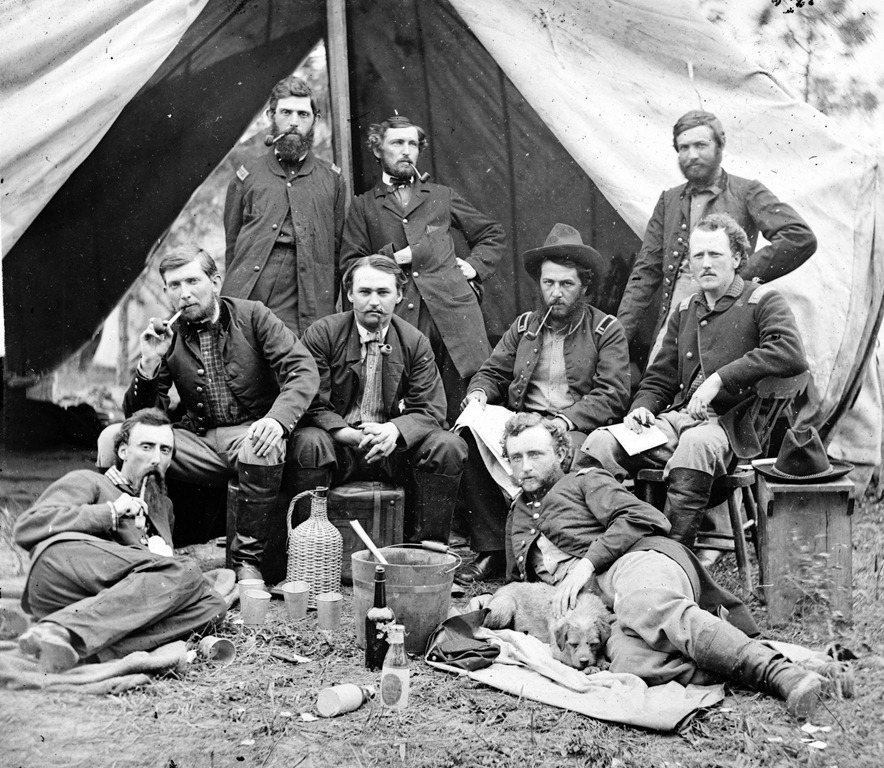
The Peninsula, Va. The staff of Gen. Fitz-John Porter; Lts. William G. Jones and George A. Custer reclining

The Peninsula, Va. The staff of Gen. Fitz-John Porter; Lts. William G. Jones and George A. Custer reclining

Photograph from the main eastern theater of war, the Peninsular Campaign

Photographed by James F. Gibson

Part of Civil War glass negative collection.  Library of Congress Prints and Photographs Division Washington, D.C. 20540 USA

Record page for this image: http://www.loc.gov/pictures/item/cwp2003000053/PP/

May 20th. The entire corps is encamped upon nine separate hills, facing the Chickahominy. All about us are, or rather were (for they are fast disappearing), waving fields of corn and wheat, evidences of better cultivation than we have seen before. The corn makes fine feed for our horses, and is about the only useful thing we have found in this state so far. Regimental headquarters are pleasantly situated in a piece of woods just in front of the regiment. We swing our hammocks between the trees, and sleep in them to keep clear of snakes, which abound near this swampy river. We are closed up now very near to the enemy, and expect a battle at any moment; get little news, and know almost nothing of the situation.

May 20.—Edward Stanly, of North-Carolina, received his commission as Military Governor of that State. He is invested with the duties and functions of that station, including the power to establish all necessary offices and tribunals, and suspend the writ of habeas corpus during the pleasure of the President, or until the loyal inhabitants shall organize a State government in accordance with the Constitution of the United States.

—Lieut.-Col. Downey, who was sent to Wardensville, near Moorfield, Va., after the guerrillas who recently overpowered a party of convalescent soldiers in that neighborhood, reported having killed the notorious chief, Umbagh, and three men, and that he wounded four. He took twelve prisoners. The Nationals lost nothing.

—A train of seventeen wagons, laden with government stores, which left Rolla, Mo., on Monday last, was overtaken to-day, when about twenty miles out on the Springfield road, by a band of rebel guerrillas, who burned the wagons and their contents, and carried off all the mules, eighty-six in number.—Four United States gunboats bombarded the rebel works on Cole’s Island, Stono Inlet, S. C, when the rebels burned their barracks and evacuated the Island.

—Lieutenant-Colonel West took possession of Tucson, Arizona, this day, without firing a shot The confederate troops stationed in that city fled across the Rio Grande on his approach, and the citizens of Tucson who were imbued with secession proclivities started for Sonora. The citizens of the town came out and met the troops in great numbers, greeting them with cheers, and of their own accord sent out wagons and brought in loads of forage for the animals, which were worn out by their march from the Pimos around by Fort Stanford.—Los Angeles News.

—A party belonging to General Fremont’s command, under Col. Crook, made a successful descent upon the Central Railroad at the Jackson River depot, Va.

—The rebel pickets were driven across Bottom’s Bridge by skirmishers of General Couch’s division of the army of the Potomac. On the right General Stoneman’s advance reached New Bridge, also on the Chickahominy.

—General Shepley, Military Commandant of New-Orleans, informed the citizens of that town, that, in the absence of the late Mayor, he, by order of Major-General B. F. Butler, commanding the Department of the Gulf, would discharge the functions which appertained to the office of mayor, until such time as the people of New Orleans should elect a loyal citizen of that city, and of the United States, as Mayor.

Written from the Sea islands of South Carolina.

Monday, May 19, 1862.

[Diary]

Our men have returned from Hilton Head and nearly all are eager to go there again and serve in the forts, though Marcus says he does not wish to fight, but only to learn to fight. . . .

Very much has occurred lately, but I have no time to write. I have received and distributed twenty-one boxes of clothing, having sold over $155 worth and sent out fifteen boxes to the plantations, which will be sold on account or given away. . . . People have come from great distances to buy here and seem almost crazy at the sight of clothes — willing to pay any price.

We have had to refuse to sell, being so overworked. I am sorry to say that I have discovered two cases of pilfering, and the cotton house has been entered again and again, we think, but nothing that we can miss is taken. Our house-servants are honest as the day.

Mr. French spent Saturday night and preached here on Sunday. He thinks good times are coming for us. He says that General Saxton[1] will be our friend, and that we shall have the military in our favor instead of against us as before. The danger now seems to be — not that we shall be called enthusiasts, abolitionists, philanthropists, but cotton agents, negro-drivers, oppressors. The mischief has been that on this side of the water, on these islands, the gentlemen have been determined to make the negroes show what they can do in the way of cotton, unwhipped. But they have only changed the mode of compulsion. They force men to prove they are fit to be free men by holding a tyrant’s power over them. Almost every one who has attempted this has failed. Those who have not attempted driving are loved and obeyed. On the rationed islands, Port Royal and Edisto, the negroes have worked much better and have been perfectly contented.

Last Saturday the provisions from Philadelphia were distributed, and I heard our folks singing until late, just as they did after their first payment of wages, only then they sang till morning.

Thorp was here the other night. He wanted Mr. Pierce to let him stay in his present position for a time, for Mr. P. had wanted to remove him. He pleaded so that Mr. P. yielded and Mr. T. went back to work, but he is now ill and Sumner is taking his place in the distribution of clothes and food. This has not yet been begun and the people are gloomy. Last Sunday Ria, of Gab. Capers, came over to me and asked me to speak to Mr. Pierce about her horse. Mr. Saulsbury, a cotton agent, had taken away a fine horse (belonging to the estate), which Ria took care of and used, and in its place he gave her an old beast to take her to church, as she is paralytic. She came to church and heard that Mr. Eustis, the provost marshal, who had made a law that no negro should ride any horse without a pass, was going to take away the horses of all the negroes who had come to church without a pass. She appealed to Mr. Pierce. He sent her to Mr. Park. She is afraid of Mr. Park and appealed to me. Park was there and I went directly to him. He heard me, and smiled as if a little pleased to be petitioned, came forward and promised the woman a pass or permission hereafter to use the horse. The Mr. Field, a sutler and friend of the Whitneys, who was here a few days ago, told me he had found a fine horse on the island named Fanny — a thoroughbred, which he meant to take North with him. As Ria’s good horse’s name was Fanny and he was probably one of Saulsbury’s gleanings, I think we can see how the negroes have been wronged in every way. Last Sunday Mrs. Whiting asked me to accept a quarter of lamb. I offered to buy it and we had it for dinner. Afterwards Mrs. W. told me she had no more right to the lamb than I had, that she took it from the estate, had it killed and generously gave me part. I told her of the strict military order against it, when she said Government agents had a right to kill, and that Mr. Mack and others did so. Mr. Pierce instantly wrote to Mr. Mack to ask if he had done this thing. Mr. Whiting has not been a Government agent for two months, and yet he lives in Government property, making the negroes work without pay for him and living upon “the fat of the lamb,” — selling too, the sugar, etc., at rates most wicked, such as brown sugar, twenty-five cents a pound; using Government horses and carriages, furniture, corn, garden vegetables, etc. It is too bad. The cotton agents, many of them, are doing this.


[1] Rufus Saxton, Brigadier-General of Volunteers.
MAY 19TH.—We await the issue before Richmond. It is still believed by many that it is the intention of the government and the generals to evacuate the city. If the enemy were to appear in force on the south side, and another force were to march on us from Fredericksburg, we should be inevitably taken, in the event of the loss of a battle—an event I don’t anticipate. Army, government, and all, might, it is true, be involved in a common ruin. Wrote as strong a letter as I could to the President, stating what I have every reason to believe would be the consequences of the abandonment of Richmond. There would be demoralization and even insubordination in the army. Better die here! With the exception of the business portion of the city, the enemy could not destroy a great many houses by bombardment. But if defeated and driven back, our troops would make a heroic defense in the streets, in the walled grave-yards, and from the windows. Better electrify the world by such scenes of heroism, than surrender the capital and endanger the cause. I besought him by every consideration, not to abandon Richmond to the enemy short of the last extremity.

The legislature has also passed resolutions calling upon the C. S. Government to defend Richmond at all hazards, relieving the Confederate authorities, in advance, of all responsibility for any damage sustained.

This will have its effect. It would be pusillanimous to retire now.

But every preparation had been made to abandon it. The archives had been sent to Columbia, S. C., and to Lynchburg. The tracks over the bridges had been covered with plank, to facilitate the passage of artillery. Mr. Randolph had told his page, and cousin, “you must go with my wife into the country, for to-morrow the enemy will be here.” Trunks were packed in readiness—for what? Not one would have been taken on the cars! The Secretary of the Treasury had a special locomotive and cars, constantly with steam up, in readiness to fly with the treasure.

Nevertheless, many of the old secessionists have resolved not to leave their homes, for there were no other homes for them to fly to. They say they will never take the oath of allegiance to the despised government of the North, but suffer whatever penalties may be imposed on them. There is a sullen, but generally a calm expression of inflexible determination on the countenances of the people, men, women, and children. But there is no consternation; we have learned to contemplate death with composure. It would be at least an effectual escape from dishonor; and Northern domination is dishonor.

Monday, 19th—We were ordered to strike our tents and move to the right, but just as we were ready to fall into line, the order was countermanded and we were ordered to go to throwing up breastworks. It was reported that the rebels were going to come out of their breastworks and attack us. The pickets were fighting all day, and there was brisk skirmishing and cannonading all along the front. Our entire picket line has been reinforced by extra men.

May 19th. We left Natchez this morning and went up some fifteen miles, followed by the other ships, and stopped in the woods. In the afternoon the steamer Laurel Hill arrived and passed from below with troops, and the gunboat Kennebec came down from Vicksburg with news. At eight P. M., William Preston, signal-quartermaster, died of apoplexy induced by the heat, after an illness of three days.

19th. Made arrangements for another horse. Had the one lost examined and got an order from the General for another. Very pretty bay, well satisfied.

19th.—Marched to-day about eight miles, but by a road so indirect, that we are only five miles nearer to Richmond. I am to-night again detailed from my regiment, with orders to report for duty at the general hospital at White House.

Monday, May 19th.—Remained at Camp Kirby Smith until May 19th; ordered to Big Creek Gap; left camp at 9 A. M.; marched about six miles through rough country.


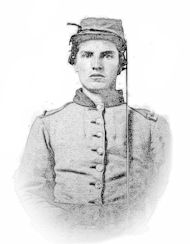
(Note: picture is of an unidentified Confederate soldier.)