16th.—Quiet at White House. Nothing worthy of note.
May 2012

“Wilson Small,” May 16.
Dear Friend, — I have asked every one within reach what day of the week it is: in vain. Reference to Mr. Olmsted, who knows everything, establishes that it is Friday. Is it one week, or five, since I left New York?
As I wrote the last words of my last letter, the “Elizabeth,” our supply-boat, came alongside with Mr. Olmsted and Mr. Knapp, and just behind them a steamer with one hundred and eighty sick on board. All hands were at once alert. The sick men were to be put on board the “Knickerbocker,” whither we all went at once, armed with our precious spirit-lamps. Meantime Mr. Olmsted read a telegram we had received in his absence, saying that a hundred sick were lying at Bigelow’s Landing and “dying in the rain.” Mr. Knapp took charge of the “Elizabeth,” saying, “Who volunteers to go up for them?” Three young men, Miss Helen Gilson, and I followed him. Not a moment was lost, — Mr. Knapp would not even let me go back for a shawl, — and the tug was off.
The “Elizabeth” is our store-tender or supply-boat. Her main-deck is piled from deck to deck with boxes. The first thing done is to pick out six cases of pillows, six of quilts, one of brandy, and a cask of bread. Then all the rest are lowered into the hold. Meantime I make for the kitchen, where I find a remarkable old black aunty and a fire. I dive into her pots and pans, I wheedle her out of her green tea (the black having given out), and soon I have eight bucketsful of tea and pyramids of bread and butter. Miss Gilson and the young men have spread the cleared main-deck with two layers of quilts and rows of pillows a man’s length apart, and we are ready for the men some time before we reach them; for the night is dark and rainy, and the boat has got aground, and it is fully ten o’clock before the men are brought alongside. The poor fellows are led or carried on board, and stowed side by side as close as can be. We feed them with spoonfuls of brandy and water; they are utterly broken down, soaked through, some of them raving with fever. After all are laid down, Miss Gilson and I give them their suppers, and they sink down again. Any one who looks over such a deck as that, and sees the suffering, despondent attitudes of the men, and their worn frames and faces, knows what war is, better than the sight of wounds can teach it. We could only take ninety; twenty-five others had to go on the small tug which accompanied us. Mr. Knapp, the doctor, and one of the young men went on board of her. Meantime the “Elizabeth” started on the homeward trip, so that Miss Gilson and I and a quartermaster were left to manage our men alone. Fortunately only about a dozen were very ill, and none died. Still, I felt anxious: six were out of their minds; one had tried to destroy himself three times that day, and was drenched through and through, having been dragged out of the creek into which he had thrown himself just before we reached him.
We were alongside the “Knickerbocker” by 1 A.M., when Dr. Ware came on board and gave me some general directions, after which I got along very well. It was thought best to leave the poor wearied fellows to rest where they were until morning, and the night passed off quietly enough; my only disaster being that I gave morphia to a man who actually screamed with rheumatism and cramp. I supposed morphia could n’t hurt him, and it was a mercy to others to stop the noise. Instead of this, I made him perfectly crazy. He rose to his feet in the midst of the prostrate mass of men, and demanded of them and of me his “clean linen” and his “Sunday clothes.” I picked my way to him, but could do nothing at first but make him worse. At last I was inspired to say that I had all his clothes “there” (pointing to a dark corner behind a bulkhead): “would he lie down and wait till I brought them?” To my surprise he subsided. I hid in trepidation for a few minutes, and at last, to my great joy, I saw the morphine take effect. One little fellow of fifteen, crushed by a tree falling on his breast, had run away from his mother, and was very pathetic. I persuaded him to let me write to her.
The next morning, after getting them all washed, I went off guard, and Mrs. Griffin and Miss Butler came on board with their breakfast from the “Knickerbocker,” where the hundred and eighty whom we had left arriving the night before, were stowed and cared for. Getting them all washed, as I say, is a droll piece of work. Some are indifferent to the absurd luxury of soap and water, and some are so fussy. Some poor faces we must wash ourselves, and that softly and slowly. I started along each row with two tin basins and two bits of soap, my arm being the towel-horse. Now, you are not to suppose that each man had a basinful of clean water all to himself. However, I thought three to a basin was enough, or four, if they did n’t wash too hard. But an old corporal taught me better. “Stop, marm!” said he, as I was turning back with the dirty water to get fresh; “that water will do for several of us yet. Bless you! I make my coffee of worse than that.”
Soon after breakfast my men were transferred to the “Knickerbocker.” She still lies alongside, and we take care of her. She is beautifully in order. The ward-masters are all excellent, and the orderlies know their duty. The men look comfortable, and even cheerful. It is a pleasure to give them their meals. I gave the men in the long ward (where they lie on mattresses in two rows, head to bead, two hundred of them) their dinner to-day, and their supper yesterday. Ah, me! how they liked it, — some of them, of course, too worn to do more than swallow a few spoonfuls and look grateful; others loud in their satisfaction. The poor, crazy man who tried to destroy himself at Bigelow’s Landing has some vague idea about me now; and sometimes, when he utterly refuses his milk-punch, and thrashes and splutters at every one who comes near him, I am sent for, when he subsides into obedience with a smile which is meant to be bland, and is so comical that people around retire in convulsions.
To-day I am “loafing.” Everything is in perfect order on the “Knickerbocker;” and as I scent a transfer this afternoon of the whole corps to the “Spaulding,” to fit her up, I am determined to husband my efforts. This boat, the “Wilson Small,” is finally smashed up; we call her the “Collida.” The hospital-boats usually lie alongside of each other, with their gangways connected; and sometimes we run through four or five boats at a time.
Captain Curtis is still on board, doing well. He goes North on the “Knickerbocker” to-day. Now that our wounded men are gone, we have a dinner-table set, and the Captain lies in his cot on one side of the cabin, laughing at the fun and nonsense which go on at meals. Mrs. Howland. has her French man-servant, Maurice, on board. He is capital. He struggles to keep us proper in manners and appearance, and still dreams of les convenances. At dinner-time he rushes through the various ships and wards: “My ladies, j’ai un petit plat; je ne vous dirai pas ce que c’est. I beg of you to be ponctuelle; I gif you half-hour’s notis.” The half-hour having expired, he sets out again on a voyage of entreaty and remonstrance. He won’t let us help ourselves, and if we take a seat not close to the person above, he says: “No, no, move up; we must have order.” His petit plat proved to be baked potatoes, which were received with acclamation, while he stood bowing and smiling with a towel (or it may have been a rag) for a napkin. But I must tell you that Maurice is the tenderest of nurses, and gives every moment he can spare to the sick. He serves his mistress, but he is attentive to all, and, like a true Frenchman, he so identifies himself with the moment and its interests that he is, to all hospital intents and purposes, “one of us.”
You are not to be alarmed by the word “typhoid,” which I foresee will occur on every page of my letters, nearly all our sick cases being that or running into that. The idea of infection is simply absurd. The ventilation of these ships is excellent; besides, people employed in such a variety of work and in high health and spirits are not liable to infection. Nobody ever thinks of such a thing, and I only mention it to check your imagination. In a boat organized like the “Knickerbocker,” we women stand no regular watch, but we are on hand at all hours of the day, relieving each other at our own convenience. As for the ladies among whom my luck has thrown me, they are just what they should be, — efficient, wise, active as cats, merry, light-hearted, thoroughbred, and without the fearful tone of self-devotion which sad experience makes one expect in benevolent women. We all know in our hearts that it is thorough enjoyment to be here, — it is life, in short; and we wouldn’t be anywhere else for anything in the world. I hope people will continue to sustain the Sanitary Commission. Hundreds of lives are being saved by it. I have seen with my own eyes in one week fifty men who must have died without it, and many more who probably would have done so. I speak of lives saved only; the amount of suffering saved is incalculable. The Commission keeps up the work at great expense. It has six large steamers running from here. Government furnishes these and the bare rations of the men; but the real expenses of supply fall on the Commission, — in fact, everything that makes the power and excellence of the work is supplied by the Commission. If people ask what they shall send, say: Money, money, stimulants, and articles of sick-food.
May 16. For some time past the pickets of the 17th Massachusetts have been a good deal troubled by being fired on in the night. The enemy’s cavalry would come down, a few of them dismount and creeping up would fire on them. They would sometimes have cow bells with them, in order to divert attention and get nearer. But the boys soon learned that dodge, and when . they heard a cow bell, would draw their straightest bead on it and let fly. In this state of affairs it was thought best to make those fellows a call, and if they wanted anything of us to give them an opportunity to take it. So, yesterday morning, we marched out to the Trent road, where we joined the 17th Massachusetts, with five companies of the 3d New York cavalry and a section of a battery the whole under command of Col. Amory, of the 17th. The cavalry taking the advance, we marched up the road a couple of miles, coming to a deep gully or ravine; crossing this, the advance cavalry guard soon came upon the enemy’s pickets, driving them in and beyond their station into a swamp, where they formed an ambuscade, thinking there was only a small cavalry force and that they might capture them. By this time the infantry had come up to their rendezvous, which was a large, nice house, with ample barn room for their horses. Thinking this was too good accommodation for them and too near our line, it was set on fire and burned. We now heard firing ahead and hurried on. They had closed around the advance cavalry guard, and commenced the fight. The other companies being close by soon took a hand in it and were giving them about all they wanted when the infantry came up. When they saw the infantry and artillery they took to their heels towards Trenton, a small village a few miles distant.
Col. Upton wanted to follow them up and give them some more, but Col. Amory being in command, thought we had accomplished our purpose and had better return. In this skirmish the enemy lost eight killed and two prisoners, one of them wounded. Our cavalry had two wounded. The wounded men were brought out and loaded into an ambulance. When they brought out the wounded rebel they put down the stretcher on which he was lying near where I was standing. He was a smooth-faced, fair-haired boy, and was moaning piteously with pain from a bullet wound in his head, and asking himself what his mother would say when she heard of it. His thoughts turned on his home and of his mother. I pitied the boy, but could not help thinking, as a cavalryman told him, he should have thought of that before being caught here., We arrived back in camp late in the afternoon, tired, hungry and covered with mud. I reckon they will not disturb our pickets any more at present in the way they have done. Creeping up in the dark and firing on a lone picket is mean and cowardly. If they want anything of us let them come in force and get it; that is proper and honorable.
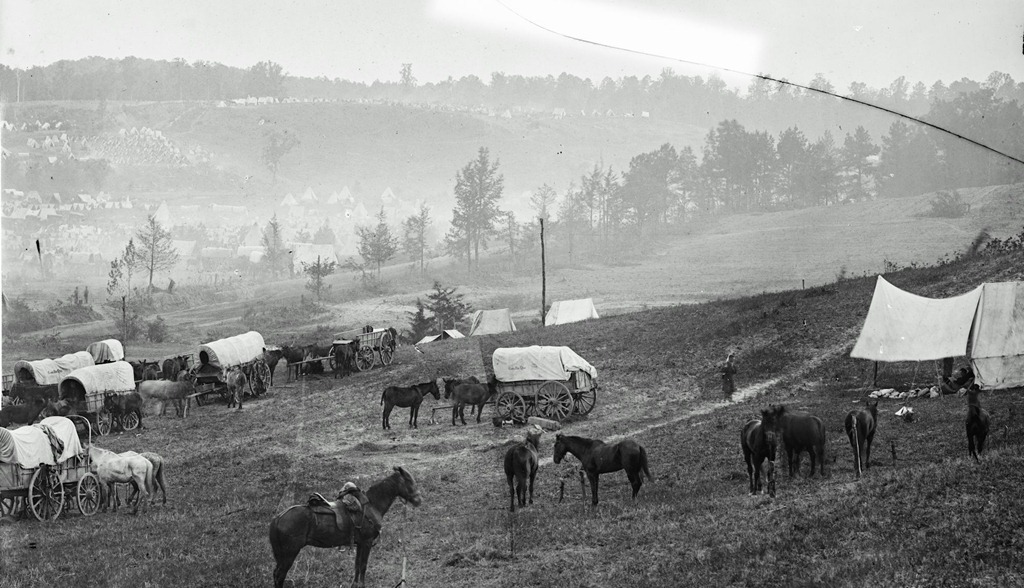
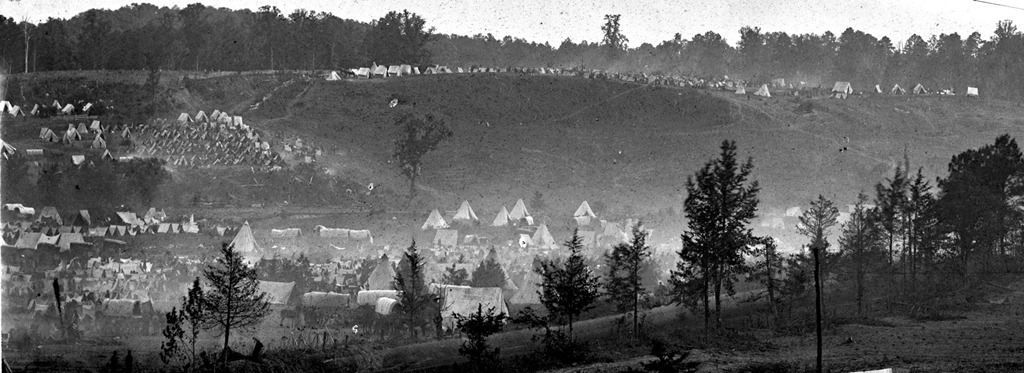
Lower image has been cropped and enhanced to show encampment in the haze in the original photo.
Photographed by James F. Gibson (highly likely)
Part of Civil War glass negative collection. Library of Congress Prints and Photographs Division Washington, D.C. 20540 USA
Record page for this image: http://www.loc.gov/pictures/item/cwp2003000051/PP/
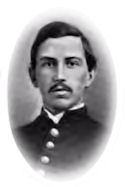 May 16th. This morning was simply perfect; early the air was resonant with the music of birds, and later on with the music of numerous bands. What would an army be without music? Music puts us in good humor, braces our nerves, and makes us cheerful and contented, whatever our surroundings may chance to be. It would be a dreary service indeed without music, and I don’t believe the men could be kept together without it. The country we marched over yesterday was covered everywhere with pines, few cultivated fields or houses, apparently a desert waste. Our quarters are just under cover of some large pines, with open ground in front; on every side, as far as the eye can reach, are vast camps of men, horses, guns, and wagons; orderlies and aides ride everywhere; batteries are moving into position, flags flutter in the breeze, and picturesque groups of men and horses are indefinitely multiplied; in fact, on all sides we see the glorious pomp and circumstance of war, and in dead earnest too, for are we not separated from the foe by only two small miles? Who would not be a soldier in time of war?
Why we should remain inactive all day long so near the enemy I can’t find out, unless it is to give him a chance to intrench; it is very clear we are not going to surprise anybody. In the meantime, we have been occupying ourselves in the study of natural history, particularly with the pine tick, an insect abounding in these parts; it has a spiral proboscis by which it screws itself fast to the fleshy part of one’s body, without attracting attention or causing any pain, and then quietly proceeds to gorge itself with blood, until it swells to the size of a large coffee berry, and looks almost exactly like one in color and shape. It is at this stage that you begin to feel an itching, and looking for the cause, find half a dozen or more of these ugly black-looking berries sticking on your legs; naturally, you yank them off without hesitancy, but are astonished to find the itching increases, and the inflammation and swelling continues spreading. Upon a close inspection, one finds that on pulling the creature off, his proboscis was left behind, imbedded deeply in the flesh, and this is the cause, or seems to be, of all the trouble. The remedy is to boldly cut out the offending head; there is, however, a scientific method of removing them, when first discovered, and that is, simply to unscrew them; seizing them carefully between the thumb and forefinger, you gently turn to the left, and are surprised to find they come out easily, and completely, exactly like a screw.
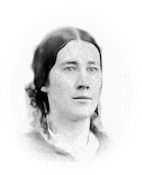 Abbie Howland Woolsey to Georgy and Eliza.
Friday, May 16.
We have hundreds of dollars sent to us to spend “for the soldiers.” Mr. Wm. Aspinwall, for one, sent Jane a cheque for $250. Now how shall we lay it out, so as to be most useful? Dr. G. said it made him heartsick, as it would us, to see the destitution and suffering of those men brought in at Yorktown. It makes me heartsick to think of it, and the only comfort is in knowing that if the condition of the men is horrible as it is, what would it be if nothing were done—if there were no Sanitary Commission. Take away all that voluntary effort has done for the army and what light would the government appear in before the world? Shamefully inefficient and neglectful!
Dr. Grymes shook Mother warmly by the hand to-day as we went on board the Daniel Webster, and said, “We can’t do without your children. We fight for them down there, to know whether they shall go up on the boats or stay at Yorktown, but on the whole, they are more useful where they are. Your son, too, is very busy and is indispensable.” I hope you will all three manage soon to be together and have the comfort of each other’s help, and keep each other in check from doing too much. Jane says she has awful dreams about Georgy, that the other night a message came that she was ill with hasty typhoid fever followed by paralysis from over-exertion! There, Georgy, is a catalogue of evils for you.
Uncle Edward is ready to do anything on earth. He sent by the Daniel Webster 75 canton flannel shirts which he thought would be useful for typhoid men brought in from camp. Up here, he says, they are sure to be taken care of after a while. He bought also eighty dollars worth of cotton pocket handkerchiefs, half of which I sent by Mrs. Trotter; etc., etc. He brought here for Jane to dispose of six jugs of very old port wine, each half a gallon, which he had decanted himself. Jane says that shall be distributed under her own eye.
We saw your red flag, I suppose it was, that you spent Sunday in making, flying at the peak of the Daniel Webster. . . . After the hundred canton flannel bed gowns were all made they told us they were too long for sick men and too heavy for fever patients. . . . Mother is extremely anxious to go on one of these trips of the Daniel Webster, and urges my consent! I generally evade the subject, for I think it would be too severe service. Don’t you need stepladders for climbing to upper berths? Have you got them?

We were all assigned to duty by Mr. Olmsted wherever he thought we fitted in best, and his large printed placards put up on the steamers gave orders for the “watches” and hours for “relief,” meals, etc., etc., so that the work went on as in a city hospital.

May 16.—The fast-day set apart by the President. I hope that it will be duly observed. I believe that it is well kept in the army. There has been no show of keeping it in this hospital; the old excuse is given—”too much to do.”
A few evenings since we came very near being burned 0ut. While the ladies downstairs were making pads for the wounded expected next day—we use hundreds of them daily—the cotton took fire and communicated to some of the ladies’ dresses. A gentleman extinguished it before any serious damage occurred. I was attending some patients at the time, and was certain from the noise that the enemy had come to storm the hospital, for which I was laughed at considerably.
Dr. Griffin of Kentucky and Dr. Benedick of New Orleans are both sick.
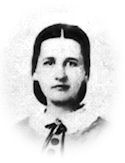
Susan Bradford Eppes, "Through Some Eventful Years"
May 16th, 1862.—There is light skirmishing around Richmond, so say last night’s papers; somebody is killed in these skirmishes—God help the South. A letter from Grandpa insists that Sister Mag and Sister Mart stop with him at Enfield; trains to and from Richmond pass his home every day and night and daily news from the front comes from reliable people. If Brother Amos should be wounded she could get to him right away. Then, too, it is almost impossible to procure accommodations in Richmond, it is so crowded at present with the divisions of the army, changing from point to point. Sister Mag wrote at once accepting his invitation; it hurts me so to think I cannot see my darling Grandpa; he cannot come to Florida, while this war is going on.

May 16.—The following General Order, made by President Lincoln, at Norfolk, Va., on the eleventh of May, was this day issued:
“The skilful and gallant movements of Major Gen. John E. Wool and the forces under his command, which resulted in the surrender of Norfolk, and the evacuation of the strong batteries erected by the rebels on Sewell’s Point and Craney Island, and the destruction of the rebel iron-clad steamer Merrimac, arc regarded by the President as among the most important successes of the present war. He therefore orders that his thanks as Commander-in Chief of the Army and Navy, be communicated by the War Department to Major-Gen. John E. Wool, and the officers and soldiers of his command, for their gallantry and good conduct in the brilliant operations mentioned.”
The United States steamer Oriental was wrecked on Body’s Island, thirty miles north of Cape Hatteras, N. C.—The Senate of the United States confirmed the nomination of Brevet Major Gen. Wool to be Major-General of the army.
—At New-Orleans, La., General Butler issued the following orders:
“The New-Orleans Bee newspaper having published an elaborate though covert argument in favor of the cotton-burning mob, is hereby suppressed. No publication of any description will issue from that office until further orders.
“The New-Orleans Delta newspaper having, in an article of to-day’s issue, discussed the cotton question in a manner which violates the terms of the proclamation of first of May instant from these headquarters, the office of that paper will be taken possession of and its business conducted under direction of the United States authorities.”
“It is hereby ordered that neither the city of New-Orleans, nor the banks thereof, exchange their notes, bills or obligations for confederate notes, bills or bonds, nor issue any bill, note or obligation payable in confederate notes.
“On the twenty-seventh day of May instant, all circulation of or trade in confederate notes and bills will cease within this Department; and all sales or transfers of property made on or after that day, in consideration of such notes or bills, directly or indirectly, will be void, and the property confiscated to the United States — one fourth thereof to go to the informer.”—(Doc. 38.)
—Two Union gunboats opened fire with shot and shell on Darien, Georgia, without inflicting any damage.—Fast day in the rebel States.— Savannah News, May 17.—(Doc. 39.)
—Colonel Johnson Hagood, Provost-Marshal of the Second Military District of South-Carolina, issued the following from his headquarters at Charleston:
“In compliance with instructions received from Brigadier-General Ripley, Capt Francis D. Lee, Engineer Corps, is empowered to impress any negro carpenters and other artisans, not now employed in government service, whether the same be slaves or not Captain Lee will be furnished with such force as may be necessary to carry out the instructions.”
—The National Intelligencer this morning contains an article, three columns in length, denouncing Gen. Hunter’s proclamation, and asserting that the President will revoke it
—Commodore Goldsborouoh with the Susquehannah, the Wachusett, the Dacotah, and the Maratanza moved up the James River, Va., to reduce two batteries on the south shore, and found the batteries abandoned.—N. Y. Times, May 21.—(Doc. 110.)
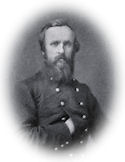
Camp, Mouth Of East River, Giles County, Virginia,
May 15, 1862.
Dear Mother: — We have marched a great many miles through this mountain region since I last wrote you. We have had some fighting, some excitement, and a great deal to do. We are now in a strong position. General Cox commands the army, about five thousand strong, in this vicinity. We feel pretty safe, although the success of our arms at the East seems to be driving the enemy to these mountains in greater strength than before.
The scenery is finer than any we have before seen. How you would enjoy the views from my tent. In sight, at the bottom of the hill the Twenty-third is camped on, runs New River, a stream larger than the Connecticut at Brattleboro, then a beautiful cultivated country along its banks, and steep high mountains bounding the scene on all sides. I am afraid I am ruined for living in the tame level country of Ohio.
The reports indicate that the Rebellion is going under very rapidly. If no serious disaster befalls us the struggle will hardly outlast the summer.
I shall write very rarely. You will hear by telegraph all important news of us. I think of you and all the dear ones often —constantly.
Affectionately,
R. B. Hayes
Mrs. Sophia Hayes.


